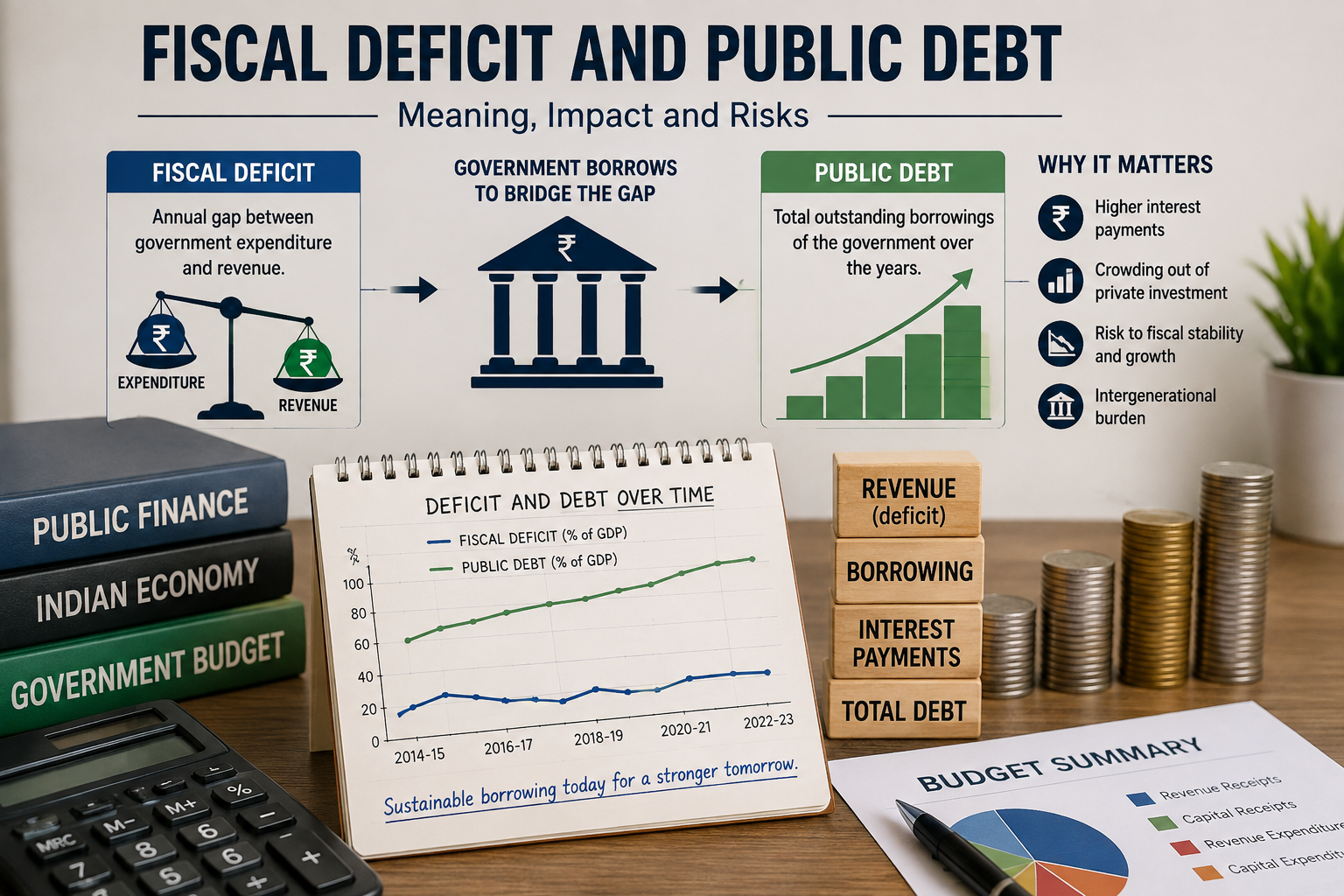
A fiscal deficit is often presented as a frightening number. Public debt is often discussed as if it were a national credit-card bill. These comparisons are useful for attention, but they can also mislead. Government finance is not identical to household finance. A household cannot tax the economy. A government can. A household does not issue sovereign debt in its own currency. A government often can. A household's spending rarely raises national productivity. Government spending sometimes does.
Yet the opposite mistake is also dangerous. Because a government is not a household, some people assume debt does not matter. That is wrong. Fiscal deficit and public debt matter because they affect interest costs, inflation risk, private investment, credit ratings, currency confidence, future taxation and the government's ability to respond to crises.
The right approach is neither panic nor complacency. It is understanding.
A fiscal deficit is the gap between total government expenditure and total receipts excluding borrowings. In simple terms, if the government spends more than it earns from taxes, non-tax revenue and non-debt capital receipts, it must borrow to cover the gap. That annual gap is the fiscal deficit.
Public debt is the accumulated stock of past borrowing that remains outstanding. Fiscal deficit is a flow, measured for one year. Public debt is a stock, built over many years. If a government runs deficits year after year, debt accumulates. If it runs primary surpluses and grows faster than its interest burden, debt can stabilise or fall relative to GDP.
This flow-stock distinction is crucial. A country may have a moderate fiscal deficit but high existing debt. Another may have a high deficit for one crisis year but manageable debt overall. The meaning of the deficit depends on the debt position, growth rate, interest rate, currency composition and credibility of fiscal policy.
Governments borrow for many reasons. Some borrowing is productive. If debt finances highways, ports, railways, power systems, irrigation, digital infrastructure, schools, hospitals or climate resilience, it may raise future growth. Higher growth can increase tax revenue and make debt easier to service. Borrowing to build assets can be justified when the returns exceed the cost.
Some borrowing is protective. During a pandemic, war, financial crisis, drought or natural disaster, governments may need to spend more even if revenue falls. A temporary deficit can prevent deeper social and economic collapse. In such cases, the question is not whether borrowing is bad. The question is whether the borrowing is targeted, temporary and accompanied by a credible recovery path.
Some borrowing is wasteful. If debt finances inefficient subsidies, politically motivated giveaways, poorly designed projects, leakages or recurring expenditure without long-term value, the burden shifts to the future without building capacity. This is when deficits become dangerous.
The composition of spending matters as much as the size of borrowing. A fiscal deficit used for capital expenditure is different from a fiscal deficit used mainly for revenue expenditure. Capital expenditure can create productive assets. Revenue expenditure may be necessary for salaries, pensions, welfare and maintenance, but if it grows without productivity or revenue support, it can narrow future fiscal space.
Interest payments are one of the biggest warning signals. Once debt rises, the government must pay interest. If interest payments consume a large share of revenue, less money remains for development spending. This creates a trap: the government borrows, debt rises, interest rises, and future budgets become more rigid. Even before a debt crisis appears, high interest burden can quietly crowd out public investment.
Debt sustainability is usually measured relative to GDP because the economy's size determines repayment capacity. A large economy can carry more debt than a small one. But debt-to-GDP is not the only indicator. Analysts also look at interest payments as a share of revenue, maturity profile, share of foreign-currency debt, investor base, inflation, growth prospects and institutional credibility.
For a country like India, public debt must be read through several layers. India has a large domestic savings base, a deepening government securities market and debt largely denominated in domestic currency. These factors reduce some external vulnerability. But India also has huge development needs, welfare responsibilities, defence requirements, climate risks and state-level fiscal pressures. Fiscal space is valuable and cannot be wasted.
The Union Budget 2026-2027 indicated a continued fiscal consolidation path. Official Budget documents placed the fiscal deficit estimate for 2026-27 at 4.3 per cent of GDP and the debt-to-GDP estimate at 55.6 per cent for the Centre, with a stated target of moving toward 50 plus or minus 1 per cent by 2030. These numbers matter because they show the government's intention to gradually reduce borrowing pressure while maintaining expenditure priorities.
But fiscal consolidation is not just about lowering a number. If a government cuts productive capital expenditure to reduce the deficit, growth may suffer. If it cuts essential welfare abruptly, social stress may rise. If it raises distortionary taxes excessively, investment may slow. Good fiscal consolidation improves the quality of spending, widens the tax base, reduces waste, manages subsidies and protects growth-enhancing expenditure.
The primary deficit is another useful indicator. It is the fiscal deficit minus interest payments. It shows how much the government is borrowing for current spending beyond interest obligations. If the fiscal deficit is high mainly because of interest payments, the problem is legacy debt. If the primary deficit is high, the current budget itself is adding pressure. Both matter, but they require different policy responses.
Fiscal deficits also interact with inflation. If deficits are financed through excessive money creation or if borrowing fuels demand beyond supply capacity, inflation can rise. However, the relationship is not automatic. A deficit used to build infrastructure may expand future supply. A deficit during recession may support demand without creating immediate inflation. Context matters.
Government borrowing can also affect private investment. If the government borrows heavily from domestic financial markets, it may absorb savings that could otherwise finance private firms. This is called crowding out. But if borrowing funds infrastructure that improves logistics, energy and productivity, it may crowd in private investment by making business more attractive. Again, the quality of spending decides the effect.
Public debt also has an intergenerational dimension. Today's borrowing becomes tomorrow's obligation. This does not mean all borrowing is unfair to future generations. If debt builds assets that future citizens use, it may be fair. But if debt pays for present consumption without durable benefits, future taxpayers inherit cost without corresponding value.
State governments add another layer. In a federal system, state borrowing, guarantees, power-sector liabilities and off-budget commitments can influence overall fiscal stability. A national fiscal picture must include both Union and state finances. Strong public finance requires discipline across levels of government.
Transparency is essential. Off-budget borrowing, delayed subsidy payments, hidden guarantees and creative accounting may reduce the reported deficit but not the real burden. Markets and citizens need honest numbers. Fiscal credibility is built when budgets show the full picture and explain the path clearly.
A fiscal deficit is not a sin. Public debt is not automatically a crisis. But both require discipline. Borrowing should be used to build capacity, protect citizens during shocks and finance investments that the private sector cannot provide adequately. It should not become a permanent substitute for revenue, reform and prioritisation.
The serious question is not whether the government borrows. Every modern government borrows. The serious question is: why is it borrowing, at what cost, for how long, and with what future return?
There is also a market-confidence dimension. Government bonds are bought by banks, insurance companies, pension funds, mutual funds, foreign investors and other institutions. They watch whether the government has a credible borrowing plan. If confidence is strong, the government can borrow at reasonable rates. If confidence weakens, investors may demand higher yields, raising the cost of debt for the state and sometimes for the wider economy.
Fiscal rules and medium-term frameworks exist to prevent short-term politics from overwhelming long-term sustainability. They do not eliminate judgement, because crises sometimes require flexibility. But they force governments to explain deviations and return to discipline when conditions improve. Without such credibility, every deficit becomes harder to finance and every promise becomes more expensive.
Citizens should therefore read fiscal numbers as signals of state capacity. A deficit figure tells part of the story, but the deeper issue is whether the state can collect revenue honestly, spend effectively, borrow credibly and build assets that raise future productivity. Fiscal health is not austerity for its own sake. It is the ability to act in the future without being trapped by past choices.
A responsible fiscal policy does three things at once. It supports growth today, protects vulnerable citizens and keeps debt sustainable for tomorrow. That balance is difficult, but it is the essence of public finance. A country that understands fiscal deficit only as a headline number will miss the real story. The real story lies in the link between borrowing, spending quality, growth, trust and the future capacity of the state.
Disclaimer
This article is for general educational and editorial use. It is not investment, tax, legal, accounting, policy or sovereign-risk advice. Fiscal numbers change with official revisions and should be verified from the latest Union Budget, RBI, CAG and official government documents before publication or analysis.