finance is no longer only a branch business
For most of modern history, banking was identified with buildings, counters, ledgers, signatures, relationship managers and institutional trust. A person needed a bank branch to open an account, a cheque book to move money, a card machine to accept payment, and a loan officer to access credit. Finance moved through institutions that controlled the customer relationship, the data, the distribution and the infrastructure.
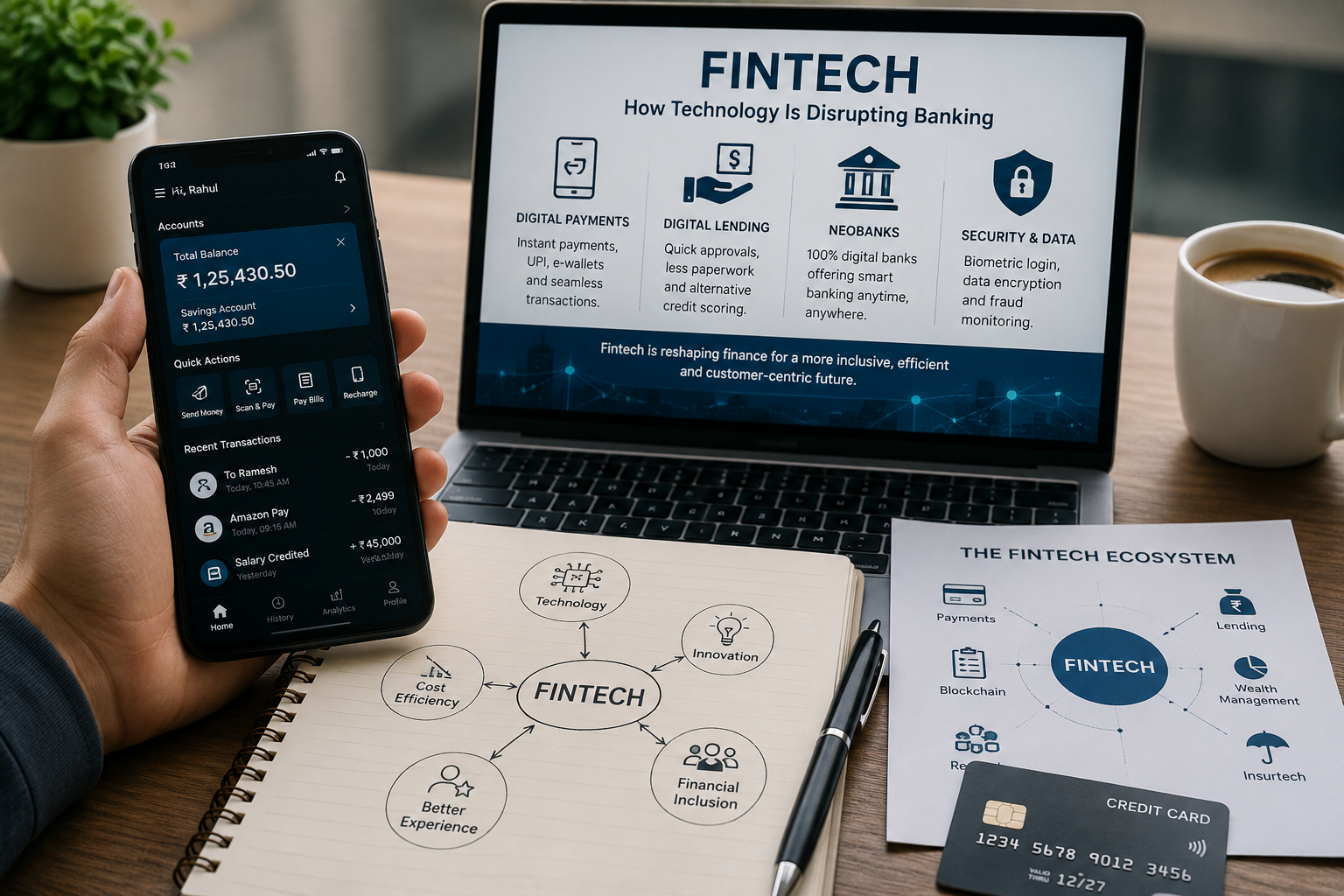
Fintech changes that map. It takes financial services that once required physical infrastructure and rebuilds them through software, data, mobile interfaces, cloud systems, digital identity, payment rails and algorithmic decision-making. The result is not only a new set of apps. It is a new competitive structure in finance. Payments, lending, insurance, investing, wealth management, compliance, remittances and credit scoring can now be delivered through technology-led models.
The word fintech sounds modern and harmless, but its impact is disruptive. It reduces the distance between user and service. It challenges the economics of branches. It shifts customer expectations toward speed, transparency and convenience. It allows non-bank companies to enter financial workflows. It also creates risks: mis-selling, algorithmic bias, data misuse, cyber vulnerability, weak grievance redressal and regulatory gaps. Fintech is therefore not simply technology applied to finance. It is finance being reorganised around technology.
What fintech means
Fintech is short for financial technology. It refers to the use of technology to design, deliver, improve or automate financial services. A payment app is fintech. A digital lending platform is fintech. Robo-advisory, insurtech, regtech, wealthtech, neobanking interfaces, credit-scoring tools, account aggregation, embedded finance and blockchain-based settlement experiments all belong to the fintech universe.
The common thread is not one product. It is the conversion of financial processes into software-driven services. A fintech firm may not always hold customer deposits or lend from its own balance sheet. Some fintechs build user interfaces. Some connect customers to banks. Some provide risk-scoring tools. Some operate payment infrastructure. Some distribute financial products. Some help regulated institutions comply with rules. Others build specialised services for businesses.
This is why fintech should not be treated as a single industry. It is a broad layer that touches banking, markets, insurance, credit, payments, accounting and personal finance. Its real power comes from combining finance with data and distribution.
Why fintech disrupted banking
Traditional banking was built around trust, regulation and balance-sheet strength. Banks collected deposits, gave loans, operated payment accounts, managed risk and served as the backbone of financial intermediation. This model is still essential. But banking also carried friction: paperwork, branch dependence, long approval cycles, opaque fees, slow service and limited access for people outside formal credit networks.
Fintech attacked these points of friction. It made payments instant. It made onboarding digital. It made credit applications shorter. It allowed users to compare products. It helped small merchants accept payments through QR codes instead of card terminals. It allowed investors to open accounts online. It gave businesses tools for invoicing, reconciliation and payroll.
The disruption was not that fintech made banks irrelevant. The disruption was that it changed what customers expect from banks. Once users experience instant payments, real-time alerts, digital documentation and app-based service, they become less tolerant of slow banking. Banks are forced to upgrade because fintech changes the benchmark of convenience.
Payments: the first major battlefield
Payments became the first visible battlefield because they are frequent, simple and emotionally powerful. A loan is occasional. Insurance is periodic. Investing may be monthly. Payments happen daily. Whoever controls the payment interface can influence customer habits, merchant relationships and financial data.
In India, UPI changed the scale and meaning of digital payments. It allowed bank-linked instant payments through interoperable apps. This reduced the advantage of closed wallets and made digital payments accessible to small merchants and ordinary users. Fintech firms built user-friendly front ends on top of public payment infrastructure. Banks remained part of the system, but the user interface often moved to apps.
This is a key feature of fintech disruption: the regulated balance sheet may remain with banks, while customer attention moves elsewhere. The institution that holds the account may not be the institution the customer interacts with most often.
Digital lending and the promise of faster credit
Digital lending is another major fintech area. Technology allows borrowers to apply online, upload documents digitally, link bank statements, receive instant eligibility decisions and disburse loans faster. Alternative data can help assess borrowers who do not fit conventional credit models. For small businesses, gig workers and first-time borrowers, this can widen access.
But digital lending also shows fintech's darker side. Speed can become recklessness. Some apps may push borrowers into expensive loans. Some may hide fees. Some may misuse contact lists or personal data. Some may use coercive recovery practices. When credit becomes too easy, borrowers may accumulate debt without understanding the full cost.
This is why regulators focus heavily on digital lending. Innovation in credit cannot be judged only by disbursal speed. A healthy lending system must also examine disclosure, affordability, consent, data use, grievance redressal and recovery conduct. Fast credit is useful only when it is responsible credit.
Data as the new financial infrastructure
The most valuable asset in fintech is often data. Transaction history, repayment behaviour, spending patterns, income flows, device information, identity data and business receipts can all be used to assess risk, personalise products or cross-sell services. This can improve financial inclusion, but it also raises privacy and fairness concerns.
A user may be happy to receive a faster loan but may not understand how much data is being collected. A small merchant may accept digital payments but may not realise that payment history can influence credit offers, insurance pricing or business profiling. Data can empower users when consent is meaningful and usage is transparent. It can exploit users when consent is buried in terms and conditions.
The future of fintech will depend on whether data becomes a tool of empowerment or extraction. Good financial technology should reduce asymmetry between institutions and customers, not create a new form of digital opacity.
Why banks are not disappearing
Predictions that fintech will kill banks are usually exaggerated. Banks remain central because they are regulated custodians of deposits, creators of credit, participants in payment systems and providers of trust during financial stress. They also have capital, compliance experience, customer bases and regulatory relationships that fintech firms often lack.
What is changing is the banking value chain. Some fintechs own the customer interface. Some banks own the balance sheet. Some technology firms provide infrastructure. Some regulated entities outsource parts of the process. This produces partnerships as much as competition. A fintech may need a bank partner, while a bank may need fintech capabilities to remain relevant.
The real future is not banks versus fintech. It is banking becoming more modular. The customer may see one app, but behind that app may be banks, payment networks, credit bureaus, identity systems, cloud providers, compliance vendors and technology platforms.
Regulation: the test of maturity
Finance is not like ordinary software. If a shopping app fails, a customer may lose time or convenience. If a financial app fails, a customer may lose savings, credit access, privacy or legal rights. This is why fintech cannot operate on the philosophy of move fast and break things. In finance, broken systems break trust.
Regulators use tools such as licensing, disclosures, capital requirements, outsourcing norms, customer protection rules and regulatory sandboxes. A sandbox allows limited testing of innovation under regulatory supervision. This is useful because regulators can observe new models without banning them prematurely or allowing them to scale without oversight.
India's challenge is to encourage useful fintech while preventing predatory finance. The solution is not hostility toward innovation. The solution is accountable innovation: clear rules, responsible data use, transparent fees, complaint systems and strict action against fraud.
India angle: public rails and private innovation
India's fintech story is distinctive because public digital infrastructure has played a major role. Bank accounts, Aadhaar-enabled identity, UPI, digital KYC, account aggregation and mobile connectivity created rails on which private innovation could build. This differs from markets where private platforms built mostly closed systems.
This public-rail model can support competition. A small fintech can build on common infrastructure instead of creating an entire payment network from scratch. Consumers can benefit from interoperability. Merchants can accept digital payments without costly infrastructure. Government transfers and formal financial access can improve.
But public rails also require strong governance. When private companies build on public infrastructure, questions arise about data use, market concentration, fees, accountability and consumer protection. The success of India's fintech model will depend on preserving openness while enforcing responsibility.
What consumers should watch
Consumers should not judge fintech only by design and speed. They should ask whether the provider is regulated, who actually offers the financial product, what fees apply, how data is used, how complaints are handled and whether there is a real human support channel. A beautiful app can still be a risky financial doorway.
Users should be especially careful with digital loans, investment apps, crypto-linked products, high-return promises, app permissions and fake customer care numbers. Fintech fraud often succeeds because it uses the language of convenience. The user is told that action is urgent, approval is instant, return is guaranteed or verification is required immediately. Good financial behaviour requires slowing down when an app pressures the user to move fast.
Financial technology should make money easier to manage, not easier to lose.
Final takeaway
Fintech is transforming banking because it changes distribution, speed, data and customer expectations. It makes financial services more accessible and convenient, but it also introduces new forms of risk. It does not eliminate banks; it forces them to evolve. It does not eliminate regulation; it makes regulation more important.
The best fintech solves real financial problems: access, cost, transparency, speed and inclusion. The worst fintech dresses old exploitation in modern design. The difference lies in governance, disclosure, consumer protection and business ethics.
For readers, the lesson is clear. Fintech is not automatically good because it is digital, and traditional banking is not automatically outdated because it is old. The future belongs to financial systems that combine the trust of regulation, the discipline of banking and the usability of technology. Disruption matters only when it makes finance safer, fairer and more useful.