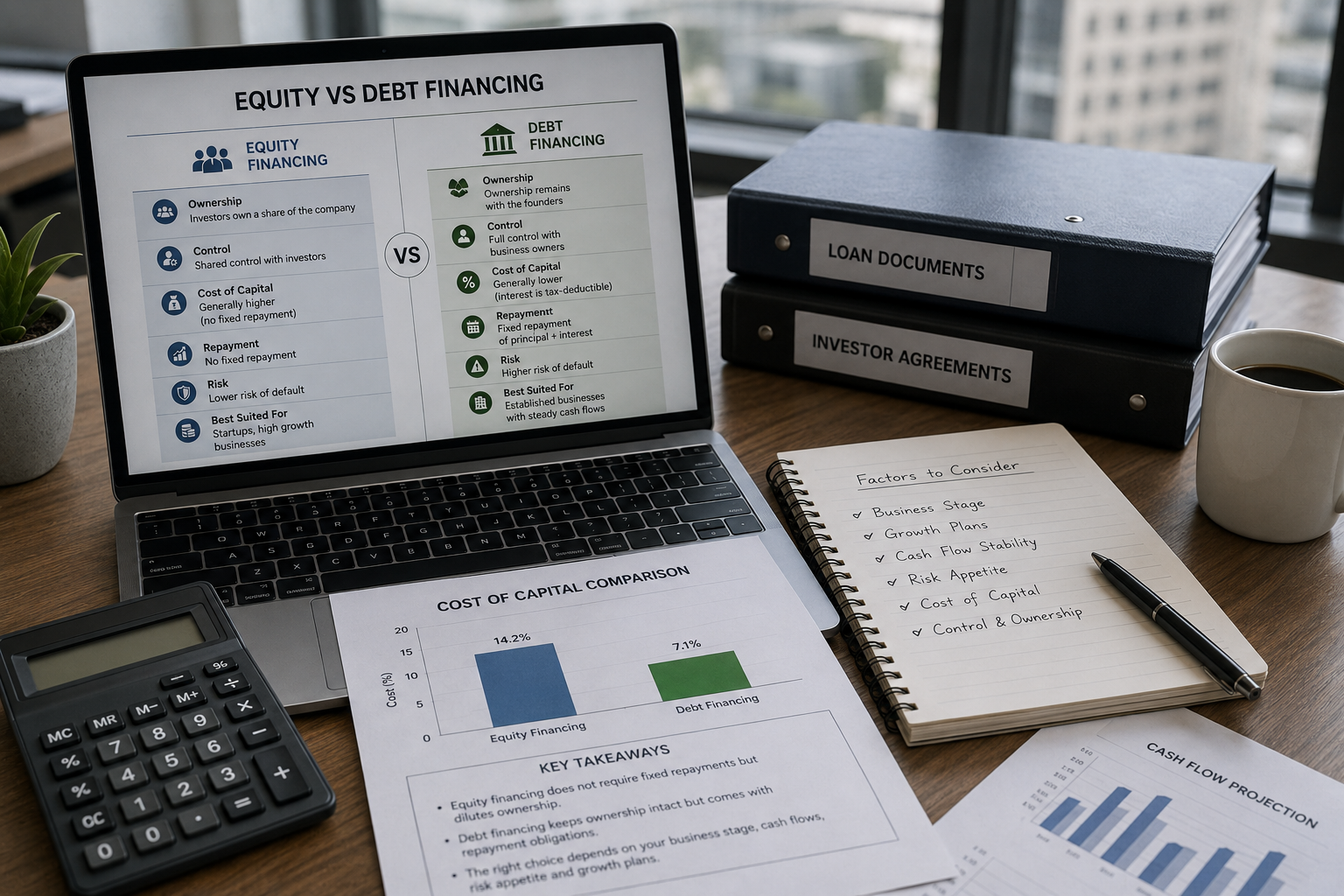
Every source of capital asks for something
Every business needs capital, but capital is never free. A founder may need money to build a product, hire employees, buy machinery, open a factory, enter a new city or survive a difficult year. The question is not only how much money the business needs. The deeper question is what the business is willing to give in exchange. Equity financing asks for ownership. Debt financing asks for repayment. That difference shapes control, risk, growth and the future character of the company.
Equity and debt are the two basic languages of business finance. Equity means raising money by selling a share of ownership. Debt means raising money by borrowing, with an obligation to repay principal and interest. Both can help a company grow. Both can destroy value if used badly. The right choice depends on stage, cash flow, risk appetite, business model, market opportunity and the owner’s willingness to share control.
What equity financing means
Equity financing happens when a business raises money from investors in exchange for ownership. The investor may receive shares, preference shares, convertible instruments or another ownership-linked claim. The company does not have to make fixed monthly repayments like a loan. Instead, the investor earns when the company grows in value, pays dividends or eventually exits through a sale, public listing or buyback.
For startups, equity financing is often attractive because early-stage companies usually do not have stable cash flows. A young technology company may have users but no profit. A manufacturing startup may need years before capacity reaches scale. A biotech or deep-tech company may need long research cycles. Debt can be dangerous in such cases because repayment begins before the business model is stable. Equity investors accept higher uncertainty in exchange for upside.
The cost of equity is dilution. The founder gives up a portion of ownership. If the company becomes highly successful, the shares sold early can become extremely valuable. This is why equity may feel cheap at the beginning and expensive later. A founder who raises too much equity too early may later realise that control has shifted, decision-making has become complex and future fundraising becomes harder.
What debt financing means
Debt financing happens when a business borrows money and agrees to repay it with interest. The lender does not normally become an owner. The company keeps control, but it must honour repayment obligations regardless of whether business conditions are good or bad. Debt can come from banks, non-bank lenders, bonds, debentures, working-capital loans, equipment loans, trade credit or private credit.
Debt is powerful when cash flows are predictable. A mature business with steady revenue, good margins and clear asset backing can use debt to expand without diluting ownership. If a company borrows at a reasonable cost and earns a higher return on the borrowed capital, debt can increase shareholder returns. This is the logic of financial leverage. But leverage works both ways. If revenue falls or interest rates rise, fixed repayments can turn growth capital into financial pressure.
Control: the biggest emotional difference
The most visible difference between equity and debt is control. Equity investors usually expect information rights, governance rights, board influence, veto rights or strategic involvement. The exact terms vary, but the principle is clear: ownership brings voice. A founder who raises equity is not merely receiving money; they are inviting partners into the business.
Debt lenders usually do not run the company, but they impose discipline through covenants, collateral, repayment schedules and reporting requirements. If the company defaults, lenders can enforce security, restructure terms or take legal action. So debt preserves day-to-day ownership control, but it creates financial discipline. Equity reduces ownership control but offers more breathing space in cash-flow timing. Neither is automatically superior.
Cash flow: the practical test
The practical test for debt is cash flow. Can the business pay interest and principal even in a weak month? Can it survive delayed receivables, inventory buildup, customer loss or margin pressure? If the answer is uncertain, debt may create stress. Many businesses fail not because the idea is bad, but because repayment schedules are unforgiving.
Equity is more flexible because there is no fixed repayment obligation. However, equity investors expect growth. They may tolerate losses, but not lack of ambition. Venture investors in particular invest for scale. A founder who wants a stable, profitable, slow-growth business may not enjoy venture equity pressure. Equity capital is patient about repayment, but impatient about growth.
Cost: interest versus ownership upside
Debt has an explicit cost: interest. The borrower can calculate the interest rate, processing fees, collateral requirement, repayment schedule and penalties. Equity has an implicit cost: future ownership value. If the company remains small, equity may be cheaper because investors share the downside. If the company becomes large, early equity can be far more expensive than debt would have been.
This is why good finance leaders compare cost of capital, not just immediate cash availability. A low-interest loan may be better for a stable business. Equity may be better for a risky, fast-growing company. Convertible instruments sit between the two, starting as debt-like or preference instruments and later converting into equity under agreed conditions. They are popular when valuation is uncertain.
Risk: who carries the pain when things go wrong?
Debt puts more downside risk on the borrower. The lender expects repayment even if profits fall. Equity shares downside risk with investors because owners benefit only if the business succeeds. If the business fails, equity investors may lose money, but the company does not owe them repayment like a lender. This is why equity is often called risk capital.
But equity creates another risk: misalignment. Investors may want aggressive expansion, a faster exit or strategic choices that the founder does not prefer. A company funded by the wrong type of equity can lose its original discipline. Similarly, a company funded by excessive debt can lose strategic freedom because every decision becomes tied to repayment pressure. Good capital structure is not just financial engineering. It is governance design.
Which businesses should prefer equity?
Equity is usually more suitable when the business has high growth potential but uncertain cash flows. Startups, technology platforms, research-heavy ventures, consumer brands entering new markets and asset-light companies often use equity because traditional lenders may not understand or accept their risk. Equity also helps when the business needs strategic support, networks, credibility and mentorship from investors.
However, equity should be raised with discipline. The founder should understand valuation, dilution, investor rights, liquidation preferences, anti-dilution clauses, vesting, board composition and exit expectations. Raising money is not success by itself. The quality of capital matters. The wrong investor can be more expensive than no investor.
Which businesses should prefer debt?
Debt is usually more suitable when the business has predictable revenue, assets, working-capital cycles and repayment capacity. A profitable manufacturer buying machinery, a distributor financing inventory, a service company bridging receivables or a mature firm expanding capacity may use debt effectively. Debt allows the owner to retain upside while using borrowed funds to grow.
But debt should match the purpose. Short-term working-capital loans should not finance long-term assets. Long-term project loans should not be used casually for operating losses. The tenure of debt should match the life of the asset or cash flow it finances. A mismatch can create avoidable distress.
The balanced answer: capital structure
Most serious companies eventually use a mix of equity and debt. Equity provides a cushion. Debt improves capital efficiency. The balance is called capital structure. Too much equity can dilute returns. Too much debt can create fragility. The right balance changes with stage. A startup may begin with founder capital and equity. A growing business may add working-capital lines. A mature business may issue bonds or use structured debt.
The best capital structure supports strategy instead of dictating it. If the business model needs patience, the capital must be patient. If the business generates steady cash, debt may be sensible. If the market opportunity is large but uncertain, equity may be necessary. Financing should serve the business, not the ego of the founder or the fashion of the market.
Final takeaway
The difference between equity and debt financing is simple in definition but deep in consequence. Equity gives money in exchange for ownership and shared upside. Debt gives money in exchange for repayment and interest. Equity reduces repayment pressure but dilutes control. Debt preserves ownership but increases fixed obligations. Wise businesses do not ask which is better in the abstract. They ask which form of capital fits their cash flow, risk, growth ambition and governance needs. Capital is not only fuel. It is also a contract about the future.