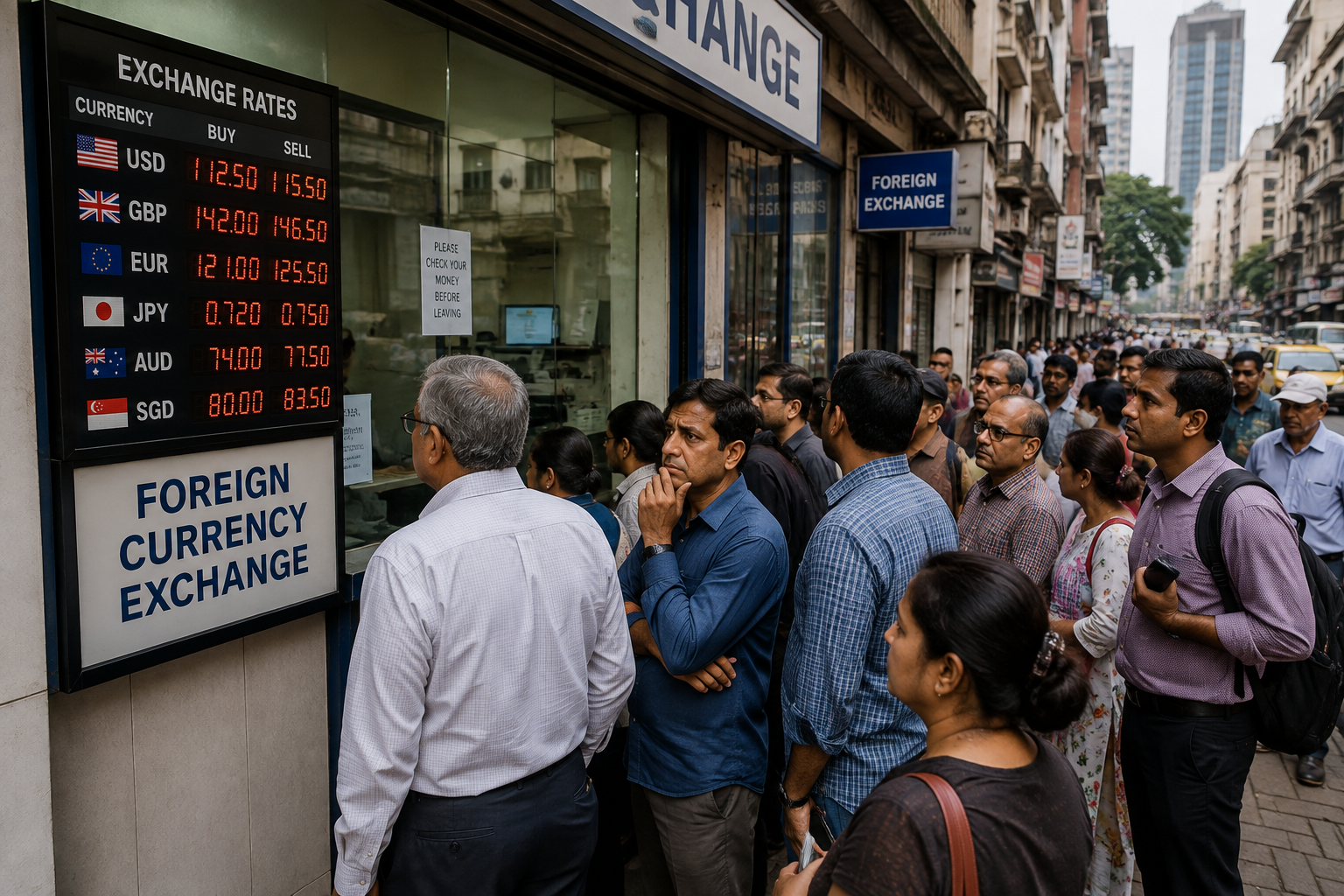
A currency crisis begins when people stop believing that a country's money can hold its external value. The exchange rate falls sharply, foreign investors pull back, residents try to protect savings, import costs rise, and the central bank may burn through reserves trying to defend the currency. What begins as pressure in the foreign-exchange market can quickly become an inflation, debt, banking and political crisis.
A currency is more than a symbol on banknotes. It is a price: the price of one country's money in terms of another. That price affects imports, exports, foreign debt, investor confidence, inflation and national purchasing power. When a currency weakens gradually because of normal market adjustment, the economy may adapt. When it collapses suddenly under panic, the effects can be severe.
The first cause of a currency crisis is an unsustainable external imbalance. If a country imports far more than it exports and cannot attract stable capital inflows, it must finance the gap through reserves, borrowing or foreign investment. This can continue for some time, but not forever. If investors begin to doubt whether the country can keep paying for imports and external obligations, pressure builds.
The second cause is a fixed or heavily managed exchange rate that markets no longer believe. A central bank may promise to keep the currency at a certain level. To defend that level, it sells foreign reserves and buys domestic currency. If reserves are large and fundamentals are strong, this can work. But if deficits are persistent and confidence weakens, speculators and investors may attack the currency because they expect devaluation.
This is the classic balance-of-payments crisis: the country tries to defend a currency value that no longer matches economic reality. When reserves fall too far, the central bank must devalue, float the currency, borrow emergency funds or impose controls. The crisis is not simply that the currency falls. The crisis is that the old promise becomes impossible to maintain.
The third cause is foreign-currency debt. If governments, banks or companies borrow heavily in dollars or euros but earn revenue in local currency, depreciation becomes dangerous. As the local currency falls, the domestic value of foreign debt rises. A company that could repay when the exchange rate was stable may become stressed after depreciation. This can turn a currency crisis into a debt and banking crisis.
The fourth cause is capital flight. In good times, foreign capital may enter emerging markets searching for higher returns. It may buy government bonds, equities, corporate debt or bank deposits. These inflows can support growth and strengthen the currency. But if global interest rates rise, geopolitical risk increases or domestic credibility weakens, the same capital can leave quickly. The reversal puts pressure on the currency and raises borrowing costs.
Capital flight is dangerous because it moves faster than trade. Export competitiveness may improve slowly after depreciation, but financial outflows can occur immediately. A country cannot build factories overnight to earn more dollars, but investors can sell assets in seconds. This speed mismatch is central to currency crises.
The fifth cause is inflation and weak policy credibility. If domestic inflation is much higher than trading partners' inflation, the currency tends to lose value over time. If the central bank is not credible, investors expect further depreciation. If fiscal policy is loose and government borrowing is high, markets may fear that money creation, debt stress or default will follow. Currency confidence depends on the full policy mix, not only on foreign-exchange intervention.
Currency crises often follow a familiar pattern. First, economic weaknesses build quietly: current-account deficits, short-term foreign debt, overvalued exchange rate, weak reserves, credit boom or political instability. Second, a trigger appears: a rise in global interest rates, commodity shock, election uncertainty, banking stress or external conflict. Third, investors reassess risk. Fourth, reserves fall as the central bank defends the currency. Fifth, panic accelerates. Finally, the currency devalues, policy tightens and the economy adjusts painfully.
The Asian financial crisis of 1997 showed how currency, banking and corporate balance sheets can interact. Several economies had strong growth but also large foreign-currency borrowing, property booms and financial vulnerabilities. When confidence turned, currencies fell, foreign debt burdens rose and banking systems came under pressure. The lesson was not that emerging-market growth is unsafe. The lesson was that foreign-currency mismatches and short-term external borrowing can make growth fragile.
Latin American crises, emerging-market sudden stops and episodes in Turkey, Argentina and other countries reveal another lesson: the exchange rate is often where broader policy contradictions become visible. A country may hide fiscal stress, banking weakness or inflation pressure for some time, but the currency market eventually asks whether the numbers add up.
A currency crisis affects ordinary people through prices. If a country imports fuel, electronics, machinery, fertiliser, medicines or edible oils, depreciation raises costs. Imported inflation then spreads through transport, food, manufacturing and household budgets. Even people who never trade currencies feel the effect when petrol, cooking oil, school equipment or medical imports become more expensive.
Exporters may benefit from depreciation because their goods become cheaper abroad. But the benefit is not automatic. If exporters rely on imported inputs, their costs also rise. If global demand is weak, cheaper currency may not produce strong export growth. If firms have foreign-currency debt, depreciation may hurt them even if export revenue improves.
Governments have several tools to respond. They can raise interest rates to attract capital and reduce pressure, but higher rates may slow growth. They can use foreign-exchange reserves, but reserves are finite. They can seek IMF or bilateral support, but programmes may require difficult reforms. They can impose capital controls, but controls can damage investor confidence if poorly designed. They can allow depreciation, but depreciation can raise inflation and debt stress.
There is no painless currency-crisis solution because the crisis usually reveals a prior imbalance. The choice is not between pain and no pain. It is between orderly adjustment and disorderly collapse. Good policy tries to adjust before panic, when options are still available.
Prevention is therefore more important than rescue. Countries reduce currency-crisis risk by maintaining adequate foreign-exchange reserves, limiting short-term external debt, avoiding excessive foreign-currency borrowing, keeping inflation under control, building credible fiscal policy, allowing flexible exchange-rate adjustment, supervising banks and communicating transparently.
Flexible exchange rates can act as shock absorbers. If the currency moves gradually, the economy receives signals before imbalances become explosive. But flexibility alone is not enough. A free-floating currency can still crash if inflation is high, reserves are low, external debt is large or policy is not credible. The exchange-rate regime matters, but fundamentals matter more.
For India, currency-crisis analysis is especially relevant because the economy is deeply connected to global oil prices, capital flows, remittances, services exports and foreign portfolio investment. India has stronger external buffers than many crisis-prone economies, but it is not immune to global shocks. Oil-price spikes, dollar strength, risk-off capital outflows and geopolitical uncertainty can all pressure the rupee.
India's policy challenge is balance. A completely rigid exchange rate can waste reserves and invite speculative pressure. A completely unmanaged disorderly fall can fuel inflation and anxiety. The practical approach is usually managed flexibility: allow market movement while preventing excessive volatility, maintain reserves, monitor external debt and keep domestic macroeconomic policy credible.
For investors and businesses, currency crises teach the importance of hedging. A company earning rupees but borrowing dollars must understand exchange-rate risk. An importer must plan for currency volatility. A government issuing foreign-currency debt must consider what happens if global conditions tighten. Currency risk is not a footnote. It can decide solvency.
Currency crises also teach that confidence is both economic and political. Markets watch data, but they also watch institutions. Are statistics credible? Is the central bank independent enough? Is the fiscal path believable? Are reforms consistent? Is the government communicating clearly? In foreign-exchange markets, credibility can reduce pressure even before money moves.
The final lesson is that currency crises rarely begin in the currency alone. They begin in imbalances, mismatches, expectations and promises. The exchange rate is where those promises are tested. A country can maintain currency stability when its policy framework, external accounts and institutions support confidence. When they do not, defending the currency becomes increasingly expensive.
A currency crisis is therefore not just about a falling number on a screen. It is about the external value of national trust. When that trust weakens, the cost appears in reserves, inflation, debt, investment and household budgets. The best defence is not panic intervention after collapse, but disciplined policy before confidence breaks.
Disclaimer
This article is for general educational and editorial use. It is not investment, foreign-exchange, banking, legal or policy advice. Exchange-rate data, reserve figures and country-specific crisis examples should be verified from official sources before publication.