Cultural Globalisation Explained: How Culture Travels and Changes
Culture has always travelled. Religions, foods, musical instruments, clothing styles, languages, stories, technologies and artistic traditions crossed regions long before the modern idea of globalisation existed. Traders carried tastes as well as goods, migrants carried rituals and recipes, empires spread languages and institutions, and religious networks moved beliefs across enormous distances. What changed in the modern era was not the existence of cultural exchange but its scale, speed, density and continuity.
Steamships and railways accelerated movement in the nineteenth century. Mass migration connected distant communities more permanently. Radio, cinema and television allowed cultural products created in one place to reach millions elsewhere. Air travel shortened physical distance, while digital networks later allowed music, video, humour, fashion and commentary to move internationally almost instantly. Cultural globalisation is therefore best understood as the intensification of these cross-border flows rather than as the invention of cultural exchange itself.
The process is also more complicated than the idea of one global culture replacing local ones. Foreign cultural forms can be copied, adapted, resisted or transformed. A global music genre can acquire a local language and political meaning. A dish introduced through migration can become part of national cuisine. A worldwide social platform can host highly local humour, religion and language. Globalisation can therefore produce similarity, hybridity and renewed local identity at the same time.
What Is Cultural Globalisation?
Globalisation broadly refers to growing interdependence among economies, populations and societies. Cultural globalisation describes the movement, circulation and interaction of cultural expressions across national and regional boundaries. These flows include people, languages, media, entertainment, food, fashion, religion, sport, artistic practices, ideas and everyday habits.
Culture does not move through one channel. Migration carries customs and family practices. Trade moves ingredients, clothing and consumer products. Film and television move stories and images. Education circulates intellectual traditions and languages. Tourism brings visitors into direct contact with local heritage. Digital platforms distribute videos, music and commentary. Translation allows cultural works to cross linguistic boundaries, while states deliberately promote cultural products through diplomacy.
Understanding cultural globalisation therefore requires more than asking what people watch or eat. It requires examining the infrastructure and power behind circulation: who owns distribution systems, which languages receive translation, which creators can afford international marketing, which platforms determine discoverability and which cultural industries possess the capital needed to reach global audiences.
Migration Is One of the Oldest Engines of Cultural Exchange
Migrants do not move as culturally empty individuals. They carry language, food, religious practices, music, clothing, family customs and memories into new places. These practices may remain important within diaspora communities while also becoming visible to neighbours and eventually entering wider local culture.
But diaspora culture rarely remains identical to culture in the place of origin. Ingredients may differ, religious practice may adapt to new laws and schedules, children may speak another language more comfortably than their parents, and traditions may acquire meanings specific to the migrant experience. Cultural continuity and cultural transformation therefore happen simultaneously.
Diaspora communities also act as cultural bridges. They can create the first overseas audience for films, music, foods or festivals from the place of origin. Once a cultural form becomes established within a diaspora, it may spread more widely into the surrounding society. Migration therefore does not simply move people across borders; it creates durable networks through which culture continues travelling.
Trade Moves Cultural Meaning Alongside Products
Goods often carry more than economic value. Tea, coffee, spices, textiles, ceramics, fashion and manufactured products have historically transformed taste, social rituals and everyday behaviour far from where they originated. A commodity may develop entirely new meanings after entering another society.
Food provides one of the clearest examples. Ingredients travel through trade and migration, then become incorporated into local cuisines. Recipes change because local ingredients, religious rules and consumer preferences differ. After several generations, an imported food can become so thoroughly integrated that people treat it as part of local tradition.
This helps explain why claims of completely pure national culture are historically difficult to sustain. Many cultural traditions regarded today as ancient or authentic contain layers of earlier exchange. Cultural globalisation intensifies this process, but borrowing, adaptation and transformation are much older than modern globalisation.
Empire Spread Culture Through Unequal Power
Not every cultural exchange is voluntary or equal. Colonial expansion spread languages, legal systems, administrative practices, religions, educational models, architecture and cultural hierarchies across large territories. These movements occurred within political systems built on unequal power.
Colonised communities did not simply receive foreign culture passively. Imported institutions were often adapted, resisted or transformed. Colonial languages could later become tools for anti-colonial politics, international communication or national administration. Religious and educational traditions could acquire local forms quite different from those intended by imperial authorities.
Yet cultural adaptation should not obscure the coercive conditions under which many exchanges occurred. Languages were sometimes marginalised, cultural institutions disrupted and communities denied control over how they were represented. Cultural globalisation therefore cannot be analysed solely as free exchange. Power shapes which cultural forms travel and under what conditions.
Mass Media Created International Audiences
Cinema, radio and television allowed cultural products created in one country to reach enormous audiences elsewhere. International film industries, popular music and global sporting events became shared reference points across national boundaries. Audiences could encounter foreign lifestyles, fashions and stories without migration or travel.
This created new forms of cultural connection but also concerns about unequal flows. Countries with large entertainment industries could export far more cultural material than smaller markets could produce or distribute internationally. A high-budget film backed by extensive marketing does not compete under the same conditions as a small local production available only within one language market.
UNESCO’s 2005 Convention on the Protection and Promotion of the Diversity of Cultural Expressions reflects this distinction by emphasising that cultural goods and services carry identities, values and meanings as well as economic value. This is one reason governments sometimes treat film, broadcasting, publishing and music differently from ordinary commercial goods.
The Internet Accelerated Cultural Circulation
Digital networks dramatically increased the speed at which culture can cross borders. A musician can upload a song locally and attract listeners abroad without first securing physical distribution. A joke can become internationally recognisable within hours. A regional television series can find viewers through streaming, subtitles and online fandom.
The internet has therefore reduced some of the costs of global cultural participation. Small creators can theoretically reach audiences once accessible mainly to large media organisations. Diaspora communities can follow cultural developments continuously, while niche audiences scattered across multiple countries can be aggregated into viable markets.
But digital distribution has not eliminated intermediaries. Platforms, search engines and recommendation systems influence which cultural products become visible. A creator may have global technical access while remaining practically invisible because the platform rarely recommends their work. Cultural globalisation in the digital era therefore combines wider participation with new concentrations of gatekeeping power.
Streaming Changed the Geography of Discovery
Streaming services weakened some of the geographical limits created by physical distribution. A film no longer necessarily needs cinema distribution or a local DVD market to reach foreign viewers. Music listeners can access enormous catalogues extending far beyond what a local record shop could have stocked.
Subtitling and dubbing have become especially important because they make works accessible outside their original language communities. Online fandom can then accelerate discovery further through recommendations, discussion and clips shared across platforms.
Yet availability remains shaped by catalogues, licensing and algorithms. A cultural work may technically exist on a platform but receive almost no visibility. The streaming era therefore expands access while simultaneously increasing the importance of recommendation systems.
Cultural Globalisation Produces Hybridity
One of the strongest arguments against treating globalisation as simple cultural replacement is the frequency with which imported forms are transformed locally. Musicians combine internationally recognised genres with regional instruments and languages. Restaurants adapt foreign dishes to local tastes. Television formats are recreated with new casts, social references and humour. Fashion combines international silhouettes with local textiles and craft.
This process is often described as cultural hybridity. The resulting form is neither entirely foreign nor simply traditional. It emerges from interaction.
Hybridity also reminds us that cultures are not sealed containers. People continually adopt, reject and reinterpret influences. A borrowed cultural form can eventually become so deeply localised that later generations experience it as tradition. Cultural globalisation therefore changes cultures partly through mixture rather than merely replacement.
Global Formats Can Carry Highly Local Content
Digital platforms provide a striking example of this interaction. The same short-video interface may operate across dozens of countries, yet users fill it with different languages, songs, political references, religious practices and humour. The infrastructure is globally standardised while much of the cultural content remains locally specific.
This distinction matters because technological standardisation does not automatically produce cultural uniformity. Common payment systems, file formats, subtitles and platform interfaces can actually make diverse cultural products easier to distribute.
The more difficult question is visibility. If algorithms consistently favour dominant languages or already successful creators, cultural diversity may exist on the platform without receiving comparable attention.
Language Is Central to Cultural Power
Language strongly affects which cultural works travel. Globally dominant languages can reduce communication barriers and make books, films, music and educational material accessible to larger markets. Creators working in such languages may therefore have structural advantages in publishing, international distribution and digital discovery.
Smaller languages face different challenges. Publishing markets may be limited, translation can be expensive, digital tools may provide weaker support, and recommendation systems may have less data available for understanding local-language content. UNESCO’s work on linguistic diversity stresses the importance of local content and digital discoverability.
The risk is not necessarily that smaller languages disappear immediately. A language can remain vibrant in everyday speech while becoming increasingly marginal within digital media, higher education or commercial publishing. Cultural globalisation therefore raises questions not only about whether a language survives, but about whether it remains visible and usable in influential cultural systems.
Translation Is Infrastructure for Cultural Globalisation
Cultural works cannot circulate widely across linguistic borders without translation, subtitling, dubbing and localisation. These processes are often treated as secondary technical services, but they are fundamental infrastructure for global culture.
Translation is also creative interpretation rather than mechanical word substitution. Humour, rhythm, slang and cultural references may have no direct equivalent in another language. Translators make choices about how meaning should travel.
A strong translation ecosystem can therefore expand cultural diversity by making smaller-language works accessible internationally. Weak translation capacity can create the opposite impression: global culture may appear concentrated among a handful of languages even when cultural production is far more diverse underneath.
Global Culture Is Not Equally Global
The phrase global culture can disguise large differences in power. Some industries possess enormous budgets for production, marketing and international distribution, while others depend on local markets, festivals or diaspora networks. English-language media often enjoy advantages in global circulation because of language reach, commercial infrastructure and established distribution systems.
Globalisation therefore has direction. Some cultures travel with institutional support, while others rely heavily on intermediaries to become visible abroad. This asymmetry can make international culture appear more homogeneous than cultural production actually is.
The problem is not necessarily that local culture has ceased to exist. It may be that global audiences cannot easily discover it.
Regional Cultural Centres Can Become Global
Cultural influence does not always flow from the same traditional centres. Film industries, music scenes and digital creators from South Korea, India, Nigeria, Latin America and many other regions have developed substantial international audiences.
This demonstrates that globalisation can become multipolar. A cultural form may originate within one regional industry, expand through diaspora audiences and streaming platforms, then become internationally influential.
The rise of new cultural centres does not eliminate inequality, but it challenges the idea that globalisation must always mean one-way cultural movement from a single dominant region toward everyone else.
Tourism Changes How Culture Is Presented
Tourism creates markets for local food, crafts, festivals, architecture and heritage. This can provide income and encourage communities or governments to invest in preservation.
But tourism can also change the culture being preserved. Performances may be shortened to fit visitor schedules. Crafts can be redesigned for souvenir markets. Complex traditions can be simplified into easily recognisable symbols.
The result is not necessarily false culture. Cultural practices constantly adapt to audiences and economic conditions. But tourism demonstrates how global demand can influence the way communities present themselves, sometimes rewarding a version of local identity designed partly around outsider expectations.
Global Brands Create Familiarity Across Borders
International food chains, clothing companies, entertainment franchises and technology brands create recognisable environments in different countries. This contributes strongly to perceptions of cultural sameness because travellers encounter similar logos, products and retail spaces across multiple cities.
Yet global brands are often localised. Menus change according to regional tastes and religious requirements. Marketing uses local celebrities or festivals. Consumers incorporate products into different social rituals.
Global branding therefore demonstrates both standardisation and localisation. The same commercial system can produce recognisable global identity while being adapted to local cultural expectations.
Cities Become Cultural Contact Zones
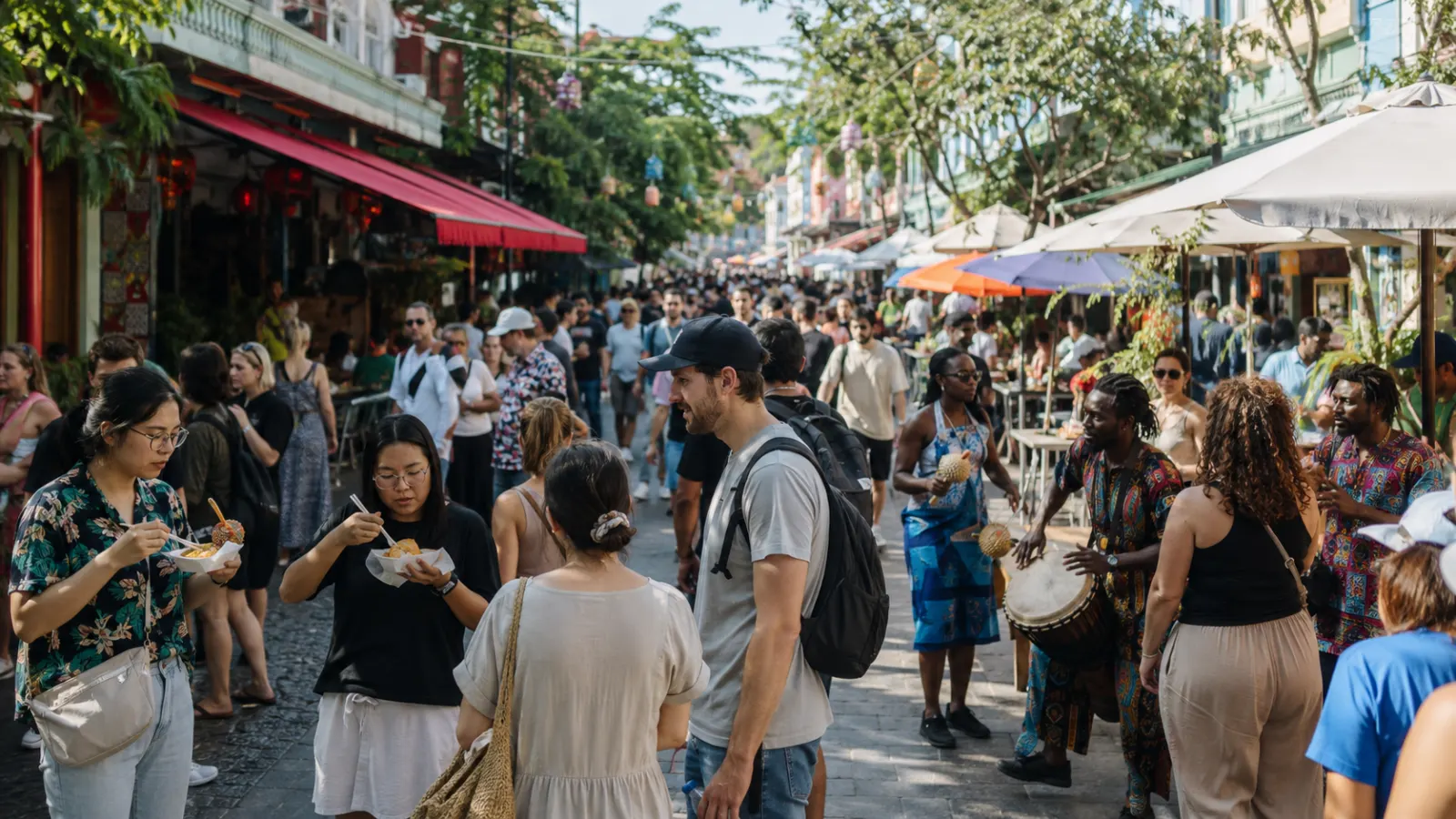
Large cities make cultural globalisation particularly visible because migrants, tourists, media industries, businesses and educational institutions interact continuously. One neighbourhood may contain restaurants, religious institutions, languages, music scenes and retail traditions associated with several regions.
Urban culture therefore develops through contact. Foods cross communities, musical styles mix, multilingual identities become common and new forms of cultural belonging emerge.
Cities are not simply places where global culture replaces local culture. They are laboratories in which global and local influences continually recombine.
Globalisation Can Strengthen Local Identity
Exposure to outside culture can sometimes make communities more conscious of their own distinctive practices. A regional language may receive renewed attention because speakers fear marginalisation. A local festival may be promoted more strongly because it differentiates the community from globally standardised entertainment. Traditional food may acquire new symbolic value in response to international chains.
This means globalisation can generate revival as well as decline. Cultural identity often becomes more deliberate when people become aware that alternatives exist.
Local cultural movements may even use global tools to strengthen themselves. Activists can archive endangered languages online, raise money internationally or connect with preservation organisations elsewhere. Resistance to globalisation can itself become globally networked.
Cultural Homogenisation Is One Possible Outcome
Cultural homogenisation occurs when cultural differences decline and societies become more similar. Global brands, dominant languages, international entertainment industries and standardised platform systems can contribute to this process.
But homogenisation should not be treated as the definition of cultural globalisation. The same global connections can produce hybrid forms, revived traditions, regional cultural industries and new local identities.
A society can therefore become more globally connected without becoming culturally identical to everyone else. Whether similarity increases depends on which cultural systems dominate, how local communities respond and whether diverse expressions remain visible.
Food Shows Both Globalisation and Localisation
Food is one of the clearest areas in which globalisation produces both convergence and diversity. Ingredients, restaurant concepts and cooking styles move through trade, migration, media and tourism. A dish can become recognisable worldwide while acquiring substantially different local versions.
Global food demand can also affect agriculture in places far from consumers. A fashionable ingredient may increase prices, change land use or influence labour conditions in producing regions. Cultural preference therefore connects directly with economic and environmental systems.
Food globalisation is not merely about what appears on restaurant menus. It can reorganise supply chains and landscapes.
Music Demonstrates the Two-Way Process
Global music genres often spread rapidly, yet musicians rarely copy them unchanged. Hip-hop, rock, electronic music and pop have been translated into local languages and connected with local political issues, instruments and styles.
The borrowed form becomes a vehicle for local expression. A genre may be internationally recognisable while the lyrical content is intensely specific to one city or social movement.
This illustrates why globalisation often produces hybridity rather than simple imitation. The cultural form travels, but local creators determine what it becomes.
Sport Combines Global Rules With Local Identity
Football, cricket and other major sports are global cultural systems. Rules, competitions and broadcasting networks connect audiences across countries, yet loyalties are often intensely local or national.
A supporter participates in an international spectacle while identifying strongly with one city, club or country. Globalisation therefore does not necessarily weaken local identity. In some contexts it gives local identity a larger stage.
Major sporting events also circulate songs, clothing, advertising and national imagery, making sport an important channel through which cultural identities become internationally visible.
Fashion Raises Questions About Attribution and Power
Fashion travels through designers, celebrities, retail chains, street style and social platforms. Regional textiles and craft traditions can gain international audiences when incorporated into global fashion markets.
This can create income and recognition, but it can also raise questions about who receives credit and economic benefit. A traditional motif may become commercially successful while the community associated with it receives little recognition.
Cultural globalisation therefore intersects with debates about appropriation, intellectual property and the ownership of cultural expression.
Religion Also Operates Through Global Networks
Religious traditions have long crossed borders through migration, pilgrimage and missionary activity. Digital media and affordable travel have intensified these connections.
Communities can participate in religious events across borders, follow teachers online and maintain relationships with institutions located elsewhere. Yet religious practices continue to adapt to local languages, law, work schedules and social customs.
A globally distributed religion therefore does not produce one uniform culture. It contains many local versions linked through transnational networks.
Education Globalises Cultural Canons
Universities, schools and academic publishing circulate theories, texts and languages internationally. Students in different countries may study similar thinkers, research methods or professional standards, creating shared intellectual vocabularies.
This can facilitate international communication and collaboration. It can also privilege institutions and traditions already possessing greater global prestige.
Educational globalisation therefore raises a cultural question similar to that found in entertainment: which traditions become internationally recognised as authoritative, and which remain locally significant but globally marginal?
Cultural Diplomacy Makes Globalisation Strategic
States do not leave cultural circulation entirely to markets. Governments sponsor language institutes, film festivals, exhibitions, educational exchanges, cuisine promotion and artistic programmes abroad.
This is cultural diplomacy: the deliberate use of cultural expression to build relationships, reputation and influence.
Its existence demonstrates that cultural globalisation is not purely spontaneous. States understand that culture can shape how countries are perceived, and they invest strategically in making certain cultural forms visible internationally.
Intellectual Property Shapes What Can Travel
Copyright and licensing influence global circulation because cultural works need economic systems capable of supporting creators and producers. International distribution can generate substantial revenue, but territorial licensing may also prevent works from being legally available in particular countries.
Digital piracy complicates the situation. Unauthorised copying can make cultural products accessible where formal distribution is weak, while also undermining revenue models relied upon by creators and industries.
Cultural circulation therefore depends partly on how legal systems balance access, ownership and financial sustainability.
Platforms Can Make Small Audiences Economically Viable
Physical distribution traditionally made small markets difficult to serve. A specialist film, album or book might not justify manufacturing and shipping inventory to many countries.
Digital catalogues can aggregate small groups of interested consumers scattered across multiple regions. Niche culture can therefore become economically viable at a global scale even when no individual country contains a large audience.
This creates significant opportunities for diverse cultural production, although discoverability remains the central challenge. A niche product cannot benefit from a global audience if recommendation systems never connect the two.
Festivals Remain Important Cultural Gatekeepers
Film festivals, art biennales, book fairs and music festivals connect creators with distributors, journalists, critics, funders and audiences. They can provide international visibility to cultural works that might otherwise remain confined to local markets.
This makes festivals part of the infrastructure of cultural globalisation. They do not simply celebrate culture; they determine which works receive opportunities for international recognition.
Like platforms, festivals therefore operate as gatekeepers. Their selections can expand diversity while also shaping which cultural expressions become legible within international cultural markets.
Digital Recommendation Systems Shape Cultural Diversity
Modern cultural circulation increasingly depends on algorithms deciding what users encounter. Streaming platforms recommend songs and films. Social networks rank videos. Search engines determine which cultural resources appear prominently.
UNESCO’s recent cultural-policy work has raised concerns about the impact of artificial intelligence and digital recommendation systems on the visibility and circulation of cultural expressions.
The problem is not necessarily that platforms remove diverse material. Diversity can exist technically while remaining difficult to discover. Cultural policy therefore increasingly needs to consider visibility alongside production.
Cultural Globalisation Changes the Speed of Culture
Foreign cultural works once sometimes took years to reach new markets. Films, fashions and music could circulate gradually, giving local versions time to develop independently.
Simultaneous global releases and social media have compressed that delay. Audiences in many countries may encounter the same song, fashion trend or television series within days or even hours.
This makes trends appear global almost immediately. It also reduces the period during which local interpretations develop without direct comparison to the original.
Globalisation therefore changes not only where culture travels but how quickly cultural reaction occurs.
Cultural Anxiety Can Reflect Real Change
Rapid cultural change can create anxiety that languages, customs, neighbourhoods or traditions are disappearing. Some of these concerns reflect real evidence of declining language use, disappearing crafts or weakening cultural institutions.
Other claims may rely mainly on nostalgia or hostility toward newer communities. Serious cultural analysis needs to distinguish between measurable loss and the ordinary fact that cultures continually change.
Cultural preservation should therefore be based on evidence about what is actually threatened rather than on the assumption that every change represents decline.
Globalisation Can Produce Political Backlash
Perceived cultural loss can become politically powerful. Movements may promise to defend language, religion, national identity or traditional values from global influence.
Such efforts can support legitimate preservation when they expand opportunities for communities to maintain cultural expression. They can become exclusionary when cultural protection is used to deny equal belonging or rights to people considered insufficiently traditional.
The distinction matters because cultural rights are compatible with exchange. Preserving a language or tradition does not require isolating a society from outside influence.
Cultural Rights Place Limits on Pure Market Logic
Culture is not simply another commercial commodity. Communities have interests in using language, participating in cultural life and maintaining cultural expression. UNESCO’s cultural-diversity framework reflects the idea that cultural goods and services embody identities and meanings in addition to economic value.
This provides a rationale for cultural policy. Governments may support local film, broadcasting, publishing, heritage or minority-language production not because foreign culture should be excluded, but because completely unregulated markets can favour cultural industries with the greatest existing capital and distribution power.
The challenge is to maintain openness while preserving meaningful opportunities for diverse cultural expression.
There Is No Neutral Global Cultural Marketplace
What reaches global audiences depends on infrastructure, finance, language, translation, policy and platform design. A culturally vibrant community can remain internationally obscure because it lacks distribution networks or marketing resources. Another industry can become globally dominant partly because it possesses enormous production and promotional capacity.
Global circulation is therefore never purely a spontaneous contest in which the most attractive cultural product automatically wins. Institutions shape visibility.
This is why cultural globalisation needs to be analysed through power as well as taste.
The Question Is Not Local Versus Global
People rarely live exclusively at one cultural scale. The same person can watch an international streaming series, speak a regional language at home, follow a global football league, eat a family recipe, work for an international company and participate in a local religious festival.
These identities are layered rather than mutually exclusive. Globalisation does not force everyone to choose between being local and global.
In many cases, people use global technologies precisely to maintain local relationships and traditions. The more useful question is therefore how global connections change the possibilities available to local cultural life.
Frequently Asked Questions
What is cultural globalisation?
Cultural globalisation is the intensified movement and interaction of cultural expressions across borders through migration, trade, media, tourism, education, digital networks and other channels.
Does cultural globalisation mean all cultures become the same?
No. Globalisation can contribute to cultural homogenisation, but it can also produce hybridity, local adaptation, cultural revival and new forms of difference.
How does migration contribute to cultural globalisation?
Migrants carry languages, foods, music, religion and traditions into new places while adapting them to different social conditions.
How does the internet affect cultural globalisation?
Digital networks allow cultural material to cross borders rapidly and reduce distribution costs, although platforms and recommendation systems strongly influence visibility.
What is cultural hybridity?
Cultural hybridity occurs when cultural influences combine to create forms that are neither simply imported nor purely local.
Why is language important in cultural globalisation?
Language affects how easily cultural works can travel, be translated, discovered and supported by digital systems.
What role does translation play?
Translation, subtitling, dubbing and localisation allow cultural works to become accessible across linguistic boundaries and are essential infrastructure for global circulation.
What is cultural homogenisation?
Cultural homogenisation refers to a reduction in cultural differences as societies adopt increasingly similar cultural forms.
Can globalisation strengthen local identity?
Yes. Exposure to external culture can increase awareness of local distinctiveness and encourage language revival, heritage protection or local cultural movements.
How does streaming affect cultural globalisation?
Streaming makes international film, television and music easier to access, while platform catalogues and algorithms influence which cultural products audiences actually discover.
Why are cultural goods treated differently from ordinary goods?
Cultural products carry meanings, values and identities in addition to economic value, which is one reason UNESCO and governments treat cultural industries as more than ordinary commerce.
Is global culture dominated by a few countries?
Cultural flows remain highly unequal, but global circulation is increasingly multipolar, with major cultural influence emerging from several regions and industries.
How does tourism affect culture?
Tourism can fund preservation and cultural livelihoods while also encouraging simplified or commercialised versions of traditions.
Can global brands become localised?
Yes. International companies routinely adapt products, advertising and consumption practices to local cultures.
How do algorithms affect cultural diversity?
Recommendation systems can influence which languages, genres and creators receive visibility even when a platform technically contains diverse content.
What is cultural diplomacy?
Cultural diplomacy is the deliberate promotion of language, art, film, cuisine, education or heritage abroad to build influence and relationships.
Is cultural globalisation voluntary?
Not always. Historical empire and unequal political or economic relationships have produced cultural flows under conditions of significant power imbalance.
Why is cultural globalisation controversial?
It can expand access and cultural exchange while also increasing concerns about homogenisation, unequal representation, commercialisation and the loss of local cultural autonomy.
Cultural Globalisation Is Not the Same as Cultural Sameness
The strongest way to understand cultural globalisation is to separate connection from uniformity. Globalisation creates denser networks through which people, products, media and ideas travel, but what happens after they arrive depends on local societies. Cultural forms can be adopted intact, modified, mixed with existing traditions, rejected or used to strengthen local identity.
The process is unequal because cultural circulation requires infrastructure. Translation, marketing, platform access, international distribution and digital discoverability determine which cultural expressions travel widely. Powerful industries can therefore shape global culture disproportionately even when cultural production itself remains highly diverse.
The Central Idea
Cultural globalisation is best understood as intensified cultural connection shaped by unequal power, not as the inevitable creation of one worldwide culture. Culture has always crossed borders, but migration, mass media, international trade, air travel, streaming and digital networks have made those exchanges faster, denser and more continuous.
The consequences move in several directions at once. Global formats spread widely, yet local communities reinterpret them. Minority cultures can find international audiences, while dominant languages and platforms can make other cultural expressions harder to discover. Tourism can support preservation and simultaneously commercialise traditions. International brands create recognisable environments while adapting to local tastes. Global music genres spread across continents and become vehicles for highly local expression.
This is why the debate cannot be reduced to global versus local. The two are constantly interacting. A regional artist may use a global platform to revive a local language. A diaspora community may preserve traditions through digital communication. A local craft may gain international commercial value while also raising concerns about attribution and control.
Power determines much of what becomes visible. Some creators have access to international marketing, translation and distribution systems, while others do not. Recommendation algorithms and digital platforms increasingly determine cultural discovery. Cultural globalisation may therefore appear open while practical influence remains concentrated among actors possessing stronger infrastructure and capital.
The policy challenge is not to stop cultural exchange. Cultural exchange has always existed and can generate creativity, understanding and new forms of expression. The challenge is to ensure that openness does not become a one-way system in which only the most powerful cultural industries remain globally visible.
The future of cultural diversity therefore depends not only on whether cultures continue producing art, language, music, food and tradition. It also depends on whether those cultural expressions can circulate, be translated, be discovered and remain economically and socially viable within increasingly global systems.
Globalisation connects cultures. It does not determine in advance what those cultures will become.