Cultural Appropriation Explained: When Cultural Borrowing Becomes Exploitative
Cultures have never developed in complete isolation. Languages borrow words, cuisines absorb ingredients, musicians adopt instruments and styles, designers reinterpret visual forms, and religious traditions influence one another through migration, trade, intermarriage and conquest. If every instance of cultural borrowing were treated as wrongdoing, much of human cultural history would become impossible to explain. The serious debate over cultural appropriation therefore begins with a narrower question: when does cultural borrowing become exploitative, disrespectful, misleading or unfair?
A useful working definition is that cultural appropriation occurs when people outside a cultural community adopt or use its expressions in circumstances shaped by exploitation, stereotyping, erasure, disrespect, restricted use or sharply unequal benefit. The term is not one universally agreed legal category. It appears across ethics, Indigenous-rights debates, museums, fashion, music, sport, intellectual-property policy and cultural criticism. That breadth explains both its usefulness and the confusion surrounding it: not every act of borrowing is appropriation, and not every controversy can be resolved by asking who “owns” a cultural practice.
Cultural Exchange and Cultural Appropriation Are Not the Same Thing
Cultural exchange is a normal part of social life. People migrate, marry across communities, teach one another, collaborate creatively and develop new forms from older influences. UNESCO’s cultural-diversity framework treats exchange and interaction as important parts of cultural expression rather than as threats to cultural identity.
The important distinction is therefore not simply borrowing versus no borrowing. It is the relationship in which the borrowing occurs. Was a cultural expression shared publicly or was it restricted? Was its origin acknowledged or erased? Were source-community practitioners included or excluded? Was the representation accurate or stereotypical? Did outsiders gain money or prestige while the originating community remained marginalised? Those questions reveal why two visually similar acts can produce very different ethical judgments.
Why Power Matters
Power is central because borrowing between communities with relatively equal social standing can be experienced differently from borrowing shaped by conquest, discrimination or exclusion. A recurring complaint arises when members of a marginalised community are mocked, penalised or commercially excluded for a cultural expression while outsiders later receive praise or profit for adopting a similar form.
In such cases, the issue is not simply that one group copied another. It is that different groups may receive different rewards for the same cultural expression. The deeper question becomes who possesses the social power to decide when a cultural form is considered inferior, fashionable, authentic or valuable.
Power does not mechanically determine every case, but ignoring it can make appropriation disputes impossible to understand.
Traditional Cultural Expressions Are More Than Decoration
The World Intellectual Property Organization uses the term traditional cultural expressions for forms through which traditional culture is expressed. These can include music, dance, art, symbols, designs, performances, ceremonies and other expressions connected to community identity and heritage. WIPO has highlighted that conventional intellectual-property systems often fit such material poorly because traditional expressions may be collectively created, transmitted across generations and governed by community norms rather than by one identifiable modern author.
This creates an important legal and ethical gap. A traditional design may be old enough to fall outside ordinary copyright protection, yet the community that maintains it may continue to regard its use as governed by cultural rules. The absence of conventional copyright does not necessarily mean the expression is culturally unrestricted.
Indigenous Rights Make Some Cases More Concrete
Questions involving Indigenous peoples are not merely abstract disputes about taste. The United Nations Declaration on the Rights of Indigenous Peoples recognises Indigenous peoples’ rights to maintain, control, protect and develop their cultural heritage, traditional knowledge and traditional cultural expressions.
That does not create one automatic rule for every Indigenous cultural expression or every use by outsiders. It does demonstrate, however, that internationally recognised collective interests can exist around cultural heritage and traditional expressions. Sacred knowledge, ceremonial objects and communally governed designs cannot always be treated simply as visual material available for unrestricted commercial reuse.
Context Can Completely Change the Meaning of the Same Object
An outsider may see a pattern, garment, symbol or hairstyle primarily as an aesthetic choice. The originating community may understand the same form through religion, social status, kinship, ceremonial responsibility or historical memory.
A design used only in a specific ceremony may lose much of its original meaning when printed on novelty merchandise. A sacred object displayed as decoration can be physically identical to the traditional form while being socially transformed by the context in which it is used.
Many appropriation disputes are therefore not about copying alone. They are about decontextualisation: removing an expression from the network of meanings, responsibilities and restrictions that made it culturally significant.
Sacred and Restricted Practices Are Different From Public Culture
Not every cultural element operates under the same rules. Some practices are openly shared and commercially circulated: everyday foods, publicly taught crafts, popular music and festivals may be designed for wide participation.
Other cultural expressions may be governed by restrictions involving initiation, kinship, gender, ritual role, season or community authority.
This distinction matters. Learning a dance style from instructors who publicly teach it is ethically different from wearing a restricted ceremonial object as costume. Eating another community’s cuisine is different from imitating a sacred ritual for entertainment.
Before asking whether an outsider may use a cultural element, it is often more useful to ask how the originating community itself regulates that element.
Consent Helps, but Cultures Rarely Have One Spokesperson
Permission seems like an obvious solution: simply ask the culture whether a use is acceptable. In practice, cultures are not corporations with one authorised representative. Communities contain disagreements, generations, political factions, religious authorities, artists and commercial interests.
One group may support a collaboration while another objects. A national government may promote the commercialisation of cultural heritage while traditional practitioners oppose a particular use. An individual member of a community cannot necessarily grant universal permission on behalf of everyone who shares that tradition.
Consent is therefore most meaningful when it follows actual community governance. If a cultural expression is controlled through recognised elders, practitioners, artists, councils or customary processes, those structures are more relevant than searching for one convenient individual willing to approve the use.
Credit Matters, but Credit Is Not Always Enough
Attribution can address one important harm: erasure. Naming the source artist, tradition or community gives audiences information about where an expression originated and reduces the possibility that an outsider will be incorrectly treated as its inventor.
But credit does not settle every ethical issue. A company can correctly name the Indigenous or traditional community behind a design while using sacred material without permission. A musician can acknowledge a borrowed tradition and still capture most of the economic benefit while practitioners from the source community receive little opportunity.
Credit is therefore an important starting point, not a universal solution.
Commercial Benefit Raises the Stakes
Cultural borrowing becomes more contentious when money, influence or status flow disproportionately toward outsiders. A fashion company may reproduce a traditional motif on expensive products while the craft community that sustained the design struggles economically. A dance can become viral through a high-profile creator while the person or community that originated it receives little attention.
The ethical question is not necessarily whether outsiders are forbidden from earning money from cultural influence. Cultural industries have always developed through exchange. The stronger question is whether commercial benefit is being distributed fairly enough to reflect contribution, authorship, community rights and cultural meaning.
Possible responses can include collaboration, licensing, attribution, employment, revenue sharing or direct partnership with practitioners from the source community.
Misrepresentation Can Harm Without Any Commercial Profit
Money is not necessary for appropriation concerns to arise. Cultural costumes used as jokes, stereotyped imitations of religious practices or exaggerated portrayals of ethnic groups can cause harm through representation alone.
Such uses may reinforce the idea that a living culture is primitive, comic, exotic or interchangeable with unrelated traditions. The injury is primarily about dignity, identity and public understanding rather than financial loss.
This is why “I did not make money from it” is not a complete defence. Representation has consequences even when no transaction occurs.
Intent Matters, but Impact Matters Too
A person can sincerely admire a culture and still use one of its expressions in a way that community members find disrespectful. Lack of knowledge about a religious restriction does not make the restriction disappear.
Good intentions remain relevant because they influence how people respond to criticism and whether dialogue is possible. But intention alone cannot settle the issue. Ethical evaluation also needs to consider impact, historical context, community views and whether reasonable information was available beforehand.
The reverse caution matters as well. Accidental resemblance or independent invention should not automatically be labelled appropriation simply because two cultural forms appear similar.
Not Every Offence Proves Cultural Appropriation
Social media can turn complicated disputes into rapid accusations. Someone expresses offence, another labels the act appropriation, and the controversy becomes framed as though the term itself settled the argument.
Discomfort is significant evidence that cultural context may have been overlooked. It is not automatically proof that one interpretation is correct.
A stronger analysis asks several questions together: What is the historical relationship between the communities? Is the cultural expression public, sacred or restricted? How do source-community members describe the use? Has the origin been acknowledged? Is the representation stereotypical? Who receives economic or social benefit?
The more carefully these factors are examined, the less useful blanket rules become.
Fashion Creates Especially Visible Conflicts
Fashion depends heavily on visual borrowing. Designers constantly reinterpret fabrics, jewellery, hairstyles, embroidery and dress traditions. This makes fashion one of the most common sites of cultural-appropriation disputes.
WIPO has specifically examined appropriation in fashion because traditional cultural expressions frequently occupy an awkward space between ordinary intellectual-property law and customary community rules.
A motif can be legally available for copying while still carrying cultural restrictions. A garment can be publicly worn within one community while a particular version is reserved for ceremonial status. Responsible fashion design therefore requires more than asking whether an image can legally be reproduced.
Music Shows Why Borrowing Cannot Be Reduced to Theft
Music demonstrates both the creativity and inequality produced by cultural exchange. Genres repeatedly develop through migration and interaction among racial, national and class communities. Instruments move across borders. Rhythms are adapted. Musicians reinterpret one another.
Trying to eliminate cross-cultural influence would erase much of music history.
Problems arise when industries erase originators, rename borrowed innovations as someone else’s invention or reward performers from dominant groups while source-community artists remain excluded from comparable opportunities.
The issue is therefore often not influence itself but recognition, access and distribution of reward.
Food Is Usually a Weak Case for Cultural Ownership
Cuisine is among the clearest examples of cultural mixing. Ingredients, recipes and cooking methods have travelled through migration, trade, empire and intermarriage for centuries.
A rule that outsiders must never cook another community’s food would misunderstand how cuisines actually develop.
That does not mean representation is irrelevant. Restaurants, television programmes or food media can erase origins, stereotype cuisines or present long-established dishes as discoveries by celebrity chefs from outside the culture.
In many food disputes, attribution and respectful representation are therefore more useful questions than cultural permission to cook.
Museums Reveal a Deeper History of Cultural Possession
Museums introduce a different form of cultural appropriation because many collections contain objects obtained through colonial rule, military conquest, excavation, unequal trade, missionary activity and private collecting.
A museum may preserve and study an object carefully while the community from which it originated argues that the institution never had a legitimate right to possess it.
Modern provenance and restitution debates therefore ask more than whether an object is being appreciated. They examine how it was acquired, whether consent existed and whether source communities retain legal, cultural or moral claims.
Cultural appropriation in museums is consequently tied to ownership, colonial history and institutional power in ways that extend far beyond fashion or personal style.
Legal Permission and Cultural Permission Can Be Different
Copyright, trademark and other intellectual-property systems protect identifiable creators, works and commercial marks relatively well. Traditional cultural expressions can be harder to fit into those frameworks because they may have evolved collectively over centuries.
WIPO’s work on traditional knowledge and traditional cultural expressions reflects this mismatch.
A design may therefore be legally considered available for public use while the originating community continues to maintain customary restrictions over who may reproduce it.
This gap creates some of the hardest appropriation disputes because two systems of authority produce different answers.
The law may say yes.
The community may say no.
Ethical judgment cannot always be reduced to whichever answer is legally enforceable.
Cultural Appropriation Is Also About Who Defines Authenticity
Commercial visibility can allow outsiders to become better-known representatives of a cultural form than practitioners from the originating community. Once that happens, audiences may encounter the outsider’s altered version first and later treat traditional practice as unusual or less authentic.
This reverses cultural authority.
The community that created and sustained the expression can become marginal to the public definition of its own culture.
That problem is more subtle than physical copying but can be equally important. Appropriation can concern not only who uses a cultural form but who gains the authority to explain what that form supposedly means.
Customary Rules Matter Even When Outsiders Cannot See Them
Many communities maintain cultural rules that have never been written into national law. A design may identify a particular clan. A song may belong to a ceremonial role. Certain stories may be told only at particular times or by authorised people.
An outsider may see no obvious restriction because there is no copyright notice or formal licence.
That absence does not prove the culture regards the expression as unrestricted.
Responsible borrowing therefore requires learning enough about the tradition to understand whether customary rules exist.
Appreciation and Appropriation Are Better Understood as a Spectrum
Attempts to divide every cultural interaction neatly into “appreciation” or “appropriation” often oversimplify the problem. Cultural borrowing exists across a spectrum.
At one end may be genuine collaborative exchange in which practitioners share knowledge voluntarily, receive recognition and participate in the benefits. At the other end may be commercial exploitation of sacred or restricted material accompanied by stereotyping and exclusion.
Many real cases fall between these extremes.
A person can admire a tradition while misunderstanding it. A company can collaborate with some practitioners while failing to recognise wider community concerns. A cultural form can be public in one context and restricted in another.
The spectrum model encourages evaluation rather than automatic categorisation.
A Better Way to Evaluate Cultural Borrowing
Instead of asking only, “Am I allowed to use this?”, several questions provide a more useful ethical test. What does the element mean within the community from which it comes? Is it widely shared or restricted? Does it have sacred, ceremonial or social significance? Who created or maintained it? Has the source been acknowledged accurately? Are community members involved in the way it is being presented? Who receives money, influence or prestige? Does the use reproduce stereotypes or distort the tradition?
No checklist can mechanically resolve every disagreement. These questions nevertheless expose the issues that matter most: meaning, power, consent, representation, recognition and benefit.
What Respectful Cultural Exchange Can Look Like
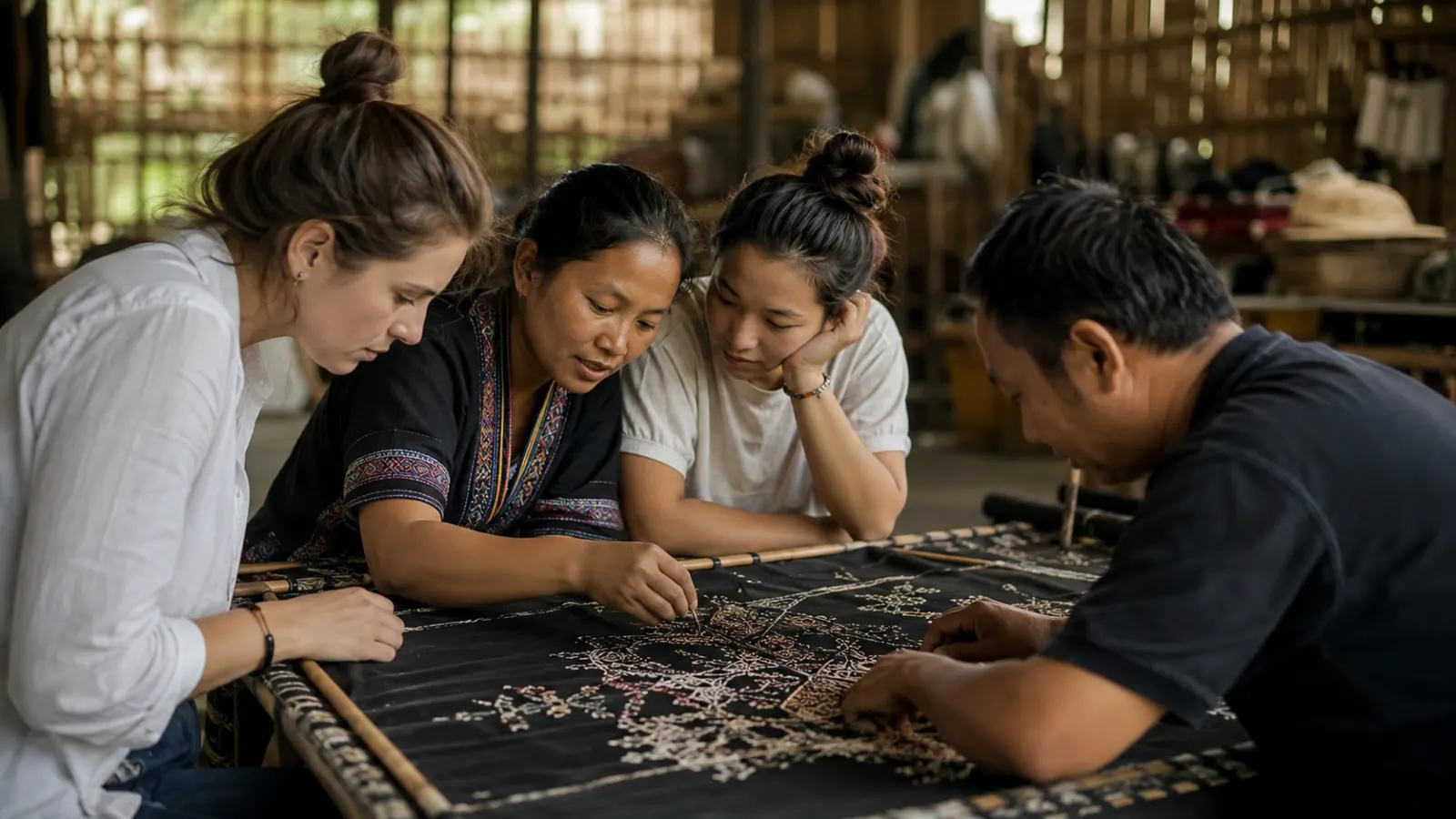
Responsible exchange does not require cultural isolation. It usually requires more knowledge and reciprocity.
Artists can collaborate directly with practitioners. Designers can commission work rather than copying traditional motifs from photographs. Businesses can identify and compensate creators. Museums can research provenance and engage source communities. Students of a cultural practice can learn through recognised teachers and understand the tradition surrounding the technique rather than treating it as an aesthetic resource alone.
These practices do not eliminate disagreement, but they shift cultural borrowing away from extraction and toward relationship.
That difference is central.
Frequently Asked Questions
What is cultural appropriation? Cultural appropriation generally refers to using cultural elements from another community in circumstances considered exploitative, disrespectful, stereotypical, decontextualised or unfairly beneficial to outsiders.
Is all cultural borrowing cultural appropriation? No. Cultural exchange is a normal part of human history. The ethical concern becomes stronger when unequal power combines with erasure, restricted use, stereotyping or one-sided benefit.
What is the difference between cultural appreciation and appropriation? Appreciation usually involves learning, context, respect, recognition and sometimes collaboration, while appropriation is more likely to involve extraction, distortion, erasure or disregard for community rules.
Why does power matter? The same cultural expression can be treated differently depending on who uses it. Members of a marginalised community may face discrimination for something that outsiders later receive praise or profit for adopting.
Does giving credit solve cultural appropriation? Credit helps prevent erasure but may not resolve problems involving sacred material, lack of permission, stereotyping or unequal commercial benefit.
Can someone culturally appropriate something without making money? Yes. Misrepresentation, mockery and misuse of sacred or restricted cultural expressions can cause harm even without financial profit.
Is cultural appropriation illegal? Not automatically. The concept is broader than one legal category. Copyright, trademark and other laws may apply to particular cases, while other disputes remain primarily ethical or cultural.
Can traditional cultural expressions be copyrighted? Some may receive protection under existing intellectual-property systems, but collectively created and intergenerational traditions often fit those systems poorly, which is one reason WIPO has developed extensive work in this area.
Can outsiders wear another culture’s clothing? There is no universal rule. Everyday public clothing is different from sacred, ceremonial or restricted dress. Context and the source community’s norms matter.
Is cooking another culture’s food cultural appropriation? Usually cultural borrowing in cuisine is part of normal exchange. Problems are more likely to involve erasure, stereotyping or falsely presenting established dishes as an outsider’s invention.
Can music be culturally appropriated? Yes, particularly when originators are erased or excluded while outsiders receive disproportionate recognition or commercial benefit. But cross-cultural musical influence itself is not automatically appropriation.
Why is fashion frequently criticised for appropriation? Fashion often uses traditional motifs, jewellery, hairstyles and ceremonial dress as visual material, sometimes without understanding customary restrictions or involving source communities.
Can a culture give permission? Sometimes recognised community authorities or practitioners can provide meaningful consent, but cultures rarely have one person entitled to approve every use.
Does good intention prevent appropriation? No. Intent matters, but a respectful intention can still produce harmful or disrespectful results if context is ignored.
Can accusations of cultural appropriation be wrong? Yes. Disagreement or offence should prompt investigation, but strong conclusions should consider history, power, restrictions, representation, community views and benefit.
What are traditional cultural expressions? WIPO uses the term for forms through which traditional culture is expressed, including designs, music, dance, art, symbols and ceremonies linked to community identity and heritage.
What does UNDRIP say about Indigenous culture? The UN Declaration on the Rights of Indigenous Peoples recognises Indigenous peoples’ rights to maintain, control, protect and develop cultural heritage, traditional knowledge and traditional cultural expressions.
Can something be legally permitted but culturally inappropriate? Yes. State intellectual-property law and customary community rules do not always recognise the same rights.
Does opposition to appropriation mean cultures should remain separate? No. Respectful cultural exchange can produce creativity, learning and hybrid forms. The issue is how exchange occurs rather than whether cultural contact should exist.
The Wrong Question Is Usually “Who Owns Culture?”
Culture rarely behaves like ordinary private property. Languages, recipes, music, clothing and stories develop through generations of contribution and exchange. Trying to assign complete ownership of every cultural element to one group can therefore produce absurd results.
But the opposite conclusion—that because culture changes, anybody can use anything in any context without responsibility—is equally inadequate.
Some cultural expressions are sacred. Some are restricted. Some are connected to communities that have historically lost control over land, heritage or representation. Some become commercially valuable only after outsiders adopt them.
The more useful question is not simply who owns a cultural form.
It is what relationships and responsibilities accompany its use.
The Central Idea
Cultural appropriation is best understood as a problem of relationship, power and fairness rather than cultural contact itself. Human cultures have always exchanged ideas, foods, music, clothing and language, and cultural diversity often grows through precisely that interaction.
Borrowing becomes ethically troubling when additional factors enter the relationship: sacred or restricted material is used without regard for community rules, the original culture is stereotyped or erased, outsiders gain recognition denied to source-community practitioners, or commercial rewards flow overwhelmingly away from the people who created and preserved the expression.
That framework also explains why simple rules fail. Credit can help but may not be enough. Consent matters but communities rarely speak with one voice. Legal permission does not always equal cultural permission. Good intentions can coexist with harmful consequences, while offence alone does not automatically prove exploitation.
Responsible cultural exchange therefore requires context.
Learn what an expression means before using it. Understand whether it is public or restricted. Acknowledge where it came from. In commercial settings, consider partnership and benefit-sharing rather than extraction. Listen to source-community voices without pretending one individual represents an entire culture.
Culture does not remain alive by being sealed behind boundaries.
It remains alive by being practiced, shared, adapted and transmitted.
The challenge is not to stop cultural exchange.
It is to make that exchange more informed, reciprocal and fair.