Trust has a price in finance
Finance runs on promises. A company promises to repay a bond. A bank promises to honour deposits. A government promises to service its debt. A borrower promises that future cash flows will be strong enough to meet today’s obligation. The problem is that promises are not equal. Some borrowers have stable income, low debt and strong governance. Others survive on hope, refinancing and aggressive accounting. Credit rating agencies exist because markets need a language to separate those promises.
A credit rating agency is an institution that assesses the creditworthiness of a borrower or a financial instrument. In simple terms, it gives an opinion on the likelihood that a debt obligation will be repaid on time and in full. The rating may apply to a company, a bank, a government, a municipal body, a structured finance product or a specific bond issue. A higher rating suggests lower perceived credit risk. A lower rating suggests higher perceived risk.
This sounds straightforward, but credit ratings sit at the centre of a very large financial ecosystem. They influence interest rates, investor eligibility, regulatory capital, bond market liquidity and public confidence. A single downgrade can raise borrowing costs. A rating watch can make investors nervous. An investment-grade rating can open access to long-term capital, while a speculative-grade rating can push a borrower toward expensive financing.
What exactly does a credit rating measure?
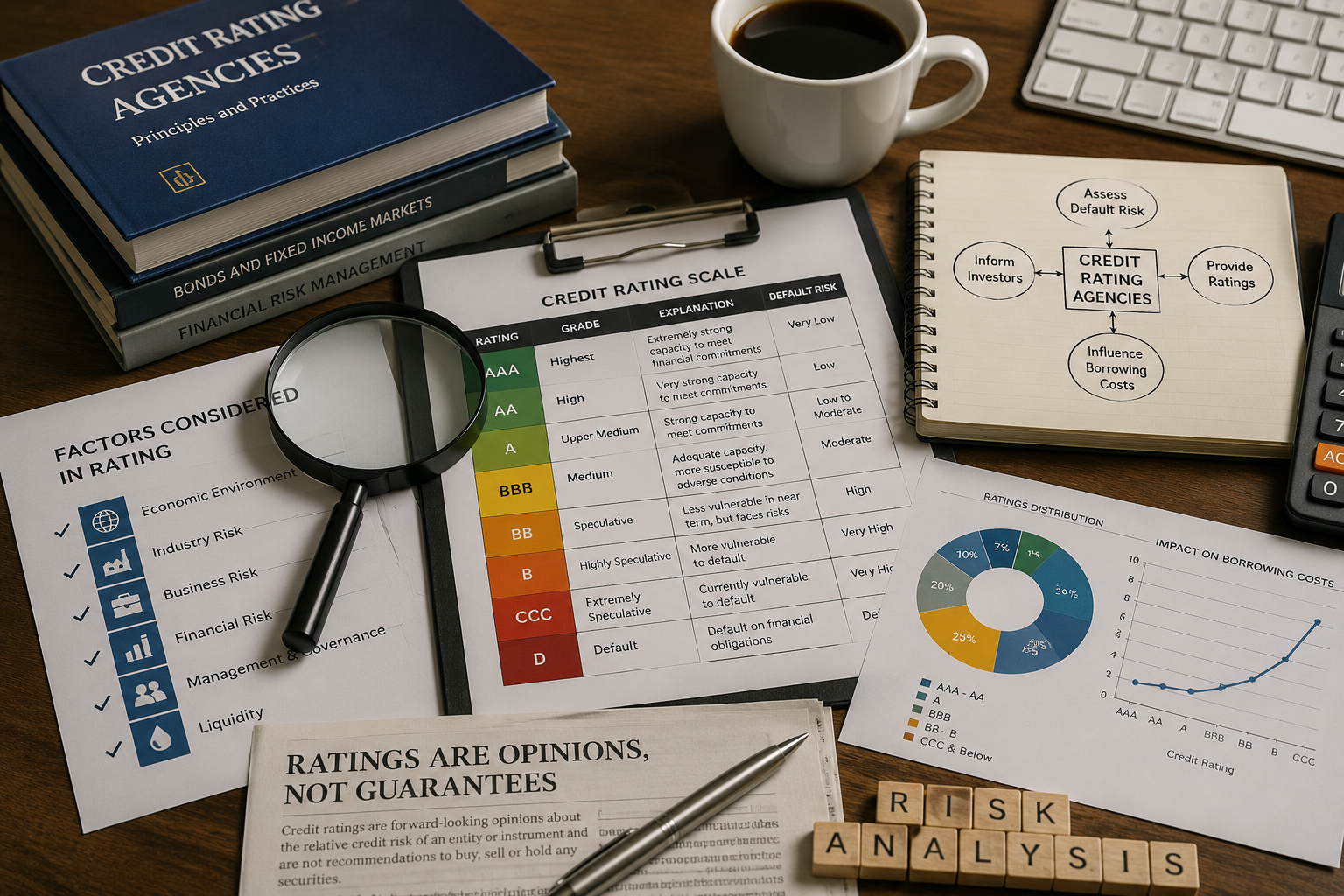
A credit rating is not a guarantee. It is not a buy recommendation. It is not a promise that a borrower will never default. It is an informed opinion about credit risk based on available information, financial analysis, sector conditions, management quality, cash-flow visibility, leverage, liquidity and external risks. The key question is not whether a business is popular or its stock price is rising. The question is whether it can meet its debt obligations.
For a corporate bond, rating analysts study revenue stability, profitability, debt levels, interest coverage, maturity schedule, cash reserves, business model resilience, promoter support, industry cycles and legal structure. For a bank, they look at asset quality, capital adequacy, liquidity profile, deposit base, regulatory oversight and exposure to stressed borrowers. For a structured product, they examine the underlying cash flows and the legal waterfall through which payments move to investors.
Ratings are usually expressed through letter grades. The exact scale varies by agency, but the broad idea is similar. The highest ratings indicate very strong repayment capacity. Middle ratings indicate moderate risk. Low ratings signal vulnerability. Default-level ratings indicate that repayment has failed or is expected to fail. Investors often divide ratings into investment grade and non-investment grade. Investment grade instruments are generally seen as more suitable for conservative institutional investors; non-investment grade instruments usually offer higher yields because they carry higher risk.
Why ratings matter to borrowers
For borrowers, a rating can determine the price of money. A company with a strong rating can borrow at a lower interest rate because investors demand less compensation for risk. A company with a weak rating must usually pay a higher yield to attract lenders. This is why ratings affect more than reputation. They affect profitability. If a company’s cost of borrowing rises sharply, its interest expense grows, its expansion plans slow and its financial flexibility shrinks.
Ratings also affect market access. Many institutional investors, such as pension funds, insurance companies and mutual funds, have mandates that restrict them from buying securities below a certain rating level. If a bond is downgraded below investment grade, some funds may be forced to sell it. This forced selling can reduce liquidity and create additional pressure on the issuer. In this way, ratings do not merely describe credit conditions; they can shape market behaviour.
Why ratings matter to investors
For investors, ratings are a shortcut, but they should never be the whole map. A rating helps investors compare credit risk across instruments, sectors and maturities. It gives a starting point for due diligence. A retail investor looking at a debt fund, corporate bond or non-convertible debenture can use ratings to understand whether the instrument is positioned as relatively safer or riskier. But ratings do not replace independent judgement.
The danger is blind reliance. Investors often remember the rating and forget the assumptions behind it. A high rating can deteriorate quickly if business conditions change, governance weakens, leverage increases or cash flows collapse. Rating agencies review ratings periodically, but markets can move faster than formal rating actions. A bond may trade at stressed yields before a downgrade is announced. Serious investors therefore combine ratings with financial statements, cash-flow analysis, sector knowledge and liquidity assessment.
The issuer-pays conflict
The most debated issue in the credit rating industry is the issuer-pays model. In many markets, the borrower or issuer pays the agency to rate its instrument. This creates an obvious conflict: the agency is supposed to serve investors with an independent opinion, but the fee comes from the entity being rated. Critics argue that this can create pressure to provide favourable ratings, especially when agencies compete for business.
Regulation tries to manage this conflict through disclosure, rotation norms, code of conduct requirements, surveillance, separation of rating and non-rating business, and penalties for misconduct. But the conflict cannot be ignored. A rating is valuable only when the market believes the agency is independent, rigorous and willing to downgrade when facts demand it. Credibility is the rating agency’s real asset. Once investors believe ratings are compromised, the letters lose meaning.
The India angle
In India, credit rating agencies became especially important as the corporate bond market expanded and investors looked beyond bank deposits and government securities. Ratings are central to non-convertible debentures, commercial papers, securitised products, debt mutual funds and bank loan assessments. They help lenders and investors evaluate risk across a market where information asymmetry can be severe.
India’s financial system has also learned difficult lessons from rating failures. When highly rated instruments later faced stress, investors realised that ratings could lag reality. The collapse or stress of large financial groups exposed how liquidity risk, promoter quality, asset-liability mismatch and governance issues could remain underappreciated until pressure became visible. This does not make ratings useless. It shows why ratings must be treated as one input, not as outsourced thinking.
How to read a rating intelligently
A smart reader should ask five questions. First, what exactly is rated: the company, the instrument or a specific facility? Second, what is the rating outlook: stable, positive, negative or under watch? Third, what are the rating drivers: profitability, leverage, liquidity, group support or sector risk? Fourth, what could trigger an upgrade or downgrade? Fifth, does the market yield agree with the rating, or is the bond trading as if risk is higher?
This final question is crucial. Markets sometimes detect stress before rating agencies act. If a highly rated bond offers an unusually high yield, the investor should not celebrate too quickly. Higher yield is often the market’s way of saying that risk is being repriced. In finance, extra return is rarely free.
Final takeaway
Credit rating agencies are useful because modern finance needs standardised signals of credit risk. They help borrowers access markets, help investors compare instruments and help regulators monitor risk. But ratings are not prophecy. They can be wrong, delayed, conflicted or misunderstood. The intelligent approach is neither blind trust nor cynical rejection. It is disciplined use. Treat ratings as warning lights and road signs, not as a driver. The responsibility for financial judgement ultimately remains with the investor, lender, board, regulator and citizen who understands that trust in finance must always be tested.