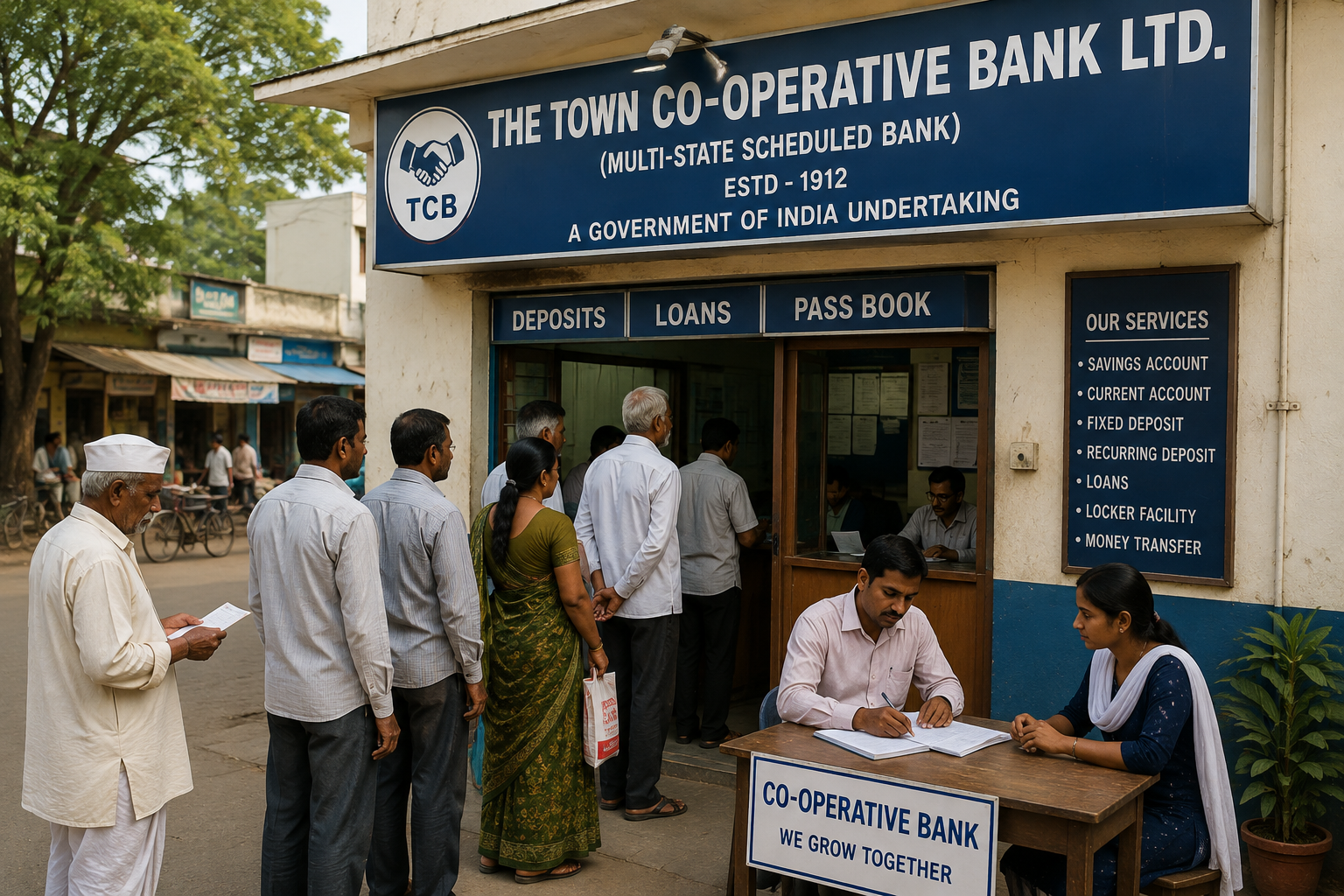
Banking built on membership, not just customers
A cooperative bank looks like an ordinary bank from the outside. It accepts deposits, gives loans, issues passbooks, processes payments and serves people who need a safe place to keep money. But its basic idea is different. A commercial bank is usually owned by shareholders and run to generate profit for those shareholders. A cooperative bank is built around members. The people who use it are often also the people who own it, govern it and benefit from it.
That difference matters. Cooperative banks grew from the idea that finance should not be available only to large traders, wealthy depositors and salaried urban elites. Small farmers, artisans, shopkeepers, self-employed workers, housing societies, local businesses and low-income households also need credit. They may not have the collateral, documentation or scale that large banks prefer. A cooperative bank tries to fill that gap by using local knowledge, member participation and community trust.
In simple terms, a cooperative bank is a financial institution organised on cooperative principles. It pools deposits from members and the public, lends mainly to members or local borrowers, and is expected to operate for mutual benefit rather than pure profit maximisation. It is not charity. It is banking. But it is banking with a social and local purpose.
Why cooperative banks exist
The case for cooperative banking begins with a flaw in conventional finance: large banks often prefer large, standardised and lower-cost customers. A bank branch in a big city can process salaried accounts, corporate loans and digital transactions at scale. But a small borrower in a semi-urban market may need a modest working-capital loan, a farmer may need seasonal credit, and a small trader may need flexibility that does not fit neatly into centralised credit models.
Cooperative banks emerged to serve such needs. Their strength is proximity. They understand the crop cycle, the local market, the reputation of a shopkeeper, the earning pattern of a small transport operator, or the reliability of a housing society. This local knowledge can reduce the distance between the formal financial system and ordinary borrowers.
They also carry a democratic promise. Members can participate in governance through elected boards and institutional rules. In theory, this keeps the institution accountable to the community it serves. A cooperative bank should not behave like an extractive lender. It should recycle local savings into local credit and help economic activity circulate within a community.
Urban and rural cooperative banks
Cooperative banking in India is often discussed through two broad families: urban cooperative banks and rural cooperative credit institutions. Urban cooperative banks usually operate in urban and semi-urban areas. They serve salary earners, small traders, shopkeepers, housing societies, micro and small enterprises, professionals and local depositors. Many began as small community-based institutions and later grew into multi-branch banks.
Rural cooperative credit institutions are more closely linked with agriculture and village-level credit. They include structures that connect primary agricultural credit societies, district cooperative banks and state cooperative banks. Their role has historically been important in farm credit, seasonal lending, input financing and rural savings mobilisation.
The distinction is useful, but the deeper point is the same: cooperative banks exist where local credit needs are too small, too dispersed or too relationship-based for purely centralised banking. Their purpose is not to replace large banks. It is to complement them by reaching social and economic spaces that large finance may treat as uneconomical.
How a cooperative bank works
A cooperative bank collects deposits from members and eligible customers, maintains reserves as required by regulation, lends to borrowers, earns interest income, pays interest on deposits and covers its operating costs. On the surface, the mechanics are familiar. The difference lies in ownership and governance.
Members generally hold shares or membership rights in the cooperative structure. They may vote in elections, approve important decisions and influence the institution through cooperative rules. The bank is expected to operate for member benefit, not only shareholder return. Surplus may be used to strengthen reserves, improve services, pay limited dividends where permitted, or support member interests.
In practice, the quality of governance decides whether this ideal works. A well-run cooperative bank can be deeply useful. A poorly governed one can become vulnerable to political interference, weak lending discipline, connected-party lending, concentration risk and inadequate supervision. The model has promise, but the promise depends on integrity.
Why local trust is both strength and risk
The greatest advantage of cooperative banking is trust. People may know the branch manager, board members or long-time staff. Borrowers may be judged not only by documents but by reputation. A small business may receive credit because the bank understands its real cash flow. For first-generation borrowers, this human layer can be invaluable.
But the same closeness can become dangerous. Local relationships may turn into pressure. Loans may be given because of influence rather than repayment capacity. Boards may be captured by local factions. Staff may hesitate to act against powerful members. A bank that is too close to its borrowers can become weak in credit discipline.
This is the paradox of cooperative finance. It is valuable because it is local, but it becomes fragile if local accountability becomes local capture. The solution is not to destroy the cooperative character. The solution is stronger governance, transparent audits, professional management, effective supervision and clear depositor protection.
Depositor safety and regulation
For ordinary readers, the most important question is simple: is money safe in a cooperative bank? The answer depends on the specific bank, its financial health, governance quality, regulatory status and insurance coverage. Deposits in eligible insured banks are covered by deposit insurance up to the prescribed limit, currently up to Rs 5 lakh per depositor per bank for principal and interest together, according to official DICGC material. But insurance is a backstop, not a substitute for choosing a sound institution.
Regulation of cooperative banks has historically been more complex than regulation of commercial banks because cooperative institutions involve both banking functions and cooperative society structures. Banking supervision, cooperative registration, board governance and state-level elements have sometimes created overlapping control. Over time, regulators have tried to strengthen oversight, particularly for urban cooperative banks that accept public deposits.
A depositor should therefore look beyond the word cooperative. The key questions are: Is the bank regulated and insured? Does it have a history of stable operations? Are its financial statements available? Has the regulator placed any restrictions? Is it offering unusually high deposit rates? Are complaints frequent? Trust is useful, but verification is essential.
Why cooperative banks still matter
In an age of mobile banking, UPI, fintech apps and large private banks, cooperative banks may look old-fashioned. That impression is misleading. They still matter because finance is not only a technology problem. It is also a trust, language, access and relationship problem.
A vegetable trader may prefer a local branch where someone understands his business cycle. A housing society may rely on a cooperative bank for deposits and payments. A small manufacturer may need working capital before formal credit scores capture the business properly. A retired depositor may value a familiar institution. A rural borrower may find cooperative credit more accessible than distant commercial banking.
The future of cooperative banks will depend on whether they can combine community trust with professional standards. They must modernise technology, improve cybersecurity, strengthen capital, reduce political interference, avoid reckless lending and communicate clearly with depositors. The cooperative model cannot survive on nostalgia. It must earn confidence every day.
Final takeaway
Cooperative banks are member-oriented financial institutions designed to serve local communities, small borrowers and groups that may not fit easily into mainstream banking. Their best version is democratic, local, accessible and socially useful. They mobilise savings and recycle them into credit for households, traders, farmers and small enterprises.
Their weakness is also clear. Governance failures can hurt depositors. Local control can become political capture. Weak lending can become bad loans. Limited scale can create operational and technology gaps. That is why regulation, audits, depositor awareness and professional management matter so much.
The correct view is balanced. Cooperative banks are neither automatically unsafe nor automatically noble. They are institutions with a valuable purpose and real risks. When well governed, they make finance more inclusive. When poorly governed, they remind us that trust without discipline can be costly.