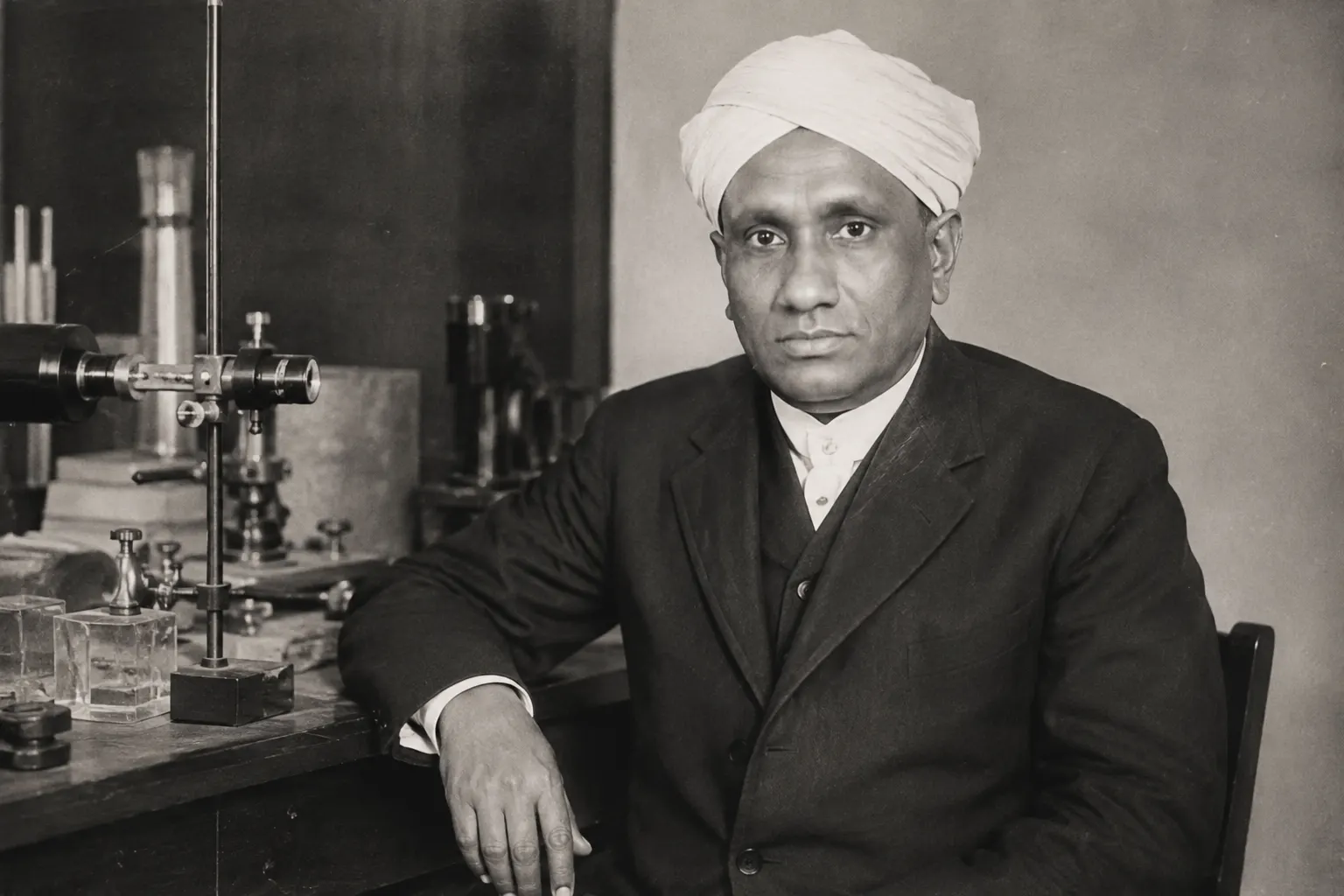
The Scientific Mind of C V Raman
There is a tempting way to tell the story of Chandrasekhara Venkata Raman: an Indian physicist works in colonial conditions, discovers a new phenomenon of light, wins the Nobel Prize, and becomes a symbol of national scientific achievement. Every part of that outline is broadly true. Yet it leaves out what makes Raman scientifically interesting.
Raman was not simply fortunate enough to encounter one great result. He built a career around a persistent habit: looking closely at apparently ordinary physical phenomena and asking questions that other researchers had either settled too quickly or overlooked entirely. Sound, colour, crystals, musical instruments, the appearance of the sea and, most famously, the scattering of light became problems to be attacked experimentally.
The Nobel Foundation records that Raman was born on 7 November 1888 in Tiruchirappalli in southern India and received the 1930 Nobel Prize in Physics for his work on the scattering of light and for the discovery of the effect named after him. His Nobel lecture was devoted to the molecular scattering of light.
But a Nobel citation can tell us only what the scientific establishment eventually recognised. To understand Raman, it is necessary to look at the route by which he reached that point.
A scientist before he had a scientific career
Raman grew up in a family in which education was taken seriously, and he demonstrated unusual academic ability early in life. He studied at Presidency College in Madras and became interested in physics while still very young. His early research appeared before he possessed the institutional position that would normally define a professional scientist.
The more remarkable feature of his early career was that he did not initially enter academia. He joined the colonial government’s finance service. In Calcutta, however, he encountered the Indian Association for the Cultivation of Science, or IACS, an institution founded to promote scientific work in India. He used its laboratory facilities outside his official working hours, pursuing experimental physics while maintaining a government career.
This double life matters because later retellings sometimes make Raman’s success appear almost miraculous: genius flourishing without infrastructure. The reality was more instructive. He had access to an existing Indian scientific institution, formed intellectual relationships, worked with students and collaborators and gradually developed a research programme. His achievement was therefore individual, but it was not institutionless.
The scientific world emerging in Calcutta in the early twentieth century eventually produced several major advances. Raman, Meghnad Saha and Satyendra Nath Bose belonged to a generation of Indian physicists whose work on matter, radiation and modern physics gained international importance.
Raman's instinct for observable phenomena
One of Raman’s defining strengths was his attraction to phenomena that could be directly observed and experimentally interrogated.
His research interests ranged far beyond the effect that now carries his name. Historical surveys identify investigations of optics, diffraction, the behaviour of crystals, acoustics, colours in nature, mineral optics and visual perception. This breadth was not accidental. Raman repeatedly began from physical experience and worked toward experimental explanation.
His work on musical acoustics, for example, reflected an interest in how complex instruments generated characteristic sounds. This was part of a larger concern with waves—mechanical and electromagnetic—and the interactions that produce observable patterns.
That orientation helps explain why scattering became such an important subject for him.
When light passes through a material, most photons that are scattered emerge with the same energy they had before the interaction. This is elastic scattering. But a very small fraction can exchange energy with molecular vibrations or rotations. The scattered light then emerges with a slightly different frequency.
That change is the essence of what became known as Raman scattering.
The 1928 discovery
The decisive experiments were performed in Calcutta in 1928.
Raman and his research associates had been investigating the behaviour of light in transparent substances. Among the most important collaborators was physicist K. S. Krishnan. Historical accounts of the discovery emphasise that Krishnan played a substantial experimental role in the work that produced the new scattering observations.
This qualification is important.
The phenomenon is rightly called the Raman effect, and the Nobel Prize was awarded to Raman alone. But responsible history should not turn scientific collaboration into a solitary-genius story.
Raman announced evidence of what he called a “new radiation.” A paper bearing that title became part of the scientific record describing the effect.
The physical meaning was profound. When monochromatic light interacts with a molecule, most scattered light retains the original frequency. A tiny fraction does not. The difference in frequency contains information about the internal energetic structure of the material.
In practical terms, matter leaves a spectroscopic signature.
That idea eventually became the foundation of Raman spectroscopy.
Why the effect mattered
The Raman effect gave researchers a new way to investigate molecular structure.
Different molecular bonds and vibrational modes produce characteristic patterns. By measuring frequency shifts in scattered light, scientists can identify chemical compounds and study molecular structures without necessarily destroying the sample.
Modern Raman spectroscopy is used across chemistry, materials science, pharmaceuticals, geology, forensic work, biological research and industrial quality control.
The scientific importance of the discovery was recognised rapidly. The Royal Swedish Academy awarded Raman the Nobel Prize in Physics in 1930, only two years after the experimental breakthrough, citing both his work on light scattering and the discovery of the effect bearing his name.
The speed of that recognition says something about the result. It was not merely a local curiosity. It offered experimental evidence relevant to the emerging quantum understanding of interactions between radiation and matter.
From researcher to scientific institution-builder
Raman’s later career also became intertwined with the development of Indian scientific institutions.
He became associated with the Indian Institute of Science in Bangalore and served as its director from 1933 to 1937. IISc records him as its first Indian director and notes the growth of physics research during his tenure.
He also founded the Indian Academy of Sciences in 1934. The Academy continues to identify Raman as its founder and highlights his work on inelastic light scattering as his best-known scientific contribution.
Institution-building mattered deeply in a country where professional research opportunities were limited. Laboratories, academies and journals create the environment in which scientific communities can outlive individual researchers.
Raman therefore belonged to a generation whose task was not simply to perform research but also to construct the institutions within which future research could occur.
Raman and the culture of experimental science
Raman’s scientific personality was strongly experimental.
Accounts by colleagues and later historians repeatedly describe his preference for physical demonstration, direct measurement and elegant laboratory arrangements. His work was often characterised by relatively modest equipment used with unusual ingenuity.
That feature has become part of the mythology around Raman, sometimes exaggerated into the claim that great science requires little more than genius and inexpensive apparatus.
That would be the wrong lesson.
Raman’s achievement shows the power of experimental imagination, but scientific research also depends on instruments, trained collaborators, institutional continuity and access to accumulated knowledge. Modern spectroscopy laboratories owe as much to advances in lasers, detectors, optical components and computation as they do to the original discovery.
The more useful lesson is that sophisticated questions do not always require spectacular beginnings.
The problem with the lone-genius narrative
The traditional biography of Raman tends to centre almost completely on Raman himself.
Scientific history has increasingly questioned such narratives.
K. S. Krishnan's role is the clearest example. He was deeply involved in experiments during the discovery period and later became a distinguished physicist in his own right. He went on to conduct major research into the magnetic properties of crystals and became an important figure in Indian science.
Recognising Krishnan does not diminish Raman.
It improves our understanding of Raman.
Scientific discovery usually emerges from laboratories rather than from isolated minds. Research leaders shape questions, interpret results and direct programmes, but experimental collaborators, students, technicians and institutional colleagues contribute to the process through which evidence is produced.
Raman’s laboratory should therefore be remembered as a scientific community as well as an extension of one personality.
A more difficult part of Raman's legacy
A serious biography also has to resist turning achievement into moral perfection.
One episode from Raman’s tenure at IISc concerns Kamala Sohonie, who later became a notable biochemist. IISc’s own historical accounts state that Raman initially resisted admitting her as a research student because she was a woman. She gained entry only after persistence and under restrictive conditions.
The episode complicates the celebratory image of Raman as a purely progressive representative of modern science.
It also illustrates a broader point: scientific modernity does not automatically eliminate social prejudice.
A scientist may be revolutionary in one domain and conservative in another.
Including this history is not an attempt to judge Raman solely by one incident. It is an attempt to avoid the equally misleading practice of sanitising famous lives.
Science after the Nobel Prize
Raman continued researching long after 1930.
His interests extended into crystal physics, optics and the behaviour of materials. He remained deeply engaged in experimentation and science communication. Historical work on his later career shows that his investigations covered a remarkably wide spectrum rather than narrowing permanently around the Nobel-winning discovery.
This is another reason why defining him only as “the discoverer of the Raman effect” is inadequate.
The discovery was the peak of his international recognition, but the scientific mind behind it was characterised by something broader: curiosity about physical phenomena that could be seen, heard, measured and explained.
What Raman changed
Raman’s most direct scientific legacy is obvious whenever a Raman spectrometer is used.
Yet his historical importance in India is larger.
He demonstrated that researchers working in India could participate at the frontiers of modern experimental physics during the colonial period. He trained researchers, helped build scientific organisations and became one of the earliest Indian scientists to achieve global public recognition.
The 1930 Nobel Prize amplified that significance. Nobel recognition is not a complete measure of scientific worth, but in Raman’s case it carried enormous symbolic power because it showed that internationally consequential experimental science was being conducted in India.
The danger is that symbolism can eventually obscure the science itself.
Raman deserves to be remembered not because a prestigious committee gave him a medal, but because his experiments revealed a measurable interaction between light and matter that became an enduring analytical tool.
Why C V Raman still matters
More than a century after Raman began working in Calcutta laboratories, Raman spectroscopy has become far more technologically advanced than the equipment available to him.
Lasers provide controlled excitation. Sensitive detectors measure weak signals. Computer algorithms analyse spectra. Microscopes can map the chemical composition of materials at fine spatial scales.
The instruments changed.
The underlying experimental question did not.
What happens to light when it meets matter?
Raman’s achievement was to extract information from a minute change that could easily have been dismissed as experimental noise.
That habit—taking a small anomaly seriously enough to measure it—is one of the defining habits of science.
His career also offers a broader historical lesson. Scientific progress is produced by talent, certainly, but also by institutions, collaborators, opportunities and arguments. Raman was a powerful personality whose work deserves its global reputation, but he belonged to a wider scientific culture emerging in colonial India.
Remembering that context makes his accomplishment larger, not smaller.
It turns the story from that of a solitary genius into something more useful: the story of how a research community, an experimental tradition and one unusually persistent physicist changed the way scientists read light.