Industrial history is often written around factories.
We remember the mill owner, the steel magnate, the engineer, the railway and the port. Finance appears only when a company runs short of money.
That is a mistake.
Industrialisation requires more than machines. It requires institutions capable of collecting savings, moving money across regions, financing inventories, discounting commercial paper, extending credit and surviving the gap between investment today and revenue tomorrow.
In colonial India, this financial infrastructure was deeply shaped by imperial priorities. Presidency banks, exchange banks, European agency houses and merchant networks served important commercial functions, but access to capital was not evenly distributed and control of finance carried political as well as economic significance.
By the late nineteenth and early twentieth centuries, Indian entrepreneurs and public figures increasingly began creating banks under Indian ownership and management.
This article uses four institutions as representative cases: Punjab National Bank, Bank of Baroda, Indian Bank and Central Bank of India.
They were founded between 1894 and 1911 in different regions and under different circumstances. They did not finance “industry” in exactly the same way, and they were not the only important Indian banks. But together they illustrate a larger transformation: Indians were no longer content merely to seek credit from financial institutions built by others. They increasingly wanted to build the institutions themselves.
What “banker-builder” means here
The phrase needs definition.
A banker-builder in this article is not simply a wealthy financier. It refers to founders and institution-builders who helped create Indian-led commercial banks capable of mobilising domestic capital and extending organised banking beyond the structures inherited from colonial finance.
This is a deliberately narrow definition.
It excludes older indigenous banking systems not because they were unimportant, but because hundis, shroffs, chettiars and merchant-bankers deserve their own history.
It also excludes later development-finance institutions created after independence.
The focus is the transition toward modern joint-stock commercial banking under Indian leadership during the late colonial period.
The financial landscape before the Swadeshi banks
Modern banking did not begin with these institutions.
The Presidency Banks of Bengal, Bombay and Madras had been operating in the nineteenth century. Exchange banks connected India to imperial trade and foreign-currency markets. Indigenous bankers financed commerce through long-established networks.
But modern joint-stock banking under Indian ownership remained limited.
The failures of several banks during nineteenth-century financial crises also demonstrated the risks of weak governance, speculative lending and unstable capital structures.
Banking required public trust. That made institution-building more difficult than opening a trading firm.
A merchant could survive on reputation within a network. A bank had to persuade thousands of depositors that money would remain safe even during panic.
Punjab National Bank: banking as economic nationalism
Punjab National Bank was incorporated in 1894 and opened for business in Lahore on 12 April 1895.
Its own institutional history describes it explicitly as a national or Swadeshi project. The founders and early supporters included figures such as Dyal Singh Majithia, Lala Harkishan Lal and Lala Lajpat Rai, along with other businessmen and public figures.
The bank’s symbolism mattered.
Economic nationalism in the late nineteenth century was not yet the mass boycott movement that would emerge after 1905. But the argument was already developing: political self-respect required economic institutions controlled by Indians.
A bank could turn that idea into infrastructure.
Deposits collected from Indian customers could be intermediated through an Indian-managed institution. Businessmen could gain access to organised credit. The bank itself could become a training ground for Indian managers and professionals.
Punjab National Bank’s official history emphasises that it was managed with Indian capital and Indian leadership.
That claim should not be stretched into the idea that it financed an entire national industrial revolution by itself.
Its deeper significance was institutional precedent.
Lala Lajpat Rai and the overlap between politics and finance
Lala Lajpat Rai is remembered primarily as a nationalist leader, not a banker.
His connection with Punjab National Bank illustrates how closely economic and political institution-building overlapped.
For nationalist-minded elites, finance was not a technical sector separate from public life. Dependence on foreign-controlled economic institutions could be understood as part of political dependence.
Yet the practical work of banking was far less romantic than nationalist rhetoric.
A successful bank required cautious lending, accounting systems, branch administration, reserves and the ability to withstand crises.
This tension between patriotic purpose and commercial discipline became a recurring challenge for Swadeshi enterprises.
A bank that failed could damage the very cause it claimed to serve.
Bank of Baroda: princely-state sponsorship
Bank of Baroda offers a different model.
It was founded on 20 July 1908 by Maharaja Sayajirao Gaekwad III of Baroda.
The institution emerged not from a nationalist association in a major British-Indian presidency city but from the reformist ambitions of a princely ruler.
Sayajirao is remembered for investments in education, administration and public institutions within Baroda State. Creating a bank fitted this broader state-building orientation.
The case complicates simple narratives of colonial versus nationalist finance.
India’s financial modernisation involved multiple political spaces: British provinces, princely states, merchant communities and emerging national organisations.
A ruler such as Sayajirao could use princely autonomy to create institutions that strengthened regional economic capacity while participating in an increasingly integrated Indian market.
Indian Bank: southern commercial networks and Swadeshi energy
Indian Bank was incorporated on 5 March 1907 and commenced business on 15 August 1907.
Its official history places its origin in the Swadeshi environment of the period.
The Madras Presidency possessed major merchant and banking communities, including powerful indigenous financial networks. The creation of a modern commercial bank in this setting represented not the arrival of finance where none had existed, but the adaptation of financial organisation to the joint-stock institutional form.
This distinction matters.
Indian banking history should not be written as a story in which colonial modernity replaces “traditional” financial emptiness.
India already had sophisticated systems of credit and remittance.
The change lay in corporate form, regulation, balance-sheet structure, branch networks and the growing importance of institutions that resembled modern commercial banks.
Indian Bank’s establishment was one piece of that transition.
Central Bank of India: the case of Sorabji Pochkhanawala
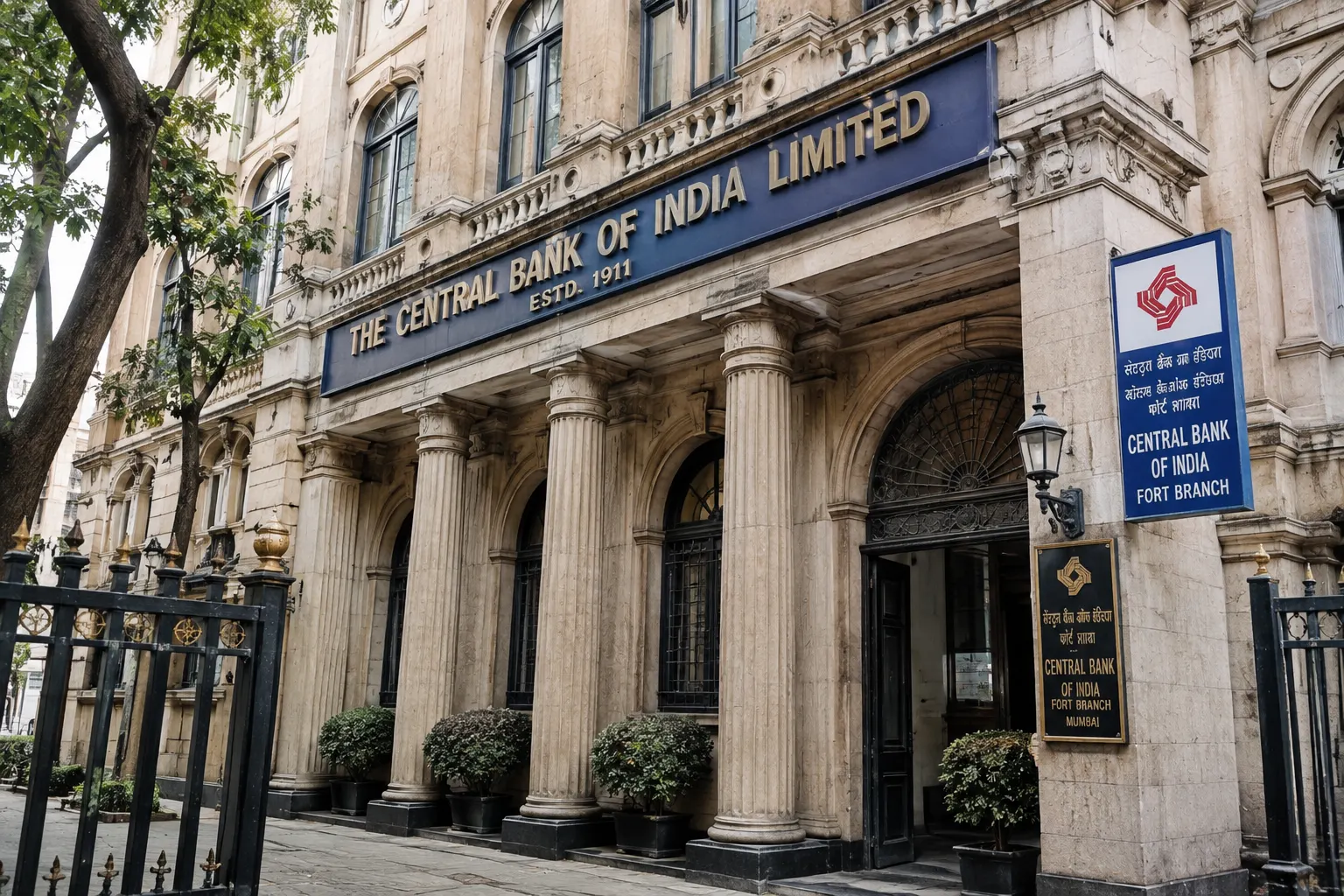
Central Bank of India was established in 1911.
Its official institutional profile describes it as the first Indian commercial bank wholly owned and managed by Indians and credits Sir Sorabji Pochkhanawala as its founder, with Pherozeshah Mehta as its first chairman.
Whether a bank is “first” depends on the precise definition being used, which is why such claims need care. Punjab National Bank had already been established under Indian capital and management. Central Bank’s claim rests on its own institutional formulation of complete Indian ownership and management.
The important point is broader.
By 1911, Indian banking ambitions had moved beyond one region or one political tendency.
Bombay—already the country’s leading commercial centre—was producing bankers who wanted institutions capable of competing in a financial environment dominated by older presidency and exchange-bank networks.
Pochkhanawala represented a new professional identity: the Indian career banker as institution-founder.
Pherozeshah Mehta and civic capitalism
Pherozeshah Mehta’s association with Central Bank highlights another recurring feature of early Indian institution-building.
The same public figures could appear across politics, municipal reform, education, commerce and finance.
Specialisation was less rigid than it is today because the modern institutional ecosystem itself was still being built.
A lawyer might help found a political association, guide a bank, support an educational institution and participate in municipal government.
This cross-institutional elite network was powerful.
It was also limited.
The leadership of early Indian banks came disproportionately from educated and propertied groups. Their institutions expanded Indian control over finance without automatically democratising access to credit for peasants, workers or the poorest communities.
The history is therefore one of national economic agency, not universal financial inclusion.
Banks and industrialisation: a relationship that should not be exaggerated
It is tempting to say that these banks “financed Indian industrialisation.”
The relationship was more complicated.
Large industrial projects often required capital beyond what ordinary commercial banks were prepared to lend long term. Industrial houses relied on merchant capital, managing agencies, equity markets, family networks and, later, specialised development-finance institutions.
Commercial banks were primarily designed around deposits, trade finance, short-term lending and working capital.
Their contribution to industrial development was therefore often indirect but essential.
A textile merchant needed payments settled.
An importer of machinery needed credit.
A distributor needed working capital.
A growing company needed accounts, remittance and short-term finance.
Employees and households needed places to deposit savings.
Banks connected these flows.
Industrial capitalism cannot function efficiently without such intermediation.
Trust as infrastructure
The key product of a bank is not money.
It is trust.
A bank accepts funds because depositors believe they can retrieve them later. It lends because borrowers promise repayment in the future. Its balance sheet is therefore built on expectations about behaviour over time.
This made the early Indian-owned bank a particularly important institution of economic self-confidence.
An Indian depositor had to believe that an Indian-managed joint-stock bank could be as reliable as established European institutions.
An Indian businessman had to believe that organised banking could serve commerce without dependence on personal moneylending networks alone.
Managers had to demonstrate professional competence strong enough to survive scepticism and crisis.
Institution-building was therefore reputational before it became scalable.
The danger of bank failure
The early twentieth century also saw numerous bank failures in India.
Not every institution created in the Swadeshi spirit survived.
Rapid proliferation could produce weak capitalisation, poor governance, connected lending and speculative exposure.
This is a crucial corrective to celebratory histories.
National ownership does not eliminate financial risk.
A badly managed Indian bank could fail as disastrously as a badly managed foreign one.
The institutions that survived did so because patriotic symbolism eventually had to be matched by banking discipline.
This is one reason their longevity matters.
Regional diversity in Indian banking
The four banks in this article also demonstrate that Indian banking did not have a single geographic centre.
Punjab National Bank emerged from Lahore and the politics of northern Indian economic nationalism.
Bank of Baroda reflected the state-building agenda of a western Indian princely ruler.
Indian Bank grew from the commercial and Swadeshi environment of Madras.
Central Bank of India arose in Bombay’s sophisticated financial world.
Different regional political economies produced different institutional routes toward the same broad objective: expanding Indian control over modern finance.
From Swadeshi banking to nationalisation
Many of these banks later entered a very different political era.
After independence, the Indian state increasingly treated banking as a developmental instrument.
The Reserve Bank of India, established in 1935 and nationalised in 1949, became central to monetary and banking policy. In 1969, the Government of India nationalised 14 major commercial banks, including several institutions with roots in the earlier Indian-owned banking movement.
The logic had shifted.
The Swadeshi bank sought Indian ownership in a colonial economy.
The nationalised bank was expected to serve state-led development, branch expansion and broader social priorities in an independent republic.
These were not the same project, but the earlier institutions helped create the organisational base on which later policy operated.
What the banker-builders actually built
The most durable contribution of these founders was not simply a pool of capital.
They built organisations that could outlive individuals.
A bank creates managerial routines.
It trains clerks and officers.
It standardises documentation.
It creates branch systems.
It records credit histories.
It develops relationships with businesses and households.
It produces a professional class of bankers.
That is institutional capital.
In a country attempting to industrialise, institutional capital can matter as much as financial capital.
The limits of the early model
The achievements of early Indian-owned commercial banks should not be confused with universal access.
Rural India remained severely underserved.
Agricultural credit often continued through moneylenders and cooperative structures.
Women had limited independent access to financial institutions.
Caste, class and region shaped who could borrow and on what terms.
Industrial finance remained constrained.
Banking crises periodically destroyed savings and confidence.
The early banks were building blocks, not a completed system.
Why these banker-builders still matter
Modern India now possesses public-sector banks, private banks, small-finance banks, payment systems, securities markets, development institutions and one of the world’s largest digital-payments infrastructures.
That scale can make the early joint-stock banks look small.
Historically, however, their importance lies precisely in being early.
They demonstrated that Indians could mobilise capital, manage modern banking institutions and use finance as part of a broader project of economic capability.
Punjab National Bank expressed the language of economic nationalism.
Bank of Baroda showed how a princely state could sponsor modern finance.
Indian Bank reflected the institutional energy of the Swadeshi era in southern India.
Central Bank of India represented professional Indian banking ambition in Bombay.
Together, these cases show why the history of industry cannot be told only through factories.
Behind every industrial machine is a network of payments, savings and credit.
The banker-builders helped make that network increasingly Indian.