Bhoodan Movement: Land Reform Through Voluntary Giving
The Bhoodan movement began in 1951 with an extraordinary proposition: could India's unequal distribution of agricultural land be challenged without either compulsory state acquisition or revolutionary seizure? Vinoba Bhave's answer was to walk from village to village and ask landowners to give part of their holdings voluntarily to families who had no land.
The method appeared simple. A landowner would pledge land, Bhoodan workers would record the donation and the land would eventually be transferred to an eligible landless household. But beneath that simple transaction lay one of the most difficult questions in rural politics. Land is not merely acreage. It is title, water, soil quality, credit, livelihood, bargaining power, inheritance and social status. A promise made publicly in a village meeting therefore had to pass through law, land records and local power before it became an economically meaningful right.
That gap between moral promise and effective possession is the key to understanding Bhoodan.
The movement achieved something remarkable. According to the official Vinoba archive, roughly 4.8 million acres were received through Bhoodan and around 2.5 million acres were distributed. Even allowing for differences between pledges, accepted donations and land actually transferred, the scale of voluntary mobilisation was extraordinary.
Yet Bhoodan did not solve India's land question. Some donated land was poor, disputed or difficult to transfer. Beneficiaries could receive legal title without irrigation, credit or enough resources to cultivate effectively. Administrative backlogs could separate a dramatic public pledge from actual possession by years.
Bhoodan was therefore neither the peaceful solution to land inequality imagined by its strongest admirers nor an empty symbolic exercise.
It was a vast democratic experiment testing how far moral persuasion could carry redistribution before law and administration had to complete the journey.
Why Land Became One of Independent India's Hardest Questions
India inherited an agrarian order marked by deep inequality. Zamindari and other intermediary systems were being dismantled in many regions after independence, but abolishing one institutional layer did not automatically produce equal access to land. Tenants could remain insecure, land records were often incomplete and powerful rural groups were capable of influencing local administration.
Governments pursued several kinds of land reform, including abolition of intermediaries, tenancy protection and later ceilings on the size of holdings. Implementation varied sharply between states. Litigation, exemptions, political resistance and weak administrative capacity could slow or dilute reform.
Bhoodan entered this environment rather than replacing a vacuum.
Its promise was that voluntary consent might achieve transfers that legislation struggled to produce. Instead of treating landowners as enemies, Vinoba asked them to recognise landlessness as an injustice and voluntarily surrender part of their holdings.
The movement began in a region where the stakes were especially high.
Vinoba was walking through Telangana, which had recently experienced intense agrarian conflict and communist-led mobilisation, when landless Dalit families at Pochampalli on 18 April 1951 raised their need for land. A local landowner offered 100 acres.
Vinoba interpreted the event as proof of a broader possibility.
If one owner could respond voluntarily to a public claim made by landless families, perhaps thousands could.
The location matters. Bhoodan was not born from a theoretical seminar about philanthropy. It emerged in a region where landlordism, peasant mobilisation and armed conflict had made property relations politically explosive.
Vinoba's intervention offered a distinctly Gandhian proposition: redistribution without class war.
The movement was therefore more radical than the English phrase “Land Gift Movement” can suggest. Vinoba did not present the landless merely as objects of charity. His argument questioned whether legal ownership exhausted the moral meaning of land. Property, in this view, carried obligations toward society.
The word yajna, meaning sacrifice, reflected this idea. Bhoodan Yajna asked owners to recognise that possession should be limited by social responsibility.
That argument was closely related to Gandhian trusteeship. A person might possess legal title, but wealth and property carried responsibilities beyond private consumption.
The difficulty was equally obvious.
A right normally exists even when somebody else refuses to be generous.
A voluntary gift depends precisely on the donor's consent.
Bhoodan tried to bridge this contradiction by transforming generosity into a social duty. Its success therefore depended on something much harder to organise than legislation: a change in what people believed legitimate ownership required.
Walking Turned Moral Appeal Into a National Movement
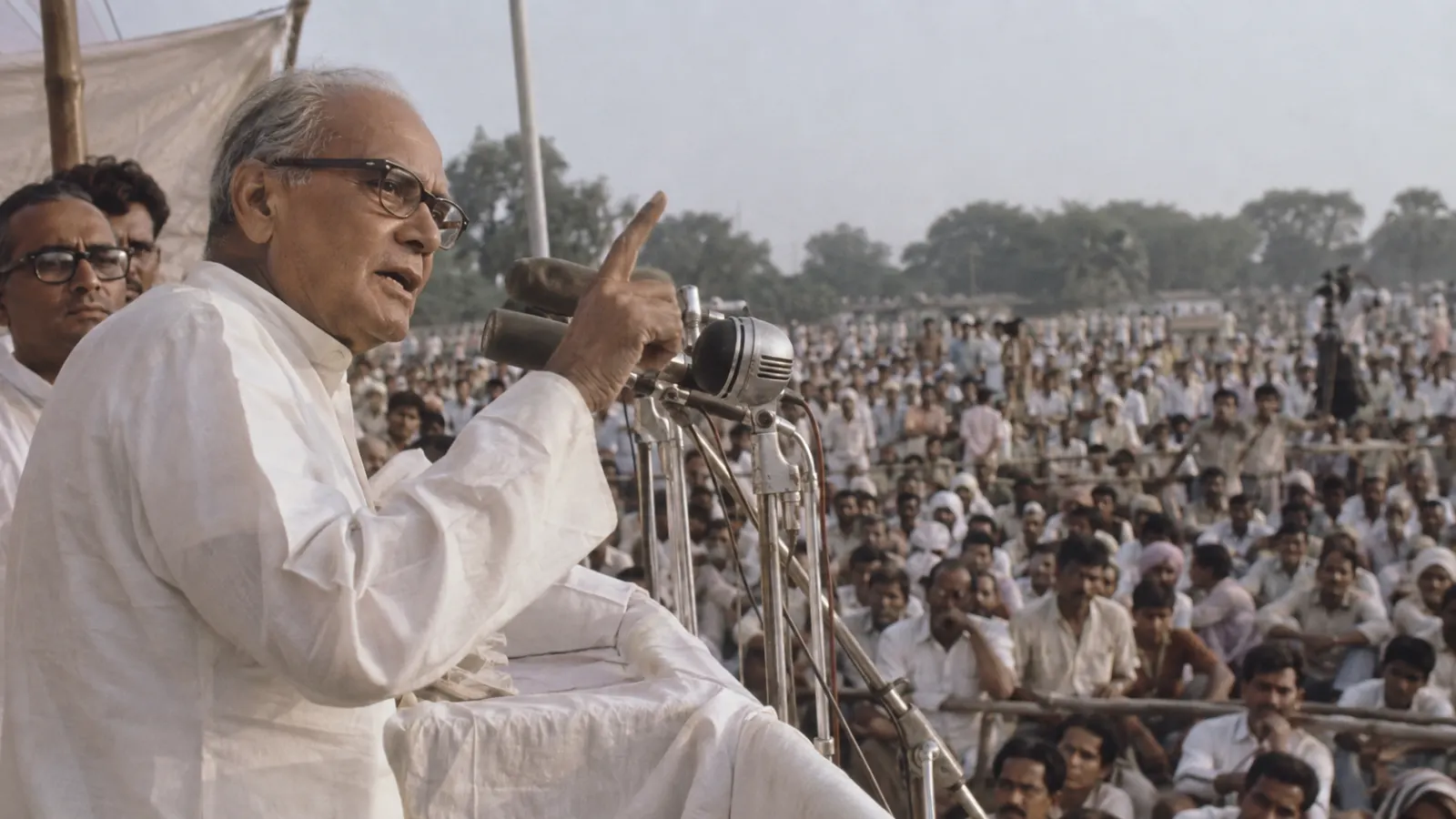
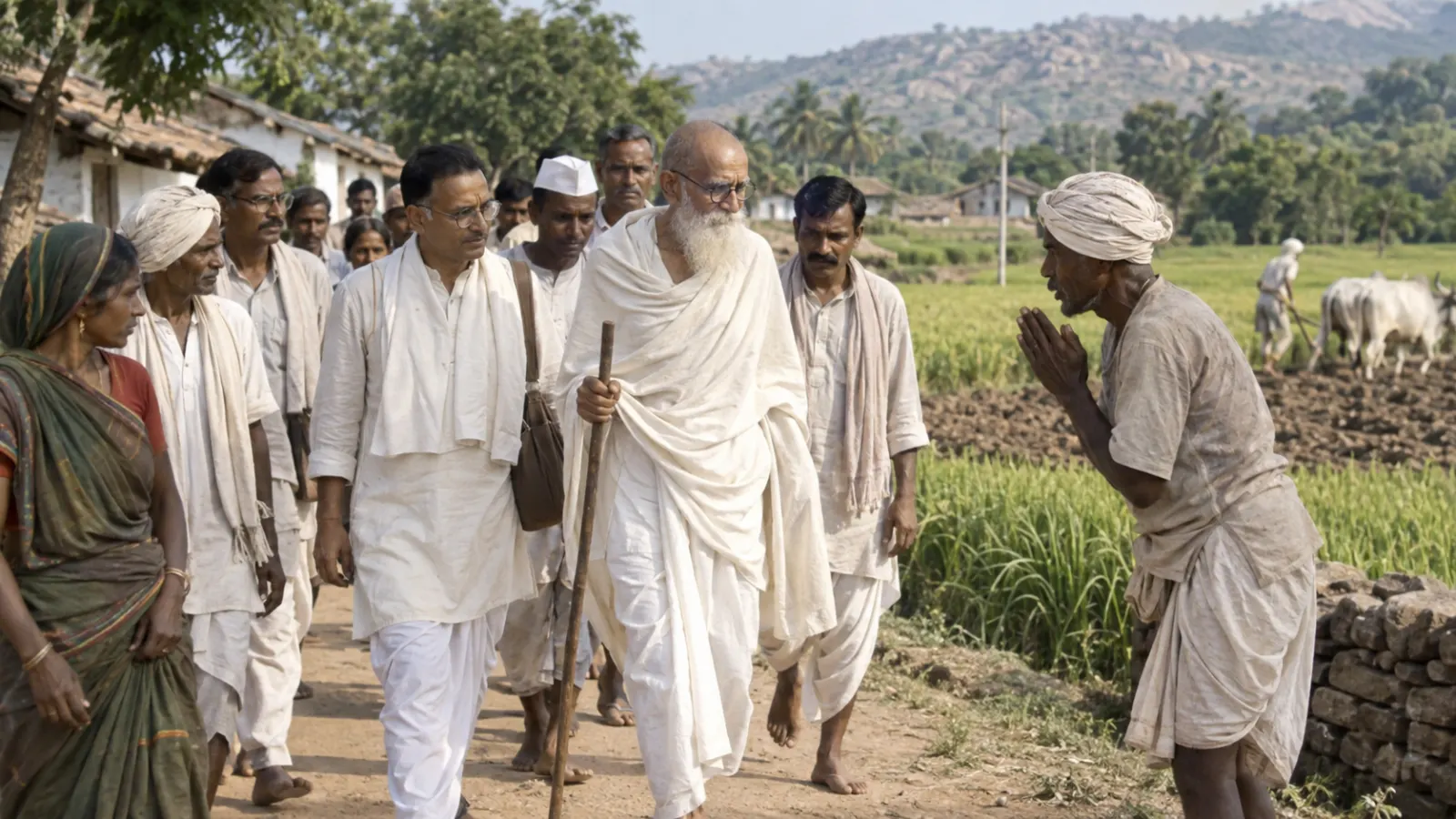
The Bhoodan movement spread primarily through padayatra, or walking tours. Vinoba travelled through village after village, addressing meetings and asking landowners directly to contribute land. The official Vinoba archive records a journey of roughly thirteen years covering about 65,000 kilometres.
Walking was not merely a practical way to reach rural India.
It was the movement's organising method.
A national political organisation normally depends on offices, media, party workers and formal chains of command. Bhoodan created a moving institution. Vinoba entered communities physically, spoke directly with villagers and placed the question of land before local society.
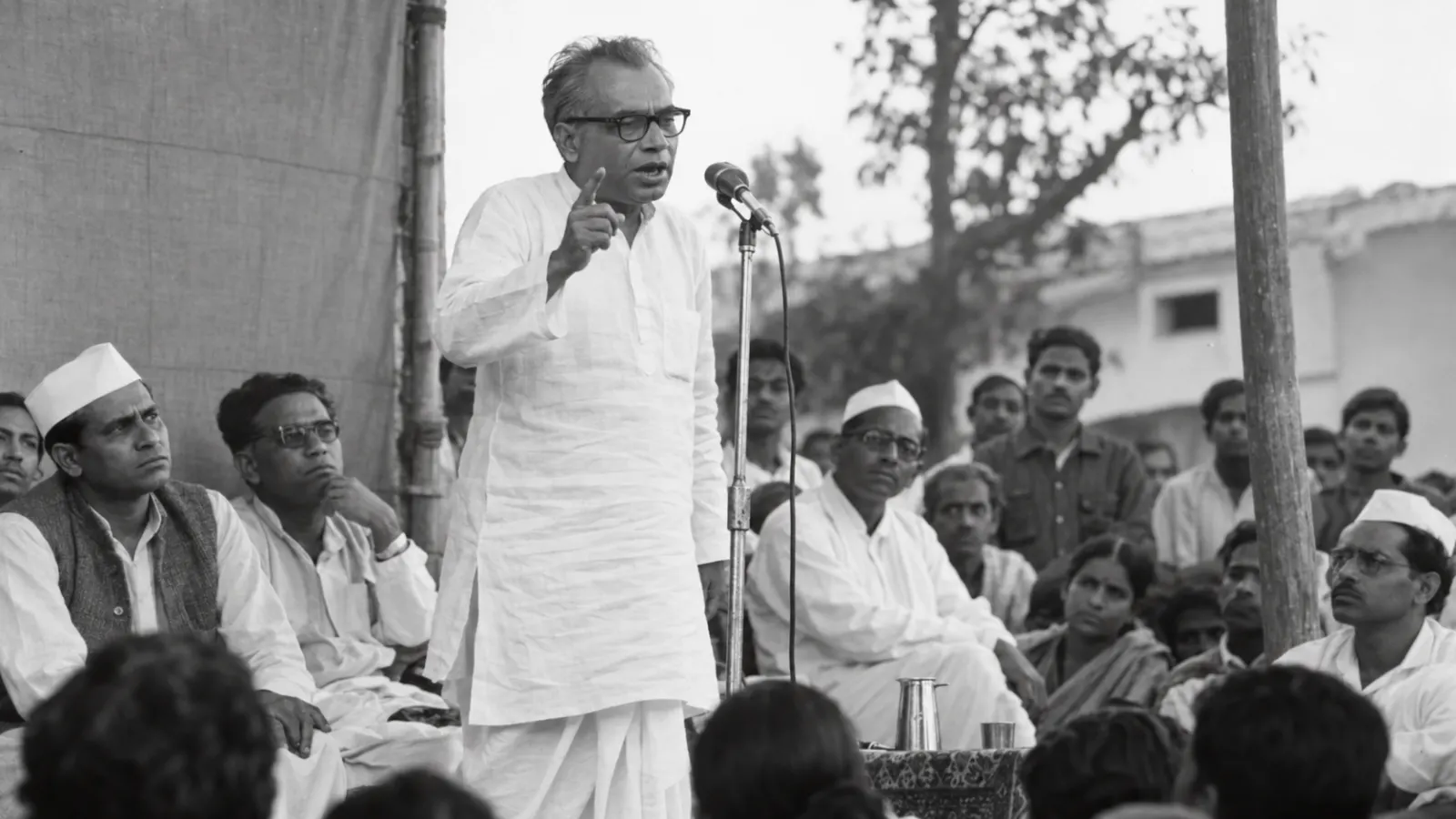
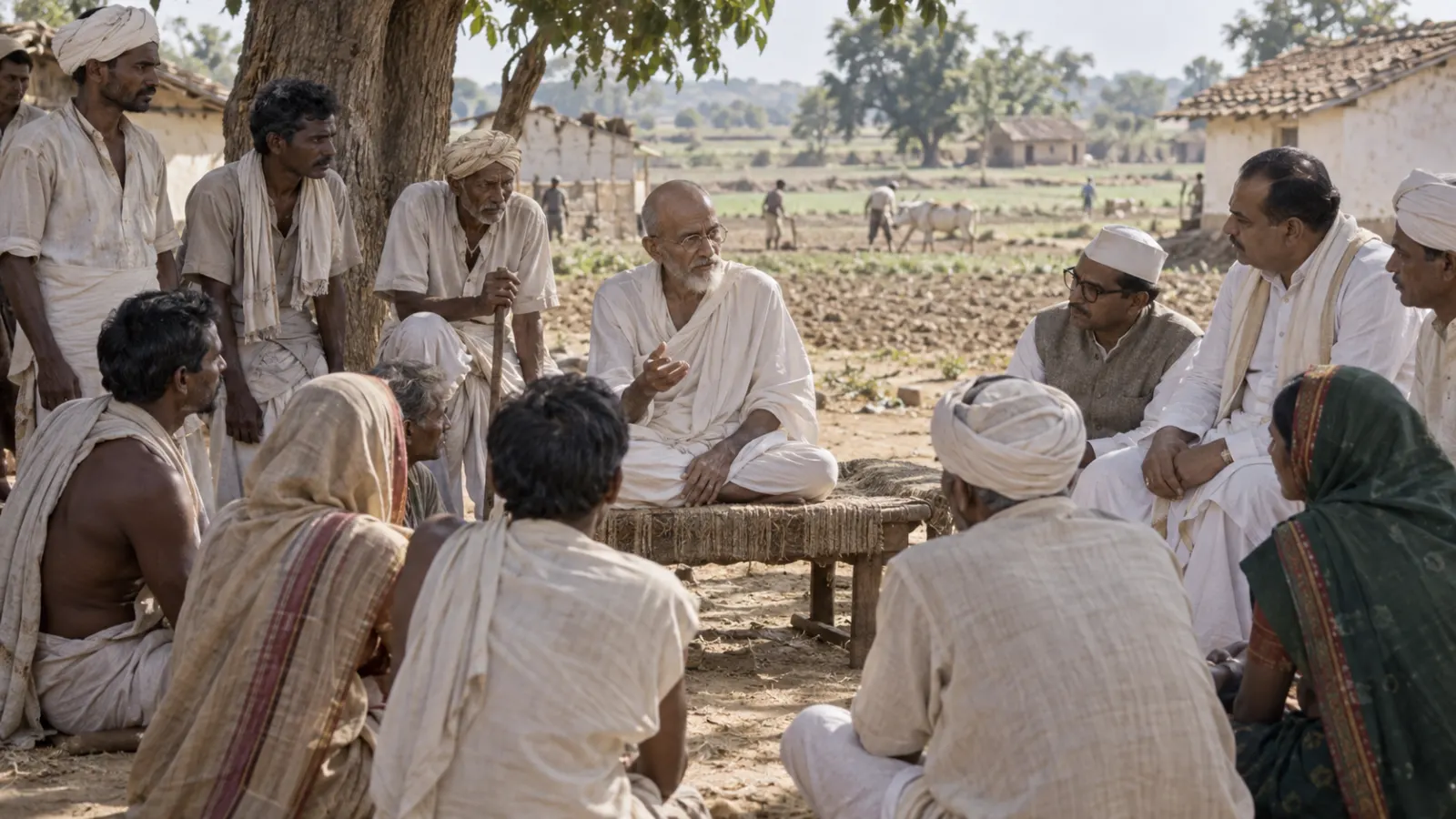
Public meetings also created social pressure. A landowner was not responding privately to a government notice. He was being asked, before neighbours and the landless themselves, whether ownership carried obligations toward the community.
Padayatra therefore turned moral argument into political theatre.
It was exceptionally effective at generating attention and commitments.
But the road was better at producing pledges than cadastral accuracy.
Once a donation was announced, a much quieter process had to begin. Officials or Bhoodan workers needed to determine exactly which parcel had been given, whether the donor possessed clear legal title, whether the land was already occupied or subject to tenancy claims, whether transfer was legally possible and whether the plot could actually support cultivation.
Then a beneficiary had to be selected.
Records needed to be updated.
Physical possession had to be established.
This sequence can be understood as a pipeline from promise to possession.
A pledge might take minutes.
A disputed title could require years.
That distinction explains why Bhoodan's headline acreage figures require careful interpretation. “Pledged,” “donated,” “accepted,” “available for distribution,” “allotted” and “actually possessed” do not describe the same stage.
Large totals can exaggerate effective redistribution when they include land that never becomes usable property in the hands of the landless.
But focusing only on failed transfers creates the opposite distortion. A voluntary movement persuaded owners across India to commit land on a scale that deserves explanation in its own right.
The most useful historical assessment therefore separates mobilisation success from implementation success.
Bhoodan was extraordinarily successful at making land inequality publicly discussable and generating voluntary commitments.
It was much less consistent at ensuring that every commitment became a secure and productive asset.
An Acre of Land Was Not Necessarily a Livelihood
The problem becomes even clearer when land quality is considered.
An acre is a unit of area, not a standard unit of economic value.
An acre of irrigated fertile land near a road and market can support very different opportunities from an acre of rocky, dry or inaccessible land. Some Bhoodan donations involved useful agricultural plots. Others could involve land that was marginal, disputed or otherwise difficult to cultivate.
This did not necessarily mean every donor offering poor land was acting cynically.
It meant that counting acreage was insufficient.
A meaningful land redistribution programme has to ask whether the beneficiary receives secure title, cultivable soil, water access, roads, credit, seeds, tools and markets. Without these supporting conditions, the transfer may improve legal status without creating a sustainable livelihood.
This problem was not unique to Bhoodan. It applies to land reform generally.
Giving land to someone does not automatically create a viable farmer.
A newly landowning family may lack irrigation or working capital. Small fragmented holdings can be vulnerable to distress sale. Informal dependence on wealthy local families can continue even after title changes.
The social significance of land therefore extends beyond agricultural output.
Landlessness frequently overlapped with caste hierarchy. Scheduled Caste, Scheduled Tribe and other marginalised families often depended economically and socially on dominant landholders. Receiving land could improve bargaining power, reduce dependence on employers and strengthen a family's standing within village society.
But land could not automatically erase caste.
Access to wells, irrigation, common land, schools, credit, temples, markets and village political institutions could remain unequal. The most meaningful question was therefore not simply whether a beneficiary's name appeared in a land register but whether the transfer altered their effective capacity to live and negotiate independently.
Gender created another layer that received much less attention in the public image of the movement.
Bhoodan stories commonly centred on male landowners giving land to households represented by male heads. Yet women contributed enormous amounts of agricultural labour while often possessing much weaker formal property rights.
A plot transferred to a household could improve family security without substantially changing a woman's bargaining position if legal title remained exclusively male.
The available historical record does not always make it possible to measure this dimension consistently across Bhoodan. That limitation itself is revealing.
Land reform should ask not only which household receives property, but who within that household possesses enforceable rights over it.
From Bhoodan to Gramdan—and From Moral Movement to Law
Vinoba soon concluded that transferring individual plots did not go far enough.
He increasingly promoted Gramdan, or “village gift,” which attempted to rethink ownership at the level of the whole community. Instead of individual landowners making isolated gifts, the village would move toward a collective framework of responsibility over land.
Gramdan connected redistribution with Vinoba's wider Sarvodaya politics. The objective was not merely to produce more small property owners but to weaken the idea of absolute individual ownership and build decentralised village self-government.
That made Gramdan more ambitious than Bhoodan.
It also made it harder to implement.
Individual donation involves one owner's property. Gramdan potentially affects an entire community's property relations, decision-making and future transfers.
The history that followed revealed one of the movement's central paradoxes.
A philosophy based on voluntarism increasingly required legislation and bureaucracy.
Several state governments enacted Bhoodan or Gramdan laws and created boards to receive, manage and distribute donated land. The movement generated the commitment; public institutions were increasingly required to turn that commitment into legally durable ownership.
This should not be treated as a failure of the philosophy.
It shows the difference between mobilising agreement and institutionalising it.
A donor can promise land voluntarily.
Only a functioning legal system can reliably establish title, update records, settle competing claims and defend the beneficiary years after the charismatic movement has moved elsewhere.
Jawaharlal Nehru captured this distinction clearly. He publicly supported Bhoodan and regarded it as potentially important for peaceful social transformation. But in 1953 he also warned governments not to use Vinoba's movement as an excuse for avoiding their own responsibilities for land legislation.
The warning remains one of the clearest contemporary interpretations of Bhoodan.
Voluntary mobilisation could change attitudes.
It could transfer land.
It could reduce resistance.
It could create moral legitimacy for redistribution.
But it could not replace land ceilings, tenancy law, accurate records, courts and administrative enforcement.
Nor was statutory reform automatically superior in practice. Legislation could be diluted through exemptions, litigation or weak implementation. Powerful local actors could undermine both government programmes and Bhoodan.
The comparison therefore reveals a broader lesson.
Redistribution usually requires several things simultaneously: enforceable law, capable administration, social legitimacy and practical support for the people receiving the asset.
Bhoodan was unusually strong in the field of legitimacy.
Its weaknesses appeared where redistribution required the other three.
Why the Movement Attracted Support—and Why Critics Remained Sceptical
Bhoodan's appeal cannot be explained by Vinoba's personal reputation alone.
Independent India had emerged from Partition, communal violence and years of intense political conflict. Bhoodan offered an image of radical change without another cycle of enemies and coercion.
Property holders could participate in reform without being treated as a class that needed to be destroyed. Landless families gained a public language through which they could make claims. Gandhian workers could pursue social transformation outside electoral office. Some socialists became interested in whether a non-violent social revolution could operate beyond party politics.
Jayaprakash Narayan became particularly significant in this respect. His movement toward Sarvodaya work connected Bhoodan with a broader debate about partyless democracy, decentralisation and non-violent socialism.
Bhoodan therefore became more than a land-distribution mechanism.
It became evidence in an argument about how democracy itself should produce social transformation.
Could people reorganise economic relationships voluntarily?
Could social revolution occur without capturing state power?
Could consent itself be mobilised on a national scale?
Critics believed these questions understated how entrenched power actually worked.
A landowner willing to donate faced a moral choice.
A landowner unwilling to donate could simply refuse.
There was no equivalent within Bhoodan of a statutory ceiling capable of compelling the surrender of holdings above a legal limit.
The movement could therefore redistribute what owners were prepared to give while leaving their most valuable productive assets untouched.
Poor or disputed land could satisfy the public expectation of giving without fundamentally altering rural power.
From this perspective, Bhoodan risked turning a question of justice into a question of generosity.
That criticism became particularly serious when officials or politicians celebrated voluntary redistribution as though it eliminated the need for statutory reform.
Yet even where land transfer failed, the movement could still produce political effects that acreage statistics do not capture.
Village meetings publicly defined landlessness as a social problem.
Landowners were required to respond to the moral argument that concentrated ownership carried obligations.
Sarvodaya organisers developed networks.
Ideas about decentralisation, trusteeship and social obligation circulated through communities.
This can be described as political education: changing what people consider legitimate to demand.
Political education is not a substitute for redistribution.
But redistribution can become easier when public expectations about justice have already shifted.
This is why the strongest criticism of Bhoodan should focus on what it could not accomplish rather than pretending it accomplished nothing.
The Legal Afterlife Shows Why Redistribution Never Ends at the Moment of Gift
By the later decades of the twentieth century, Bhoodan had ceased to dominate national political discussion. But the land itself did not disappear.
State laws, Bhoodan boards, beneficiary records and disputed plots remained.
Old donations could become increasingly valuable as land prices rose. Questions emerged about encroachment, resale, possession and whether land originally donated for redistribution remained protected for its intended beneficiaries.
This legal afterlife is central to the movement's history.
A land transfer is not secure simply because it was morally legitimate when announced.
Rights have to survive changes in governments, generations and economic value.
Records must remain accurate.
Beneficiaries need protection.
Institutions must prevent donated property from being quietly captured or redirected.
Bhoodan therefore demonstrates why successful reform requires long-term governance after public attention has moved on.
Its outcomes also differed by region. States had different revenue systems, laws, political coalitions, administrative capacity and agrarian structures. Some areas could move relatively efficiently from pledge to distribution. Others accumulated disputes or backlogs.
There was never one identical national Bhoodan experience.
That variation cautions against both sweeping triumphalism and sweeping dismissal.
The movement should be investigated at several levels: national mobilisation, state legal frameworks, district administration and actual beneficiary experience.
One district may demonstrate meaningful redistribution.
Another may reveal a large gap between pledged and usable land.
Both can belong to the same historical movement.
What Bhoodan Ultimately Demonstrated
The Bhoodan movement did not eliminate India's agrarian inequality.
It did not provide land to every landless family.
It did not make land-ceiling laws unnecessary.
It could not ensure that every donated plot was fertile, uncontested or economically viable.
It did not automatically remove caste domination or guarantee women equal ownership.
These are substantial limitations.
But dismissal is equally inadequate.
A movement based largely on walking, public meetings and persuasion generated millions of acres in land commitments, distributed significant land, helped inspire legal frameworks and transformed landownership into a subject of national moral debate.
Its achievement lies partly in the improbability of what it attempted.
Vinoba was asking whether consent itself could be organised at revolutionary scale.
The experiment showed that it could—up to a point.
Moral language could persuade property owners.
Public pressure could produce extraordinary commitments.
A movement could redefine landlessness as a question of justice rather than private misfortune.
But the movement also demonstrated where voluntary politics reaches its boundary.
A promise requires verification.
A donation requires legal transfer.
A title requires protection.
A plot requires water, credit and productive support.
A right requires institutions willing to defend it after the movement's leaders have gone.
The lasting lesson of Bhoodan is therefore not that persuasion is superior to law or that law is superior to persuasion.
It is that durable redistribution requires legitimacy and enforceability together.
Law without social legitimacy can face evasion and resistance.
Moral consent without legal protection can disappear before the beneficiary ever receives secure possession.
That relationship between ethics and institutions is why Bhoodan remains relevant beyond the particular land politics of the 1950s.
Modern disputes over land acquisition, commons, informal tenure and access to productive assets still involve questions of legal ownership and social legitimacy.
Vinoba Bhave's movement offers no ready-made policy solution.
It offers something more useful historically: a large-scale test of what different forms of power can and cannot accomplish.
The padayatra could carry the claim for justice from village to village.
The pledge could make that claim visible.
But turning the promise into lasting economic freedom required another journey—from gift to title, from title to possession and from possession to livelihood.
That unfinished journey is the real history of Bhoodan.