Why Architecture Matters: How Buildings Shape Culture, Society and Daily Life
Why architecture matters becomes clear when we stop thinking of buildings as containers and start thinking about what they make possible. Architecture determines where people can gather, who can enter, what is private, what is visible, how comfortably people can live and work, and how communities relate to climate, landscape and one another.
Every society needs shelter, but shelter alone does not explain architecture. Human beings make choices about materials, room arrangements, entrances, windows, streets, courtyards, height, decoration, orientation and scale. Those decisions respond partly to practical problems such as rain, heat, structure and cost, but they also reflect ideas about family, religion, authority, privacy, status, work and beauty.
A courthouse with a monumental staircase communicates something different from a neighbourhood clinic with a welcoming entrance at street level. A house built around an internal courtyard creates different relationships between family and street than a glass apartment tower. A place of worship can use orientation, procession, sound, light and enclosure to turn religious belief into spatial experience.
Architecture therefore does more than occupy culture.
Architecture gives culture physical form.
That is also why architecture belongs at the centre of social and cultural history rather than at its decorative edge. Buildings record the societies that produced them, influence the societies that use them and often survive long enough to transmit those values to generations that think very differently.
Architecture Begins With Shelter but Does Not End There
At the most basic level, buildings protect people from environmental conditions. Roofs shed rain. Walls provide enclosure. Openings allow light and ventilation. Structures carry loads and resist wind, snow or earthquakes.
Yet societies facing similar physical requirements often produce radically different architecture.
Two communities living in hot climates may use courtyards, shaded streets, thick walls, raised floors or lightweight ventilated structures according to different combinations of humidity, available material, construction knowledge, family organisation and cultural practice. Climate sets constraints, but it rarely dictates one inevitable building form.
This is where shelter becomes culture.
The question is no longer simply, “How can people remain dry and safe?” It becomes: How should a family live together? Where should guests be received? Which activities belong in public view? How should a settlement relate to land and water? Which materials communicate permanence, status or sacredness?
Architecture begins with necessity but accumulates meaning through choice.
Architectural critic Paul Goldberger makes a similar distinction in Why Architecture Matters: buildings become culturally significant not merely because they protect people from the weather but because they create emotional, symbolic and social experiences.
Architecture Is Culture You Can Walk Through
Many cultural values are abstract until architecture turns them into space.
Privacy becomes walls, doors, curtains, courtyards and distances between rooms. Authority becomes gates, podiums, elevated platforms and controlled entrances. Hospitality becomes reception areas, verandas and gathering spaces. Religious hierarchy becomes orientation, sacred thresholds and restricted zones.
Architecture can therefore be read as a physical arrangement of relationships.
Consider a traditional house organised around an internal courtyard. The courtyard may provide ventilation and shade, but it can simultaneously organise family interaction, domestic work and degrees of privacy. A visitor may enter only certain rooms while more private activities remain deeper inside the plan.
A government complex works differently. Its architecture may create a ceremonial approach, visually prominent entrances and controlled security zones. A school may organise dozens of classrooms around corridors and assembly spaces, expressing particular assumptions about teaching, supervision and childhood.
None of these arrangements is socially neutral.
When architecture distributes people in space, it also distributes visibility, access, comfort and sometimes power.
Vernacular Architecture Preserves Local Knowledge
Architectural history is often told through celebrated monuments and famous architects, yet much of the world's built environment was created without architects in the modern professional sense.
Vernacular architecture develops through accumulated local knowledge. Builders learn which materials survive local weather, how far a timber beam can span, how walls respond to heat, where water collects and how spaces need to accommodate cooking, livestock, craft, storage or extended families.
A building tradition can therefore encode generations of experimentation.
Thick masonry may moderate temperature fluctuations. Deep overhangs may protect walls from rain and provide shade. Raised construction can respond to flooding, insects or ventilation. Compact settlements can reduce exposure to harsh weather, while courtyards can produce protected outdoor rooms.
These responses should not be romanticised as automatically sustainable or universally superior to modern construction. Traditional buildings also emerged under very different expectations of comfort, population density, labour and available technology.
Their importance lies in the knowledge they preserve.
When modern designers reconsider passive cooling, shading, natural ventilation and locally appropriate materials, they are often rediscovering questions vernacular builders had already been solving for centuries.
Climate Becomes Visible in Architecture
Architecture is also an environmental record.
A steep roof may reveal heavy rainfall or snow. A deep veranda may indicate the need for shade. Small openings in thick masonry can reduce heat gain in one climate, while large openings may maximise limited winter sunlight in another.
Materials respond to geography as well as climate. Stone architecture may emerge where workable stone is locally available. Timber traditions depend on forests and carpentry knowledge. Earth construction reflects suitable soils and building techniques. Brick becomes more widespread where clay, fuel and organised production make firing economical.
Infrastructure changes these patterns.
Railways, roads and industrial manufacturing can suddenly make cement, structural steel, sheet metal and glass available far beyond their original production regions. Within a generation, a built landscape can shift from local material systems to globally traded ones.
Architecture therefore records not only climate but economic connectivity.
A concrete house in a landscape once dominated by earth construction may tell a story about roads, industrialisation, changing aspirations, labour markets and access to finance as much as about engineering.
Homes Turn Family Structure Into Floor Plans
Domestic architecture is especially revealing because houses organise some of the most ordinary parts of life.
A floor plan can tell us who is expected to live together, how much privacy is considered necessary, where food is prepared, how guests are received and whether work happens inside the home.
An extended-family household may need a different organisation from a small nuclear household. A society in which cooking is highly social may produce a very different kitchen from one where food preparation is expected to remain visually separate from formal entertaining.
Domestic architecture also changes when social conditions change.
Smaller households alter the demand for room sizes. Remote work creates demand for spaces that can support both domestic and professional activity. Ageing populations increase the importance of accessibility. Migration can introduce new household patterns into building types originally designed for different family structures.
This is one reason houses are constantly altered.
People move walls, enclose balconies, add bathrooms, extend kitchens and subdivide rooms because architecture has to adapt when the social structure using it changes.
The building becomes a record of family change.
Religious Architecture Makes Belief Physical
Architecture becomes particularly symbolic in sacred spaces.
Religious buildings often use orientation, height, light, sound, procession, enclosure and decoration to distinguish sacred experience from ordinary space. Architecture may direct worshippers toward a particular location, create a sequence of increasingly sacred spaces or establish boundaries between areas accessible to different participants.
This does not mean religious architecture has one universal formula.
A mosque, temple, church, synagogue, monastery, shrine or sacred landscape emerges from a different theological and ritual tradition. Even within one religious tradition, building forms vary enormously across geography and history.
What they share is the capacity to make abstract religious concepts spatial.
Movement can become ritual.
Light can become symbolic.
Orientation can become cosmology.
Thresholds can indicate transitions between ordinary and sacred domains.
The building does not merely contain religious practice. Its architecture can help organise how that practice is experienced.
Architecture Makes Power Visible
Political authority has always used architecture.
Palaces, citadels, government complexes, parliaments, courthouses, ceremonial avenues and monumental public spaces can communicate permanence, order and hierarchy through scale and location.
A ruler who occupies elevated ground overlooks the city both literally and symbolically. A palace approached through a sequence of enormous courtyards can make visitors experience the distance separating ordinary life from political authority.
Modern states use architecture differently but no less deliberately.
Courthouses may combine monumental mass with symbolic transparency. Parliaments may draw on historic styles to express institutional continuity. Civic buildings can use public plazas and accessible ground floors to suggest openness.
Even supposedly functional government architecture communicates values through who enters where, what spaces are visible, how security is organised and whether citizens feel welcomed or intimidated.
Architecture can therefore operate as political language without words.
Architecture Can Carry Ideology
Some architectural movements are associated not merely with aesthetic preferences but with programmes for changing society.
Nineteenth-century revival styles could connect new political institutions with idealised historical precedents. Modernism later promoted functional organisation, industrial materials and rejection of certain historical ornament, but its political meanings varied widely.
The same formal language could be used for social housing, corporate headquarters, authoritarian state buildings or optimistic civic institutions.
This demonstrates why architectural style cannot be interpreted mechanically.
Concrete does not have one political ideology. Glass does not automatically mean openness. Classical columns do not always represent the same political values.
Architecture acquires meaning from who builds it, why, where and how people experience it.
The relationship between ideology and design is therefore contextual rather than fixed.
Public Space Determines How Strangers Meet
Architecture extends beyond individual buildings.
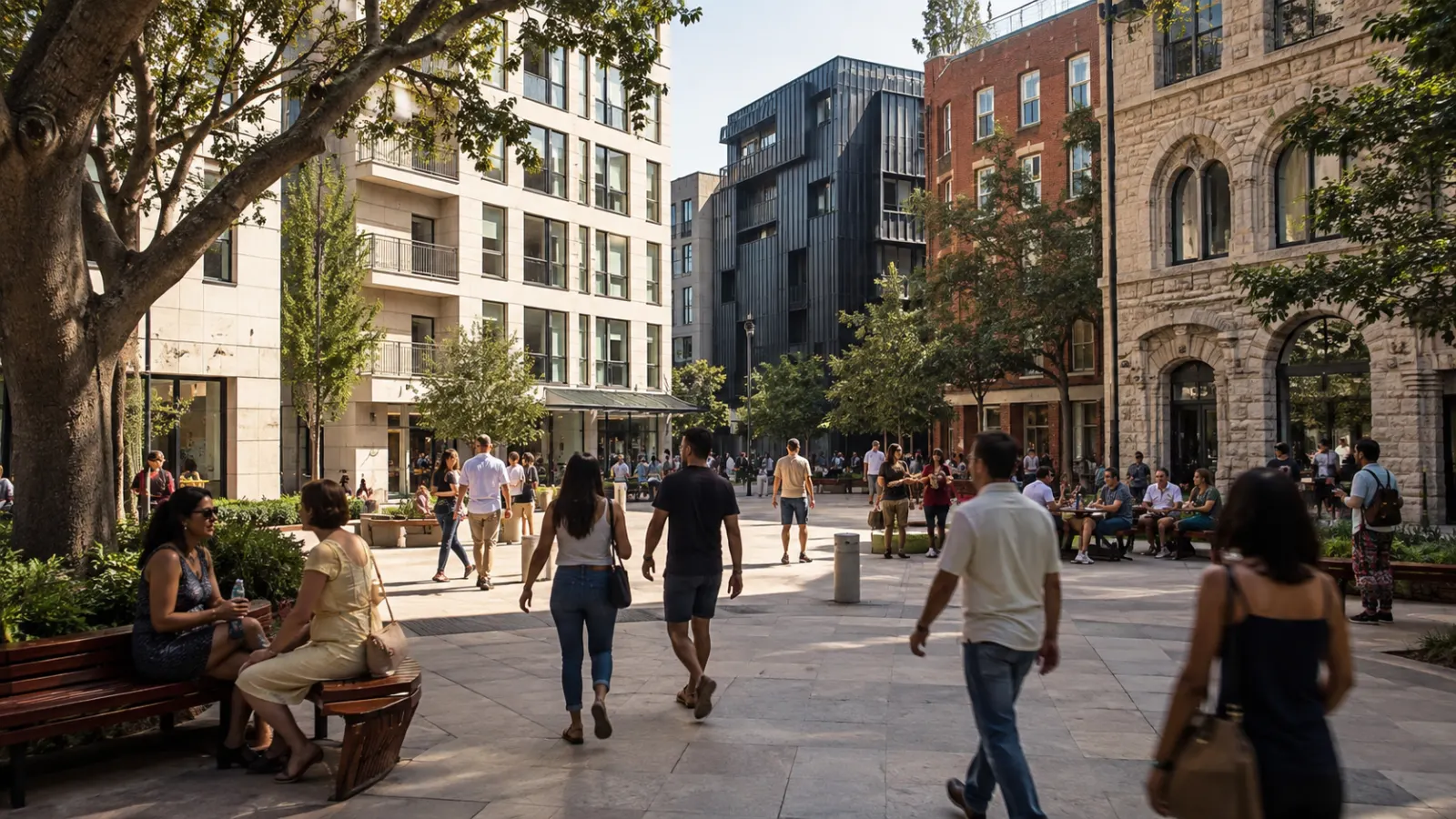
Streets, squares, markets, parks, pavements, transit stations and waterfronts determine how people encounter one another in public.
A city with shaded pavements, benches, public transport and accessible parks makes different forms of everyday interaction possible from a city dominated by private compounds, parking lots and high-speed roads.
This does not mean design can manufacture community automatically.
People use spaces in unexpected ways, and social behaviour depends on economics, culture, safety, climate and many other factors.
Architecture sets possibilities and frictions.
A public square does not force people to gather, but it can make gathering easier. A pavement does not guarantee walking, but its absence makes walking more difficult. A park cannot eliminate loneliness, but it can provide conditions in which strangers, families and neighbours occupy common space.
Small spatial choices accumulate into patterns of social life.
Architecture Can Include—and Exclude
Because architecture controls movement and access, it can also exclude.
A building reached only by stairs excludes some wheelchair users. Narrow doorways can create barriers. Poor lighting may make public space feel unsafe. Gated developments can physically separate populations. Hostile design can intentionally discourage particular people from remaining in public areas.
Historically, buildings have also encoded formal segregation through separate entrances, waiting rooms, residential quarters and circulation systems.
Accessibility standards make the political nature of these decisions especially clear.
A doorway width looks like a technical measurement, but it determines whose body can use the building independently. A ramp, lift or accessible toilet is therefore not merely an engineering detail. It expresses an expectation about who belongs in the space.
Architecture is never completely neutral because dimensions and circulation are always designed for some understanding of the people expected to use them.
Workplaces Turn Labour Systems Into Space
Factories, warehouses and offices reveal how economic production is organised.
A factory designed around an assembly line creates linear movement of materials and workers. A warehouse is shaped by storage systems, vehicle access and logistics. A cellular office with individual rooms reflects a different managerial organisation from an open-plan floor.
As work changes, workplace architecture changes.
Early factories often relied heavily on daylight and were therefore designed with large windows. Later artificial lighting and mechanical ventilation loosened those constraints. Office towers became possible because elevators, steel structures and building services made vertical working environments practical.
Digital technology is changing offices again.
Remote and hybrid work have challenged assumptions about how much permanent desk space organisations need and increased demand for collaborative spaces rather than rows of assigned workstations.
Architecture therefore preserves the history of labour even when the people and machinery have disappeared.
Schools Reveal What Societies Think Education Should Be
School design makes educational philosophy physical.
A conventional classroom organised around rows facing one teacher supports a particular model of instruction and supervision. More flexible spaces may be designed around collaboration, independent learning or multiple simultaneous activities.
Corridors, assembly halls, playgrounds and dining areas also influence social interaction.
Schools therefore record changing beliefs about childhood, discipline and learning.
But architecture should not be credited with educational outcomes independently of teaching quality, resources, class size and social conditions.
A beautifully designed classroom cannot compensate automatically for inadequate education.
The more defensible claim is that architecture can support or obstruct educational practices.
It creates the spatial conditions within which teaching occurs.
Architecture Shapes Health and Comfort
People spend substantial portions of their lives inside buildings, making ventilation, daylight, temperature, crowding, sanitation, acoustics and accessibility important aspects of everyday wellbeing.
Architecture has long responded to changing understandings of health.
Urban sanitation systems transformed cities when contaminated water and inadequate sewage became recognised as major health threats. Housing regulation developed in response to overcrowding, poor ventilation and unsafe construction. Fire regulations changed materials, exits and building layouts after catastrophic losses exposed earlier vulnerabilities.
Modern buildings respond to additional concerns such as indoor air quality, thermal stress, ageing populations and accessibility.
Building codes therefore preserve social learning.
Requirements that appear purely technical often represent lessons accumulated after disasters, disease outbreaks or long periods of exclusion.
Architecture changes as societies redefine what counts as an acceptable environment.
Housing Policy Becomes Visible as Architecture
Housing is one of the clearest places where political economy becomes physical.
Private development, social housing, public housing, informal settlements, company towns and cooperative models reflect different approaches to land, finance and responsibility for shelter.
Standardised housing blocks can represent ambitious welfare programmes, severe cost constraints, rapid urbanisation or attempts at social engineering.
Their eventual success cannot be judged by architecture alone.
Maintenance, transport, employment, schools, safety and public services strongly influence whether housing environments remain desirable.
This is why apparently similar buildings can produce radically different long-term outcomes in different cities.
Architecture matters, but architecture operates inside institutions.
Informal Settlements Are Architecture Too
Restricting architecture to formally designed buildings excludes a large part of human settlement.
Around the world, people construct and modify homes outside conventional planning and professional design systems. These environments often respond rapidly to family growth, employment, available materials and limited land.
Informal construction can demonstrate remarkable adaptation and ingenuity.
It can also expose residents to serious risks involving structural safety, fire, flooding, sanitation and insecure tenure.
Both realities can exist simultaneously.
Describing informal settlements only as architectural failure ignores the knowledge and social systems embedded in them. Romanticising them as pure grassroots creativity ignores the inequalities that often force people to build without adequate infrastructure or legal protection.
A serious architectural analysis considers both agency and constraint.
Cities Are Built in Layers
Cities rarely represent one coherent design.
They accumulate.
An old street pattern may survive beneath later buildings. Industrial infrastructure can sit beside religious monuments. Colonial-era districts may coexist with contemporary towers, informal commerce and new transit systems.
UNESCO's Historic Urban Landscape framework explicitly describes urban areas as products of historic layering that includes historic and contemporary buildings, infrastructure, open spaces, land-use patterns, economic processes, cultural practices and community values.
This layered perspective is more realistic than imagining heritage cities as collections of isolated monuments.
A railway line can be as important to understanding a city as its most famous palace.
A market may carry cultural significance even when its architecture is modest.
A neighbourhood's meaning may come from the relationship among streets, shops, religious buildings, housing and everyday routines rather than from any single architectural masterpiece.
Historic Cities Cannot Be Frozen
Preservation sometimes creates the mistaken idea that historic areas should stop changing.
Cities cannot function that way.
People still need housing, schools, utilities, transport, accessibility and economic opportunity. Buildings deteriorate. Households change. New technologies require new infrastructure.
UNESCO's Historic Urban Landscape approach therefore attempts to integrate conservation with wider urban development rather than treating preservation and change as automatic opposites. It considers both tangible and intangible heritage, contemporary needs, socioeconomic conditions and local community values.
The question is not whether historic places should change.
They inevitably will.
The important question is which changes preserve significant relationships and which destroy them unnecessarily.
Adaptive Reuse Lets Architecture Continue Living
Adaptive reuse gives an existing building a new function.
A warehouse may become housing. A factory can become a university or cultural centre. A railway station can acquire a new public role after trains stop using it.
This can preserve architectural character and embodied material while giving the structure a financially viable future.
But adaptive reuse is not automatically good conservation.
A new use may require so much alteration that the building's important spatial character disappears. Conversely, insisting on an obsolete original function can leave a structure vacant and deteriorating.
The best adaptive reuse usually involves identifying what makes the building significant and designing the new intervention around those values.
The result does not need to pretend that nothing has changed.
A successful adaptation can allow the new chapter to remain recognisably new.
Preservation Is Also a Resource Question
Demolition destroys more than architectural appearance.
Existing buildings contain materials and energy already invested in extraction, manufacture, transport and construction. Reusing a viable structure can preserve some of that embodied value and avoid part of the material demand associated with complete replacement.
But the environmental argument should not become a slogan.
Some buildings require major upgrades to achieve acceptable energy performance, safety or accessibility. In other cases, structural condition may make reuse extremely difficult.
The responsible comparison is therefore lifecycle-based.
What can be retained? What must be replaced? How much new material would demolition require? How will the building operate after renovation?
Architectural conservation and environmental sustainability often support one another, but not automatically.
Architecture Records Inequality as Clearly as Wealth
Traditional architectural histories often concentrate on palaces, cathedrals, monumental government buildings and houses designed for wealthy patrons.
That produces an incomplete picture.
Workers' housing, industrial buildings, migrant neighbourhoods, informal settlements and everyday shops contain equally important evidence about society.
Grand houses reveal wealth partly because workers' quarters reveal who supported that wealth. Ceremonial boulevards acquire different meaning when compared with overcrowded districts nearby. Infrastructure reveals which neighbourhoods received investment and which remained disconnected.
Preserving only elite architecture therefore risks preserving elite history.
The built environment can reveal inequality precisely because unequal access to land, resources, services and political power becomes spatially visible.
Colonial Architecture Carries More Than One History
Colonial architecture is often contested because one building can represent several histories simultaneously.
It may demonstrate local craftsmanship, imported engineering, commercial development and changing urban form while also representing conquest, racial hierarchy or political domination.
These meanings do not cancel one another.
A building can be architecturally significant and politically difficult at the same time.
Communities may therefore choose different responses: preservation, adaptive reuse, reinterpretation, changed naming, removal of particular symbols or more explicit explanation of historical context.
There is no universal architectural rule capable of resolving these debates.
They concern historical memory and political values as much as conservation technology.
Architecture Stores Personal and Collective Memory
People rarely remember cities exclusively through famous monuments.
A neighbourhood cinema, school, bus stop, market, sports ground or street corner may carry more emotional significance than an internationally recognised building.
Memory accumulates through repeated use.
Someone passes the same doorway every morning. A family returns to the same religious building for decades. Workers spend much of their lives inside one factory. Children remember a school courtyard long after forgetting the architectural style of the building.
When such places disappear, people can experience a genuine sense of disorientation.
The attachment may exist even when residents never considered the building architecturally important.
This everyday memory is one reason heritage evaluation increasingly considers community values alongside professional judgments about age, style and design.
Buildings Become Symbols
Some buildings eventually acquire meanings far beyond their practical functions.
Their silhouettes appear on tourist advertising, currency, political imagery and souvenirs. They become visual shorthand for cities, institutions or nations.
Once this happens, changing the architecture can become politically sensitive.
People may defend a building they rarely enter because it represents continuity, identity or shared memory.
Symbolic architecture also allows governments and institutions to shape narratives deliberately. New museums, memorials, parliaments and cultural centres may be designed partly to communicate how a society wants to represent itself.
Architecture therefore participates in identity-making at several scales—from household to neighbourhood to nation.
Architecture Can Function as Cultural Diplomacy
Embassies, world's fairs, museums and national pavilions demonstrate this symbolic role internationally.
Such buildings often present a carefully selected image of the society they represent.
A country may emphasise technological innovation, environmental responsibility, historical continuity, craftsmanship or particular materials.
The architecture becomes a form of cultural diplomacy.
Visitors may never read a formal political statement, but they encounter a spatial argument about national identity.
This reminds us that architecture communicates even when no words are present.
Architecture Shapes Tourism and Local Economies
Distinctive architecture can generate substantial economic value.
Historic districts, waterfronts, monuments and culturally distinctive neighbourhoods attract visitors, businesses and investment. Adaptive reuse can turn disused buildings into hotels, restaurants, offices, museums or housing.
But success creates its own pressures.
Rising demand can increase property values. Housing may shift toward visitor accommodation. Everyday shops can be replaced by tourism businesses. Residents may eventually leave the very neighbourhood whose cultural life attracted visitors.
Preserving façades while losing local communities can create a visually historic environment with a radically transformed social reality.
Architecture and heritage management therefore have to consider who benefits economically and whether cultural continuity survives alongside commercial success.
Infrastructure Is Cultural Architecture Too
Bridges, railways, canals, reservoirs, roads and transit networks often disappear from discussions of architecture because they are treated as engineering or necessity.
Yet infrastructure shapes settlement just as profoundly as individual buildings.
A railway station can reorganise an entire city. A bridge can connect communities previously separated by geography. A highway can divide neighbourhoods. A reservoir can support urban growth while displacing existing settlements.
Infrastructure determines whose movement becomes easier and whose landscape changes.
Its cultural importance therefore lies not only in technical achievement but in the social relationships it creates.
Building Codes Record What Societies Have Learned
Modern buildings are heavily shaped by regulations that occupants may never notice.
Fire escapes, stair dimensions, structural reinforcement, accessible entrances, ventilation requirements and sanitation systems reflect lessons learned through experience.
Many regulations emerged because earlier buildings failed.
Fires demonstrated inadequate escape routes. Earthquakes revealed structural weaknesses. disease exposed sanitation problems. Disability-rights movements challenged assumptions about which bodies public buildings should accommodate.
Building codes are therefore cultural documents as well as technical ones.
They show which risks a society recognises and which obligations it expects designers and owners to meet.
Digital Technology Is Changing Architecture and Preservation
Digital tools are altering both how buildings are designed and how older ones are documented.
Building-information modelling can coordinate complex technical systems. Digital fabrication changes how components are manufactured. Laser scanning and photogrammetry can record existing structures with remarkable precision.
For heritage, repeated digital surveys can help monitor movement, deterioration or damage. Detailed models may assist restoration after disasters.
Yet a digital model is not the building.
It can record geometry and appearance extraordinarily well, but it does not preserve original material, social use, sound, smell, location or emotional attachment.
Technology expands architectural evidence.
It does not eliminate the importance of physical place.
Architecture Is Never Only About the Architect
The culture of architectural celebrity can make buildings appear to be the creations of individual designers.
In reality, architecture is collective production.
A building depends on clients, engineers, contractors, craftspeople, labourers, manufacturers, planners, regulators, financiers and users. Its eventual form is shaped by budgets, land ownership, building codes, political negotiation and available materials.
Users then continue changing it after the original architect has left.
They add partitions, install equipment, modify entrances and adapt spaces to uses the designer may never have anticipated.
Understanding architecture therefore requires studying systems rather than biographies alone.
The architect matters.
But so do the people who commissioned, financed, constructed, regulated, maintained and inhabited the building.
Architecture Influences Behaviour Without Determining It
Designers sometimes make grand claims that architecture can create better communities or fundamentally change human behaviour.
The relationship is more complicated.
People are adaptable. They appropriate spaces in unexpected ways. A plaza designed for ceremonial use can become an informal market. A corridor intended only for circulation can become a social meeting place. Residents modify housing that does not fit their everyday lives.
Architecture therefore does not control behaviour like programming.
It creates affordances, barriers and incentives.
Where can people sit?
Which routes are easiest?
Who can see whom?
Can children play safely?
Can strangers meet without purchasing something?
Does a person with limited mobility enter independently?
These apparently small spatial conditions influence daily life repeatedly.
Over years, repetition makes architecture socially powerful.
Beauty Matters—but Beauty Changes
Architecture is also an aesthetic experience.
Proportion, texture, light, scale, rhythm, colour and material can generate pleasure, solemnity, excitement, comfort or unease.
But ideas about architectural beauty change.
Buildings once condemned as ugly can become beloved heritage. Styles celebrated by one generation can fall dramatically out of favour in another.
Aesthetic judgment is therefore historically variable.
This is important for preservation because architectural value should not depend entirely on current taste.
A building may deserve study because of its social, technological or historical significance even when contemporary observers dislike its appearance.
Likewise, a beautiful building can still embody exclusion or destructive planning.
Architecture should be evaluated through more than beauty alone.
Architecture and Culture Influence Each Other
It is tempting to say simply that architecture reflects culture.
The relationship works in both directions.
Culture influences what people build, but buildings then influence how cultural practices continue.
A religious ritual may adapt to the space available. A courtyard can become the centre of family interaction. A public square can support forms of political assembly. A neighbourhood street pattern can sustain particular commercial and social practices.
Architecture therefore participates in cultural reproduction.
It preserves certain arrangements long enough for later generations to experience them as normal.
At the same time, people constantly modify buildings when inherited spaces no longer fit contemporary life.
Architecture is therefore neither a passive mirror of culture nor an all-powerful force shaping society.
It is part of an ongoing feedback loop between people and place.
Frequently Asked Questions About Why Architecture Matters
Why does architecture matter?
Architecture matters because the built environment shapes how people live, move, work, worship, gather and interact while also recording cultural values, technology, politics and history.
How does architecture reflect culture?
Architecture reflects culture through decisions about space, materials, privacy, hierarchy, family life, ritual, decoration and relationships with climate and landscape.
How does architecture affect society?
Architecture influences access, mobility, social interaction, housing, work, education and public life by making some activities easier and others more difficult.
Why is architecture important in everyday life?
People spend much of their lives in buildings and built environments. Housing, schools, workplaces, transport systems, shops and public spaces influence ordinary routines continuously.
How does architecture reflect history?
Buildings preserve evidence through materials, construction methods, alterations, repairs, spatial organisation and relationships with surrounding streets and landscapes.
How does architecture reflect religion?
Sacred architecture can use orientation, light, sound, procession, symbolism and spatial hierarchy to express religious beliefs and organise worship.
How does architecture express political power?
Political architecture can use scale, location, ceremonial space, security and symbolism to communicate authority, permanence, openness or hierarchy.
How does architecture influence behaviour?
Architecture does not determine behaviour completely, but it creates physical opportunities and barriers affecting movement, interaction, visibility and access.
Why is public space important in architecture?
Public space allows people who are not members of the same household or organisation to encounter one another. Streets, squares, parks and markets can support social, cultural and civic life.
How can architecture exclude people?
Stairs, narrow entrances, inaccessible transport, gated environments and other spatial barriers can restrict participation. Architecture has also historically encoded segregation and social hierarchy.
What is vernacular architecture?
Vernacular architecture is architecture developed largely through local building traditions, materials, climate knowledge and social practices rather than primarily through formally trained architects.
How does climate affect architecture?
Climate influences roof form, shading, ventilation, wall construction, orientation, materials and relationships between indoor and outdoor space.
Why are historic buildings important?
Historic buildings can preserve evidence of past technologies, social organisation, cultural identity and everyday life while also contributing to contemporary places.
What is adaptive reuse?
Adaptive reuse gives an existing building a new function while retaining important parts of its physical and historical character.
Is preserving old buildings environmentally sustainable?
It can be, because reuse may conserve existing materials and embodied resources, but each project needs lifecycle consideration, including operational energy, safety and required upgrades.
How does architecture preserve memory?
People attach memories to homes, schools, workplaces, religious sites, streets and landmarks. Buildings can therefore function as anchors of both personal and collective memory.
How does architecture show inequality?
Differences in housing, infrastructure, access, public investment and spatial segregation can reveal unequal distributions of wealth and power.
Why is informal architecture important?
Informal settlements contain a large share of human urban experience and reveal how communities respond to limited land, resources and formal infrastructure.
How does architecture affect identity?
Distinctive buildings, neighbourhoods and public spaces can become symbols through which communities, cities and nations understand and represent themselves.
Is architecture only about buildings?
No. Architectural and built-environment analysis also includes public spaces, landscapes, infrastructure, streets and relationships among buildings.
Why Architecture Matters Is Ultimately a Question About People
The most important answer to why architecture matters is not that buildings can be beautiful or historically famous.
Architecture matters because human life has to happen somewhere.
People are born in buildings, grow up in neighbourhoods, learn in schools, work in offices and factories, travel through stations, worship in sacred spaces, meet in public squares and eventually attach memories to places that may have seemed ordinary while they were using them.
Every one of those spaces is shaped by decisions.
Someone decided how wide the door should be, whether the street should accommodate pedestrians, where the kitchen belongs, how much daylight reaches the classroom, whether a wheelchair user can enter independently, whether workers can see one another, whether the public approaches government through an intimidating staircase or an accessible plaza.
Those choices accumulate.
Over time, they become the physical environment through which people experience society.
Architecture also outlives many of the assumptions that created it. A building may survive the political system, industry or family structure for which it was designed. Later generations inherit the physical result and have to decide whether to preserve it, adapt it, reinterpret it or replace it.
That is why cities become historical layers rather than finished compositions. UNESCO's Historic Urban Landscape approach recognises precisely this accumulation of buildings, infrastructure, natural features, cultural practices, economic processes and community meanings.
Architecture therefore operates simultaneously in three directions.
It comes from the past, because every building emerges from particular materials, technologies, institutions and values.
It acts in the present, because physical space influences what people can do every day.
And it reaches into the future, because buildings, streets and infrastructure often survive long after the people who made the original decisions are gone.
This is why architecture cannot be reduced to decoration.
It is culture made physical.
It is politics given dimensions.
It is technology turned into daily experience.
It is memory anchored to place.
And because the built environment surrounds people almost continuously, architecture participates in human life even when nobody consciously notices it.
That is why architecture matters.