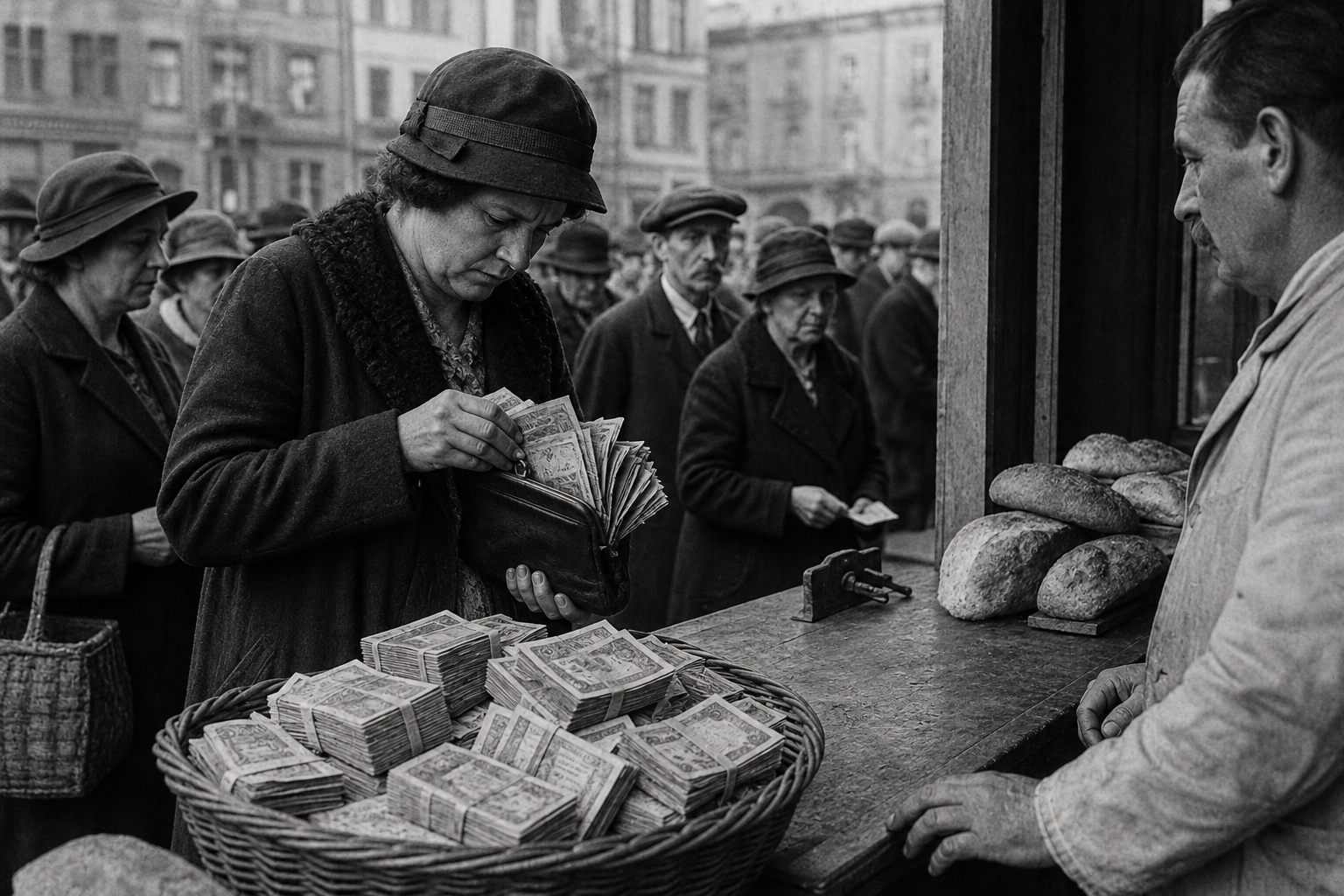
Hyperinflation is not ordinary inflation with a louder name. It is a monetary breakdown. In normal inflation, prices rise over time and households feel pressure on budgets. In hyperinflation, money itself stops performing its basic functions. It no longer stores value, no longer gives people confidence and may no longer serve as a reliable unit of account. Prices do not merely rise; they run.
The public image of hyperinflation is dramatic: workers being paid twice a day, families rushing to spend wages before prices change, wheelbarrows of currency, banknotes with absurd zeros, and shops refusing local money. These images are memorable because they show something deeper than price increase. They show the collapse of trust between the state, the currency and citizens.
Historic hyperinflations have different local triggers, but they usually share several conditions. The first is severe fiscal stress. Governments spend more than they can finance through taxes or sustainable borrowing. War, reparations, political crisis, falling revenues, subsidies, public-sector wage bills or collapsing production can create large deficits. When investors refuse to lend and tax systems weaken, the government may turn to the central bank.
The second condition is monetary financing. This means the state finances deficits by creating money. Not all money creation causes hyperinflation. Modern central banks expand balance sheets in many circumstances without producing runaway inflation. The danger begins when money creation becomes a substitute for fiscal discipline and when the public believes the government will keep printing to meet obligations it cannot otherwise finance.
The third condition is loss of confidence. Inflation becomes hyperinflation when people stop wanting to hold the currency. If workers receive wages and immediately convert them into goods, foreign currency or real assets, the speed of money circulation rises. This increases price pressure. Sellers raise prices because they expect the currency to lose value. Buyers spend faster because they expect prices to rise. Expectations become self-reinforcing.
The fourth condition is a collapse in productive capacity or supply. If farms, factories, trade networks or imports fail, fewer goods are available. More money then chases fewer goods. In some historic cases, war damaged production. In others, land policies, political disorder, sanctions, foreign-exchange shortages or administrative failure reduced output. Hyperinflation is rarely about money alone. It often reflects a real economy that can no longer produce or import enough.
The fifth condition is institutional weakness. A strong and credible central bank can resist pressure to finance deficits. A strong fiscal authority can raise revenue or cut expenditure. A trusted government can negotiate adjustment. But when institutions are weak, politicised or distrusted, policy loses credibility. People do not believe promises of stabilisation. Without credibility, even technically correct measures may fail.
Weimar Germany remains the most famous historical example. After the First World War, Germany faced war debts, reparations, political instability and social unrest. The government relied heavily on money creation, and the value of the mark collapsed dramatically in 1923. The episode damaged savings, redistributed wealth, weakened middle-class security and left a lasting psychological scar in German monetary culture.
The Weimar case teaches that hyperinflation is not only an economic event. It is a political trauma. Creditors are destroyed, savers are punished, wage contracts become unstable and ordinary planning becomes impossible. People who lived carefully can lose everything, while debtors may benefit from repaying obligations in worthless money. Such redistribution feels unfair because it is not openly legislated; it happens through monetary collapse.
Zimbabwe offers another powerful lesson. In the 2000s, the economy suffered from a combination of falling production, fiscal stress, political decisions, foreign-exchange shortages and aggressive money creation. As inflation accelerated, banknotes with larger and larger denominations were issued. The famous 100 trillion Zimbabwe dollar note became a symbol of monetary collapse. Eventually, the domestic currency lost practical credibility and foreign currencies became central to everyday transactions.
Zimbabwe shows how hyperinflation destroys the measurement system of the economy. Accounting becomes meaningless. Budgets become outdated immediately. Prices lose informational value. Businesses cannot plan inventory, wages or investment. Workers cannot protect income unless wages constantly adjust or they gain access to stable currencies. The poor suffer most because they hold fewer real assets and have weaker access to foreign currency.
Other hyperinflations, including episodes in Latin America, Eastern Europe and parts of Africa, reveal similar patterns. The specific details differ, but the chain often runs from fiscal crisis to money creation, from money creation to inflation, from inflation to loss of confidence, from loss of confidence to currency rejection, and from currency rejection to even faster inflation.
A key point must be stated clearly: hyperinflation is not caused by one budget deficit or one round of money creation. Countries can run deficits during war, recession or pandemic without immediately entering hyperinflation. The danger is persistent fiscal dominance. Fiscal dominance means monetary policy becomes subordinate to the financing needs of government. The central bank cannot credibly control inflation because it must keep creating money for the state.
Hyperinflation also differs from high inflation. High inflation hurts households but may still leave the currency functioning. Hyperinflation breaks the currency's social role. Once citizens begin pricing goods in foreign currency, storing wealth in commodities, rushing wages into groceries or refusing long-term contracts, the domestic money system loses authority.
Stopping hyperinflation is difficult because technical measures require political credibility. A government may need to cut deficits, stop monetary financing, reform taxes, restructure debt, stabilise the exchange rate, rebuild central-bank independence and restore production. But each measure can be painful. Cutting deficits may reduce subsidies or public wages. Stabilising currency may require external support. Rebuilding trust may take years.
Some countries stop hyperinflation through currency reform, dollarisation or a hard monetary anchor. These measures can quickly reduce price chaos, but they also reduce policy flexibility. Dollarisation may stabilise prices but limits the central bank's ability to act as lender of last resort or manage domestic liquidity. A new currency can work only if citizens believe the old behaviour will not return.
For ordinary readers, hyperinflation matters because it shows that money is not just paper or digital balance. Money is a public institution. Its value depends on confidence that the state will not abuse issuance, that the central bank will protect stability, that taxes and spending are governed responsibly, and that the economy can produce real goods and services.
For India and other large developing economies, the lesson is not fear of every fiscal deficit. Developmental states need public spending, infrastructure investment and countercyclical support. The real lesson is institutional discipline. Borrowing must remain transparent. Deficits must be financeable. Central bank credibility must be protected. Welfare and subsidies must be designed within fiscal capacity. Growth must be supported by productivity, not by printing purchasing power unsupported by output.
Hyperinflation also teaches a communication lesson. Once people believe a currency will collapse, confidence is hard to regain. Governments may announce reforms, but citizens judge actions, not speeches. They watch whether deficits fall, whether central-bank financing stops, whether exchange rates stabilise, whether goods return to shelves and whether wages regain meaning.
The deepest cause of hyperinflation is therefore not simply too much money. It is too much money issued by a state whose promises are no longer believed. Historic hyperinflations begin in budgets and balance sheets, but they end in psychology. When the public stops trusting money, money stops working.
That is why price stability is more than a technocratic goal. It is a social contract. Stable money allows workers to save, businesses to invest, lenders to price risk, governments to budget and families to plan. Hyperinflation destroys that contract. The historic lesson is clear: once monetary credibility is lost, the cost of restoring it can be far greater than the cost of preserving it in the first place.
Disclaimer
This article is for general educational and editorial use. It is not investment, currency, legal, accounting or policy advice. Hyperinflation cases and historical figures should be verified from primary and institutional sources before publication.