Water Scarcity Explained: When Demand, Supply and Access Fall Out of Balance
Water scarcity is often illustrated with cracked earth, empty reservoirs and drought-stricken landscapes. Those images capture one form of scarcity, but they can also create the misleading impression that water scarcity occurs only when nature fails to provide enough rainfall.
In reality, a city can experience severe shortages beside a large river. A farming region can appear productive while groundwater levels fall year after year. A household can live close to abundant water yet remain water-insecure because there are no pipes, treatment systems or affordable services capable of delivering it safely.
Water scarcity is therefore better understood as an imbalance between usable water and demand.
The imbalance can worsen when rainfall declines, when population or irrigation demand increases, when groundwater is pumped faster than it recharges, when pollution makes existing water unusable or when infrastructure and institutions fail to connect available water with the people who need it.
This broader definition is important because it changes the solution. A drought may require emergency conservation and temporary supply measures. Structural scarcity may require changes in agriculture, groundwater regulation, infrastructure, pollution control, pricing and long-term allocation.
The empty reservoir is only one possible symptom.
What Is Water Scarcity?
UN-Water describes water scarcity as a relative concept. The amount of water available matters, but so does the amount people, farms, industries and ecosystems require.
A region receiving relatively little rainfall may remain secure if population and demand are also low, storage is adequate and water is carefully managed. Another region with substantially more rainfall can experience scarcity when demand grows faster than supply or when pollution removes large volumes from practical use.
Scarcity is therefore not determined by rainfall alone.
The important question is whether available freshwater is sufficient to meet human and environmental needs reliably and sustainably.
This includes quantity, timing, quality and accessibility.
A river may contain water, but if contamination makes treatment extremely expensive, the usable supply is smaller than the physical volume suggests. An aquifer may contain enormous reserves, but if extraction greatly exceeds recharge, current users are effectively borrowing water from the future.
Water scarcity is therefore a systems problem rather than simply a meteorological one.
Water Scarcity Is Not the Same as Drought
Drought and water scarcity are closely related but not identical.
A drought is generally a period of abnormally dry conditions relative to the climate of a particular region. Rainfall may decline, reservoirs may fall, river flow may weaken and groundwater recharge may decrease.
Water scarcity is broader.
A drought can trigger scarcity, but scarcity can persist even after rainfall returns to normal.
Consider a rapidly growing city where total water demand has exceeded the capacity of the existing system for years. Normal rainfall may refill the reservoir, but the structural imbalance remains. The city still needs additional supply, lower demand, improved infrastructure or better management.
The reverse can also occur.
A region with large reservoirs, groundwater reserves, diversified sources and strong demand-management systems may experience a drought without immediately facing severe household shortages.
The distinction matters because drought eventually ends.
Structural scarcity can continue indefinitely until something in the water system changes.
Water Stress Is a Related but More Specific Measurement
The phrase water stress is often used alongside water scarcity, but the two are not perfectly interchangeable.
Under the Sustainable Development Goal framework, the level of water stress compares freshwater withdrawals with available renewable freshwater resources while also accounting for environmental flow requirements.
UN-Water notes that a territory withdrawing 25 per cent or more of its renewable freshwater resources is considered water-stressed, with progressively higher levels indicating greater pressure.
This type of indicator is useful because it provides a standardised way to compare pressure on water resources.
But national averages have limitations.
A country may appear moderately stressed overall while one river basin experiences severe seasonal shortages. A large wet region can offset a very dry part of the country statistically even though people cannot transport those water resources easily from one region to another.
Water scarcity is therefore usually most meaningful when examined at the scale of the basin, aquifer, season and community rather than only through national averages.
Physical Scarcity and Access Scarcity Are Different Problems
Some regions genuinely possess very little renewable freshwater relative to population and economic demand. This is often described as physical water scarcity.
Arid climates naturally limit rainfall and river flow. Population growth can intensify pressure. Irrigation, cities and industry may compete for relatively small supplies.
Elsewhere, water exists physically but people cannot access enough safe water because storage, treatment, pipes, financing or governance are inadequate. This is sometimes described as economic or institutional water scarcity.
The distinction matters because the solutions are different.
A physically dry country may need strict demand management, wastewater reuse, desalination, improved storage and careful groundwater regulation.
A water-rich but poorly served region may gain more from building and maintaining distribution networks, improving treatment and strengthening institutions.
Calling both situations “water scarcity” is correct.
Treating them as the same problem is not.
Freshwater Availability Per Person Is Declining
FAO’s 2025 AQUASTAT Water Data Snapshot reported that renewable freshwater availability per person fell by about 7 per cent over the preceding decade.
This does not mean Earth lost 7 per cent of its freshwater.
Per-person availability depends on the relationship between renewable supply and population.
If population increases while renewable water resources remain relatively stable, the amount theoretically available to each person declines.
The pressure is distributed unevenly.
Northern Africa, Western Asia and Southern Asia are among the regions with particularly low freshwater resources per person.
Water scarcity is therefore global in significance but highly unequal geographically.
Some countries possess enormous renewable resources.
Others must manage very limited supplies under rapidly increasing demand.
Population Growth Can Intensify Scarcity Without Changing Rainfall
This demonstrates an important principle.
A region does not need to become drier for water scarcity to worsen.
Suppose a river basin provides approximately the same renewable supply for decades while the population doubles. Household demand rises. More food may need to be produced. Industrial and energy demand may increase.
The hydrology has not necessarily changed.
The balance has.
Urbanisation can intensify the effect because millions of people may become concentrated in a small geographical area whose local water resources were never capable of supporting that population without imports, reservoirs or groundwater pumping.
Scarcity therefore emerges from demand as well as supply.
Agriculture Uses the Largest Share of Withdrawn Freshwater
Agriculture dominates global freshwater withdrawals.
FAO and UN-Water figures cited in your draft place agriculture’s share at roughly 72 per cent of global freshwater withdrawals.
This has major implications for how scarcity should be discussed.
Households absolutely need reliable safe water, and wasteful domestic use matters. But in many severely stressed basins, asking people to shorten showers cannot solve the underlying water balance if most withdrawals are associated with irrigation.
Agricultural water management therefore becomes central.
What crops are being grown?
Where are they being grown?
How efficient is the irrigation?
How much groundwater is being pumped?
How much water returns to the basin after use?
These questions can have far greater consequences for total demand than household conservation alone.
Crop Choice Can Be a Water Decision
Different crops have different water requirements and different economic values.
Growing a highly water-demanding crop in a very dry basin may place more pressure on scarce resources than growing the same crop in a wetter region.
But crop decisions cannot be reduced to water use alone.
Farmers respond to markets, prices, subsidies, soil conditions, labour availability and food-security objectives.
A crop may use substantial water while also supporting important livelihoods or national food supply.
Water policy therefore cannot simply declare one crop “bad.”
The more useful question is whether agricultural production is compatible with the basin’s long-term water budget.
Irrigation Efficiency Can Reduce Waste
Improved irrigation systems can deliver water more precisely to crops and reduce unnecessary losses.
Drip irrigation, improved scheduling, soil-moisture monitoring and better canal management can all contribute to more efficient use under appropriate conditions.
This is valuable.
But efficiency should not automatically be confused with conservation.
If a farmer uses less water per hectare and then expands the irrigated area, total water consumption may remain unchanged or even increase.
The same effect can occur when improved productivity makes irrigated agriculture more profitable and encourages expansion.
The real objective is therefore not merely more crop per litre.
It is sustainable total water use at the level of the basin or aquifer.
Groundwater Can Hide Water Scarcity
Groundwater provides one of the most important buffers against rainfall variability.
When rivers decline or reservoirs fall, farms and cities can pump aquifers.
This can make a region appear remarkably resilient during drought.
But groundwater creates a visibility problem.
A reservoir can be photographed as it empties.
An aquifer exists underground.
Its decline may remain invisible to most people until wells begin failing or pumping costs rise sharply.
Groundwater therefore allows societies to postpone the visible consequences of scarcity.
That can be helpful during temporary drought.
It becomes dangerous when temporary extraction turns into permanent overuse.
Pumping More Than Recharge Is Not Sustainable Supply
Aquifers are replenished through recharge as water moves into the ground from rainfall, rivers and other sources.
Recharge rates vary enormously.
Some aquifers renew relatively quickly.
Others contain water accumulated over very long periods.
If withdrawals consistently exceed recharge, groundwater levels fall.
Wells must be deepened.
Pumps consume more energy.
Shallow users may lose access.
Streams or wetlands connected with the aquifer may receive less groundwater.
In coastal regions, declining freshwater pressure can allow saline water to move inland.
What looked like additional water supply was partly depletion of stored reserves.
Groundwater therefore acts both as a solution and a warning.
Groundwater Depletion Can Shift Scarcity Toward Poorer Users First
Declining groundwater does not affect every user equally.
A wealthy farmer may be able to drill a deeper well.
A large city may invest in more powerful pumps.
A poorer household relying on a shallow well may have no such option.
The resource decline therefore creates distributional consequences.
As the water table falls, the users with the least financial capacity may lose access first even though they contributed relatively little to total pumping.
This illustrates why water scarcity is not simply a hydrological issue.
It is also a question of power, rights and access.
Pollution Can Turn Water Abundance Into Scarcity
Water quantity and quality cannot be treated separately.
A river may carry millions of cubic metres of water while being so contaminated that using it safely requires expensive treatment.
Sewage can introduce pathogens.
Agricultural runoff can introduce nutrients, nitrates and pesticides.
Industrial activity can release chemicals and metals.
Salinity can make freshwater unsuitable for many uses.
The physical water remains.
The usable water supply declines.
UN-Water’s broader scarcity framework recognises this connection between quantity and quality.
Protecting water quality is therefore also a scarcity strategy.
Preventing Pollution Can Increase Effective Supply
This leads to a powerful but sometimes overlooked idea.
A government can expand usable water supply without constructing a new reservoir if it prevents an existing river from becoming too polluted to use.
Source protection reduces treatment burden.
Wastewater treatment can protect downstream users.
Regulating hazardous industrial discharge can preserve aquifers and rivers that would otherwise become extremely expensive to restore.
Pollution control therefore belongs inside water-security planning.
A litre that remains usable is as important as a litre obtained from a new source.
Climate Change Makes Water Less Predictable
Climate change complicates water scarcity because it affects the water cycle itself.
Rainfall patterns can change.
Some drought risks may intensify.
Higher temperatures can increase evaporation and water demand.
Snow and ice that historically stored water and released it gradually can decline or melt differently.
Extreme rainfall can also become more intense.
This last point is important because more rainfall does not automatically solve scarcity.
A large amount of rain falling in a short period may run rapidly into rivers and out to sea rather than replenishing groundwater or reservoirs effectively.
It can also create flooding and damage infrastructure.
Climate change therefore adds uncertainty as well as simple increases or decreases in rainfall.
Historical Average Rainfall Is Becoming Less Reliable for Planning
Water systems are usually designed using observations from the past.
Engineers study historical rainfall, river flows, drought frequency and demand.
Reservoir capacity, drainage systems and irrigation plans are developed partly around those patterns.
Climate change weakens the assumption that the future will behave exactly like the past.
A reservoir designed for one historical pattern of drought may face longer or differently timed dry periods.
A drainage system may struggle with more intense rainfall events.
Water planning therefore increasingly requires resilience to a wider range of possible conditions rather than optimisation around one expected average.
Scarcity Can Exist Even Where Annual Rainfall Looks Adequate
Annual rainfall totals can hide seasonal scarcity.
A region may receive substantial rain during a short monsoon and very little during the remainder of the year.
If storage is inadequate, the wet-season water cannot necessarily support demand through the dry months.
This is why water management often involves moving water through time as much as through geography.
Reservoirs store river flow.
Aquifers store water underground.
Soils retain moisture.
Rainwater harvesting can preserve part of seasonal rainfall for later use.
The total annual volume matters.
The timing of that volume matters too.
Seasonal Demand Can Intensify Scarcity
Demand also changes through the year.
Agricultural irrigation may peak during dry months.
Tourist regions may experience large seasonal population increases.
Hot weather can increase household and industrial water demand.
If peak demand coincides with minimum supply, severe scarcity can develop even when the annual average appears manageable.
Water systems therefore have to be designed for critical periods, not merely average conditions.
An average that looks comfortable can conceal several months of acute pressure.
Water Scarcity Is Unequal Within Cities
A citywide supply figure does not tell us how water is distributed.
One neighbourhood may receive continuous piped supply.
Another may receive water for only a few hours every few days.
Wealthier households can purchase storage tanks, pumps, private wells or tanker water.
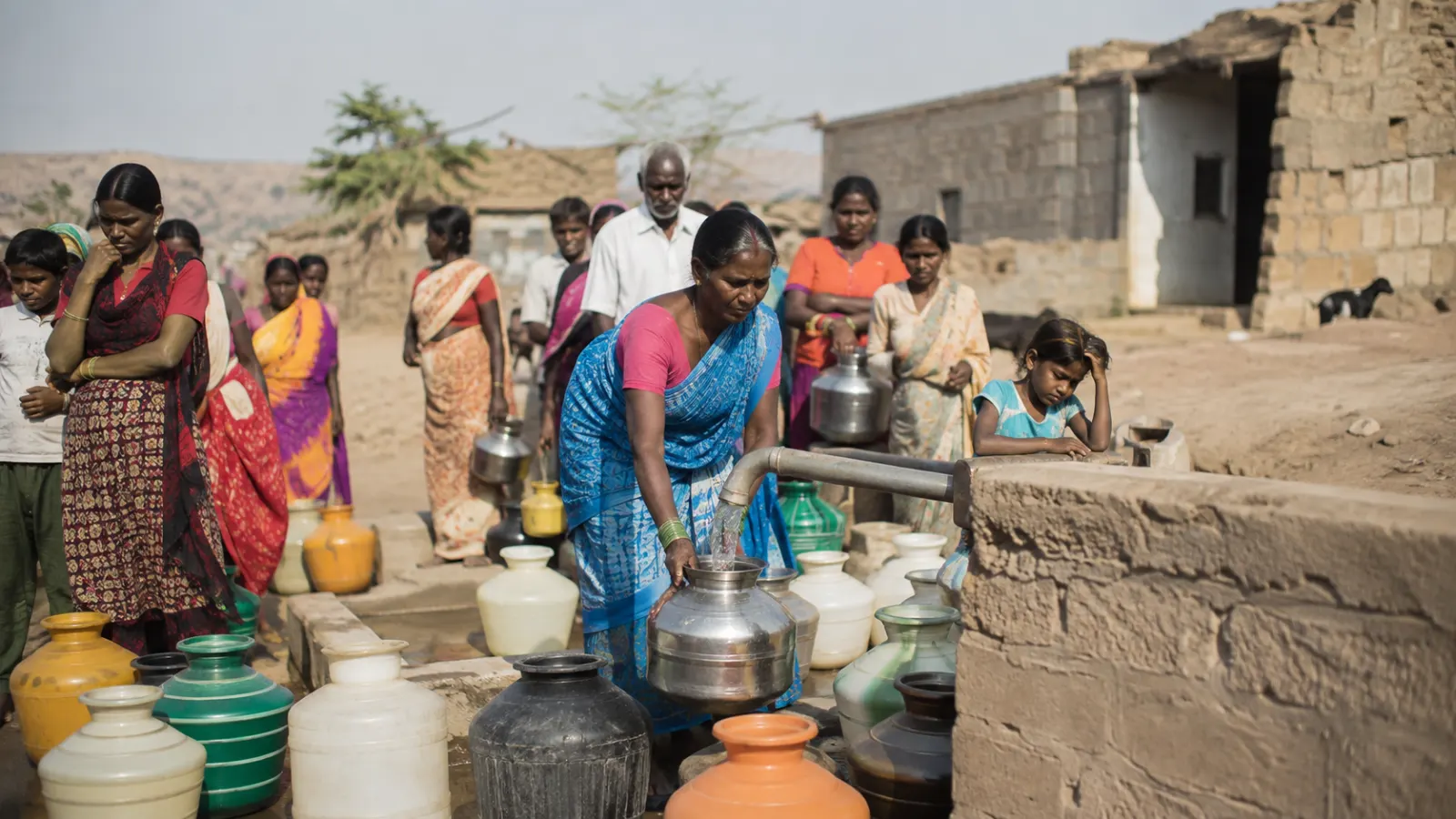
Lower-income households may wait in queues or purchase small volumes from informal vendors at high prices.
The physical shortage affects the city.
Its consequences depend partly on household resources.
Water scarcity can therefore intensify existing inequality.
The people paying the highest price per litre may be those receiving the least reliable service.
Scarcity Has a Time Burden
Where households lack nearby supply, someone has to collect water.
This frequently imposes a disproportionate burden on women and girls.
Time spent collecting water can replace school attendance, paid employment, rest or other household work.
Scarcity therefore has an economic dimension that ordinary water-volume statistics do not capture.
A household may technically obtain enough water to survive while paying for it with several hours of unpaid labour every day.
Water access improves when both the quantity burden and the time burden decline.
Water Scarcity Can Affect Food Prices
Because agriculture uses such a large share of withdrawn freshwater, severe scarcity can affect food production.
Restrictions on irrigation may reduce crop output.
Groundwater decline can raise pumping costs.
Drought can reduce yields.
Farmers may switch crops or reduce planting.
These effects can move through food markets and eventually influence consumer prices.
Water scarcity therefore does not remain confined to water utilities.
It can appear indirectly through food affordability and rural livelihoods.
Industry and Energy Also Compete for Water
Agriculture and households are not the only users.
Manufacturing may require water for processing and cleaning.
Power generation can require water for cooling.
Mining and construction may consume significant amounts locally.
When water becomes scarce, governments may face difficult allocation decisions among cities, agriculture, ecosystems and industry.
These choices are political as well as technical.
One allocation may protect employment while reducing river flow.
Another may protect irrigation while limiting urban expansion.
Scarcity exposes competing priorities that remain less visible when supply is abundant.
Ecosystems Need Water Too
Human water demand does not exist separately from ecological systems.
Rivers need sufficient flows to maintain habitats, water quality and fisheries.
Wetlands depend on hydrological conditions.
Groundwater supports some streams and ecosystems.
If every technically available litre is allocated to human consumption, the ecological systems supporting long-term water security can deteriorate.
This is why the SDG water-stress indicator accounts for environmental flow requirements.
Water remaining in a river should not automatically be described as “unused.”
It may be performing ecological work.
Environmental Flows Protect Future Water Security
Maintaining environmental flows can sometimes appear inefficient during severe scarcity.
Why leave water in the river when farms or cities need it?
The answer is that ecosystems provide services that also support human use.
Healthy rivers can transport sediment, maintain fisheries and help sustain water quality.
Wetlands can support biodiversity and influence flooding.
Groundwater-dependent ecosystems can decline when extraction lowers water tables.
Short-term over-allocation can therefore damage the very systems societies depend upon for future water security.
Scarcity management requires a long-term horizon.
“Use Less Water” Is Not Enough
Water conservation is valuable.
But the phrase use less water is too simple to guide serious policy.
Where is the water being used?
Is it being consumed or returned to the basin?
Is the source renewable?
What are the environmental requirements?
Could another sector use the same water more productively?
Would efficiency actually reduce total consumption?
These questions matter because water is geographically specific.
Saving a litre in a humid basin does not automatically provide an additional litre to a drought-stricken basin thousands of kilometres away.
Scarcity management therefore needs local accounting.
Withdrawals and Consumption Are Not the Same
Another important distinction concerns water withdrawals and water consumption.
A user can withdraw water from a river and later return much of it.
Another use may consume water through evaporation or incorporation into a product, leaving much less available for downstream users.
The distinction affects basin-wide scarcity.
A large withdrawal is not necessarily equivalent to a large net reduction in available water.
Serious water planning therefore considers both withdrawals and return flows rather than treating every litre removed temporarily from a river as permanently lost.
Leakage Reduction Can Increase Effective Supply
Urban water systems sometimes lose large volumes through ageing pipes.
Reducing those leaks can increase the amount of treated water reaching households without finding a new source.
This is one of the most direct scarcity interventions available to cities.
The water has already been captured, treated and pumped.
Preventing it from escaping the distribution network protects both water and the money used to produce it.
Leak reduction can therefore be considered a supply strategy.
The best new water source may sometimes be water the city is already producing but failing to deliver.
Water Recycling Can Reduce Pressure on Freshwater
Wastewater can become another supply source after appropriate treatment.
Recycled water may be suitable for irrigation, industrial processes, landscaping or other uses depending on quality requirements and regulation.
Advanced systems can support much broader reuse.
The main benefit is that the same water can provide multiple services before being discharged.
This reduces pressure on rivers and aquifers.
Wastewater reuse is particularly attractive in water-stressed cities because wastewater generation tends to remain relatively predictable even when rainfall is low.
The challenge is ensuring treatment, monitoring and public confidence.
Rainwater Harvesting Can Help Manage Seasonal Scarcity
Rainwater harvesting captures water during wet periods for later use.
At household scale, rooftop systems can provide supplementary water.
At larger scale, land management and local storage can support recharge or reduce pressure on conventional supplies.
The usefulness depends on rainfall patterns, storage capacity and intended use.
Rainwater harvesting cannot replace major urban supplies everywhere.
It can still diversify the water portfolio and reduce vulnerability to short interruptions or seasonal shortages.
Like most water technologies, it works best as part of a system rather than as a universal solution.
Desalination Expands Supply in Some Coastal Regions
Desalination can convert seawater or brackish water into freshwater.
For coastal cities with severe natural scarcity, this can create a dependable supply that is less directly dependent on rainfall.
But desalination has costs.
Plants require energy and sophisticated infrastructure.
Freshwater production can be expensive.
Concentrated brine needs environmentally responsible disposal.
Desalination therefore works well in some places and poorly in others.
It expands the range of available options.
It does not eliminate the need for conservation, wastewater reuse, groundwater management or source protection.
Better Storage Can Move Water Through Time
Storage is central to many scarcity strategies because rainfall and demand rarely align perfectly.
Reservoirs can preserve wet-season river flows for dry months.
Aquifer recharge can move water underground.
Smaller storage systems can support households and farms.
But storage also has trade-offs.
Large reservoirs can affect ecosystems and communities.
Water can evaporate from surface storage.
Sedimentation can reduce capacity over time.
Storage should therefore be evaluated alongside demand management rather than treated automatically as the answer to every shortage.
Integrated Water Resources Management Attempts to Join the Pieces
UN-Water promotes integrated water resources management, or IWRM, as a framework for coordinating water across sectors rather than treating household supply, agriculture, industry and ecosystems as unrelated systems.
The principle is important because decisions in one sector affect others.
A new irrigation project may reduce downstream urban supply.
A polluted industrial discharge can increase drinking-water treatment costs.
Groundwater pumping can reduce river flow.
Urban wastewater can become an irrigation resource after treatment.
Integrated planning attempts to make these connections visible before decisions are made.
The challenge lies in translating coordination from policy documents into actual allocation and enforcement.
Governance Determines Whether Scarcity Is Managed or Delayed
Water scarcity is often technically visible before it becomes politically unavoidable.
Groundwater levels fall.
Reservoir trends worsen.
Demand forecasts rise.
Leakage remains high.
Governments may still postpone difficult decisions because reducing allocations, changing subsidies or raising tariffs can be politically unpopular.
The result is management by crisis.
Restrictions are introduced only when reservoirs are nearly empty or wells begin failing.
Strong governance acts earlier.
It uses monitoring, allocation rules and long-term planning before scarcity becomes an emergency.
Water Pricing Can Influence Demand
Water prices can affect consumption by making waste more expensive.
But pricing is politically and ethically complicated because water is an essential human need.
Tariffs set too low may encourage waste and leave utilities without enough revenue to maintain infrastructure.
Tariffs set too high can make essential household use unaffordable.
Effective systems may therefore combine basic affordable access with prices or charges that rise for higher levels of consumption.
The precise design depends on local institutions.
Pricing is not merely an economic instrument.
It is also a question of fairness.
Allocation Rules Become More Important as Scarcity Intensifies
When water is abundant, allocation disputes can remain relatively invisible.
Scarcity forces them into the open.
Who receives water first during drought?
Households?
Farmers?
Industry?
Power stations?
Environmental flows?
Existing legal rights can shape the answer, as can political power.
A sustainable system requires rules established before crisis rather than improvised after supplies collapse.
Clear allocation frameworks can reduce uncertainty and make trade-offs more transparent.
Scarcity cannot always be eliminated.
It can be governed more fairly.
Water Rights Can Determine Who Bears the Shortage
Legal access to water varies greatly across countries and regions.
Some systems attach rights to land.
Others issue extraction permits.
Some groundwater users face weak regulation because monitoring thousands of private wells is difficult.
When rights are unclear, users may race to withdraw water before others do.
This creates a classic common-resource problem.
Individually rational pumping can produce collective depletion.
Effective groundwater and surface-water governance therefore often requires enforceable rights, measurement and limits.
Data Makes Invisible Scarcity Visible
Water managers need information about river flow, reservoir storage, rainfall, groundwater levels, withdrawals, water quality and demand.
Without data, scarcity can develop unnoticed.
Groundwater is especially vulnerable because declining reserves are hidden underground.
Monitoring wells can reveal trends.
Remote sensing can help track surface water and agricultural conditions.
Meters can show where urban water is being consumed or lost.
Data does not solve scarcity by itself.
It allows decisions to be made before the problem becomes impossible to ignore.
National Averages Can Hide Local Water Emergencies
Water scarcity is fundamentally geographical.
A country can have abundant water overall while one city or agricultural basin experiences extreme stress.
National per-capita figures can therefore mislead when interpreted too literally.
Water cannot always be transferred easily from where it is abundant to where it is scarce.
Mountains, distance, political boundaries and infrastructure costs matter.
This is why basin-level analysis is essential.
The hydrological unit and the political unit are often different.
Rivers and Aquifers Cross Political Borders
Some of the world’s most important water resources are shared between states or countries.
Upstream withdrawals can affect downstream users.
A dam can alter seasonal river flow.
Groundwater pumping on one side of a border can affect the same aquifer on the other.
Pollution can travel downstream.
Scarcity therefore can become a diplomatic issue.
Cooperation can improve forecasting, reservoir management and drought response.
Poor coordination can make a natural shortage more difficult to manage.
Water follows hydrology rather than political borders.
Virtual Water Connects Scarcity With Trade
Water used to produce food and manufactured goods is sometimes described as virtual water.
When a water-scarce country imports food, it is effectively relying on water used in the exporting country to grow that food.
This can reduce local pressure.
Trade therefore becomes part of the global water system.
However, reliance on imports also creates exposure to global prices and supply disruptions.
Virtual-water concepts are useful because they reveal that water scarcity is not managed only through physical pipes and reservoirs.
Economic exchange can move water demand indirectly across borders.
Scarcity Is Not Automatically Permanent
Low rainfall does not condemn a society to permanent crisis.
Several interventions can change the balance.
Demand can be reduced.
Leakage can be repaired.
Wastewater can be reused.
Groundwater pumping can be regulated.
Agricultural practices can change.
New storage can be constructed where appropriate.
Desalination can expand coastal supply in some regions.
Polluted sources can be restored.
The difficulty is that no intervention works universally.
Good policy begins by identifying which part of the water balance is failing.
Frequently Asked Questions
What is water scarcity?
Water scarcity occurs when available and accessible usable water is insufficient to meet human and environmental demand reliably and sustainably.
Is water scarcity the same as drought?
No. Drought is a period of abnormally dry conditions. Water scarcity is a broader imbalance involving supply, demand, quality, access and management.
What is water stress?
Water stress is an indicator comparing freshwater withdrawals with renewable freshwater resources while accounting for environmental flow requirements.
When is a country considered water-stressed?
Under the SDG framework cited by UN-Water, withdrawal of 25 per cent or more of renewable freshwater resources indicates water stress.
What causes water scarcity?
Causes can include low natural supply, drought, population growth, irrigation demand, groundwater depletion, pollution, poor infrastructure, climate change and weak governance.
What is physical water scarcity?
Physical scarcity occurs where renewable freshwater resources are genuinely limited relative to demand.
What is economic water scarcity?
Economic or institutional scarcity occurs where water exists physically but inadequate infrastructure, finance or governance prevents people from accessing sufficient safe supply.
Which sector uses the most freshwater globally?
Agriculture accounts for roughly 72 per cent of global freshwater withdrawals according to the FAO and UN-Water data cited in the supplied article.
Can groundwater depletion cause water scarcity?
Yes. Pumping groundwater faster than recharge can lower water tables, increase costs and eventually reduce accessible supply.
Can pollution cause water scarcity?
Yes. Pollution can make physically available water unsafe or expensive to use, shrinking effective supply.
How does climate change affect water scarcity?
Climate change can alter rainfall, evaporation, snow and ice, drought, flooding and the timing of water availability, making supply less predictable.
Can a rainy country experience water scarcity?
Yes. High rainfall does not guarantee adequate storage, clean water, infrastructure or equal access.
Can cities reduce scarcity by fixing leaks?
Yes. Reducing distribution losses can increase effective supply without developing another water source.
Does irrigation efficiency always save water?
Not necessarily. Total use may remain high if efficiency gains encourage expansion of irrigated land or production.
Can desalination solve water scarcity?
Desalination can provide important additional supply in some coastal areas but has financial, energy and environmental costs.
Is wastewater reuse useful during scarcity?
Yes. Properly treated wastewater can replace freshwater for several uses and reduce pressure on conventional supplies.
Why do ecosystems need water during scarcity?
Rivers, wetlands and aquifers require water to maintain habitats, water quality and ecological functions that also support long-term human water security.
Is household conservation enough to solve water scarcity?
Usually not by itself. In many basins, agriculture, infrastructure losses and groundwater use are much larger parts of the water balance.
Can water scarcity be prevented?
Some forms can be reduced or prevented through better management, infrastructure, pollution control, demand management, groundwater regulation and diversified supply.
Water Scarcity Is an Imbalance, Not an Empty Reservoir
The familiar image of an empty reservoir remains useful.
It shows a visible shortage.
But the water may become scarce long before the reservoir reaches that point.
The aquifer may already be declining underground.
Pollution may have removed part of the usable supply.
Agricultural demand may exceed sustainable availability.
Poor neighbourhoods may already experience shortages while wealthier areas remain protected by storage.
Infrastructure may be leaking enough water to create artificial scarcity.
The system can therefore be in trouble before the dramatic photograph appears.
The Central Idea
Water scarcity is best understood as a relationship between supply, demand, quality, timing, access and environmental needs rather than as a synonym for drought.
The source you supplied captures this distinction clearly. Scarcity can intensify because less water is available, because demand grows, because pollution reduces usable supply or because infrastructure and governance fail to deliver water effectively.
That understanding explains why scarcity can occur in places that do not look dry.
A city beside a river may lack treatment and distribution capacity.
A farming region may appear green because it is drawing down groundwater reserves.
A rainy region may receive most of its precipitation during a few months and lack enough storage to cross the dry season.
A polluted basin may contain plenty of water physically while having very little that is economical to use safely.
Agriculture matters particularly because it accounts for roughly 72 per cent of global freshwater withdrawals. This means meaningful scarcity policy often has to include irrigation, crop choices and groundwater management rather than focusing only on domestic consumption.
Groundwater adds another layer. Aquifers can stabilise supply during drought, but unsustainable pumping can conceal a worsening water balance for years.
Climate change further complicates planning by making water availability more variable and less predictable.
None of this means scarcity is inevitable.
Demand can change.
Leaks can be repaired.
Groundwater can be regulated.
Polluted water can be protected or restored.
Wastewater can be reused.
Rainwater can be captured.
Storage can be improved.
Agricultural production can become more compatible with basin limits.
Alternative supplies such as desalination can play a role where appropriate.
But no technology can substitute for knowing the actual water balance.
That is why the most important scarcity question is not simply:
How can we find more water?
It is:
How much usable water is available, who is using it, what must remain for ecosystems, and can the system continue operating that way without eventually failing?
When those questions are answered before shortages become emergencies, water scarcity becomes something societies can manage rather than merely endure.