The United Nations was created to prevent humanity from repeating its worst mistakes.
It was born after world war, genocide, imperial collapse and the recognition that unrestrained power could destroy civilisation itself. Its promise was ambitious: peace, sovereignty, human rights, development, cooperation and a forum where even small states could speak in the presence of great powers.
Eighty years later, the United Nations is still necessary. But it is no longer unquestionably authoritative.
Wars continue despite Security Council debates. Humanitarian catastrophes unfold while diplomats negotiate commas. Great powers use the veto to protect allies or themselves. Smaller countries ask why a world body built in 1945 still reflects the power balance of 1945. Agencies carry large mandates but face shrinking resources. The Global South demands representation, climate finance, debt reform and development justice, but sees slow institutional movement.
The UN is not collapsing. That would be too simple a diagnosis. The deeper problem is that the UN is being asked to govern a twenty-first-century world with twentieth-century power structures.
That is the crisis of authority.
And reform is no longer a polite diplomatic slogan. It is a test of whether multilateralism can survive the age of fractured power.
The current trigger: an 80-year-old institution under financial and political stress
The UN’s crisis is not only philosophical. It is operational.
Secretary-General António Guterres has placed the UN80 Initiative at the centre of the organisation’s reform conversation. In October 2025, while presenting the proposed programme budget for 2026, he said the initiative was driven by urgency and aimed at making the Secretariat more effective, agile, resilient and cost-efficient amid deepening geopolitical divides, inequality, climate disruption and technological change.
That reform push has become sharper because the UN is also facing a serious liquidity crisis. Reuters reported in December 2025 that Guterres proposed cutting the 2026 core UN budget by $577 million, or 15 percent, and reducing more than 18 percent of jobs. He told the General Assembly budget committee that arrears stood at $1.586 billion, including outstanding 2024 dues and unpaid 2025 dues.
The crisis continued into 2026. Reuters reported on May 28, 2026, that Guterres was seeking reductions in senior leadership positions, had already shifted more than 2,000 UN jobs out of expensive cities such as New York and Geneva, and said member states held the key to deeper reform.
This matters because an underfunded UN cannot be an authoritative UN. A body asked to manage wars, humanitarian disasters, peacekeeping, climate negotiations, development goals, refugee crises, human rights monitoring and global norms cannot function properly when its members load it with mandates but delay or reduce funding.
A crisis of authority quickly becomes a crisis of capacity.
The UN’s legitimacy problem begins with the Security Council
The Security Council is the centre of the UN’s authority problem.
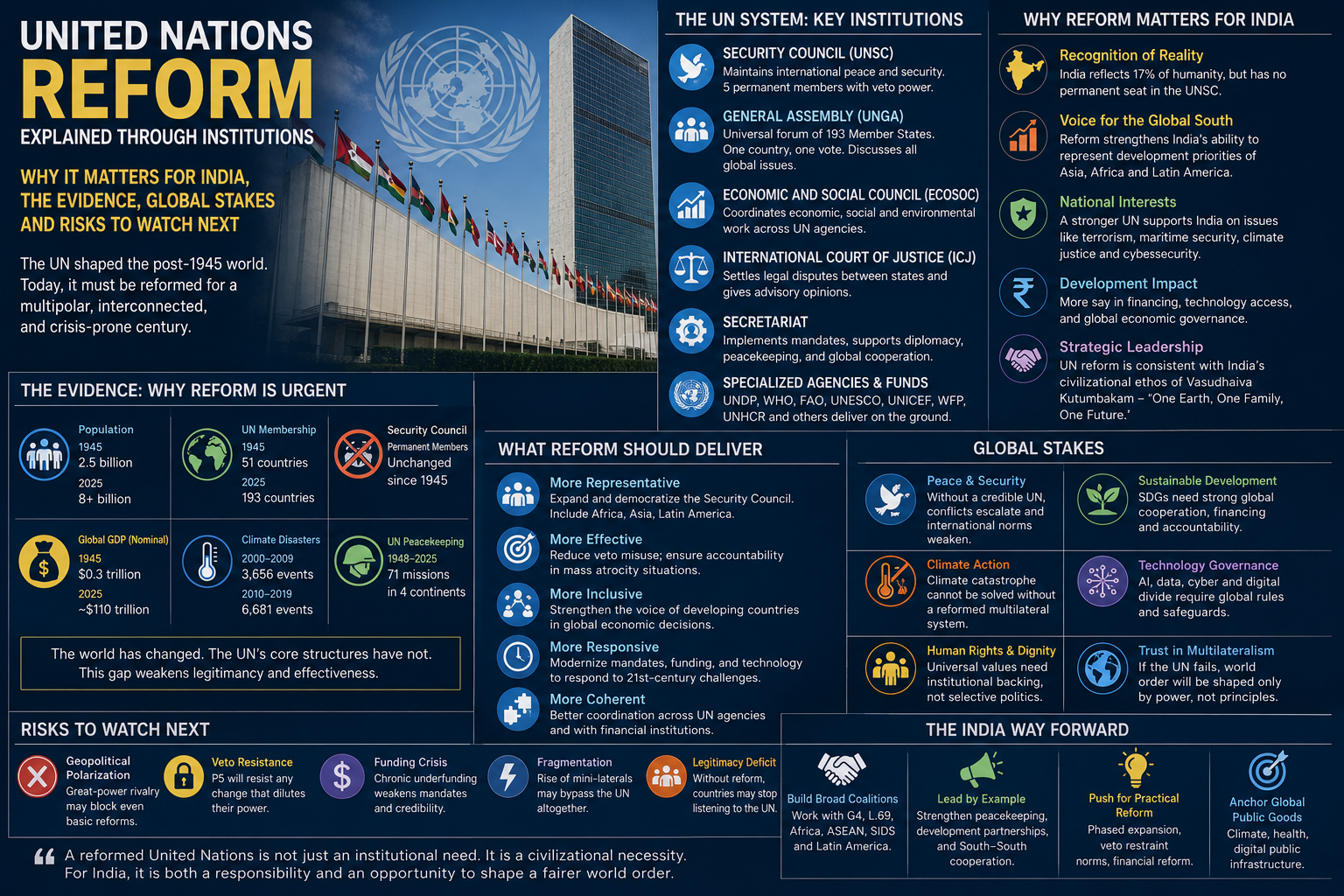
The Council has 15 members: five permanent members — China, France, Russia, the United Kingdom and the United States — and ten non-permanent members elected for two-year terms by the General Assembly. This structure gives permanent members veto power over substantive resolutions, meaning one great power can block action even when a majority of the Council supports it.
The problem is not simply that the veto exists. The problem is that the veto now symbolises a wider democratic deficit in global governance.
The world of 1945 was shaped by the victors of the Second World War. The world of 2026 is shaped by decolonisation, emerging economies, regional powers, demographic shifts, climate vulnerability, digital power, financial interdependence and the rise of the Global South. Yet the most powerful organ of the UN still gives permanent decision power to the old post-war settlement.
That mismatch weakens legitimacy.
When the Security Council acts, critics ask whether it reflects global justice or great-power consent. When it fails to act, victims ask whether international law means anything without enforcement. Either way, the Council’s design produces frustration.
The veto has become the visible symbol of paralysis
The veto was originally justified as a practical compromise. The UN’s founders believed that no global security system could survive without the great powers inside it. Giving them veto power was the price of keeping them at the table.
But the same mechanism that kept great powers inside the UN also gave them a tool to block the UN.
The Gaza war made this visible again. On June 4, 2025, a draft Security Council resolution demanding an immediate and permanent ceasefire in Gaza failed after the United States cast its veto, even though the text received 14 votes in favour and was backed by all ten elected members of the Council.
That episode captured the central problem. The Security Council can represent near-universal concern and still be blocked by one permanent member.
The same pattern appears in other conflicts. Russia’s position on Ukraine, Western divisions over the Middle East, Chinese and Russian concerns over interventionism, and broader geopolitical rivalry have made consensus harder. When great powers or their close allies are involved, the Council often becomes a theatre of accusation rather than an instrument of action.
This does not mean every veto is morally identical. States use vetoes for different reasons, sometimes to prevent what they see as unbalanced or dangerous resolutions. But politically, the effect is similar: the world’s main peace-and-security body appears unable to act when stakes are highest.
The General Assembly speaks, but cannot enforce
The General Assembly gives every UN member state a voice. That is its moral strength.
But it does not have the enforcement power of the Security Council. It can pass resolutions, create political pressure, express global opinion and strengthen legitimacy around certain norms. Yet it cannot compel compliance in the same way a binding Security Council decision can.
This creates a strange imbalance. The body that is most representative is often less powerful. The body that is most powerful is often least representative.
That is why many countries, especially in the Global South, see UN reform as a justice issue. They are not merely asking for procedural change. They are asking why global authority is concentrated in structures that do not reflect contemporary demographics, economic weight or political realities.
The UN cannot claim to represent “We the Peoples” if the centre of hard power remains frozen in the world of its founding.
The Pact for the Future recognised the problem
The UN system is not unaware of its crisis.
At the Summit of the Future in September 2024, world leaders adopted the Pact for the Future, along with the Global Digital Compact and the Declaration on Future Generations. UN sources described the Pact as a major effort to modernise international cooperation for a world very different from the one in which today’s institutions were created.
The Pact included what UNIS Vienna described as the most progressive and concrete commitment to Security Council reform since the 1960s, including improving the Council’s effectiveness and representativeness and redressing Africa’s historical under-representation as a priority.
That language matters. But language is not reform.
The UN has produced many strong documents. Its problem is implementation. Member states often agree that reform is needed in principle, then disagree on who should gain power, who should lose privilege, how veto rights should change, and whether new permanent members should be added.
The politics of reform is harder than the poetry of reform.
The Global South wants representation, not sympathy
The Global South’s argument is straightforward: the world has changed.
Africa has 54 UN member states but no permanent seat on the Security Council. India is the world’s most populous country and a major economy but remains outside the permanent membership. Latin America has no permanent representation. Large contributors to peacekeeping and development debates often have little structural power in decision-making.
This is not sustainable for long-term legitimacy.
For developing countries, UN reform is connected to other frustrations: debt, climate finance, unequal trade rules, vaccine inequity, technology access, migration, development finance and humanitarian double standards. The Security Council is only one institution, but it has become a symbol of a wider global order that many countries consider outdated.
The Global South is not asking for symbolic inclusion alone. It wants voice where decisions are made.
A world body cannot expect developing countries to support multilateral norms while excluding them from the highest table of global authority.
India’s UN reform case is serious but politically difficult
India has made UN Security Council reform a central foreign-policy objective.
In a November 2024 parliamentary reply, India’s Ministry of External Affairs said the government accords the highest priority to obtaining permanent membership in an expanded Security Council and believes India has the credentials to be a permanent member of a reformed and expanded Council reflecting contemporary global realities.
The same MEA reply noted that India is active in the Inter-Governmental Negotiations on UNSC reform and works through the G4 group — India, Japan, Brazil and Germany — and the L.69 group of developing countries from Asia, Africa and Latin America to build support for expansion. It also stated that Charter amendment would require approval by two-thirds of UN members and ratification by two-thirds of members, including all permanent Security Council members.
This is the core obstacle. India’s claim may be strong, but the process is structurally difficult.
Any serious reform must overcome regional rivalries, resistance from existing permanent members, disagreement over veto rights, and competing claims from other aspirants. India’s population, economy, peacekeeping role and Global South credentials strengthen its case. But geopolitics, not merit alone, will decide the outcome.
Peacekeeping shows both the UN’s value and weakness
Peacekeeping is one of the UN’s most visible contributions to global security.
The UN currently lists 11 peacekeeping operations, including missions in Western Sahara, Central African Republic, Democratic Republic of Congo, Golan, Cyprus, Lebanon, Abyei, Kosovo, South Sudan, India and Pakistan, and the Middle East.
Peacekeeping shows why the UN still matters. In many fragile regions, UN missions provide monitoring, civilian protection, humanitarian support, de-escalation and a thin line between conflict and wider collapse. The UN does not have its own army; peacekeepers are contributed by member states, which makes the system dependent on political will and funding. The UN Peacekeeping site notes that military and police personnel are first members of their national services and then seconded to work with the UN.
India’s role here is significant. The MEA said in July 2025 that India’s Centre for UN Peacekeeping has trained nearly 10,000 Indian peacekeepers and 2,000 foreign peacekeepers from 96 countries. It also stated that India had 154 women peacekeepers deployed in six UN missions and organised a conference for women peacekeepers from 35 Global South countries in February 2025.
But peacekeeping also reveals the UN’s weakness. Missions are often deployed where there is no peace to keep. They operate under political constraints, limited mandates, hostile armed groups and uncertain funding. When major powers disagree, peace operations can become overstretched, under-resourced and vulnerable.
The UN is blamed for failures even when member states deny it the tools required to succeed.
The funding crisis exposes a deeper hypocrisy
The UN’s member states often demand more from the organisation than they are willing to fund.
They ask the UN to respond to wars, feed the hungry, protect refugees, monitor human rights, support elections, coordinate climate action, fight pandemics, regulate emerging technology and deliver development programmes. Then many delay payments, cut contributions or attach political conditions.
The 2026 budget crisis exposed this contradiction. Reuters reported that the proposed 2026 core budget was $3.238 billion after a 15 percent reduction and that contributions to agencies such as the World Food Programme and UNICEF are mostly voluntary, not part of the core budget.
This means the UN’s most politically visible functions and many of its life-saving operations are vulnerable to donor mood, domestic politics and geopolitical bargaining.
A global institution cannot be stable if its funding is unstable.
If member states want a leaner UN, reform is legitimate. If they want a cheaper UN while increasing mandates, that is hypocrisy.
Development failure weakens UN authority
The UN is not only a peace-and-security body. It is also the home of the Sustainable Development Goals.
That development agenda is also under stress. The UN’s 2025 SDG reporting found that only about 35 percent of SDG targets were on track or making moderate progress, while many were moving too slowly or regressing.
This matters because the UN’s authority depends not only on stopping war, but also on improving lives.
If poverty remains deep, hunger rises, climate shocks intensify, debt traps worsen and young populations lose faith in development promises, the UN’s legitimacy suffers. Developing countries will ask whether multilateralism is only good at producing declarations, not delivery.
The UN cannot solve development failure alone. National governments, private capital, development banks, trade systems and regional institutions all matter. But the UN is the moral and diplomatic centre of the global development promise. When that promise fails, its credibility is weakened.
Humanitarian work is becoming harder
The UN’s humanitarian role is also under pressure.
The 2026 Global Humanitarian Overview set out plans to support people affected by conflict, climate shocks, displacement and crisis. OCHA’s 2026 appeal was reported as seeking around $33 billion to assist 135 million people, with an urgent prioritised plan for 87 million people in the most life-saving category.
This reflects a painful reality: humanitarian agencies are no longer planning to reach everyone in need. They are being forced to prioritise the most desperate because funding is inadequate.
That is not only a budget problem. It is a moral problem.
A world that spends heavily on war but underfunds humanitarian relief sends a clear message about its priorities. The UN becomes the institution asked to manage the consequences of decisions made elsewhere: wars it did not start, sanctions it did not design, climate damage it did not cause, and displacement it did not create.
The UN is expected to treat wounds while member states continue producing them.
International law is weakened by selective obedience
The UN’s authority depends on the belief that rules matter.
But international law becomes fragile when powerful states obey it selectively. Smaller states notice when interventions are justified in one case and ignored in another. They notice when civilian protection is invoked in one conflict but subordinated to alliances in another. They notice when sovereignty is defended in Europe but negotiated differently in the Middle East or Africa.
This perception of double standards is one of the most corrosive threats to the UN system.
The UN cannot function if rules apply only to weak states. Its Charter is built on sovereign equality, but its enforcement mechanisms reflect unequal power. This contradiction has existed since 1945, but it has become harder to defend in a more politically aware and multipolar world.
The more visible the double standards, the weaker the authority of international law.
The counter-view: the UN is flawed because the world is flawed
There is a serious counter-argument: blaming the UN is too easy.
The UN is not a world government. It cannot force great powers to cooperate when they refuse. It cannot create peace where states and armed groups prefer war. It cannot fund itself without member contributions. It cannot reform its Charter without approval from the very powers whose privileges are being questioned.
In that sense, the UN’s failures often reflect the failures of its member states.
The Security Council is paralysed because great powers are divided. Humanitarian appeals are underfunded because governments do not pay enough. Peacekeeping struggles because mandates are political compromises. Development goals fall behind because national policies, conflict, debt and climate stress overwhelm cooperation.
This argument is valid.
But it does not absolve the UN system. Institutions shape incentives. Outdated institutions can worsen mistrust. A body that cannot adapt to new power realities will lose legitimacy even if its failures are partly caused by member states.
The UN is both a mirror and a machine. It reflects global politics, but it also structures global politics.
What real reform should include
UN reform must go beyond cost-cutting.
A cheaper UN is not automatically a better UN. Reform should make the organisation more representative, effective, accountable and capable.
First, Security Council reform must remain central. Expansion should include stronger representation for Africa, Asia and Latin America. India’s case deserves serious consideration, but reform cannot be reduced to India alone. The Council must reflect contemporary global realities, not only national ambitions.
Second, the veto must be constrained, even if it cannot be abolished. Permanent members should face greater political accountability when using it, especially in cases involving mass atrocities, humanitarian catastrophe or direct conflicts of interest.
Third, funding must become more predictable. Member states should not be allowed to demand mandates without paying dues. Voluntary funding models also need reform because they give wealthy donors disproportionate influence over priorities.
Fourth, mandates should be reviewed seriously. The UN should not carry overlapping programmes simply because old mandates are politically difficult to close. The UN80 reform process is right to examine silos, duplication and operational inefficiency.
Fifth, the UN must strengthen regional partnerships. The African Union, ASEAN, the European Union, Arab League and other regional bodies can often act faster or with greater local legitimacy.
Sixth, digital governance, artificial intelligence, cyber norms and climate security must move from side conversations to core governance issues. The Pact for the Future recognised digital cooperation and future generations as central themes, but implementation will decide whether these commitments matter.
What India should do next
India should pursue UN reform with strategic patience and sharper diplomacy.
First, India must continue building support for permanent membership, but it should avoid making reform appear like a narrow Indian demand. It must frame its case as part of a wider democratic correction in global governance.
Second, India should deepen coordination with Africa, Latin America and small island states. A reformed UN must not look like a deal among large powers alone.
Third, India should connect its peacekeeping role, development diplomacy, digital public infrastructure, vaccine capacity and Global South advocacy into one coherent multilateral identity.
Fourth, India should propose practical reforms short of Charter amendment: veto accountability, stronger General Assembly follow-up, improved peacekeeping mandates, better financing of humanitarian operations, and greater transparency in Security Council working methods.
Fifth, India must preserve credibility by supporting international law consistently. A country seeking a permanent seat must be seen not only as powerful, but as responsible.
The strongest case for India is not simply that India is large. It is that a Council excluding India looks increasingly disconnected from global reality.
What happens next
Three futures are possible.
In the first, the UN adapts. Security Council reform advances, veto accountability improves, funding becomes more predictable, the UN80 process reduces duplication, and the organisation becomes more representative without losing functionality.
In the second, the UN survives but weakens. It continues producing resolutions, reports and humanitarian appeals, but great powers increasingly bypass it, regional blocs fragment global governance, and the Security Council becomes less relevant to major crises.
In the third, the UN becomes a stage without authority. States use it for speeches, blame and symbolism while real decisions move to coalitions, minilateral groups, military blocs, development banks and ad hoc arrangements.
The world should work for the first scenario because the alternatives are dangerous.
A weak UN does not produce a more democratic world. It usually produces a more lawless one.
The final argument
The United Nations faces a crisis of authority because the world still needs it but no longer fully trusts it.
That is the tragedy of modern multilateralism.
No other institution has the same universal membership, normative legitimacy, humanitarian reach, development mandate and symbolic authority. Yet no other institution so clearly exposes the gap between global ideals and geopolitical reality.
The UN was built to prevent great-power conflict, protect sovereignty and organise cooperation. But today it must also confront civil wars, climate breakdown, debt distress, digital power, pandemics, migration, terrorism, inequality, artificial intelligence and the demands of a rising Global South.
It cannot do all of that with outdated structures, unpaid dues, selective obedience and a Security Council trapped in old privilege.
Reform will be difficult because those who benefit from the present system must approve changes to it. But difficulty is not an argument for delay. It is an argument for urgency.
The United Nations does not need to become a world government. It needs to become a credible world forum again.
For that, it must be more representative, better funded, less paralysed, more accountable and more honest about the gap between power and justice.
The UN’s future will not be decided by speeches praising multilateralism.
It will be decided by whether member states are willing to share authority, pay their dues, restrain their vetoes and accept that a world changed by decolonisation, development, demography and technology cannot be governed forever by the arrangements of 1945.
The United Nations is not irrelevant.
But without reform, it may become respected in language and ignored in practice.
That is the crisis.
And that is the test.
Language correction: “Start writing the nineteenth article.” is grammatically correct.