Why This Topic Matters
In practical terms, this subject connects legal theory with everyday governance. It affects how the state may act, how citizens may respond and how courts may examine public power. A clear understanding of understanding the role of the president therefore helps readers move beyond surface-level definitions and understand the working logic of law.
Meaning
The President is the constitutional head of the Union and represents the Republic in formal constitutional action.
A useful way to understand the topic is to ask three questions: what power or right is involved, who exercises or claims it, and what limits or safeguards control it. Legal concepts become clearer when they are connected to institutions, procedures and remedies rather than memorised as isolated definitions.
Legal or Constitutional Basis
Primary reference points: Articles 52, 53, 54, 74, 75, 79 and 111 of the Constitution.
These provisions and principles should be read with the broader constitutional values of justice, liberty, equality, dignity, accountability and rule of law. In Indian public law, no institution or legal power exists in isolation. Every power is shaped by text, precedent, procedure and constitutional morality.
How It Works in Practice
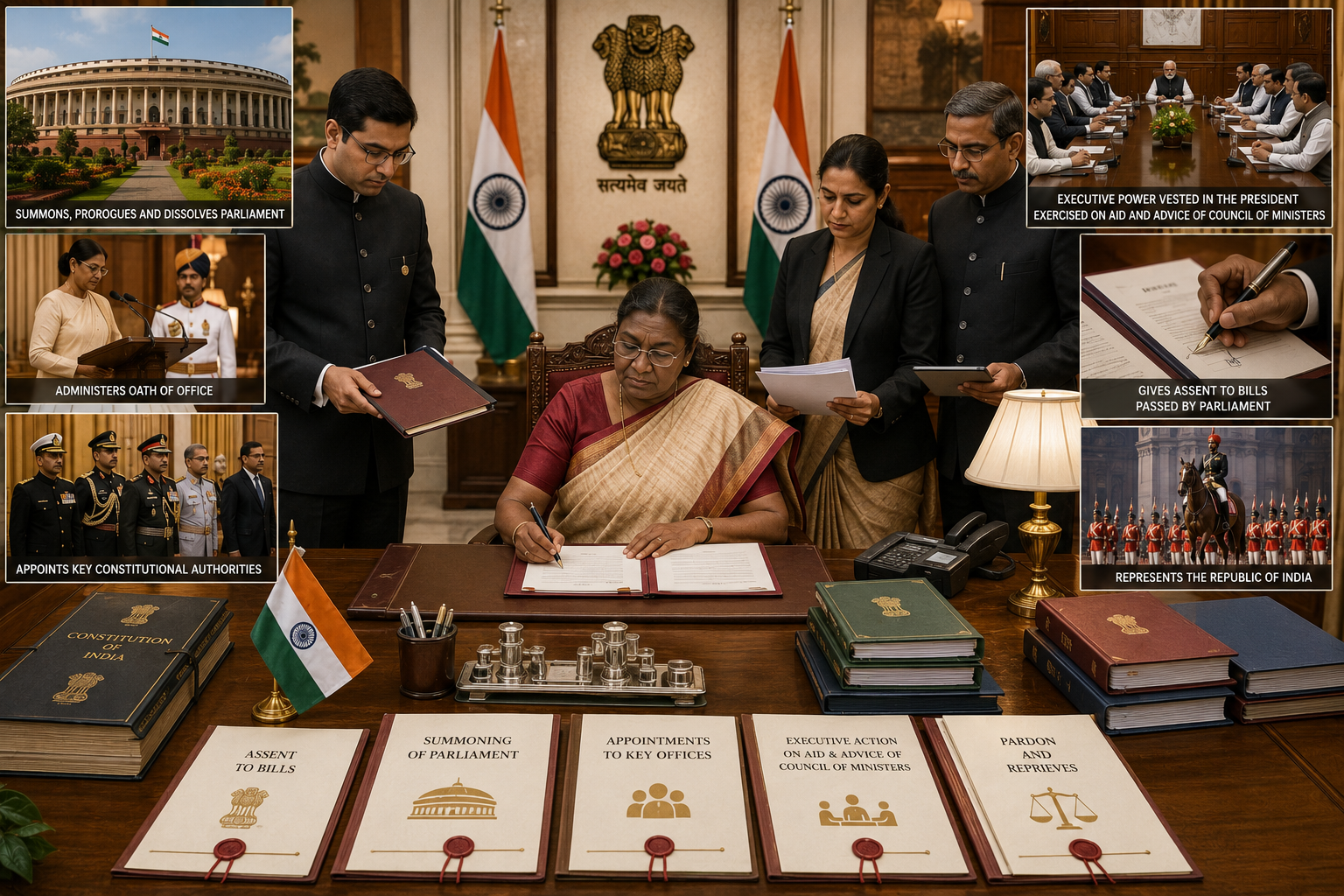
Executive power is vested in the President but is ordinarily exercised on the aid and advice of the Council of Ministers.
The practical working of this topic usually depends on procedure. Procedure decides who may act, what form the action must take, what safeguards must be followed, and what remedy is available when the rule is violated. This is why legal education must explain process and not only principle.
Citizen and Governance Impact
The President appoints key officials, summons Parliament, gives assent to Bills and ensures constitutional continuity.
For governance, the topic strengthens institutional responsibility. For citizens, it creates awareness about rights, duties, remedies and limits. In a democracy, legal literacy is not only useful for lawyers; it is part of responsible citizenship.
Examples and Practical Illustration
For example, a citizen reading about understanding the role of the president should be able to identify where the concept appears in public life: in courts, elections, administration, law-making, police procedure, public finance, rights enforcement or ordinary disputes. The point is not only to know the term, but to recognise when it becomes relevant.
A practical article should therefore connect doctrine with lived situations: a voter checking the electoral roll, an accused person seeking bail, a student invoking equality, a litigant approaching a High Court, a worker seeking legal protection, or Parliament debating a law.
Limits, Debates and Misunderstandings
The President is not the day-to-day political executive; India is a parliamentary system led by the Prime Minister and Council of Ministers.
Most legal concepts are misunderstood when they are treated as absolute. Rights have limits, powers have procedures, institutions have jurisdictions and remedies have conditions. A good legal explainer must therefore show both the strength and the boundary of the concept.
Final Takeaway
Understanding the Role of the President should be understood as part of the larger constitutional promise that power must remain accountable, law must remain fair and citizens must have meaningful access to rights and remedies. The topic is important not only for examinations or legal awareness, but for understanding how democracy functions in real life.
Disclaimer: This article is for general information and educational understanding only. It is not personal legal advice. For specific legal problems, consult a qualified legal professional.