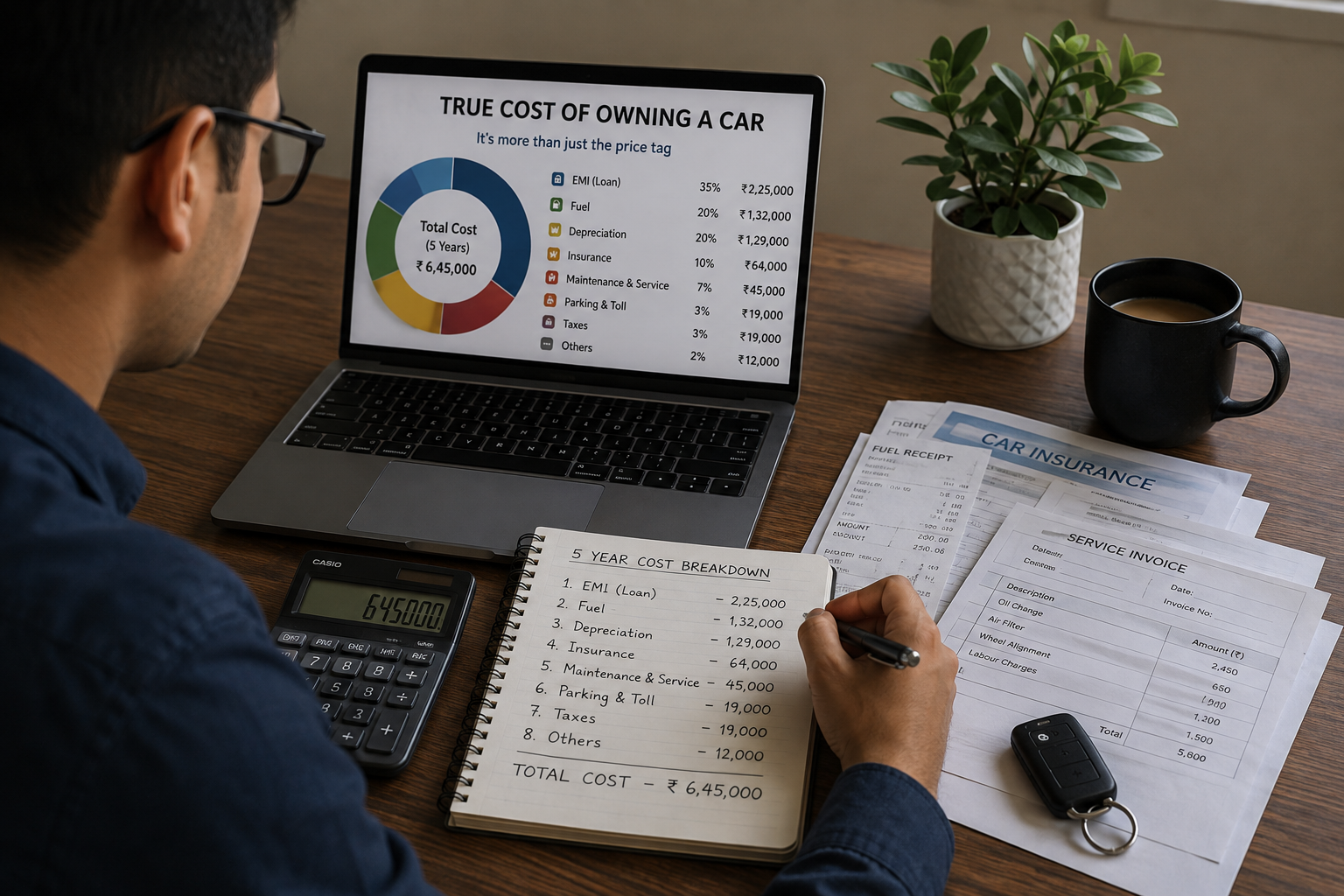
The car price is not the car cost
A car is rarely bought only with money. It is bought with aspiration, comfort, family pride, convenience, status, safety and emotion. The showroom price is visible. The smell of a new vehicle is immediate. The promise of freedom is powerful. But the real financial cost of owning a car begins after the purchase, not before it.
Most buyers calculate the car through one or two numbers: down payment and EMI. If the EMI fits the monthly income, the car feels affordable. But car ownership is not only an EMI decision. It is a recurring financial commitment that includes depreciation, fuel, insurance, maintenance, repairs, tyres, parking, tolls, cleaning, registration, taxes, interest cost and the opportunity cost of money locked into a depreciating asset.
This is why the true cost of a car is usually much higher than what a buyer imagines at the time of purchase. A car can improve quality of life. It can save time, protect family comfort and provide mobility. But it can also quietly eat wealth if bought without full-cost awareness.
The first cost: purchase price and on-road price
The ex-showroom price is not the amount the buyer finally pays. The real entry cost is the on-road price. This may include registration charges, road tax, insurance, fastag, handling-related expenses where applicable, accessories, extended warranty, basic kit, temporary registration and other state or dealer-level charges.
Many buyers negotiate only the ex-showroom discount and ignore the total on-road cost. A car that appears affordable in advertisements may become significantly costlier once taxes, insurance and add-ons are included. This gap matters because the loan amount and down payment are often built around the on-road figure, not the headline price.
The buyer should therefore ask for a complete cost sheet before making a decision. Every line should be understood. Some items may be mandatory. Some may be optional. Some may be negotiable. The correct question is not, "What is the EMI?" The correct question is, "What is the total amount I will pay to put this car on the road?"
Depreciation: the invisible wealth loss
Depreciation is usually the largest hidden cost of car ownership. A car loses value as soon as it is purchased and continues to lose value with age, mileage, wear, model changes and market preference. Unlike a productive business asset, a personal car generally does not generate income. It consumes capital and gradually loses resale value.
Depreciation hurts because it is not paid monthly like EMI or fuel. It is invisible until resale. A buyer may feel the car costs only the EMI and fuel, but every year the vehicle's market value is declining. The more expensive the car, the larger the absolute depreciation can be.
This does not mean no one should buy a car. It means a buyer must understand that a car is usually a consumption asset, not a wealth-building asset. If the car saves time, supports work, improves family convenience or is necessary due to location, it may be justified. But if it is bought mainly for status, depreciation becomes the price of that status.
Loan interest and EMI burden
When a car is financed through a loan, the buyer pays interest in addition to the vehicle price. EMI makes the purchase feel manageable, but it can hide total cost. A lower EMI achieved through longer tenure may increase total interest. A small difference in interest rate can also matter over time.
The EMI should be judged against income stability and other financial goals. A household already paying home loan EMI, education expenses, insurance premiums and family responsibilities should not stretch too aggressively for a car. The car EMI should not crowd out emergency savings, retirement investing or health protection.
A useful rule is to calculate not only EMI, but total car outflow: EMI plus fuel plus insurance plus maintenance plus parking plus tolls. If the full monthly car cost feels heavy, the car is not affordable even if the EMI alone looks comfortable.
Fuel, charging and running cost
Running cost depends on fuel type, mileage, usage pattern, traffic conditions and driving behaviour. A petrol car, diesel car, CNG car and electric vehicle have different cost profiles. A vehicle that is economical for highway driving may be expensive in city traffic. An electric vehicle may offer lower running cost, but the buyer must also consider charging access, battery warranty, resale uncertainty and upfront price.
Many people underestimate running cost because they do not track kilometres driven. A daily commute of 40 kilometres, weekend travel and family trips can add up quickly. Fuel cost also changes with price movement. A car that is affordable at one fuel price may feel expensive when fuel prices rise.
The correct approach is to estimate annual kilometres, expected mileage, fuel or charging cost, and maintenance pattern. A car's cost should be calculated per kilometre as well as per month. This reveals whether the car is genuinely efficient for the buyer's lifestyle.
Insurance, maintenance and repairs
Insurance is not a one-time cost. It renews every year. Comprehensive insurance, third-party cover, own-damage cover, zero-depreciation add-on, engine protection, roadside assistance and other add-ons can change the annual premium. Cheaper insurance is not always better if it removes essential protection. But unnecessary add-ons can also inflate cost.
Maintenance includes scheduled servicing, oil, filters, brake pads, alignment, balancing, tyres, battery, cleaning, accidental repairs and wear-and-tear items. Luxury cars and imported components can make maintenance far more expensive than expected. Even affordable cars can become costly if parts are expensive or service networks are weak.
The buyer should check service intervals, estimated annual service cost, tyre replacement cost, battery cost and common repair patterns before purchase. A car should be evaluated like a long-term household expense, not just a showroom event.
Parking, tolls, fines and city costs
Urban car ownership has additional costs. Parking at home may require society charges or rented space. Office parking may be paid. Market parking, airport parking and event parking add small but repeated outflows. Toll roads, expressways and city restrictions also affect the total cost.
Fines and compliance costs should not be ignored. Pollution certificate, insurance renewal, registration-related rules, traffic fines and document updates are part of responsible ownership. Poor compliance can turn a small expense into a legal or financial problem.
In dense cities, the cost of owning a car is not only financial. There is time spent in traffic, stress of parking and the opportunity cost of choosing car travel over public transport, cab, metro or two-wheeler alternatives. Mobility should be evaluated against real usage, not imagined lifestyle.
Opportunity cost: what else could the money do
The opportunity cost of car ownership is the return or benefit the buyer gives up by spending money on the car. A large down payment could have gone into an emergency fund, debt repayment, mutual funds, business capital, education or home down payment. Monthly EMI could have been invested for long-term goals.
This does not mean every rupee must be invested and no comfort should be purchased. Personal finance is not about punishment. But opportunity cost helps reveal the trade-off. A car bought too early can delay wealth creation. A car upgraded too frequently can keep a family in permanent consumption mode.
A financially mature buyer asks: what will this car improve in my life, and what will it delay? The answer may still support buying the car, but the decision becomes conscious.
New car vs used car
A used car can reduce depreciation cost because the first owner absorbs the steepest early decline in value. For buyers who need mobility but want lower ownership cost, a well-inspected used car can be financially sensible. However, used cars require careful checks: service history, accident record, ownership transfer, insurance, loan hypothecation, odometer reliability and mechanical condition.
A new car offers warranty, latest features, lower immediate repair uncertainty and emotional satisfaction. A used car offers lower capital cost. The right choice depends on budget, usage, risk comfort and ability to inspect the vehicle properly.
The financial point is clear: the cheapest car is not always the best, and the newest car is not always the wisest. The best car is the one that meets the real need at a sustainable lifetime cost.
Final takeaway
The true cost of owning a car is the total cost of mobility, not the showroom price. EMI is only one part. Depreciation, fuel, insurance, service, repairs, parking, taxes, tolls, compliance and opportunity cost all shape the real burden.
A car can be a good decision when it solves a real mobility problem, fits the household budget and does not weaken long-term financial goals. It becomes dangerous when it is bought mainly to impress others, stretched through a long loan, or upgraded before the previous car has delivered enough value.
The financially intelligent car buyer does not ask only, "Can I afford the EMI?" They ask, "Can I afford the full ownership cycle?" That question changes the decision from excitement to wisdom.