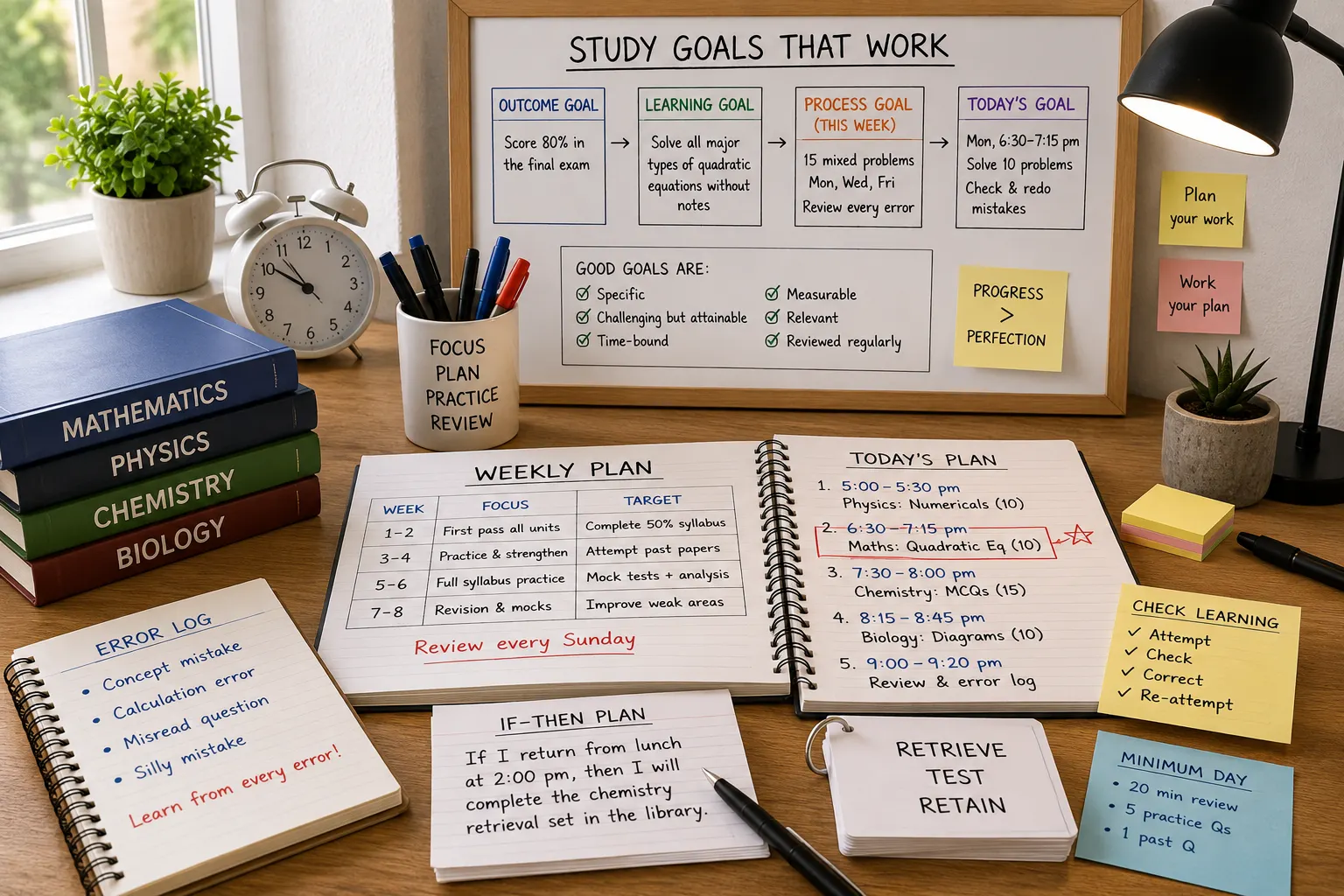
Mistakes are informative only when they change what happens next. The useful sequence is not failure followed by optimism, but error detection, explanation, correction and another…
Growth mindset is often reduced to “believe you can improve.” The research is more precise: beliefs about whether abilities can develop may influence responses to challenge, but e…
Growth mindset is often reduced to “believe you can improve.” The research is more precise: beliefs about whether abilities can develop may influence responses to challenge, but e…
Reading faster is useful only if the information you need survives the increase in speed. Research suggests there is a real speed-comprehension trade-off, so efficient readers var…
The goal of exam preparation is not to eliminate every nervous feeling. It is to reduce avoidable uncertainty by preparing early, testing what you know, protecting recovery time a…
“Study harder” is an intention, not a plan. Effective study goals translate a desired result into specific actions, realistic milestones and a system for checking whether learning…
Revision is not simply reading the same material again. Memory becomes more durable when learners revisit information across time and actively retrieve it, making the design of re…
Enjoying the reporting?
We noticed an ad blocker. Ads keep our journalism free — please consider allowing them, or subscribe to our newsletter instead.
We use cookies to keep you signed in and to understand how readers use the site. See our Privacy Policy.