How to Set Study Goals That Actually Improve Learning
“I need to study more.”
“I want better marks.”
“I’ll finish the whole syllabus this month.”
These statements express ambition, but they do not tell a student what to do next. A useful study goal performs a more practical function: it converts a distant outcome into an action that can be started, measured and adjusted today.
Decades of goal-setting research associated with psychologists Edwin Locke and Gary Latham found that, under suitable conditions, specific and appropriately challenging goals can improve performance compared with vague instructions to simply “do your best.” Their work also emphasises important qualifications. Ability, commitment, feedback, task complexity and the distinction between learning goals and performance goals all influence whether a target actually helps.
For students, the lesson is therefore not simply to set more goals. It is to set the right kind of goal at the right level and connect it to evidence of learning.
Start With the Outcome, Then Work Backward
An outcome goal describes where you eventually want to arrive: passing an entrance examination, achieving a particular grade, completing a semester successfully or finishing a syllabus before the examination period.
Such goals provide direction, but they are too distant to organise today's behaviour. A student cannot directly command a future examination score. What can be controlled is the preparation that makes that score more likely.
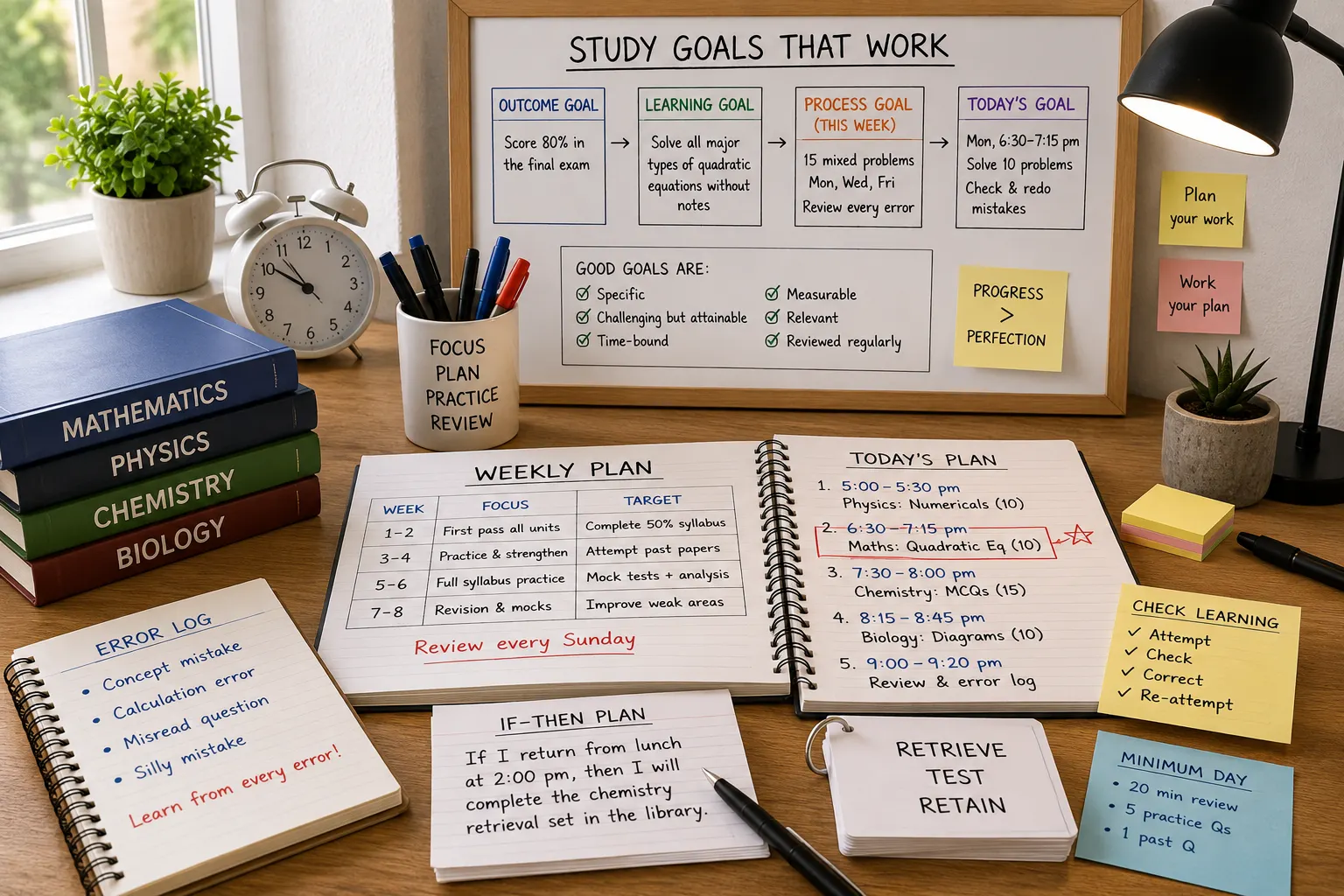
Suppose the outcome goal is to score at least 80% in a final examination. A learning goal could be to solve all major types of quadratic-equation problems without referring to notes. A process goal could then specify completing 15 mixed problems on Monday, Wednesday and Friday and reviewing every incorrect answer.
The closer the goal gets to observable behaviour, the easier it becomes to execute. Long-term outcomes establish direction; learning goals define capability; process goals determine what happens today.
Make the Goal Specific Enough to Start
Compare “Study biology tonight” with: “From 7:00 to 7:45 p.m., answer 20 retrieval questions on cell division and check every incorrect answer afterward.”
The second instruction removes several decisions before the session even starts. The student already knows the subject, topic, starting time, activity, approximate duration and completion criterion.
Specificity reduces friction because fewer choices have to be made at the moment of action.
But specificity is not sufficient by itself. “Read 900 pages tonight” is extremely specific and still a poor goal. A target also needs to fit available time, current ability and the complexity of the material.
The best study goals therefore combine precision with realism. They should make the next action obvious without creating a plan that collapses as soon as ordinary life interferes.
Set Goals That Are Challenging but Credible
Goals that require almost no effort may do little to change performance. At the other extreme, targets perceived as impossible can encourage avoidance rather than persistence.
Goal-setting theory therefore places importance on appropriately challenging goals alongside commitment, ability, feedback and adequate resources.
For students, that means difficulty should usually increase progressively.
If someone currently manages 20 minutes of focused mathematics study, suddenly designing a schedule requiring six hours every evening is not necessarily ambitious. It may simply be badly calibrated.
A more useful approach begins with observed behaviour. Establish what can currently be completed with reasonable consistency, then increase the challenge as concentration, knowledge and study routines improve.
A strong goal should create effort without making failure almost inevitable.
Break Large Goals Into Milestones
A semester-sized goal does little to guide a Tuesday afternoon.
Large academic objectives become useful only when they are divided into shorter planning horizons. An examination eight weeks away might be organised into an eight-week outcome, a four-week milestone, weekly targets and daily actions.
The long-term goal might be to complete and test the entire syllabus. The four-week milestone could be first-pass understanding of all major units. A weekly target could involve two specified units plus cumulative revision. The daily action might be one subtopic followed by a defined set of retrieval or practice questions.
Each level answers a different question.
The outcome asks, where am I going?
The weekly target asks, what must move this week?
The daily goal asks, what do I do now?
This structure prevents large ambitions from remaining motivational slogans without operational meaning.
Use Learning Goals When You Do Not Yet Know How
Students frequently set performance goals before they have acquired the underlying skill.
“Complete 50 advanced calculus questions today” sounds disciplined. But if the student does not yet understand how to identify the appropriate integration method, completing a large quantity of questions may turn into repeated guessing or copying solutions.
A better early-stage target would be to learn how to recognise five common problem types and then solve two examples of each independently.
Locke and Latham's work distinguishes situations in which learning goals can be particularly useful, especially when tasks are complex or unfamiliar. When the student does not yet know how to perform successfully, the immediate objective should often be acquiring an effective strategy rather than maximising output.
Performance goals become more useful once the required method is reasonably understood.
This distinction can prevent students from confusing activity with progress.
Measure Evidence of Learning, Not Only Time
Time spent studying is easy to record. Learning is harder to measure.
A three-hour session can contain sustained retrieval practice and problem solving, or it can contain repeated rereading interrupted by distraction. Both appear identical on a timetable.
Better evidence includes questions answered correctly without notes, concepts explained from memory, problems solved independently, mistakes corrected and material successfully recalled after a delay.
Practice-test performance can provide another useful signal because it exposes the difference between familiarity and retrieval.
This does not mean study time is irrelevant. Time is still a resource that needs to be scheduled. But hours are an input, not the final educational outcome.
A useful study goal therefore combines a planned period of work with a visible test of what was learned.
“Study chemistry for one hour” measures attendance.
“Complete the electrochemistry retrieval set and correct every missed question” provides evidence.
Turn Study Goals Into Appointments
Even a well-designed goal can fail if the student never decides when it will happen.
Research on implementation intentions suggests that specifying when and where an intended behaviour will occur can strengthen the connection between intention and action. An if-then plan links a particular cue with a predetermined response.
Instead of saying, “I will revise chemistry tomorrow,” a student might decide: “When I return from lunch at 2 p.m., I will complete the electrochemistry retrieval set in the library.”
The activity is now attached to a time, place and trigger.
That matters because procrastination often occurs during the gap between deciding that something should happen and deciding exactly when to begin.
Turning a study intention into an appointment removes part of that negotiation. When the trigger arrives, the decision has already been made.
Plan for Bad Days Before They Arrive
Many study schedules are built around an imaginary student who never becomes tired, ill, distracted or unexpectedly busy.
Real life does not work that way.
Family responsibilities appear. Assignments take longer than expected. Difficult chapters consume extra time. Energy varies. One disrupted day can then create a backlog large enough to make the entire plan feel broken.
A more resilient system contains slack.
If a syllabus contains 20 units and the examination is ten weeks away, scheduling exactly two units every week until the final day leaves no room for revision, illness or unexpectedly difficult material.
It is also useful to create a minimum version of the normal routine. A normal day might involve a 60-minute session. A difficult day could require only a 20-minute review and five practice questions.
The reduced version is not intended to replace serious study permanently. Its purpose is to prevent one difficult day from becoming several days of complete disengagement.
Consistency becomes easier when the system has a recovery mode.
Review the Plan Every Week
A study plan should be treated as adjustable rather than sacred.
Once a week, compare the plan with what actually happened. Which tasks were completed? Which material was genuinely learned? Which topics took longer than expected? Where were errors repeated? Which planned sessions were repeatedly missed?
The answers should change the next week's targets.
If almost every goal is missed, the correct conclusion is not automatically that the student lacks discipline. The schedule may simply be unrealistic.
If every target is completed easily and far ahead of schedule, the goals may be too conservative.
Planning is based on estimates. Feedback reveals whether those estimates were sensible.
In this sense, a study goal is a hypothesis: given this amount of time, this method and this level of difficulty, a particular amount of progress should be possible.
Weekly review tests that hypothesis.
Avoid the Most Common Goal-Setting Traps
One common mistake is setting only outcome goals. “Get 90%” can be motivating, but it does not specify what should happen tonight.
Another is measuring only hours. Sitting at a desk for four hours is not equivalent to learning for four hours.
Students also frequently build schedules around their best possible day rather than their normal level of energy and concentration. Plans that require exceptional motivation every day rarely survive for long.
Another mistake is allocating identical time to every subject. Study effort should reflect examination importance, current weakness, remaining workload and how difficult each subject is to improve.
Finally, some students treat the original plan as a contract that cannot be changed. A target created three weeks earlier may have been based on inaccurate assumptions. Revising it in response to evidence is not failure. It is better planning.
A Simple Formula for Daily Study Goals
A practical daily goal can often be written in one sentence:
At [time or cue], I will [specific learning activity] on [specific topic] until [clear completion point], then I will [check learning].
For example:
At 6:30 p.m., I will solve ten probability problems without notes, mark them and redo every incorrect question.
That statement contains far more useful information than “study statistics.”
It establishes a trigger, defines an activity, identifies the topic, sets a completion point and includes feedback.
The formula can be adapted to almost any subject. A history student might retrieve the causes of an event from memory and then compare the answer with notes. A language learner might practise vocabulary before completing a short recall test. A science student might solve problems and categorise mistakes afterward.
The content changes. The structure remains useful.
Good Study Goals Reduce Uncertainty
The purpose of goal setting is not to make a planner look organised. It is to improve the quality of action.
A strong goal connects today's work with an important long-term outcome without pretending that the final result can be controlled directly. It is specific enough to start, challenging enough to require effort and realistic enough to survive ordinary life.
It also produces feedback.
That last element matters because students do not merely need goals. They need a system capable of learning from its own performance.
A good study goal therefore has three qualities:
It points somewhere important.
It tells you what to do now.
And it produces evidence that makes the next goal better.
The difference between “I need to study more” and an effective study plan is not greater ambition.
It is clearer action.