Why a “Slave Dynasty” Founded a Sultanate
The phrase “Slave Dynasty” can mislead modern readers. It does not mean that the dynasty was made up of enslaved subjects ruling a kingdom of slaves. It refers to the Mamluk background of some of its leading rulers. In the medieval Islamic world, mamluks were military slaves who could rise through training, loyalty and service to become commanders, governors and even kings. In India, the first ruling house of the Delhi Sultanate emerged from this world of military slavery, elite service and political ambition.
The Slave or Mamluk dynasty ruled from 1206 to 1290. It founded the Delhi Sultanate, defended it against rivals and Mongol threats, and transformed Delhi from a conquest base into a durable political centre. Its most important figures were Qutb al-Din Aibak, Iltutmish, Razia Sultan and Balban. Their story is about more than dynastic succession. It is about how outsiders became rulers, how military service became sovereignty, and how a fragile conquest became a state.
What Does Mamluk Mean?
The Arabic word mamluk means “owned” or “possessed,” but in historical context it referred to slave-soldiers trained for military and administrative service. In many Islamic societies, young men acquired as slaves could be educated, converted, trained and integrated into elite military households. Their dependence on their master was expected to create loyalty. Yet because they acquired military skills and political experience, they could become extremely powerful.
This system seems paradoxical to modern readers: how could a slave become a ruler? The answer lies in the difference between plantation slavery, domestic slavery and military slavery. Mamluks were unfree in origin but often elite in training. Once manumitted or elevated, they could command armies and govern territories. Qutb al-Din Aibak’s rise from slave-general to Sultan of Delhi illustrates this pattern dramatically.
Qutb al-Din Aibak and the Foundation of Rule
Qutb al-Din Aibak had served Muhammad Ghori as a trusted military commander in north India. After Ghori’s death in 1206, his empire did not pass to a single strong heir. Instead, former commanders and provincial elites carved out authority in different regions. Aibak became the ruler of Delhi and Lahore, founding the Mamluk line in India. His reign was short, lasting until 1210, but it established the political foundation of the Sultanate.
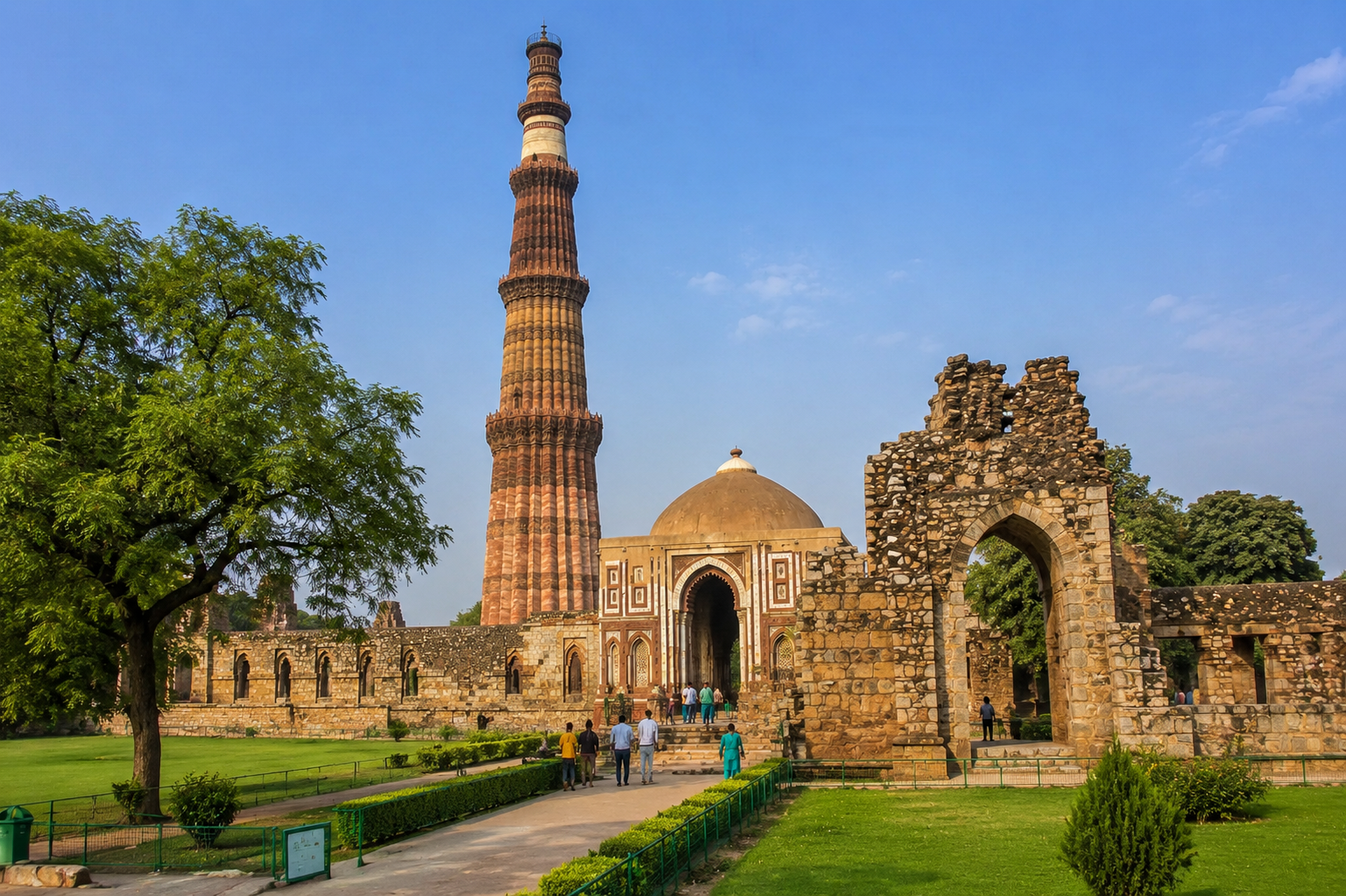
Aibak’s importance lies less in long administration and more in transition. He converted military command into kingship. He maintained control over key north Indian territories, faced rival claimants and initiated monumental construction associated with early Islamic rule in Delhi. The Qutb complex, including the Quwwat-ul-Islam mosque and the beginnings of Qutb Minar, became a symbol of the new political order. Aibak’s sudden death after a polo accident left the succession unstable, proving that the new state still needed consolidation.
Iltutmish: The Real Consolidator
Iltutmish is often regarded as the true consolidator of the Slave Dynasty. He defeated rivals, secured Delhi, expanded authority and gave the Sultanate stronger institutional shape. His reign from 1211 to 1236 transformed a fragile post-Ghurid inheritance into a more stable monarchy. He shifted the centre of gravity firmly to Delhi and handled challenges from rival Turkish commanders, regional rulers and frontier threats.
Iltutmish also strengthened the symbolism of sovereignty. He sought recognition within the wider Islamic political world and developed court institutions that gave the Sultanate legitimacy. His reign is associated with the silver tanka and copper jital currency tradition, administrative organisation and the expansion of Delhi’s political authority. He understood that conquest alone was not enough; a Sultan needed revenue, coinage, elite loyalty, urban prestige and religious-political recognition.
The Forty and the Problem of Noble Power
One of the key political features of the Slave Dynasty was the power of Turkish nobles, often discussed through the group known as the Chihalgani or “the Forty.” These elite nobles had helped build and maintain the Sultanate, but they also limited royal power. They could support a ruler, undermine a ruler or replace a ruler. The dynasty’s history is therefore full of tension between monarchy and military aristocracy.
This tension explains many succession crises. The Sultan needed nobles to govern provinces, command armies and collect revenue. But the same nobles could become kingmakers. The problem was not unique to Delhi; many medieval states struggled with military elites. In the Slave Dynasty, however, the issue was especially sharp because the ruling house itself emerged from a world of military households, personal loyalty and slave-commanders.
Razia Sultan: Possibility and Resistance
After Iltutmish’s death, his daughter Razia attempted to rule as Sultan. Her reign was brief but historically significant. She was not merely a symbolic woman ruler; she tried to exercise sovereign authority in her own right. Her attempt challenged both gender expectations and the interests of powerful nobles. She adopted the language and practice of kingship, but her authority faced resistance from elite factions unwilling to accept her independent rule.
Razia’s fall reveals the limits of political innovation in a deeply patriarchal military court. Her failure was not due simply to personal weakness. It reflected the structural power of nobles, gendered assumptions about rulership, and factional rivalries. Yet her reign remains one of the most remarkable episodes in medieval Indian history because it shows that the early Sultanate’s political imagination was contested, not fixed.
Balban and the Discipline of Kingship
Ghiyath al-Din Balban, who ruled from 1266 to 1287 after years as a powerful noble, represented a different model of kingship. He believed royal authority had to be elevated, disciplined and feared. His rule is associated with stern court ritual, the suppression of rebellious nobles, frontier vigilance and a severe concept of monarchy. He sought to break the excessive influence of the Turkish aristocracy and restore the dignity of the crown.
Balban also faced Mongol pressure on the northwestern frontier. The Mongol threat was one of the great anxieties of thirteenth-century Asia, and Delhi could not ignore it. Balban strengthened frontier defences and treated internal disorder as a danger to state survival. His style of rule was harsh, but it reflected the insecurity of the time. For him, kingship was not simply privilege; it was an instrument of order in a violent political world.
The End of the Dynasty
After Balban, the dynasty weakened quickly. Succession problems, court factionalism and the youth or incapacity of later rulers undermined stability. The final phase ended when Jalal al-Din Khalji overthrew the last Mamluk ruler in 1290, beginning the Khalji dynasty. This transition was more than a palace coup. It marked the rise of new political groups and a shift from the dominance of old Turkish slave-noble elites toward broader military constituencies.
The end of the Slave Dynasty did not mean failure in a simple sense. By 1290, the Sultanate it founded had survived nearly a century. It had endured succession crises, regional revolts, rival claimants and Mongol danger. It had turned Delhi into a serious imperial capital. The Khaljis inherited a state that the Mamluks had made possible.
Architecture and Material Legacy
The Slave Dynasty’s architectural legacy is concentrated in early Sultanate Delhi. The Qutb Minar and associated monuments demonstrate the political symbolism of early Indo-Islamic architecture. Built with red sandstone, inscriptions and a combination of imported forms and local craftsmanship, the Qutb complex became a statement of victory, devotion and legitimacy. It also reveals the complex relationship between conquest, reuse of earlier materials and new architectural experimentation.
Architecture under the early Sultanate was not simply about beauty. It marked space. It announced new authority in a landscape filled with older sacred and political meanings. Mosques, minarets, tombs, reservoirs and fortifications helped transform Delhi into a new capital of power. The dynasty’s buildings therefore serve as physical evidence of state formation.
Historical Debates
The term “Slave Dynasty” itself is debated. Many scholars prefer “Mamluk dynasty” because it more accurately captures the military-slave background of its founders and avoids modern misunderstandings. Another debate concerns the nature of early Sultanate rule: was it primarily a foreign military regime, or did it become an Indian state? The answer changes over time. It began through conquest and military control, but it gradually adapted to Indian conditions, revenue networks, local politics and urban life.
Historians also debate the interpretation of monuments, temple reuse, elite violence, and cultural exchange. A responsible account must neither deny conflict nor reduce the entire period to destruction. The Mamluk dynasty was a state-building project born out of conquest but sustained through administration, military discipline, coinage, urbanisation and political adaptation.
Legacy: The First Pillar of the Delhi Sultanate
The Slave Dynasty mattered because it gave the Delhi Sultanate its foundation. Aibak created the opening, Iltutmish consolidated it, Razia challenged its gendered boundaries, and Balban hardened its concept of kingship. Their combined legacy shaped later dynasties. The Khaljis, Tughlaqs, Sayyids and Lodis all operated in a political world first stabilised by the Mamluks.
To explain the Slave Dynasty is to explain how medieval power could move through unexpected social channels. Men of slave origin became sovereigns. A woman claimed the throne. Nobles made and unmade kings. A frontier capital became the centre of a major Sultanate. The dynasty’s history is therefore not only about rulers. It is about mobility, military slavery, legitimacy and the difficult birth of a new political order in India.