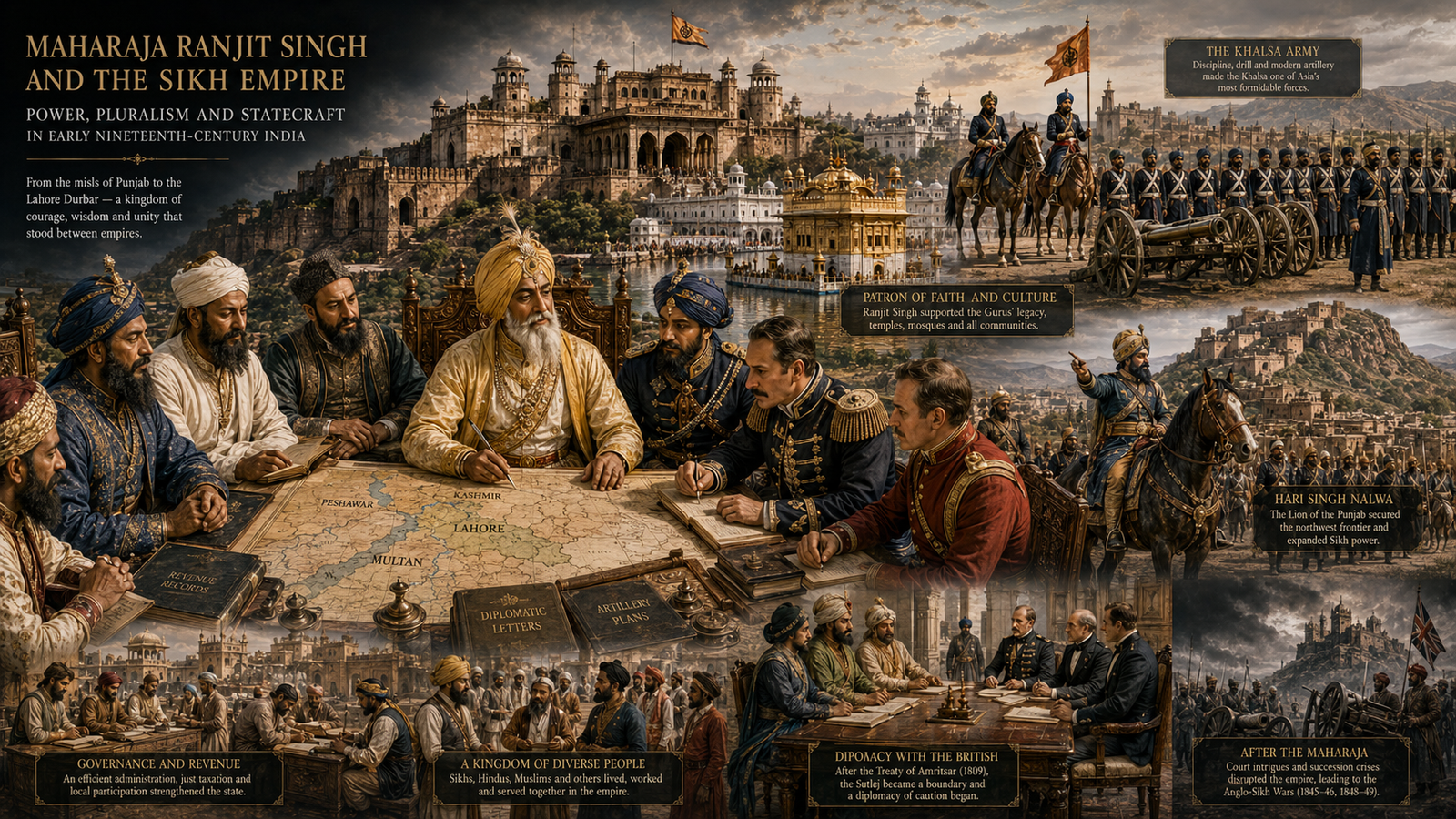
The Empire That Rose Between the Mughals, Afghans and British
Maharaja Ranjit Singh’s empire occupies a distinctive place in the history of the Indian subcontinent because it emerged in a period when older imperial structures had weakened but colonial power had not yet completed its expansion. It was not merely a warrior state built on cavalry raids. It was a disciplined, multi-religious and strategically organised kingdom that converted the fragmented Sikh misls of Punjab into a powerful state centred on Lahore. Its rise shows how authority could be rebuilt after the decline of the Mughal order, the turbulence of Afghan invasions and the early advance of the East India Company.
The story of the Sikh Empire is also the story of a frontier society learning to defend itself, govern itself and negotiate with larger forces. In the eighteenth century, Punjab was not a quiet province waiting for a king. It was a contested zone between Delhi, Kabul and local chiefs. Armies crossed it, revenue networks collapsed, religious communities reorganised themselves, and armed bands became political institutions. Out of this world came Ranjit Singh, a leader whose genius lay not only in conquest but also in coalition-building.
Setting the Stage: Punjab After Mughal Decline
To understand Ranjit Singh, one must first understand Punjab in the eighteenth century. The Mughal Empire had once held the region through provincial governors, forts, revenue officers and imperial patronage. But as Mughal central power weakened after Aurangzeb, provincial elites and military groups gained autonomy. Afghan ruler Ahmad Shah Abdali and his successors repeatedly entered north India, turning Punjab into a corridor of conflict. The result was not complete chaos but a new political order in formation.
The Sikh community had already gone through a profound transformation. The teachings of Guru Nanak and the succeeding Gurus had created a religious and ethical community. The formation of the Khalsa under Guru Gobind Singh in 1699 gave this community a militant and institutional identity. After periods of persecution, guerrilla struggle and mobility, Sikh groups organised into misls, or confederacies. These misls were not modern states, but they controlled territories, collected revenue, fought enemies and made alliances. Ranjit Singh inherited this world of decentralised power.
Ranjit Singh’s Early Rise
Ranjit Singh was born in 1780 into the Sukerchakia misl. He inherited leadership at a young age after the death of his father, Maha Singh. His early life was marked by physical hardship, military exposure and political calculation. He was not the most obvious candidate to dominate Punjab. Other chiefs had larger resources and older prestige. Yet he possessed an unusual combination of patience, courage, adaptability and instinctive understanding of power.
His seizure of Lahore in 1799 was the decisive turning point. Lahore was not just another city. It was the old Mughal centre of Punjab, a symbol of legitimacy, commerce and administrative command. By entering Lahore and later declaring himself Maharaja in 1801, Ranjit Singh converted military success into sovereign authority. He did not frame his rule simply as personal kingship. Coins were issued in the name of the Sikh Gurus, and the state was represented as connected to the Sikh commonwealth. This gave his authority spiritual legitimacy while allowing practical monarchy.
Building an Empire, Not Just Winning Battles
Ranjit Singh expanded through a blend of conquest, diplomacy, marriage alliances, negotiated submission and strategic timing. Amritsar, Multan, Kashmir, Peshawar and other territories entered the orbit of the Lahore state at different moments. The empire eventually stretched across much of Punjab and into frontier regions, creating a powerful buffer between Afghanistan and British India. This expansion required more than battlefield courage. It required revenue, logistics, commanders, intelligence and the ability to absorb diverse elites.
One of Ranjit Singh’s major strengths was his willingness to employ talent across communities. His court included Sikhs, Hindus, Muslims and Europeans. Muslim officials, Hindu administrators, Sikh sardars and foreign military specialists all served the state. This was not modern secularism in a constitutional sense, but it was pragmatic pluralism. In a region where religious identity mattered deeply, Ranjit Singh governed by using loyalty, utility and honour rather than narrow exclusion.
Military Reform and the Khalsa Army
The Sikh Empire’s military power came from both indigenous martial traditions and selective borrowing from European techniques. Ranjit Singh recognised that cavalry mobility alone would not be sufficient in an age of disciplined infantry, artillery and fortification. He therefore strengthened infantry units, artillery formations and drill practices, often using European officers who had experience in Napoleonic or other military traditions. The result was the famous Khalsa army, which became one of the most formidable forces in Asia.
Yet the army remained culturally rooted in Punjab. It combined Sikh martial symbolism, local recruitment, frontier cavalry and modernised artillery. Generals such as Hari Singh Nalwa became central to frontier consolidation. The empire’s campaigns in the northwest were especially significant because they challenged Afghan power in areas that had long shaped north Indian politics. Control over Peshawar and frontier zones gave the Lahore state strategic depth but also exposed it to continuous military pressure.
The Lahore Durbar: Governance and Statecraft
The Lahore Durbar was the heart of the empire. It operated through personal authority, aristocratic negotiation, revenue administration and court patronage. Ranjit Singh was not a ruler who hid behind ceremonial distance. Accounts often describe him as accessible, practical and keenly attentive to military and administrative details. He could reward loyalty generously but also discipline rivals. His court culture mixed Punjabi, Persianate, Sikh and broader Indian forms of power.
Revenue was essential to the empire’s survival. Like earlier Indian states, the Sikh Empire depended heavily on agrarian surplus, customs, tribute and control over strategic towns. Local chiefs were often incorporated rather than destroyed. This method allowed rapid consolidation, but it also meant that the empire remained partly dependent on Ranjit Singh’s personal ability to balance factions. Institutions existed, but they were not fully independent of the ruler’s charisma and judgement.
Religion, Culture and Symbolism
Ranjit Singh is remembered not only as a conqueror but also as a patron. His support for the Harmandir Sahib, popularly known as the Golden Temple, shaped Sikh memory profoundly. The gilding and patronage associated with Amritsar helped transform the shrine into an even more powerful visual centre of Sikh identity. At the same time, the ruler patronised Hindu temples, Muslim shrines and religious figures from different traditions. This patronage helped stabilise a diverse empire.
His own image was strikingly different from many royal models. Though he ruled as Maharaja, he was often represented as comparatively simple in dress and direct in manner. The absence of exaggerated imperial distance became part of his legend. Yet simplicity should not be mistaken for lack of grandeur. The Lahore court controlled jewels, manuscripts, weapons, horses, forts and diplomatic ceremonies. Ranjit Singh understood that power needed both restraint and spectacle.
Relations with the British
The rise of the Sikh Empire coincided with the expansion of the East India Company. Ranjit Singh’s diplomacy with the British was cautious and realistic. He understood that the Company was not simply another regional rival. It possessed financial depth, disciplined armies and political ambition. The Treaty of Amritsar in 1809 stabilised relations along the Sutlej and effectively recognised spheres of influence. For Ranjit Singh, this was not surrender but strategic containment. It allowed him to focus westward while avoiding premature confrontation with a powerful colonial force.
This diplomatic restraint was one reason the Sikh Empire survived as long as it did. Ranjit Singh avoided the mistakes of rulers who underestimated British military and financial organisation. Yet the treaty also marked a limit. The empire could expand toward the northwest but not freely toward the east. In the long run, British patience and observation would matter. The Company waited while internal weaknesses developed after Ranjit Singh’s death.
The Turning Point: The Problem of Succession
Ranjit Singh died in 1839. His death exposed the empire’s greatest vulnerability: the absence of a stable succession and durable institutional balance. Court factions, rival princes, powerful military units and ambitious nobles competed for influence. The Khalsa army, once the ruler’s instrument, became a political actor in its own right. This was a common pattern in pre-modern states where charismatic authority had built unity faster than institutions could secure continuity.
The years after 1839 saw instability, intrigue and weakening central control. The British, watching from the east, recognised that the Lahore state was no longer guided by the same political intelligence. The Anglo-Sikh Wars eventually led to British annexation in 1849. The fall of the empire was not inevitable from the beginning, but it became increasingly likely once leadership, court discipline and strategic unity collapsed together.
Historical Debates
Historians debate how to interpret the Sikh Empire. One view emphasises it as the last great indigenous power in northwest India before British annexation. Another highlights its hybrid nature: Sikh legitimacy, Persianate administration, Punjabi military society and European military techniques. Some focus on Ranjit Singh’s pluralism; others warn against romanticising his rule and stress the coercive realities of conquest, taxation and frontier warfare. A balanced view recognises both state-building achievement and the limits of personal monarchy.
Another debate concerns whether the empire could have survived with stronger institutions. The answer is complex. Ranjit Singh created a formidable state, but its administrative system remained closely tied to his personal authority. Had succession been clearer, had the army remained subordinated to civil command, and had factions been controlled, the Sikh Empire might have remained a major power for longer. But it faced a colonial neighbour whose resources and methods were unusually strong.
Legacy: Why the Sikh Empire Still Matters
The Sikh Empire matters because it shows that the history of eighteenth- and nineteenth-century India was not simply a story of Mughal decline and British rise. Between those two poles stood regional powers with real creativity and agency. Ranjit Singh’s kingdom defended Punjab, reshaped Sikh political memory, patronised sacred institutions and built a state that commanded respect from allies and enemies alike.
Its legacy survives in Punjab’s historical imagination, in Sikh memory, in Lahore’s political history, in frontier military traditions and in debates over plural rulership. Ranjit Singh is remembered as Sher-e-Punjab, the Lion of Punjab, not only because he conquered territory but because he gave a fractured region a centre. His empire reminds us that state-building is never only about armies. It is about legitimacy, timing, coalition, revenue, symbols and the difficult art of holding diversity together under pressure.