The Role of Predators in Ecosystems: How They Shape Food Webs
The role of predators in ecosystems extends far beyond catching and killing prey. Predators can influence how many prey animals survive, where they feed, how they behave, which smaller predators occupy an area and how energy and nutrients move through a food web. Under some conditions, those effects travel through several trophic levels and influence vegetation, scavengers and even the physical structure of habitats.
But predator ecology is also more complicated than the popular idea that adding a top predator automatically “restores balance.” Predation is only one force shaping ecosystems. Food availability, climate, disease, competition, habitat, human hunting and other predators can be equally important or sometimes more important.
The scientifically useful question is therefore not whether predators matter. They clearly do. It is when, where and how strongly their effects spread through an ecosystem.
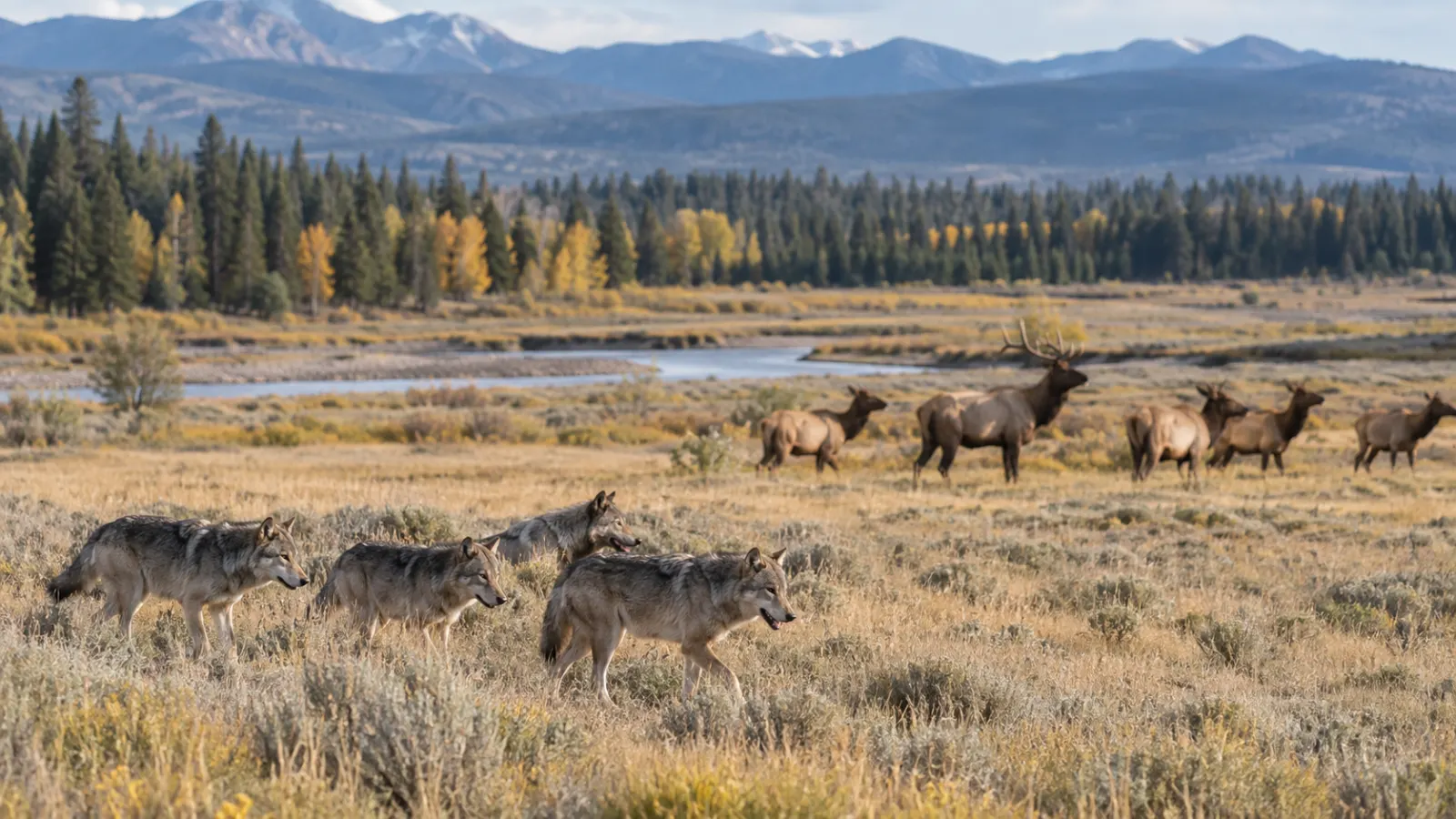
Yellowstone's wolves provide a famous example. Their reintroduction changed interactions among wolves, elk and other species, but the National Park Service emphasises that vegetation recovery cannot be explained by wolves alone. Elk abundance, groundwater, climate, beavers, other predators and human management also contribute.
That complexity is precisely what makes predators so important to ecology: they participate in networks rather than simple predator-prey pairs.
Predators Can Influence Prey Populations
The most obvious effect of predation is mortality. A predator kills an animal that would otherwise remain alive at that moment, reducing the number of individuals in the prey population.
Under some conditions, this mortality can meaningfully limit prey abundance or slow population growth. If predators consistently remove enough individuals relative to reproduction and immigration, prey numbers may remain lower than they would in the predator's absence.
But the relationship is rarely as simple as:
more predators = fewer prey.
Prey populations are simultaneously affected by food, weather, disease, reproductive success, habitat quality, migration, competition and human harvest.
Yellowstone illustrates this well. According to the National Park Service, wolves had relatively little effect on elk abundance during the earliest years after reintroduction; climate and human hunting contributed substantially to initial declines. Wolves later became more important in northern elk population dynamics, alongside cougars, grizzly bears, black bears and weather.
The impact also differs among prey species. Yellowstone wolves primarily hunt elk and bison, yet the NPS reports that their overall impact on bison population size has been relatively small. Effects on deer, moose, bighorn sheep and pronghorn are different again.
Predation therefore has to be measured within a particular ecological system rather than assumed from the mere presence of a predator.
Predators Do Not Usually Remove Prey at Random
Predators often catch some individuals more easily than others.
Depending on the predator and prey species, young, old, injured, inexperienced or nutritionally stressed animals may face greater risk. Other predators select according to body size, habitat or behaviour.
This selection matters because predation can alter more than the total number of prey.
It may affect:
-
the age structure of a population;
-
which behaviours become advantageous;
-
where animals spend their time;
-
reproductive opportunities;
-
and, over long evolutionary periods, traits associated with detecting or escaping predators.
It also explains why predator mortality cannot always be treated as simple subtraction.
An animal killed by a predator is not necessarily an animal that would otherwise have lived for many more years and reproduced repeatedly. Some would eventually have died through disease, starvation, injury, hunting or another predator.
Ecologists therefore distinguish between predation that adds substantial new mortality to a population and predation that partly replaces mortality that would have occurred through other causes.
That distinction becomes especially important when evaluating predator control or restoration programmes.
Fear Can Change an Ecosystem Without a Predator Making a Kill
Predators can influence prey simply by being present.
An animal that perceives predation risk may alter where or when it feeds, spend more time watching for danger, remain closer to cover, form larger groups or move away from particular locations.
Ecologists often call these non-consumptive effects because the predator changes prey behaviour without actually consuming the individual.
The consequences can extend to plants.
Suppose herbivores avoid one part of a valley because predator encounters are more likely there. Vegetation in that area may experience less browsing even if the total herbivore population has not changed dramatically.
This idea is sometimes described as a landscape of fear.
The phrase is useful but can also be oversimplified. Animals do not make decisions based on predators alone. Hunger, snow depth, water, reproductive condition, forage quality, terrain and competition can all influence whether prey choose a risky area.
Predation risk may be powerful in one location or season and much less important elsewhere.
This is why researchers increasingly use GPS collars and other tracking technologies to compare predator and prey movements through space instead of assuming that predator presence affects an entire landscape uniformly.
Yellowstone's current wolf monitoring programme, for example, combines GPS data from wolves and elk with kill-site investigations and long-term population monitoring to examine how predation influences movement and food-web dynamics.
Trophic Cascades Can Connect Predators to Plants
One of the most influential ideas in modern ecology is the trophic cascade.
A trophic cascade occurs when a change at one level of a food web produces indirect effects at lower levels.
A simplified terrestrial example looks like this:
predator → herbivore → vegetation
If predators reduce herbivore abundance or alter where herbivores feed, plants may experience less browsing. Changes in vegetation can then influence insects, birds, soils, streams and other organisms.
The predator may therefore affect species it never directly encounters.
Marine ecosystems can produce similar cascades.
Sea otters, for example, prey on sea urchins, which consume kelp. Where otters strongly suppress urchins, kelp can become more abundant. A 2025 USGS-supported analysis of long-term kelp-forest data found a strong classic trophic cascade following sea otter recolonisation off Vancouver Island—but a much weaker cascade around San Nicolas Island.
That contrast is important.
It demonstrates that even a famous “keystone predator” does not produce an identical ecological outcome everywhere.
Habitat, prey density, community structure and the strength of species interactions determine how far predator effects spread.
Predators Can Even Influence the Physical Structure of Habitats
Trophic cascades are sometimes presented as changes in animal and plant abundance. Recent research shows that predator effects can occasionally extend into the physical environment itself.
A striking example comes from California's Elkhorn Slough.
Researchers combined decades of observations with predator-exclusion experiments and found that recovering sea otters suppressed populations of burrowing crabs. With fewer crabs damaging marsh vegetation and sediment, marsh edges became stronger and erosion slowed despite increasing physical stresses such as sea-level rise and tidal scour.
The pathway was approximately:
sea otters → fewer burrowing crabs → stronger marsh vegetation and sediment → less erosion
This is an important ecological insight because the predator was indirectly influencing geomorphology—the physical shape and stability of the coastline.
But such examples should not be converted into a universal rule that predators always improve habitat.
The strength and direction of trophic cascades remain highly context-dependent.
Yellowstone Wolves Are Important Because the Story Is Complicated
Few ecological stories have become as famous as wolf reintroduction to Yellowstone National Park.
Gray wolves were restored to Yellowstone beginning in 1995, decades after their eradication from the park. Their return created an unusual opportunity to study what happens when a large predator is restored to an ecosystem from which it had been absent for generations.
The simplified popular story runs like this:
wolves returned → elk avoided rivers → willows and aspens recovered → beavers returned → rivers changed
Parts of this sequence are supported by ecological evidence, but the complete story is more complicated.
The National Park Service says most researchers agree that wolves contributed to changes in elk numbers and behaviour. Long-term studies also associate reduced herbivory with some recovery of woody plants. At the same time, researchers continue to debate the relative importance of predator behaviour versus elk abundance and other environmental factors.
Groundwater availability matters for willow growth. Climate and precipitation have changed. Beavers modify hydrology. Other predators—including cougars and bears—kill elk. Human hunting strongly influences elk outside park boundaries.
NPS material consequently describes the Yellowstone trophic cascade as an active area of long-term research rather than a finished ecological morality tale.
That makes Yellowstone more scientifically useful, not less.
The lesson is not that wolves are unimportant. It is that ecosystems rarely have one causal lever.
Predators Also Interact With Other Predators
Predators do not only influence prey.
Large carnivores can compete with, intimidate, displace or kill smaller predators. They may monopolise carcasses, force smaller carnivores into different habitats or alter when those species are active.
When a dominant predator disappears, smaller predators sometimes increase. This phenomenon is known as mesopredator release.
A simple example might involve the decline of a large carnivore allowing smaller carnivores to become more abundant, increasing predation on birds, reptiles or small mammals.
But mesopredator release should not be treated as automatic either.
A USGS-supported study in Wyoming, for example, tested whether disturbed landscapes increased nest predation through mesopredator release. The results did not support that simple mechanism: apex-predator presence and perceived predation risk actually increased with disturbance in the studied system.
The lesson is broader than that individual study.
A plausible ecological hypothesis still has to be tested.
Food webs contain competition within trophic levels as well as consumption between them. Restoring or removing one carnivore can therefore reorganise the predator community in ways that are difficult to predict from a simple food-chain diagram.
Predator Kills Feed Far More Than the Predator
When a wolf kills an elk or a lion kills an antelope, the ecological event continues after the predator has eaten.
Carcasses can become food for ravens, vultures, eagles, foxes, insects and other scavengers. Bacteria and fungi eventually process what remains.
In Yellowstone, elk are not only prey for wolves; the NPS notes that they also provide food for bears, mountain lions and at least a dozen scavenger species.
This means predation can redistribute concentrated packages of nutrients and energy across a landscape.
A carcass may be particularly important during winter or other periods when food is scarce. Insects can use the remains for reproduction, scavengers gain calories, microorganisms decompose tissue and nutrients eventually re-enter soil and vegetation.
Predators therefore help connect living prey populations with the scavenger and decomposition pathways of food webs.
A kill is not simply biomass transferred from prey to predator.
It can become an ecological resource shared by an entire community.
Predators Can Influence Disease, but the Direction Is Not Predictable
Another frequently repeated claim is that predators “keep prey populations healthy” by removing sick individuals.
Sometimes they may.
If a predator disproportionately catches infected animals or reduces host density enough to reduce transmission, disease prevalence could fall.
But modern disease ecology shows that the relationship can also move in the opposite direction.
Predators can alter prey behaviour, stress, movement, age structure and contact rates. Some can even contribute to parasite transmission directly or indirectly. A 2023 review concluded that predators can either suppress or increase disease depending on the host, predator, parasite and environment.
A separate review of aquatic predator-host-parasite systems reached a similar conclusion: the common assumption that predators automatically reduce disease by removing infected individuals is too simple.
The defensible statement is therefore not:
predators prevent disease.
It is:
predators can alter disease dynamics.
Whether that produces more or less disease has to be demonstrated for the particular ecological system.
Top-Down and Bottom-Up Forces Operate Together
Predators represent what ecologists call top-down control because their influence can move downward through a food web.
But ecosystems are also shaped from the bottom up.
Plants depend on sunlight, rainfall, temperature, nutrients and soil conditions. When primary productivity rises, more food may become available to herbivores, which can support more predators. Drought can reduce vegetation so strongly that food availability becomes more important than predator pressure.
An ecosystem may therefore experience both processes simultaneously:
top-down: predators influence herbivores and other consumers;
bottom-up: nutrients, water and primary production influence herbivores and ultimately predators.
The relative strength can also change over time.
During a productive wet period, predators might become an important limit on a growing prey population. During severe drought, food shortage might dominate population dynamics regardless of predator abundance.
Modern predator ecology consequently avoids the assumption that either top-down or bottom-up control explains every ecosystem.
Even studies documenting powerful predator effects frequently emphasise environmental context. Research on sea otters, for example, shows strong cascades in some kelp ecosystems but much weaker effects elsewhere.
Ecological control is dynamic.
Not Every Predator Is a Keystone Species
Predators and keystone species are often discussed together, but the terms are not interchangeable.
A predator is an organism that consumes other organisms.
A keystone species is a species whose ecological effect is unusually large relative to its abundance.
Some predators are keystone species because controlling one prey population causes major changes across the wider community. Sea otters are a classic example in some kelp ecosystems.
But not every predator produces such effects.
Several predators may perform overlapping functions. Losing one may therefore be partly compensated by others. Alternatively, a predator might specialise on prey that does not strongly influence the broader ecosystem.
Even recognised keystone effects can depend on location. The 2025 sea-otter study found classic keystone-like trophic effects off Vancouver Island while observing a muted cascade around San Nicolas Island.
The label therefore has to emerge from evidence about interaction strength, not simply from an animal's position near the top of a food web.
Being impressive, rare or carnivorous does not automatically make a species ecologically keystone.
Predator Effects Vary Across Landscapes
Predators are not uniformly distributed.
A wolf pack's territory, a leopard's hunting route or a shark's preferred habitat can create areas of high and low predation pressure within the same larger ecosystem.
Terrain matters. So do roads, water, human settlements, prey migration and vegetation.
This spatial variation can produce local ecological differences.
Herbivores may browse intensely in one location while rarely entering another. Smaller carnivores may concentrate where large predators are uncommon. Carcass availability can be clustered near preferred hunting areas.
As tracking technology has improved, ecologists have increasingly been able to test these spatial relationships rather than merely assuming that “predators are present” across a whole protected area.
Yellowstone now uses GPS information from wolves and elk, alongside long-running winter predation studies, to examine where wolves hunt, what they kill and how prey movements change through time.
This matters because an ecosystem-scale average can conceal strong local effects.
A predator may be ecologically influential in one valley and nearly irrelevant several kilometres away.
Removing or Restoring Predators Can Produce Unexpected Results
Predator management often begins with an apparently simple objective.
If predators kill livestock or game animals, reduce predators.
If herbivores have become overabundant, restore predators.
Real ecosystems do not always respond linearly.
Removing predators may initially increase a prey population but later contribute to habitat degradation, competition or altered disease dynamics.
Restoring predators may reduce prey abundance but fail to restore historical vegetation because climate, hydrology or land use has changed since the predator disappeared.
An ecosystem can also settle into a different ecological state that is difficult to reverse.
This is why long-term monitoring matters.
A study lasting two or three years may capture one severe winter, one drought or one unusual reproductive cycle and incorrectly attribute the result to predators. Yellowstone's current programme continues annual wolf predation monitoring more than three decades after reintroduction because interactions have changed over time.
Ecological restoration is therefore not equivalent to reinstalling a missing mechanical component.
A returning predator enters an ecosystem that may no longer be the ecosystem it left.
Predator Conservation Can Create Real Costs for People
The ecological importance of predators does not eliminate human conflict.
Large carnivores may kill livestock, threaten pets, compete with hunters for game animals and, in some circumstances, pose risks to people. Communities living alongside predators can therefore bear costs that are experienced much less directly by people who value those animals from distant cities.
Predator conservation is consequently a problem of governance as well as ecology.
Approaches to coexistence can include livestock guarding, changes in husbandry, fencing, compensation programmes, rapid response to problem animals and management of attractants.
No single approach works everywhere.
A policy that focuses only on ecological benefits risks ignoring the people carrying the economic burden. A policy that focuses only on immediate conflict can ignore wider ecosystem effects and conservation obligations.
Durable predator management has to consider both.
This is especially important because public debates often reduce predators to opposite symbols. One side depicts them as ecological saviours; another treats them exclusively as threats.
Neither stereotype is sufficient for management.
Frequently Asked Questions
Why are predators important in ecosystems?
Predators can influence prey abundance, behaviour, competition, scavenger food supplies and the structure of food webs. Under some conditions, their effects cascade downward to vegetation and other organisms.
What happens when predators are removed from an ecosystem?
The result depends on the ecosystem. Prey or smaller predators may increase, potentially changing vegetation, competition or other species. In other systems, the effect may be relatively modest because food availability, climate or other predators exert stronger control.
What is a trophic cascade?
A trophic cascade occurs when changes at one trophic level produce indirect effects at lower levels. For example, a predator may reduce an herbivore, allowing vegetation to increase.
Did wolves really change Yellowstone's ecosystem?
Wolves contributed to changes in elk abundance and behaviour and may have contributed to vegetation recovery, but the Yellowstone ecosystem is influenced by many other factors, including groundwater, climate, beavers, bears, cougars and human hunting. Scientists continue studying the relative importance of these processes.
Do predators always keep prey populations under control?
No. Predators can strongly regulate some prey populations while having relatively little effect on others. Food availability, weather, disease, habitat, migration and human harvest can also determine prey abundance.
Do predators remove sick animals?
Some predators may disproportionately capture weakened or infected prey, but this is not universal. Research shows that predators can either reduce or increase disease transmission depending on the ecological system.
Are all apex predators keystone species?
No. A keystone species has an unusually large ecological effect relative to its abundance. Some apex predators meet this definition, but the ecological influence of predators varies strongly among species and ecosystems.
Predators Are Part of a Network, Not a Single Control Switch
The role of predators in ecosystems is best understood as a network of direct and indirect effects.
Predators consume prey, but they can also change how prey behave. They interact with other carnivores, provide carcasses for scavengers and influence the movement of energy through food webs. In some ecosystems, these effects trigger trophic cascades that reach plants and even physical habitat structure.
In other ecosystems, predator effects are weaker because climate, food supply, habitat or alternative species dominate.
That is why ecology has moved beyond the simple claim that predators “keep nature in balance.”
Nature does not operate around one perfect balance point.
Ecosystems change continuously. Predator and prey populations fluctuate. Climate varies. Species migrate. Human activity modifies landscapes. Interactions that are powerful in one location may be weak somewhere else.
The strongest ecological conclusion is therefore more precise: predators can be powerful organisers of ecosystems, but the strength and direction of their influence depend on context.
Understanding that context—through experiments, tracking, population studies and decades of monitoring—is what turns a dramatic predator story into reliable ecological science.