The Politics of Fear Wearing the Mask of Renewal
Fascism rose in Europe by promising national rebirth while attacking the freedoms and institutions that make political life humane. the rise of fascism in Europe cannot be understood as a single date or a simple textbook label. It was a historical process in which older structures survived into a world that had begun to demand new answers. The drama came from the collision between inherited institutions and pressures that were no longer containable by old formulas. That collision gave the story its force and explains why its consequences reached far beyond the immediate event.
The story unfolded across Italy, Germany and wider interwar Europe, with echoes across societies destabilised by war, depression, nationalism and fear of communism during 1919 to 1939, from the post-First World War crisis and Mussolini’s movement to Nazi rule, authoritarian alliances and the road to the Second World War. Its importance lies not merely in what leaders decided, but in how those decisions entered society. A treaty, depression or ideology becomes historically decisive when it reorganises confidence, fear, labour, borders, rights and political imagination. The subject therefore demands narrative, but also analysis of the economic, social and cultural worlds beneath the official record.
This article follows the historical narrative flow required for the series: hook, time and place, background, rise or development, key actors and events, peak or turning point, decline or impact, historical debates and legacy. The aim is not to flatten the rise of fascism in Europe into a slogan. The aim is to show how the process emerged, why it mattered, who shaped it, what it damaged, and why later generations still return to it for warnings about power.
The deeper historical importance of European fascism lies in the way it connected high politics with the lives of ordinary people. The opening crisis was not experienced only in conference rooms, stock exchanges, ministries or party headquarters. It reached families through prices, wages, borders, propaganda, fear, unemployment, schoolbooks, uniforms, rationing, migration and public memory. That is why this subject must be studied as a civilisational story rather than a narrow political episode. It changed institutions, but it also changed expectations about security, justice, citizenship and the future.
Time and Place: Interwar Europe After Catastrophe
The rise of fascism belonged to interwar Europe, where the First World War had shattered old confidence and the Depression later deepened despair. Geography mattered because historical processes need routes, frontiers, markets, capitals and symbolic spaces. In Italy, Germany and wider interwar Europe, with echoes across societies destabilised by war, depression, nationalism and fear of communism, the map was not a neutral background. Borders shaped grievance, cities concentrated power, rural zones absorbed hardship, and international links carried both opportunity and crisis. During 1919 to 1939, from the post-First World War crisis and Mussolini’s movement to Nazi rule, authoritarian alliances and the road to the Second World War, distance was shortened by railways, newspapers, telegraphs, finance and mass politics, but human communities still experienced change locally.
Time also mattered. These events occurred after the nineteenth century had already transformed the relationship between state and society. Mass armies, industrial production, democratic language, nationalism, public debt, international trade and popular newspapers had made politics more public and more volatile. A crisis could no longer remain confined to cabinets; it could move into streets, factories, farms and homes.
The setting therefore contained both power and fragility. States could mobilise more people than ever before, but they also depended more heavily on consent, credit, production, transport and legitimacy. When those foundations weakened, the result was not merely administrative difficulty. It became a crisis of belief, in which citizens questioned whether the inherited order could still protect them.
The deeper historical importance of European fascism lies in the way it connected high politics with the lives of ordinary people. The geographic and chronological setting was not experienced only in conference rooms, stock exchanges, ministries or party headquarters. It reached families through prices, wages, borders, propaganda, fear, unemployment, schoolbooks, uniforms, rationing, migration and public memory. That is why this subject must be studied as a civilisational story rather than a narrow political episode. It changed institutions, but it also changed expectations about security, justice, citizenship and the future.
Background: War Trauma and the Crisis of Liberal Order
Before fascism gained power, Europe had already been unsettled by mass death, revolution, inflation, veterans, class conflict and weak parliamentary systems. Before the decisive turning point, there was an older order with its own logic. That order had survived because it seemed to solve real problems: it distributed authority, secured property, regulated borders, protected elites, organised production and gave people a language for obedience. Its defenders often believed they were preserving civilisation from chaos, not defending a dying system.
Yet the older order contained contradictions. War trauma, national humiliation, fear of socialism, economic instability, weak parliamentary institutions, propaganda, paramilitary violence, antisemitism, ultranationalism and the promise of authoritarian order did not appear overnight. They accumulated through repeated failures of reform, unequal access to power, shocks of war and the growing gap between official confidence and social experience. People could still repeat inherited symbols of stability while privately sensing that the system was becoming brittle.
This background matters because later events are often misunderstood when treated as sudden explosions. What appears sudden usually becomes possible through years of structural pressure. Institutions lose credibility before they formally collapse. Leaders misread society before society openly rejects them. Markets, parties, treaties and empires can look durable from the outside while internally depending on assumptions that no longer hold.
The deeper historical importance of European fascism lies in the way it connected high politics with the lives of ordinary people. The background conditions was not experienced only in conference rooms, stock exchanges, ministries or party headquarters. It reached families through prices, wages, borders, propaganda, fear, unemployment, schoolbooks, uniforms, rationing, migration and public memory. That is why this subject must be studied as a civilisational story rather than a narrow political episode. It changed institutions, but it also changed expectations about security, justice, citizenship and the future.
Rise of Italian Fascism: Mussolini and the Blackshirts
Italian Fascism developed through nationalism, street violence, fear of socialism and the claim that liberal politics had made Italy weak. The development phase shows how scattered pressures became a recognisable historical force. In the rise of fascism in Europe, the process did not move in a straight line. It was shaped by contingency, ambition, fear and adaptation. Leaders tried to solve immediate problems, but their solutions often created deeper ones by changing incentives and expectations.
The main actors were Benito Mussolini, Adolf Hitler, Fascist squads, Nazi organisers, conservative elites, industrialists, veterans, unemployed citizens, middle-class voters, communists, socialists, monarchs, churches and paramilitary movements. None of them acted in a vacuum. They inherited institutions, prejudices, economic limits and public moods. A diplomat faced domestic opinion; a banker faced panic; a party leader faced street violence; an unemployed worker faced hunger; an empire faced the cost of maintaining prestige. History moved through these linked pressures.
Development also depended on communication. Newspapers, speeches, official statements, rumours, party organisations and international reporting turned local events into public narratives. People did not merely live through change; they interpreted it. That interpretation could produce hope, resentment, radicalisation, resignation or a demand for authority.
The deeper historical importance of European fascism lies in the way it connected high politics with the lives of ordinary people. The development of the crisis was not experienced only in conference rooms, stock exchanges, ministries or party headquarters. It reached families through prices, wages, borders, propaganda, fear, unemployment, schoolbooks, uniforms, rationing, migration and public memory. That is why this subject must be studied as a civilisational story rather than a narrow political episode. It changed institutions, but it also changed expectations about security, justice, citizenship and the future.
From Movement to Regime: The March on Rome and Dictatorship
Mussolini did not seize power by electoral majority alone; he entered power through intimidation, elite compromise and royal appointment. This part of the story reveals how the rise of fascism in Europe moved from background pressure into historical consequence. The forces at work were never isolated. They joined political calculation, economic strain, social fear and cultural meaning into a single field of action.
The central tensions were war trauma, national humiliation, fear of socialism, economic instability, weak parliamentary institutions, propaganda, paramilitary violence, antisemitism, ultranationalism and the promise of authoritarian order. These shaped the choices of leaders and the responses of societies. They also made moderate solutions harder to sustain because each failed compromise strengthened those who claimed that only radical action could restore control.
The result was a transformation of political imagination. People no longer saw the existing order as inevitable. They asked whether security required punishment, whether recovery required state intervention, whether national renewal required exclusion, and whether peace could survive without justice.
The deeper historical importance of European fascism lies in the way it connected high politics with the lives of ordinary people. This stage of development was not experienced only in conference rooms, stock exchanges, ministries or party headquarters. It reached families through prices, wages, borders, propaganda, fear, unemployment, schoolbooks, uniforms, rationing, migration and public memory. That is why this subject must be studied as a civilisational story rather than a narrow political episode. It changed institutions, but it also changed expectations about security, justice, citizenship and the future.
Germany After Versailles: Weimar Fragility and Nazi Opportunity
German fascism grew in the wounded environment of Versailles resentment, economic crisis, political polarisation and the perceived failure of Weimar democracy. This part of the story reveals how the rise of fascism in Europe moved from background pressure into historical consequence. The forces at work were never isolated. They joined political calculation, economic strain, social fear and cultural meaning into a single field of action.
The central tensions were war trauma, national humiliation, fear of socialism, economic instability, weak parliamentary institutions, propaganda, paramilitary violence, antisemitism, ultranationalism and the promise of authoritarian order. These shaped the choices of leaders and the responses of societies. They also made moderate solutions harder to sustain because each failed compromise strengthened those who claimed that only radical action could restore control.
The result was a transformation of political imagination. People no longer saw the existing order as inevitable. They asked whether security required punishment, whether recovery required state intervention, whether national renewal required exclusion, and whether peace could survive without justice.
The deeper historical importance of European fascism lies in the way it connected high politics with the lives of ordinary people. This stage of development was not experienced only in conference rooms, stock exchanges, ministries or party headquarters. It reached families through prices, wages, borders, propaganda, fear, unemployment, schoolbooks, uniforms, rationing, migration and public memory. That is why this subject must be studied as a civilisational story rather than a narrow political episode. It changed institutions, but it also changed expectations about security, justice, citizenship and the future.
Key Actors: Dictators, Elites, Militias and Mass Followers
The rise of fascism required charismatic leaders, violent organisations, conservative collaboration and enough public support to make dictatorship possible. Key actors matter because structures become history through decisions. The people at the centre of this story did not know the ending. They acted under pressure, with partial information, inherited assumptions and competing fears. Their choices accelerated processes that might otherwise have remained unresolved for longer.
The principal actors included Benito Mussolini, Adolf Hitler, Fascist squads, Nazi organisers, conservative elites, industrialists, veterans, unemployed citizens, middle-class voters, communists, socialists, monarchs, churches and paramilitary movements. Some wanted order, some revenge, some security, some profit, some revolution and some national rebirth. Their motives were rarely simple. Pragmatism and ideology mixed easily. Fear could be presented as prudence; ambition could be presented as necessity; exclusion could be described as renewal.
But a serious historical account must avoid both hero worship and simple blame. Leaders had agency, but they also operated inside institutions and social moods. The crucial question is how far they shaped events and how far they were carried by forces already in motion. In the rise of fascism in Europe, the most consequential actors were those who converted uncertainty into irreversible decisions.
The deeper historical importance of European fascism lies in the way it connected high politics with the lives of ordinary people. The decisions of major actors was not experienced only in conference rooms, stock exchanges, ministries or party headquarters. It reached families through prices, wages, borders, propaganda, fear, unemployment, schoolbooks, uniforms, rationing, migration and public memory. That is why this subject must be studied as a civilisational story rather than a narrow political episode. It changed institutions, but it also changed expectations about security, justice, citizenship and the future.
Economic and Social Dimensions of Radicalisation
Fascism fed on unemployment, middle-class fear, agricultural distress, veteran frustration and anxiety about social revolution. The economic dimension is essential because political change becomes real through material life. Wages, debts, savings, taxation, production, reparations, trade and unemployment are not background details. They are the channels through which ordinary people discover whether an order is working or failing. When those channels break, legitimacy breaks with them.
The social dimension was equally important. Different groups experienced the same crisis differently. Elites could protect capital or status; workers faced dismissal; farmers faced debt and falling prices; minorities could become scapegoats; women often carried intensified domestic burdens; young men were mobilised through uniform, party membership, military training or ideological education.
Culture translated hardship into meaning. Songs, posters, speeches, cartoons, textbooks, ceremonies and newspapers taught people how to name their suffering. A crisis could be explained as betrayal, decadence, foreign conspiracy, capitalist collapse, national humiliation or necessary sacrifice. These stories mattered because people rarely respond to statistics alone; they respond to stories that tell them who is guilty and what must be done.
The deeper historical importance of European fascism lies in the way it connected high politics with the lives of ordinary people. The economic, social and cultural dimensions was not experienced only in conference rooms, stock exchanges, ministries or party headquarters. It reached families through prices, wages, borders, propaganda, fear, unemployment, schoolbooks, uniforms, rationing, migration and public memory. That is why this subject must be studied as a civilisational story rather than a narrow political episode. It changed institutions, but it also changed expectations about security, justice, citizenship and the future.
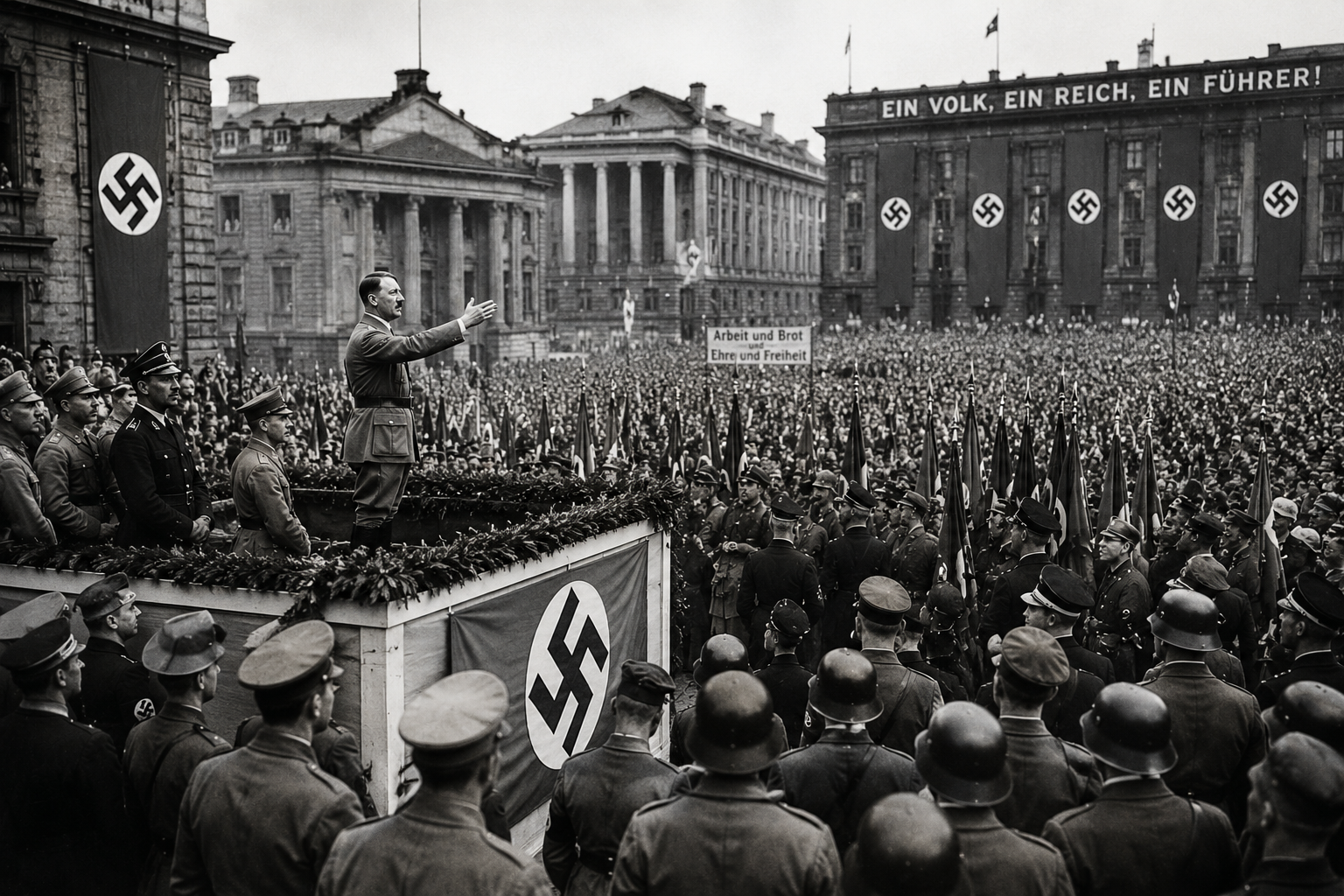
Cultural Machinery: Propaganda, Myth and the Leader Cult
Fascist movements did not merely argue; they staged politics through spectacle, uniforms, rallies, symbols, enemies and myths of rebirth. The economic dimension is essential because political change becomes real through material life. Wages, debts, savings, taxation, production, reparations, trade and unemployment are not background details. They are the channels through which ordinary people discover whether an order is working or failing. When those channels break, legitimacy breaks with them.
The social dimension was equally important. Different groups experienced the same crisis differently. Elites could protect capital or status; workers faced dismissal; farmers faced debt and falling prices; minorities could become scapegoats; women often carried intensified domestic burdens; young men were mobilised through uniform, party membership, military training or ideological education.
Culture translated hardship into meaning. Songs, posters, speeches, cartoons, textbooks, ceremonies and newspapers taught people how to name their suffering. A crisis could be explained as betrayal, decadence, foreign conspiracy, capitalist collapse, national humiliation or necessary sacrifice. These stories mattered because people rarely respond to statistics alone; they respond to stories that tell them who is guilty and what must be done.
The deeper historical importance of European fascism lies in the way it connected high politics with the lives of ordinary people. The economic, social and cultural dimensions was not experienced only in conference rooms, stock exchanges, ministries or party headquarters. It reached families through prices, wages, borders, propaganda, fear, unemployment, schoolbooks, uniforms, rationing, migration and public memory. That is why this subject must be studied as a civilisational story rather than a narrow political episode. It changed institutions, but it also changed expectations about security, justice, citizenship and the future.
Turning Point: When Authoritarianism Became Respectable
The crucial turning point came when elites and citizens began treating fascist violence as a solution rather than a threat. The turning point arrived when previous tensions became impossible to manage through ordinary methods. Compromise narrowed. Delay became dangerous. People who had once hoped for adjustment now demanded decisive action, while leaders began to treat risk as unavoidable. At such moments, history accelerates because institutions lose the ability to absorb pressure gradually.
The turning point mattered because it changed expectations. After it, the old language of stability no longer convinced enough people. A treaty no longer looked like peace, a market downturn no longer looked temporary, and extremist politics no longer looked like a fringe disturbance. The psychological threshold had been crossed before every institutional consequence became visible.
Such moments also expose limits. Law has limits when legitimacy collapses. Markets have limits when trust disappears. International agreements have limits when enforcement fails. Democratic institutions have limits when citizens no longer believe they can deliver security. In the rise of fascism in Europe, the turning point was decisive because it revealed those limits in public.
The deeper historical importance of European fascism lies in the way it connected high politics with the lives of ordinary people. The decisive turning point was not experienced only in conference rooms, stock exchanges, ministries or party headquarters. It reached families through prices, wages, borders, propaganda, fear, unemployment, schoolbooks, uniforms, rationing, migration and public memory. That is why this subject must be studied as a civilisational story rather than a narrow political episode. It changed institutions, but it also changed expectations about security, justice, citizenship and the future.
Nazi Consolidation: Law, Terror and Racial Ideology
In Germany, fascism became especially destructive through Nazi racial ideology, antisemitism, concentration camps, militarisation and totalitarian ambition. This part of the story reveals how the rise of fascism in Europe moved from background pressure into historical consequence. The forces at work were never isolated. They joined political calculation, economic strain, social fear and cultural meaning into a single field of action.
The central tensions were war trauma, national humiliation, fear of socialism, economic instability, weak parliamentary institutions, propaganda, paramilitary violence, antisemitism, ultranationalism and the promise of authoritarian order. These shaped the choices of leaders and the responses of societies. They also made moderate solutions harder to sustain because each failed compromise strengthened those who claimed that only radical action could restore control.
The result was a transformation of political imagination. People no longer saw the existing order as inevitable. They asked whether security required punishment, whether recovery required state intervention, whether national renewal required exclusion, and whether peace could survive without justice.
The deeper historical importance of European fascism lies in the way it connected high politics with the lives of ordinary people. This stage of development was not experienced only in conference rooms, stock exchanges, ministries or party headquarters. It reached families through prices, wages, borders, propaganda, fear, unemployment, schoolbooks, uniforms, rationing, migration and public memory. That is why this subject must be studied as a civilisational story rather than a narrow political episode. It changed institutions, but it also changed expectations about security, justice, citizenship and the future.
International Dimension: Fascist Cooperation and Appeasement
European fascism gained confidence as authoritarian regimes cooperated, tested international weakness and expanded aggression. This part of the story reveals how the rise of fascism in Europe moved from background pressure into historical consequence. The forces at work were never isolated. They joined political calculation, economic strain, social fear and cultural meaning into a single field of action.
The central tensions were war trauma, national humiliation, fear of socialism, economic instability, weak parliamentary institutions, propaganda, paramilitary violence, antisemitism, ultranationalism and the promise of authoritarian order. These shaped the choices of leaders and the responses of societies. They also made moderate solutions harder to sustain because each failed compromise strengthened those who claimed that only radical action could restore control.
The result was a transformation of political imagination. People no longer saw the existing order as inevitable. They asked whether security required punishment, whether recovery required state intervention, whether national renewal required exclusion, and whether peace could survive without justice.
The deeper historical importance of European fascism lies in the way it connected high politics with the lives of ordinary people. This stage of development was not experienced only in conference rooms, stock exchanges, ministries or party headquarters. It reached families through prices, wages, borders, propaganda, fear, unemployment, schoolbooks, uniforms, rationing, migration and public memory. That is why this subject must be studied as a civilisational story rather than a narrow political episode. It changed institutions, but it also changed expectations about security, justice, citizenship and the future.
Decline and Impact: From Dictatorship to World War
The rise of fascism culminated in war, occupation, genocide and the destruction of the very societies it claimed to renew. The aftermath was not a neat ending. Historical processes rarely close with a final scene. They leave institutions, wounds, habits and arguments that continue to shape later decades. The consequences of the rise of fascism in Europe moved through political systems, economic policy, international relations, social memory and moral debate.
The major consequences were one-party dictatorships, destruction of liberal democracy, militarisation, censorship, imperial aggression, racial persecution, alliance between fascist regimes and the road to genocide and world war. These outcomes did not affect everyone equally. Some groups gained leverage; others lost security. Some states attempted reform; others moved toward repression. Some communities interpreted the crisis as proof that democracy, markets or international law had failed. Others saw it as evidence that stronger institutions and wider justice were necessary.
Impact must be measured across scales. There were immediate effects visible in laws, borders, prices, elections and governments. There were also slower effects visible in political culture, fear, memory, school curricula and later diplomatic choices. The deeper impact lay in the way the crisis changed what people thought was possible or necessary.
The deeper historical importance of European fascism lies in the way it connected high politics with the lives of ordinary people. The aftermath and impact was not experienced only in conference rooms, stock exchanges, ministries or party headquarters. It reached families through prices, wages, borders, propaganda, fear, unemployment, schoolbooks, uniforms, rationing, migration and public memory. That is why this subject must be studied as a civilisational story rather than a narrow political episode. It changed institutions, but it also changed expectations about security, justice, citizenship and the future.
Historical Debates: Class, Capital, Culture and Ideology
Historians debate whether fascism should be explained mainly by capitalism, nationalism, war trauma, ideology, mass politics or elite failure. Historians continue to debate this subject because the evidence can support several layers of explanation. Some interpretations emphasise individual decisions; others stress structural pressures. Some focus on economics; others on ideology, diplomacy, class, empire, nationalism or culture. The best interpretation does not choose one cause mechanically but asks how several causes interacted.
One debate concerns responsibility. Was the outcome driven by deliberate policy, miscalculation, institutional weakness, popular pressure or global forces? Another debate concerns inevitability. Looking backward, events can appear to move logically toward crisis. But to people living through them, many alternatives still seemed possible. This gap between hindsight and lived uncertainty is central to serious historical analysis.
The debate is also moral. Historical explanation is not the same as excuse. To explain why a policy failed, why an economy collapsed or why fascism rose is not to justify the suffering that followed. It is to understand the conditions under which societies make catastrophic choices, so that memory becomes more than ceremony.
The deeper historical importance of European fascism lies in the way it connected high politics with the lives of ordinary people. The major historical debates was not experienced only in conference rooms, stock exchanges, ministries or party headquarters. It reached families through prices, wages, borders, propaganda, fear, unemployment, schoolbooks, uniforms, rationing, migration and public memory. That is why this subject must be studied as a civilisational story rather than a narrow political episode. It changed institutions, but it also changed expectations about security, justice, citizenship and the future.
Legacy Conclusion: The Fragility of Democracy
The legacy of fascism is the warning that democracy can die when citizens, elites and institutions normalise contempt, violence and exclusion. The legacy of the rise of fascism in Europe lies in its warning that democratic systems can be destroyed from within when fear, grievance, propaganda and elite collaboration normalise authoritarian violence. Its importance is not limited to specialists. It remains a warning about how fragile institutions become when people lose trust in justice, stability, representation or peace. It also shows that history is not only made by dramatic leaders; it is made by systems that either protect human dignity or expose people to fear.
The subject continues to matter because it sits at the intersection of memory and policy. Later generations used it to argue about diplomacy, economics, democracy, nationalism, war, welfare and human rights. Each return to the subject reveals a new anxiety. When societies ask about failed peace, financial collapse or authoritarian movements, they are also asking how their own systems might fail.
A powerful conclusion must therefore avoid easy closure. The past does not repeat itself mechanically, but it leaves patterns. Humiliation can become politics. Economic panic can become extremism. Weak international rules can invite revisionism. Democratic fatigue can open the door to movements that promise unity while destroying freedom. The history of the rise of fascism in Europe endures because it teaches that civilisation depends on institutions, but institutions depend on trust.
The final lesson is responsibility. Human beings inherit conditions they did not choose, but they still make choices inside those conditions. The tragedy of the rise of fascism in Europe is that many choices narrowed the future instead of widening it. Its value as history is that it restores complexity without removing judgment. It asks later generations to recognise danger before it becomes destiny.
In editorial terms, The Rise of Fascism in Europe is not only a topic from the past. It is a case study in historical causation. It shows how time, place, background, development, actors, turning points, consequences, debates and legacy must be read together. Only then does the subject become more than chronology. It becomes a way of understanding how societies rise into confidence, enter crisis, make decisions under pressure and leave behind lessons that later generations cannot afford to ignore.
Extended Analytical Note: Why This History Still Demands Attention
A final layer of analysis is necessary because European fascism belongs to the category of events whose consequences exceeded their immediate setting. It shaped political language, institutional design and public memory long after the first generation of participants had left the stage. That afterlife is part of the history, not an optional appendix. A historical subject becomes civilisational when it changes how later societies define danger, justice, reform and responsibility.
The evidence also demands humility. No single cause can explain the entire story. War trauma, national humiliation, fear of socialism, economic instability, weak parliamentary institutions, propaganda, paramilitary violence, antisemitism, ultranationalism and the promise of authoritarian order interacted with decisions made by Benito Mussolini, Adolf Hitler, Fascist squads, Nazi organisers, conservative elites, industrialists, veterans, unemployed citizens, middle-class voters, communists, socialists, monarchs, churches and paramilitary movements. This interaction produced outcomes that were not fully planned by any one actor. The historian’s task is to recover the chain of cause and consequence without flattening it into destiny. The past was structured, but it was not automatic.
For modern readers, the most valuable lesson is not a mechanical comparison with the present. It is a discipline of attention. European fascism warns that societies often ignore warning signs because each individual sign appears manageable. Only later do people see that the signs were connected. To study this history well is to learn how connected pressures become catastrophe, and how responsible institutions might prevent that movement before it hardens.
[Approximate article word count: 4685 words]