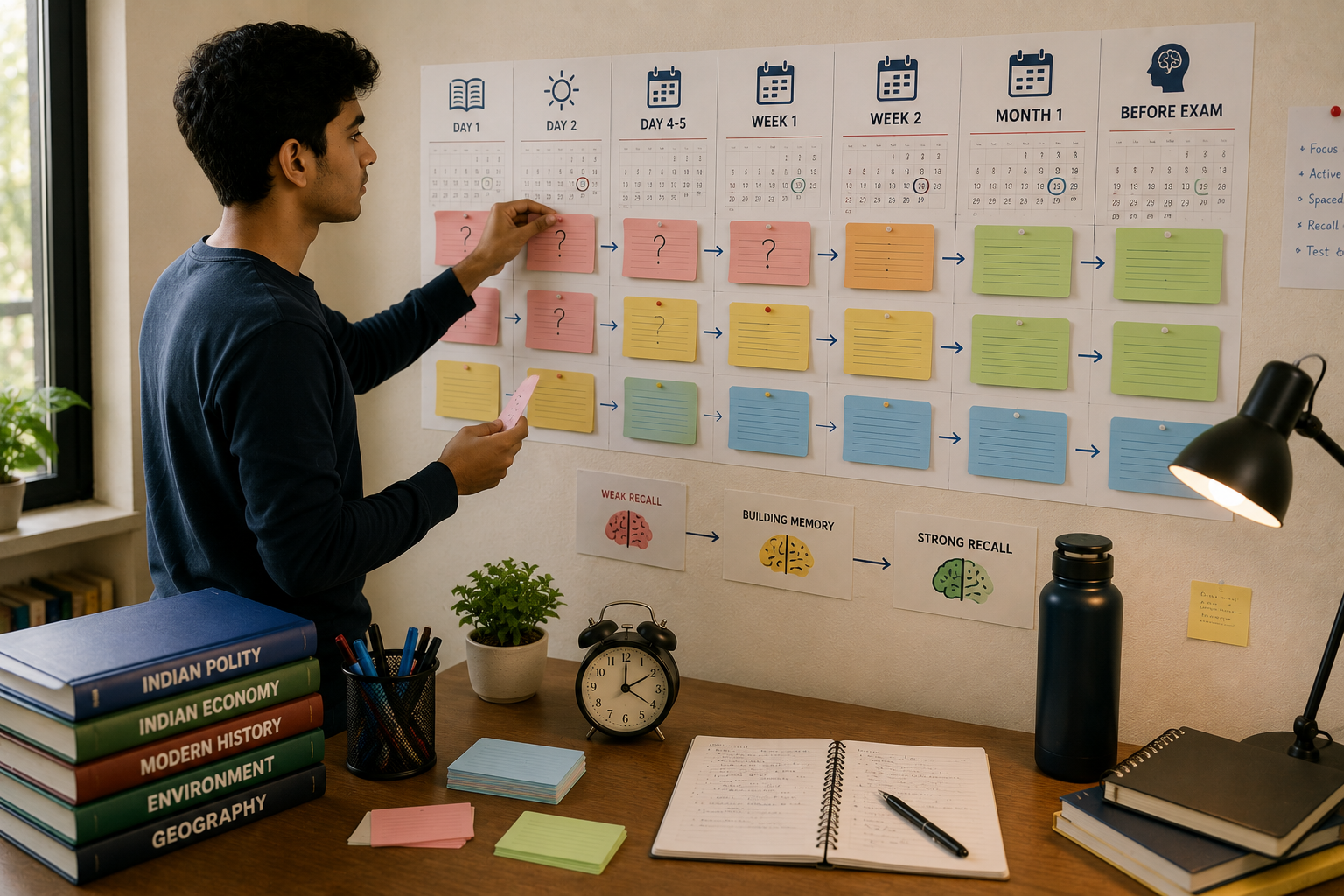
Most students revise in two extreme ways. Either they read a topic once and assume it is done, or they wait until the exam is near and try to revise everything at once. Both methods create problems. The first ignores forgetting. The second creates panic. Spaced repetition offers a better path. It is one of the simplest and most powerful study methods because it works with the natural rhythm of memory.
Spaced repetition means reviewing information repeatedly at planned intervals over time. Instead of reading the same chapter five times in one evening, the student reviews it today, tomorrow, after a few days, after a week, after two weeks, and again later. Each review strengthens memory and increases the time before the next review is needed. The method is simple, but its effect can be deep.
The scientific foundation behind spaced repetition is the spacing effect. The American Psychological Association describes the spacing effect as the advantage of distributed practice over massed practice. In practical terms, learning is usually stronger when sessions are separated across time rather than compressed into one block. A student who studies vocabulary for fifteen minutes across six days is likely to remember more later than a student who studies for ninety minutes in one sitting and never returns to it.
Spaced repetition is powerful because it responds to forgetting. Forgetting is not random. After learning something new, memory often weakens quickly if the material is not used. This is why a topic that felt clear yesterday may feel unclear next week. Spaced repetition interrupts that decline. It brings the material back before it disappears completely. Over time, the memory becomes more stable.
However, spaced repetition is not just repeated reading. This is an important distinction. A student can open the same notes many times and still learn poorly if the reviews are passive. The strongest form of spaced repetition includes active recall. At each interval, the student should try to retrieve the answer before checking notes. For example, do not simply reread the definition of demand elasticity. Ask yourself, “What is demand elasticity? What is the formula? What does elastic demand mean? What is an example?” Then check. The attempt to remember is the learning work.
Research on effective learning techniques supports this combination. Dunlosky and colleagues rated distributed practice and practice testing as high-utility techniques. Retrieval practice research, including work by Karpicke and Roediger, shows that testing can strengthen memory. When spaced repetition and active recall are combined, students get two advantages: the timing helps memory, and the retrieval effort strengthens it.
The reason spaced repetition feels harder than rereading is also the reason it works. When some time has passed, recall is not effortless. The student has to search memory. This effort is useful. If the answer comes back after effort, memory becomes stronger. If the answer does not come back, the student has found a gap early. Either way, the review produces information. Easy study often feels smooth but produces weak learning. Slightly difficult study often feels uncomfortable but produces stronger retention.
A basic spaced repetition plan can be built without any app. After learning a topic on Day 1, review it on Day 2. Then review it on Day 4 or Day 5. Then after one week. Then after two weeks. Then after one month. For exam preparation, add a final review before the test. The interval should be flexible. If a topic is easy, increase the gap. If a topic is difficult, shorten the gap. The goal is to review at the edge of forgetting, not after total forgetting.
Students can use a simple table with four columns: topic, first study date, next review date, and confidence level. Confidence can be marked as low, medium, or high. Low-confidence topics return sooner. High-confidence topics are pushed later. This prevents students from wasting equal time on everything. Revision should be need-based. The chapter you already know well does not deserve the same attention as the chapter you keep forgetting.
Spaced repetition also works for different subjects, but the method must be adapted. For vocabulary, dates, formulas, and definitions, flashcards work well. For mathematics, spaced repetition should include problem-solving. For history, it should include timelines, causes, consequences, and comparisons. For science, it should include diagrams, processes, and application questions. For law or polity, it should include provisions, case examples, distinctions, and previous-year questions. The principle is the same, but the review activity must match the subject.
For example, a student learning biology may review photosynthesis like this. Day 1: understand the process and draw the diagram. Day 2: redraw the diagram from memory and explain each step. Day 4: answer questions on chlorophyll, sunlight, carbon dioxide, and glucose. Day 8: compare photosynthesis with respiration. Day 15: solve exam questions. Day 30: teach the topic aloud in five minutes. Each review adds a new layer instead of repeating the same sentence.
A student preparing for UPSC or another competitive exam can use spaced repetition for large syllabi. The mistake many aspirants make is finishing one subject and moving on completely. By the time they return, the subject has faded. A better system is rolling revision. Every week should contain some new learning, some recent revision, some older revision, and some test practice. This keeps old topics alive while new topics are added.
Spaced repetition also reduces exam anxiety. Panic often comes from uncertainty. Students fear that they have forgotten everything because they have no recent evidence of memory. Regular spaced testing gives evidence. The student knows which topics are strong, which are weak, and which need review. Anxiety does not disappear completely, but it becomes more manageable because preparation is visible.
The method also prevents the illusion of productivity. Cramming creates a dramatic feeling of effort. Long nights, heavy notes, and last-minute intensity feel serious. But seriousness is not the same as effectiveness. Spaced repetition is quieter. It may look less heroic because it uses short sessions across time. But education is not a performance of suffering. It is a process of retention and application. The quieter method often wins.
There are common mistakes in spaced repetition. The first is making too many flashcards. If every line becomes a card, review becomes impossible. Cards should focus on important, testable, and easily forgotten points. The second mistake is reviewing without recall. Looking at the answer too quickly weakens the method. The third mistake is ignoring application. Knowing a definition is not enough if the exam asks for analysis. The fourth mistake is keeping intervals fixed even when performance changes. Spacing should respond to difficulty.
Another mistake is using spaced repetition only for facts. It is true that spaced repetition is excellent for factual memory, but it can also support conceptual learning. A concept can be reviewed through explanation prompts. For example: “Why does inflation reduce purchasing power?” “How is federalism different from decentralisation?” “Why does opportunity cost matter in decision-making?” These prompts require understanding, not just memory. Spaced conceptual recall builds durable clarity.
Students should also combine spaced repetition with interleaving. Suppose a student studies three physics formulas. If each formula is practised separately, the student may learn them temporarily. But in an exam, the challenge is choosing the correct formula. Interleaving mixes related problems so the student practises selection. Spacing preserves the memory; interleaving improves judgment. Together they prepare students for real performance.
Teachers can use spaced repetition in classrooms as well. A lesson should not disappear after one day. Teachers can begin class with three questions from last week, add monthly cumulative quizzes, and revisit core ideas through new examples. Low-stakes quizzes are especially useful because they reduce fear and increase retrieval. Students learn that revision is normal, not a punishment.
Parents can support spaced repetition by asking better questions at home. Instead of asking, “Did you finish the chapter?” ask, “Can you explain the chapter without looking?” Instead of asking, “How many hours did you study?” ask, “Which old topic did you revise today?” These questions shift attention from completion to retention.
Technology can help, but it is not necessary. Apps such as flashcard systems can schedule reviews automatically, but the student must still create good prompts and answer honestly. A notebook, calendar, spreadsheet, or wall chart can work just as well. The best system is the one the student actually uses. A perfect app that is ignored is worse than a simple notebook used daily.
Spaced repetition also teaches a deeper life lesson. Important knowledge needs return. Skills, languages, professional concepts, laws, formulas, and ideas fade when unused. Professionals who keep learning throughout life often use informal spaced repetition: they revisit important documents, practise skills, discuss concepts, teach others, and solve real problems. The method is not only for school exams. It is a lifelong learning strategy.
To begin, choose one subject and one week. Do not redesign your entire life on the first day. Select five topics. Create recall questions for each. Review them after one day, three days, and seven days. Track which ones you remember. Adjust the next review. After two weeks, add more topics. The system grows gradually.
Students do not need to remember everything forever after one reading. They need a system that brings knowledge back at the right time. Spaced repetition is that system. Used consistently, it makes learning lighter, revision smarter, and exam preparation more reliable. It proves that the best study method is not always the longest. Sometimes, the best method is the one that returns at the right interval.
Sources Used:
APA Dictionary of Psychology on the spacing effect; Dunlosky et al., Improving Students’ Learning With Effective Learning Techniques; Karpicke and Roediger, The Critical Importance of Retrieval for Learning; UC San Diego guidance on spaced practice.
A useful way to begin is the “minimum review promise.” After every new topic, promise at least three returns: one within twenty-four hours, one within a week, and one within a month. This small promise alone can transform retention. Students who cannot maintain large systems can still maintain this basic rhythm. It prevents the most common error: learning and abandoning. Once this habit is stable, more sophisticated intervals can be added.
Spaced repetition also makes revision emotionally easier because it reduces the size of each review. If you wait one month, a chapter may demand two hours. If you review after one day and again after a week, the same chapter may need only ten to twenty minutes. The total load becomes lighter because the memory never collapses fully. This is the hidden efficiency of spacing: it may look like more sessions, but each session is smaller, sharper, and more effective.
Finally, spaced repetition builds discipline without drama. It asks the student to return regularly, not desperately. It rewards small acts done on time. It turns revision from an emergency into maintenance. In a world where students are surrounded by distractions, this rhythm is valuable. It creates trust between the student and the system: if I return at the right intervals and test honestly, my memory will improve. That trust keeps preparation steady even when motivation changes.
The strongest students understand this early. They do not ask memory to do impossible work after one reading. They build return points into the calendar, protect those return points, and let repetition compound over time.