The Map That Could Have Broken India
At independence, India faced not one problem of partition but two. The first was the division of British India into India and Pakistan. The second was the fate of more than five hundred princely states. These states were scattered across the subcontinent, from large and powerful territories to tiny estates. If they had remained independent, joined rival blocs, or negotiated separately with foreign powers, India’s political map could have become unworkable.
The Legal Background: Paramountcy Lapses
Under British rule, princely states were governed through the doctrine of paramountcy. The rulers had internal authority, but the British controlled external relations and strategic matters. When the British decided to leave India, they declared that paramountcy would lapse. This meant that the treaty relationship between the Crown and the princely states would end.
In theory, this created a dangerous ambiguity. Some princes believed that they would regain full sovereignty. Others considered joining India or Pakistan. A few imagined independence. But the logic of geography made complete independence unrealistic for most. Many states were landlocked inside Indian territory. Their railways, postal systems, currency, markets, security, and communications depended on the larger subcontinent. Nevertheless, the legal uncertainty created an opening for political fragmentation.
The Challenge Before Indian Leaders
For Indian leaders, the question was urgent. Partition had already produced violence, refugee crises, and military uncertainty. A fragmented map of princely sovereignties would have made defence, economic planning, and political unity nearly impossible. Imagine a railway line interrupted by independent enclaves, or a river system subject to multiple mini-states, or foreign powers using princely territories as strategic footholds.
The challenge was also ideological. India was becoming a democratic republic. Could hereditary rulers continue as sovereign authorities over millions of people? Could the people of princely states be denied the rights promised to citizens of independent India? The integration question was therefore not only about territory. It was about the meaning of sovereignty in a modern democratic state.
The States Department and the Patel-Menon Partnership
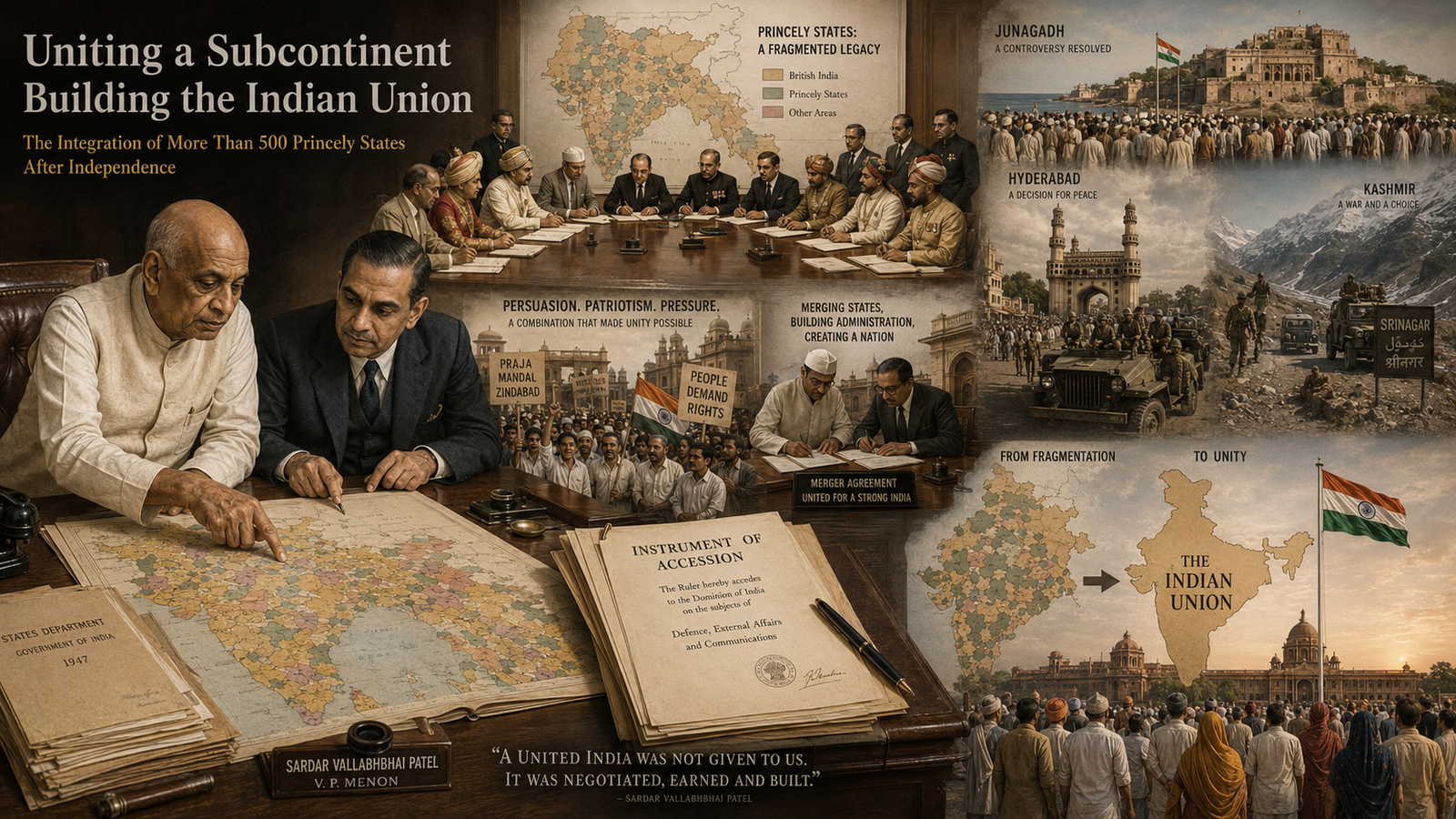
The task of integration was handled by the States Department under Sardar Vallabhbhai Patel, with V.P. Menon as secretary. Patel brought political authority, firmness, and clarity. Menon brought administrative skill, constitutional understanding, and negotiation expertise. Together, they developed a strategy that combined reassurance with pressure.
Their immediate goal was accession on three subjects: defence, external affairs, and communications. This limited Instrument of Accession was tactically brilliant. It did not immediately demand total surrender of internal powers, making it easier for rulers to sign. At the same time, it secured the essentials required for national survival. Once accession was achieved, deeper merger and administrative integration could follow.
The Instrument of Accession
The Instrument of Accession became the key legal document through which princely states joined India. By signing it, rulers accepted that India would control specified subjects. The arrangement was framed as practical rather than revolutionary. It reassured princes that their dignity and certain privileges would be respected, while preventing the emergence of independent states within India’s geographical body.
Most rulers signed because the alternatives were weak. Independence was impractical. Accession to Pakistan was possible only for states geographically connected or politically aligned with Pakistan, though even that raised issues of demography and location. India also offered privy purses, recognition of titles, and gradual transition. The process moved with remarkable speed, largely because Patel and Menon understood that delay would encourage uncertainty.
Persuasion, Patriotism and Pressure
The integration of princely states is often remembered as a peaceful diplomatic triumph. In many cases, it was. Patel appealed to the rulers’ sense of responsibility and warned them against creating chaos. Menon negotiated details and found face-saving formulas. Princes were reminded that their people, geography, and economic interests tied them to India.
But persuasion existed alongside pressure. The new Indian state made it clear that it would not tolerate Balkanisation. Popular movements within princely states added pressure from below. In some regions, people demanded democratic rights and union with India. The princes were not negotiating in a vacuum. They faced a changed political world in which hereditary authority no longer carried unquestioned legitimacy.
The Easy Accessions and Their Importance
Many states acceded without dramatic conflict. This should not make their integration seem unimportant. Each accession helped establish momentum. Once a majority joined India, holdouts became more isolated. The rapid accession of numerous states created the impression that joining India was the normal and practical choice.
Smaller states especially had little capacity to remain independent. Many lacked viable armies, modern administrations, financial autonomy, or diplomatic networks. Their integration prevented the emergence of hundreds of micro-sovereignties. In this sense, the quiet accessions were as important as the dramatic cases because they gave India territorial coherence.
Junagadh: Geography Versus Ruler’s Choice
Junagadh became an early test. It was a princely state in Kathiawar with a Muslim ruler and a majority Hindu population. Its ruler chose accession to Pakistan, even though Junagadh was geographically surrounded by Indian territory and had no land connection to Pakistan. India rejected the move as impractical and dangerous.
Internal unrest, administrative breakdown, and pressure from local leaders led India to intervene. A plebiscite later showed overwhelming support for accession to India. The Junagadh case established an important principle: the ruler’s legal choice could not be separated from geography and the will of the people. It also showed that India was willing to act decisively when accession threatened territorial logic.
Hyderabad: The Largest Internal Challenge
Hyderabad was the most serious internal challenge. It was large, wealthy, centrally located, and ruled by the Nizam, who sought independence. Hyderabad’s population was majority Hindu, but its ruling elite was Muslim. The state had its own administration, currency traditions, and diplomatic aspirations. Its location in the heart of the Indian peninsula made independence strategically unacceptable to India.
The situation worsened with the rise of the Razakars, a paramilitary force associated with militant support for the Nizam’s position. Reports of violence, political repression, and instability increased pressure for intervention. Negotiations failed to produce a stable settlement. In September 1948, India launched Operation Polo, a military action that ended the Nizam’s resistance and integrated Hyderabad into India.
Kashmir: Accession Under Invasion
Jammu and Kashmir presented a different kind of challenge. It had a Hindu ruler, Maharaja Hari Singh, and a majority Muslim population, with regions of great religious, linguistic, and geographic diversity. The Maharaja initially preferred independence. But in October 1947, tribal forces backed from Pakistan entered Kashmir. Facing military collapse, Hari Singh sought Indian assistance and signed the Instrument of Accession.
India accepted accession and sent troops. Pakistan contested the accession, and war followed. The Kashmir issue soon reached the United Nations and became one of the most enduring disputes of modern South Asian history. Kashmir shows that princely integration could not always be separated from Partition, identity, international diplomacy, and military conflict.
Travancore, Bhopal and Other Negotiations
Not all difficult cases resulted in military action. Travancore initially considered independence, partly due to its economic resources and strategic coastline. Bhopal also hesitated. In both cases, political pressure, negotiation, and changing circumstances led to accession. These examples show that the Indian leadership used different methods depending on the situation.
The integration process was not a single formula imposed mechanically. It involved reading each state’s geography, ruler, population, administrative capacity, and political atmosphere. Some required reassurance. Some required deadlines. Some required popular mobilisation. Some required force. The success lay in combining these methods without allowing the larger objective to collapse.
Merger Agreements and Administrative Consolidation
Accession secured limited subjects, but India still had to transform princely territories into governable units. This required merger agreements. Many smaller states were consolidated into unions such as Saurashtra, Rajasthan, Madhya Bharat, and Patiala and East Punjab States Union. Administrative systems were reorganised, courts and laws were harmonised, and revenue systems were adjusted.
This stage was less dramatic than accession but equally important. A state is not integrated merely when a ruler signs a document. Integration becomes real when citizens can access courts, administration, elections, transport, taxation, policing, and constitutional rights under a common framework. The administrative integration of princely states laid the groundwork for India’s federal structure.
The Constitution and the End of Separate Sovereignty
The Constitution of India brought princely states into a new legal order. Former princely territories were classified in different constitutional categories, but the long-term direction was clear: hereditary sovereignty would give way to democratic citizenship. The Constitution converted the political relationship between ruler and subject into one between state and citizen.
Privy purses and royal privileges were initially retained as part of the settlement. This compromise helped secure peaceful accession and merger. But it also created tension within a democratic republic committed to equality. In 1971, privy purses were abolished, marking the symbolic end of official royal privilege in India’s constitutional order.
People’s Movements and Democratic Legitimacy
The integration story should not be told only through rulers and statesmen. People’s movements in princely states played a vital role. Praja Mandals and local political organisations demanded responsible government, civil liberties, and integration with democratic India. In many states, subjects were impatient with autocratic rule and wanted the rights promised by independence.
This popular pressure gave moral legitimacy to integration. It showed that princely territories were not private estates but homes of people entitled to citizenship. Without these movements, integration might have appeared as merely a negotiation among elites. With them, it became part of a wider democratic transformation.
Historical Debates: Was Integration Too Centralised?
Some critics argue that integration strengthened central authority at the cost of regional autonomy. Others argue that given the dangers of Partition, foreign interference, and internal fragmentation, strong central action was necessary. The truth lies in the historical context. India in 1947 was not a settled, peaceful environment. It was facing violence, displacement, uncertain borders, and administrative rupture.
The integration of princely states required speed because delay could have hardened separatist claims. Yet the process also involved compromises that later generations would question. Kashmir remains the most contested example. Hyderabad’s integration raises debates about force and communal politics. The abolition of privileges raises questions about promises made during accession. These debates do not diminish the achievement; they make it historically real.
Legacy: The Making of the Indian Union
The integration of princely states created the territorial foundation of the Indian Union. It prevented the subcontinent from fragmenting into hundreds of political units. It enabled economic planning, national defence, constitutional citizenship, and democratic expansion. It also gave India a stronger bargaining position in a turbulent postcolonial world.
Sardar Patel is often called the Iron Man of India because of this achievement. But the process was not the work of one person alone. It involved Menon’s administrative brilliance, popular movements, cooperative rulers, provincial leaders, civil servants, soldiers, and ordinary citizens. It was one of the rare moments when political imagination and bureaucratic execution converged at national scale.
Conclusion: Unity Was an Achievement, Not an Accident
India’s political unity after independence can appear natural on today’s map. But it was not natural in 1947. It was created. The princely states could have produced fragmentation, conflict, and instability. Instead, through accession, merger, negotiation, pressure, and constitutional incorporation, they were woven into a republic.
The integration of princely states teaches that freedom is not only the end of foreign rule. It is also the building of institutions capable of holding diversity together. India became independent on 15 August 1947, but it became politically coherent through the difficult work that followed. The integration of princely states was one of the decisive acts that turned independence into a functioning Union.