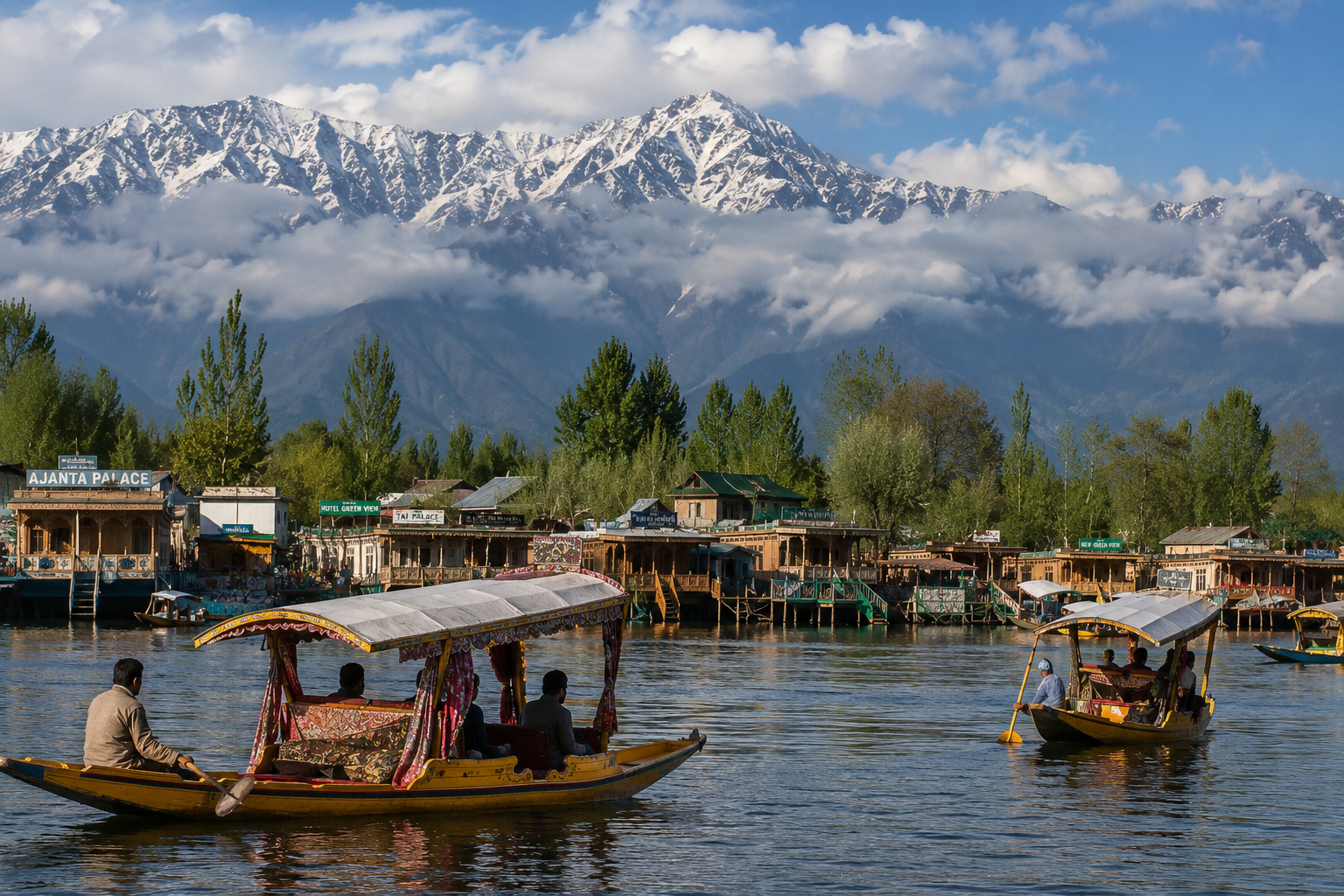
A Valley Where Geography Became Destiny
Kashmir is one of the most historically layered regions of the Indian subcontinent. Its story cannot be reduced to modern conflict, even though modern politics has made the region globally visible. Long before it became a disputed frontier, Kashmir was a centre of Sanskrit learning, Buddhist transmission, Shaiva philosophy, courtly culture, Sufi practice, craft production and mountain-state politics. Its valley geography created beauty, strategic vulnerability and cultural distinctiveness at the same time.
To write the history of Kashmir responsibly is to hold several truths together. It has been a sacred landscape, a literary centre, a kingdom, a conquest zone, a princely state, a symbol of nationalism, and a lived homeland for many communities. Its history belongs not only to rulers and wars but also to poets, monks, artisans, peasants, saints, migrants and families shaped by repeated transitions of power.
Geography: The Valley, the Mountains and the Routes
Kashmir’s geography has always mattered. The Kashmir Valley is enclosed by mountains, giving it a distinctive ecological and cultural character. Yet it has never been completely isolated. Routes connected it to Punjab, Central Asia, Tibet and the wider Himalayan world. These routes carried trade, religious ideas, armies and artistic influences. The same mountains that protected Kashmir also made it strategically valuable to surrounding powers.
The valley’s climate, water systems and fertile land supported agriculture, settlement and urban life. Srinagar became a historic centre. Lakes, rivers and gardens shaped the aesthetic imagination of Kashmir. But geography also created vulnerability. Whoever controlled the passes and surrounding highlands could influence the valley’s security. This tension between enclosure and connectivity is one of the keys to Kashmir’s history.
Ancient Kashmir: Myth, Text and Early Kingdoms
Ancient Kashmir appears in mythological, literary and historical traditions. The Nilamata Purana and Kalhana’s Rajatarangini are central to Kashmir’s historical memory, though they must be read critically as texts shaped by genre, politics and worldview. Rajatarangini, composed in the twelfth century, is especially important because it presents a continuous narrative of Kashmir’s kings. It is not modern academic history, but it is one of South Asia’s most remarkable historical compositions.
Kashmir’s early religious world was diverse. Hindu traditions, Buddhism and local cults coexisted and interacted. The region became associated with Sanskrit learning and philosophical reflection. Kashmir Shaivism developed sophisticated metaphysical ideas that influenced Indian intellectual history. Buddhist links connected Kashmir to wider trans-Himalayan networks. This early period established Kashmir as not merely a remote valley but a major cultural centre.
Karkotas, Utpala and the High Point of Early Kashmir
Among ancient and early medieval dynasties, the Karkota period is often remembered as a high point, especially under Lalitaditya Muktapida in the eighth century. His reign is associated with expansion, monumental building and political ambition. The Martand Sun Temple, though now in ruins, remains one of the striking symbols of early Kashmir’s architectural imagination. Whether every account of conquest in later narratives is taken literally or not, the period reflects Kashmir’s aspiration to regional power.
Subsequent dynasties, including the Utpala rulers, continued the complex politics of the valley. Court factions, landholding elites, religious institutions and military chiefs shaped governance. Kashmir’s history during these centuries was not peaceful continuity. It included prosperity, intrigue, succession struggles and social stress. The importance of this era lies in the maturation of Kashmir’s court culture and the deepening of its literary and religious traditions.
The Coming of Islam and the Sultanate Period
From the fourteenth century, Kashmir came under Muslim rule. This transition was not a single event but a gradual political and social transformation. The Shah Mir dynasty and later rulers established Sultanate authority in the valley. Islam spread through court patronage, Sufi networks, social change and interactions with local society. As elsewhere in South Asia, religious transformation cannot be explained only by conquest. It involved saints, shrines, land relations, political legitimacy and cultural adaptation.
The figure of Sultan Zain-ul-Abidin, often remembered as Bud Shah or the Great King, occupies a special place in Kashmiri memory. His reign is associated with cultural patronage, relative tolerance, crafts and administrative stability. Under Muslim rule, Kashmir developed new artistic and literary forms while retaining elements of older traditions. Persian became important, but local Kashmiri culture remained vibrant. The valley’s identity became increasingly composite, shaped by Sanskritic inheritance and Islamic spiritual traditions.
Mughals, Afghans and the Loss of Local Sovereignty
In 1586, Kashmir was incorporated into the Mughal Empire under Akbar. Mughal rule linked Kashmir more closely to the imperial politics of north India. The Mughals admired the valley’s beauty and developed gardens, pleasure retreats and routes of imperial movement. Kashmir became both a province and an imperial landscape of aesthetic imagination. Mughal gardens remain part of the region’s historical memory.
After Mughal power declined, Kashmir came under Afghan rule in the eighteenth century. Afghan control is often remembered in Kashmiri narratives as a difficult period marked by heavy extraction and political hardship. The region’s political autonomy had diminished. It was increasingly ruled by outside powers whose priorities were shaped by larger imperial struggles. This pattern would continue under Sikh and Dogra rule.
Sikh and Dogra Rule
In 1819, the Sikh kingdom of Punjab under Ranjit Singh annexed Kashmir. Sikh rule ended Afghan dominance but did not restore local sovereignty. After the First Anglo-Sikh War, the Treaty of Amritsar in 1846 transferred Kashmir to Gulab Singh, the Dogra ruler of Jammu, creating the princely state of Jammu and Kashmir under British paramountcy. This state combined diverse regions: the Kashmir Valley, Jammu, Ladakh, frontier areas and other territories.
Dogra rule reshaped administration, taxation and regional relations. It also intensified questions of identity and representation because the princely state contained different religious, linguistic and geographical communities. The Kashmir Valley had a Muslim-majority population ruled by a Hindu Dogra dynasty under the British imperial umbrella. This political structure became one of the important backgrounds to later twentieth-century conflict.
Twentieth Century Politics and 1947
By the twentieth century, political consciousness in Jammu and Kashmir was growing. Movements for rights, representation and reform emerged under princely rule. Sheikh Abdullah and the National Conference became central to politics in the valley. At the same time, wider currents of Indian nationalism, Muslim politics and princely-state reform affected the region.
In 1947, British India was partitioned into India and Pakistan. The princely states were expected to accede to one dominion or the other, taking into account geography, demography and political circumstances. Jammu and Kashmir’s ruler, Maharaja Hari Singh, initially hesitated. After tribal forces from Pakistan entered the state, the Maharaja signed the Instrument of Accession to India in October 1947, and Indian troops were airlifted to defend the territory. This led to the first Indo-Pakistani war over Kashmir and the eventual division of the region by a ceasefire line, later known as the Line of Control.
Kashmir in Modern Political History
After 1947, Kashmir became one of the central disputes between India and Pakistan. The region experienced constitutional arrangements, wars, diplomacy, insurgency, militarisation, displacement and competing national narratives. For India, Jammu and Kashmir’s accession became a legal and constitutional fact. For Pakistan, the Muslim-majority character of the region became central to its claim. For many Kashmiris, the experience has been shaped by questions of autonomy, identity, security, rights and memory.
Any historical article on Kashmir must be careful not to collapse centuries of culture into the post-1947 dispute. Modern conflict matters deeply, but it is not the whole of Kashmir’s history. The valley’s older traditions of learning, craft, religion and aesthetics continue to shape identity. At the same time, modern suffering, migration and political conflict cannot be ignored or softened into picturesque nostalgia.
Culture: Language, Craft and Spiritual Traditions
Kashmir’s cultural history is exceptionally rich. The region contributed to Sanskrit learning, Shaiva philosophy, Buddhist transmission, Persianate culture, Sufi poetry, shrine traditions, music, cuisine and crafts. Kashmiri shawls, carpets, papier-mache, woodwork and gardens became markers of regional refinement. The Kashmiri language carried oral traditions, songs and everyday memory, while Persian and Sanskrit shaped elite literary worlds at different times.
The idea of Kashmiriyat is often used to describe a shared cultural ethos of coexistence and regional identity. Historians and political thinkers debate the term, because it can sometimes romanticise the past or obscure conflict. Yet it points to a real historical fact: Kashmir has long been shaped by interaction among communities, languages and spiritual traditions. Its culture cannot be understood through a single religious or political lens.
Historical Debates
Kashmir’s history is highly contested. Debates involve the interpretation of ancient texts, the nature of Islamisation, the memory of different ruling periods, the legitimacy of accession, the meaning of autonomy, the causes of insurgency, and the representation of displaced communities such as Kashmiri Pandits. Because modern politics is intense, history is often used as a weapon. This makes careful scholarship even more necessary.
A balanced historical approach distinguishes between evidence, memory and political claim. Kalhana’s Rajatarangini is invaluable but not a modern archive. Persian chronicles reveal power but not always popular experience. Colonial records are detailed but shaped by imperial assumptions. Oral memory preserves suffering and identity but requires sensitive contextualisation. Kashmir’s past must therefore be reconstructed through multiple kinds of sources.
Legacy: Beyond Paradise and Conflict
Kashmir has often been described either as paradise or as a conflict zone. Both images are incomplete. The region is beautiful, but beauty alone cannot explain its history. The region is contested, but conflict alone cannot define its civilisation. Kashmir’s true historical significance lies in the way it combined mountain geography, intellectual production, religious transformation, artistic refinement and strategic vulnerability.
To understand Kashmir is to understand how a small valley can become central to vast historical forces. Empires desired it, saints transformed it, poets remembered it, artisans shaped it, states contested it and ordinary people lived through its upheavals. Its history is therefore not merely regional. It is a window into South Asian civilisation itself: plural, wounded, creative, strategic and deeply layered.