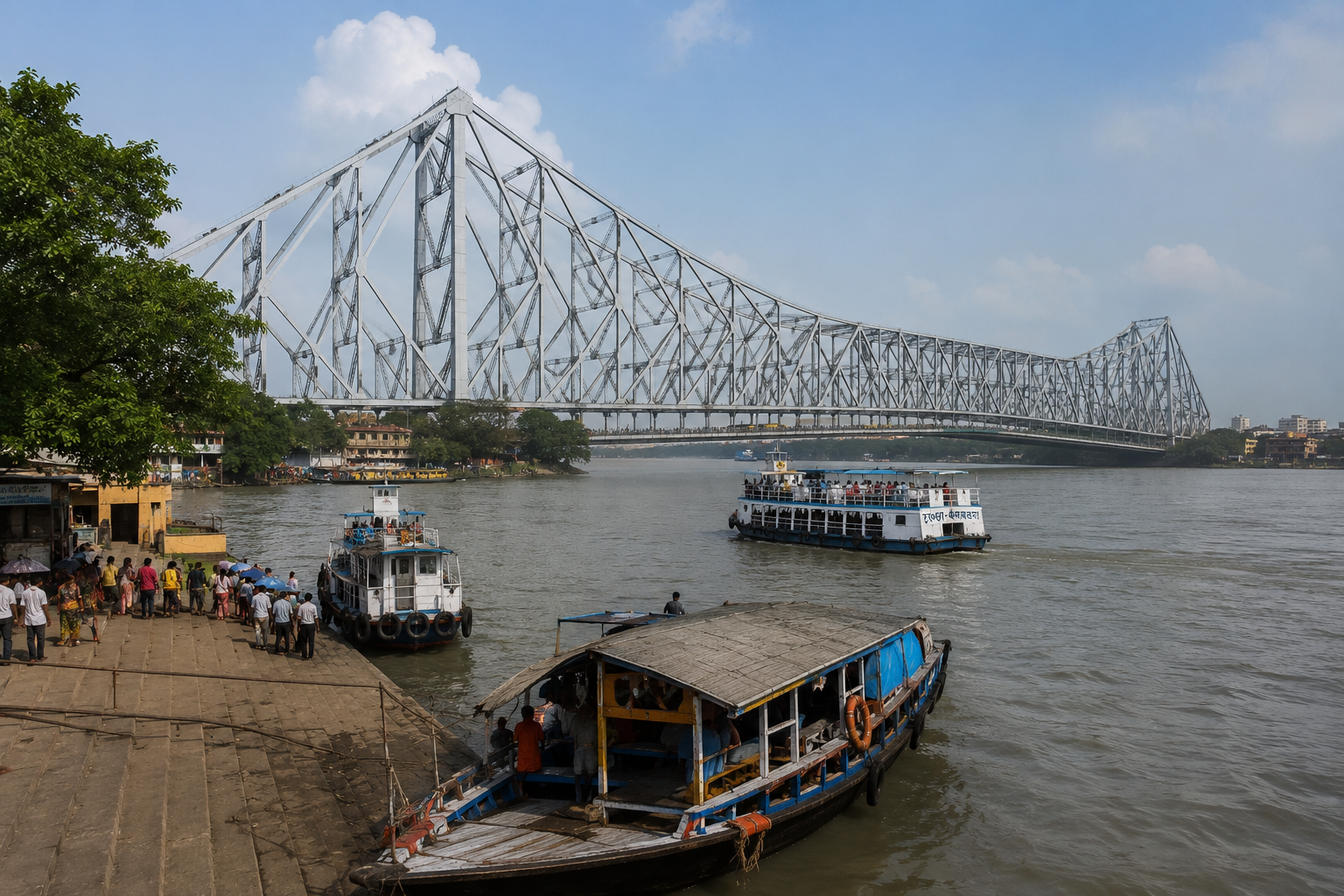
A Delta That Repeatedly Changed the Subcontinent
Bengal’s history is the history of a riverine civilisation that repeatedly turned geography into power. Situated around the Ganga-Brahmaputra delta and the Bay of Bengal, Bengal has been a frontier, a granary, a trading zone, a cultural laboratory, a centre of imperial revenue, a home of devotional movements, a colonial capital region, and one of the most emotionally charged landscapes of partition. Few regions in South Asia combine ecological richness, linguistic confidence, political turbulence and cultural productivity so intensely.
Unlike empires that can be described through a single dynasty or capital, Bengal must be understood as a landscape of water, silt, ports, forests, villages and cities. Its rivers nourished agriculture but also shifted courses. Its delta connected inland India to the sea but also made administration difficult. Its culture absorbed Sanskritic, Buddhist, Islamic, Persianate, European and modern nationalist influences without losing its strong linguistic identity. Bengal was not peripheral to Indian history. It repeatedly became central to it.
Ancient Bengal: Vanga, Pundra and the Eastern Frontier
The name Bengal is usually associated with ancient terms such as Vanga or Banga, mentioned in early Sanskritic traditions. The early history of the region is difficult to reconstruct because political boundaries were fluid and textual references are scattered. Ancient Bengal was not a single unified state. It included several cultural and geographical zones such as Vanga, Pundra, Radha and Samatata. These names remind us that Bengal emerged gradually from local societies, trade connections and expanding political networks.
In early imperial history, parts of Bengal came under wider north Indian empires such as the Mauryas and later the Guptas. But Bengal’s geography gave it a degree of distinctiveness. Dense river systems and wetlands made it both attractive and difficult to control. Agricultural expansion, iron use, settlement growth and riverine trade slowly integrated the region into broader subcontinental patterns. Yet Bengal remained a zone where local identity and wider imperial influence constantly interacted.
The Pala Age: Buddhism, Monasteries and Regional Power
The Pala dynasty, beginning in the eighth century, marked one of the great high points of Bengal’s early medieval history. The Palas ruled over large parts of Bengal and Bihar and became major patrons of Buddhism. Their period is associated with monastic universities, artistic production, manuscript culture and links across the Buddhist world. Institutions such as Nalanda, Vikramashila and other centres flourished in the wider eastern Indian zone under Pala patronage.
The Pala age also matters because it shows Bengal as an exporter of ideas, not merely a receiver of influence. Buddhist art, tantric traditions, scholastic networks and monastic scholarship connected Bengal to Tibet, Southeast Asia and other parts of Asia. Pala sculpture and bronze images developed refined forms that influenced religious art beyond the region. Politically, the Palas competed with the Gurjara-Pratiharas and Rashtrakutas in the tripartite struggle for north Indian prestige, demonstrating that Bengal had become a major imperial player.
The Sena Dynasty and Changing Religious Worlds
After the Palas, the Sena dynasty became prominent in Bengal. The Senas are often associated with Brahmanical revival, temple patronage and Sanskritic culture. This transition should not be seen as a simple replacement of Buddhism by Hinduism, but as part of a wider change in religious patronage and social hierarchy. Land grants, Brahmin settlements and agrarian expansion helped reshape society. Literary and cultural production continued, while regional languages and devotional practices grew stronger over time.
This period also highlights Bengal’s layered identity. Elite culture might use Sanskrit, administration might rely on landholding structures, local communities might follow varied cults and practices, and the delta’s frontier zones might retain distinct social patterns. Bengal was never culturally flat. Its history is best understood as a constant negotiation between courtly traditions, local religious worlds and ecological expansion.
Islamic Bengal: Sultanate Power and Cultural Synthesis
From the thirteenth century onward, Muslim rule became increasingly important in Bengal. The Bengal Sultanate emerged as one of the most significant regional powers of medieval India. Its rulers used Persianate political forms, minted coins, built mosques, patronised cities and connected the region to wider Islamic networks. Yet Islamisation in Bengal was not only a story of conquest. It also involved agrarian expansion, Sufi networks, local patronage, settlement in frontier zones and social mobility.
Bengal’s Islamic architecture developed distinctive forms suited to local materials and climate. Brick mosques, curved cornices and terracotta ornament reflected adaptation to the deltaic environment. Persian became a language of administration and high culture, but Bengali continued to grow as a literary language. The result was not cultural erasure but a complex synthesis in which Islamic, regional and older Indic forms interacted. Bengal’s Muslim history is therefore both regional and connected to larger Indian Ocean and Indo-Persian worlds.
Mughal Bengal: Wealth, Trade and the Subah
Under the Mughals, Bengal became one of the richest provinces of the empire. The Mughal Subah of Bengal was valued for its agriculture, textiles, river routes and overseas trade. Dhaka, Murshidabad and other centres became important in administration, craft production and commerce. Bengal’s fine textiles, including muslins, entered global circuits. European companies came not because Bengal was weak but because it was wealthy.
The Mughal period deepened agrarian expansion in the delta. Forests were cleared, new lands were settled, and local elites were integrated into imperial revenue systems. The region’s productivity made it a prize. But wealth also made Bengal vulnerable to external commercial and military ambitions. By the eighteenth century, as Mughal central authority declined, Bengal’s nawabs gained autonomy. This autonomy, however, would soon collide with the East India Company.
Plassey and the Beginning of Company Rule
The Battle of Plassey in 1757 is one of the most consequential events in the history of South Asia. The defeat of Nawab Siraj-ud-Daulah by the East India Company, aided by internal betrayal and political intrigue, opened the way for Company dominance in Bengal. The subsequent acquisition of revenue rights transformed a trading corporation into a territorial power. Bengal became the financial base from which the Company expanded across India.
This transformation was not merely political. It altered revenue extraction, trade priorities, judicial structures and rural life. The Bengal famine of 1770 exposed the harshness and fragility of early Company rule. Calcutta grew as a colonial city and administrative centre. Bengal became the laboratory of colonial governance, where experiments in revenue settlement, law, education and bureaucracy were developed before influencing other parts of British India.
Bengal Renaissance and the Modern Public Sphere
In the nineteenth century, Bengal became a major site of intellectual and social change. Calcutta’s schools, presses, colleges, debating societies and reform movements created a modern public sphere. Figures such as Raja Rammohan Roy, Ishwar Chandra Vidyasagar, Bankim Chandra Chattopadhyay and later Rabindranath Tagore shaped debates on religion, reform, language, literature, women’s education, nationalism and identity. This period is often called the Bengal Renaissance, though historians debate the term because it can overemphasise elite urban society.
The importance of this era lies in its contradictions. Bengal produced modern Indian journalism, reformist thought and nationalist literature, but it also remained marked by social hierarchy, rural poverty and colonial dependence. English education created new opportunities and new alienations. Bengali literature flourished, but the colonial economy distorted local industries. The modern Bengali middle class became a powerful cultural force, yet it did not represent all sections of society equally.
Partition of Bengal, Nationalism and Communal Politics
The 1905 partition of Bengal by the British triggered a major nationalist response. Officially justified on administrative grounds, it was widely seen by Indian nationalists as an attempt to divide political opposition. The Swadeshi movement, boycott campaigns, nationalist songs and public mobilisation made Bengal a centre of anti-colonial politics. The partition was annulled in 1911, but the episode had already revealed the power of mass politics.
Bengal’s twentieth-century history also became increasingly shaped by communal and class tensions. Peasant movements, revolutionary nationalism, Muslim political mobilisation, Hindu bhadralok politics, famine, wartime disruption and debates over representation transformed the region. The Bengal famine of 1943 remains one of the darkest episodes of colonial rule, raising enduring questions about policy failure, wartime priorities and human suffering.
1947 and After: A Region Divided
In 1947, Bengal was partitioned into West Bengal in India and East Bengal in Pakistan, later East Pakistan and then Bangladesh after 1971. Partition cut through language, families, land, memory and economy. Unlike Punjab, where violence was immediate and massive, Bengal’s partition unfolded through waves of displacement over many years. Refugee movements, border anxieties and cultural trauma shaped both sides of the border.
The creation of Bangladesh in 1971 added another layer to Bengal’s history. Bengali linguistic nationalism became central to the struggle against Pakistani domination. Thus Bengal’s modern story is shared across India and Bangladesh but not identical in both places. The region remains united by language and cultural memory, yet divided by nation-states, religious demography and political histories.
Historical Debates
Historians debate many aspects of Bengal’s past: the nature of Islamisation, the meaning of the Bengal Renaissance, the economic impact of colonialism, the causes of famine, the role of class and caste in nationalism, and the memory of partition. These debates are important because Bengal’s history has often been claimed by competing narratives. Some emphasise cultural glory; others stress exploitation and trauma. Some focus on Hindu reformers; others highlight Muslim peasant society, Buddhist legacies or subaltern movements.
A careful history must resist single-cause explanations. Bengal was shaped by ecology, empire, trade, language, religion, class and colonial power together. Its river systems mattered as much as its rulers. Its poets mattered alongside its peasants. Its urban modernity cannot be separated from rural distress. Its partition cannot be understood without long histories of colonial policy, political representation and social anxiety.
Legacy: Bengal as a Civilisational Region
Bengal’s legacy lies in its ability to generate culture under pressure. It produced powerful literary traditions, devotional movements, revolutionary politics, reform debates, music, cinema, cuisine and intellectual life. It also endured famine, partition and displacement. To study Bengal is to see how a region can be both deeply wounded and extraordinarily creative.
In the larger history of civilisation, Bengal shows that geography is not passive. A delta can create abundance, vulnerability, trade, migration and cultural hybridity. Bengal’s rivers carried silt, boats, songs, armies, scriptures, textiles and refugees. Its history is therefore not a straight line from ancient kingdom to modern province. It is a layered story of water, words, wealth, power and memory.