Courage Before It Became a National Language
Rani Lakshmibai of Jhansi occupies a rare place in Indian public memory. She is remembered not only as a queen who took up arms, but as a young woman who converted a personal succession dispute into a symbol of political dignity. In popular imagination, she appears on horseback, sword in hand, refusing surrender before a powerful empire. Yet the enduring power of her story does not come merely from the drama of battle. It comes from the larger moral question her life raises: what does a ruler do when law, custom, sovereignty, and survival are all suddenly weaponised against her? Lakshmibai’s answer was neither passive obedience nor reckless spectacle. It was resistance grounded in duty, honour, and the defence of a state she believed had been unjustly taken from her.
Her biography must therefore be read at two levels. At one level, it is the story of Manikarnika Tambe, a girl born in Varanasi who grew into the queen of Jhansi and became one of the most visible figures of the uprising of 1857. At another level, it is the story of how colonial expansion collided with Indian political traditions, especially the rights of adoption, succession, and regional sovereignty. The British described the events of 1857 as mutiny and disorder; Indian nationalist memory later saw them as the first great war of independence. Lakshmibai stands at the centre of that disagreement because her life exposes how personal grief, legal injustice, and imperial ambition could combine to produce rebellion.
Early Life: Manikarnika and the Making of a Fearless Temper
Lakshmibai was born as Manikarnika Tambe, commonly placed in 1828 in Varanasi, into a Marathi Brahmin family. Her father, Moropant Tambe, was connected with the courtly and administrative world of the Maratha tradition, and her mother, Bhagirathi Bai, died when Manikarnika was young. The loss of her mother, the mobility of her father’s position, and the atmosphere of a changing India shaped her early personality. Unlike the stereotype of royal women confined to ornamental roles, Manikarnika grew up in an environment where physical courage, religious learning, and political awareness could exist together. Later traditions emphasise that she learned horse riding, swordsmanship, and other martial skills in childhood. Whether every detail of these memories can be historically proven is less important than the pattern they reveal: she was remembered as someone whose confidence was formed before queenship arrived.
Her childhood also belonged to a post-Maratha world. The old Peshwa power had collapsed, but its cultural memory remained alive in places such as Bithoor, where the adopted son of the last Peshwa, Nana Sahib, lived. The world around Manikarnika was full of displaced princes, pensioned elites, legal anxieties, and resentment against British interference. This matters because Lakshmibai was not formed in a politically neutral setting. She grew up among people who knew that sovereignty had already been lost in many parts of India and that the British East India Company was no longer just a trading power. It had become a territorial state. Her later resistance was not an accident of temperament alone; it emerged from a generation that had seen older Indian political orders weakened, absorbed, or humiliated.
Marriage to Jhansi: From Manikarnika to Lakshmibai
Manikarnika’s marriage to Maharaja Gangadhar Rao of Jhansi transformed her public identity. As queen, she took the name Lakshmibai, aligning herself with both royal dignity and the sacred symbolism of Lakshmi, the goddess associated with prosperity and auspicious power. Jhansi was not among the largest Indian states, but it had strategic importance in Bundelkhand, a region where forts, lineages, warrior traditions, and shifting alliances shaped politics. The transition from a spirited young woman to a queen required more than ceremonial adjustment. Lakshmibai entered a court where administration, succession, finances, and British relations were central questions. A queen in such a setting had to understand both domestic court politics and the language of colonial diplomacy.
Her marriage also introduced her to the vulnerability of princely states under Company rule. Many Indian rulers retained internal authority, but their survival depended increasingly on British recognition. A ruler’s legitimacy was no longer judged only by dynastic tradition, local acceptance, or religious custom; it was filtered through Company approval. This created a new kind of insecurity. A state could lose its independence not only through military defeat, but through legal interpretation. The court of Jhansi faced this danger directly when Gangadhar Rao’s health declined and the question of succession became urgent. The personal grief of the royal household soon became a constitutional crisis.
The Succession Crisis and the Doctrine of Lapse
In 1853, shortly before his death, Gangadhar Rao adopted a son, Damodar Rao, in accordance with Indian custom. Adoption in many Indian royal traditions was not merely a private family arrangement; it was a recognised way to preserve lineage, ritual continuity, and political succession. For Jhansi, the adoption meant that the dynasty had an heir and that the state’s continuity could be preserved. The British East India Company, however, under Governor-General Lord Dalhousie, applied the Doctrine of Lapse to several states where it refused to recognise adopted heirs for purposes of sovereignty. Under this doctrine, the Company claimed the right to annex a princely state if the ruler died without a natural male heir recognised by British authority.
Lakshmibai’s famous position, often remembered through the phrase that she would not give up Jhansi, must be understood against this background. She was not merely defending personal privilege. She was challenging a political doctrine that downgraded Indian custom and placed colonial approval above local legitimacy. Her petitions to the British reflected legal argument, not immediate rebellion. She sought recognition for Damodar Rao and asked that Jhansi’s rights be respected. When the Company rejected her claim and annexed the state, it created the conditions for a deeper conflict. The injustice was not only emotional. It was institutional. A kingdom had been converted into property, and a queen had been reduced to a pensioned widow in the name of administrative legality.
Jhansi Before the Revolt: Administration, Suspicion, and Waiting
After annexation, Lakshmibai remained in Jhansi, but her position was transformed. She no longer ruled as sovereign, yet she remained the most visible symbol of the old state. This created a tense and ambiguous political situation. British officials saw her through a lens of caution, while many local people continued to associate her with rightful authority. The years before 1857 were therefore not simply a pause between annexation and rebellion. They were years in which anger, memory, and uncertainty accumulated. The queen had to navigate humiliation without losing dignity, and she had to preserve the loyalty of a population that still looked to her as more than a private individual.
The revolt of 1857 did not begin in Jhansi. It began as a military uprising among Company soldiers and then spread across northern and central India through a mix of grievances: religious anxiety, military discontent, land issues, princely resentment, and anger against racial arrogance. When violence reached Jhansi, the situation became chaotic and morally complicated. British accounts long blamed Lakshmibai for events in Jhansi, especially the killing of Europeans, while Indian accounts emphasised her attempts to maintain order and her later role as a defender of the state. A serious biography should not flatten this complexity into propaganda. What is clear is that by the time the rebellion deepened, Lakshmibai had moved from a dispossessed queen to a political actor in a region at war.
Leadership in 1857: A Queen Becomes a Commander
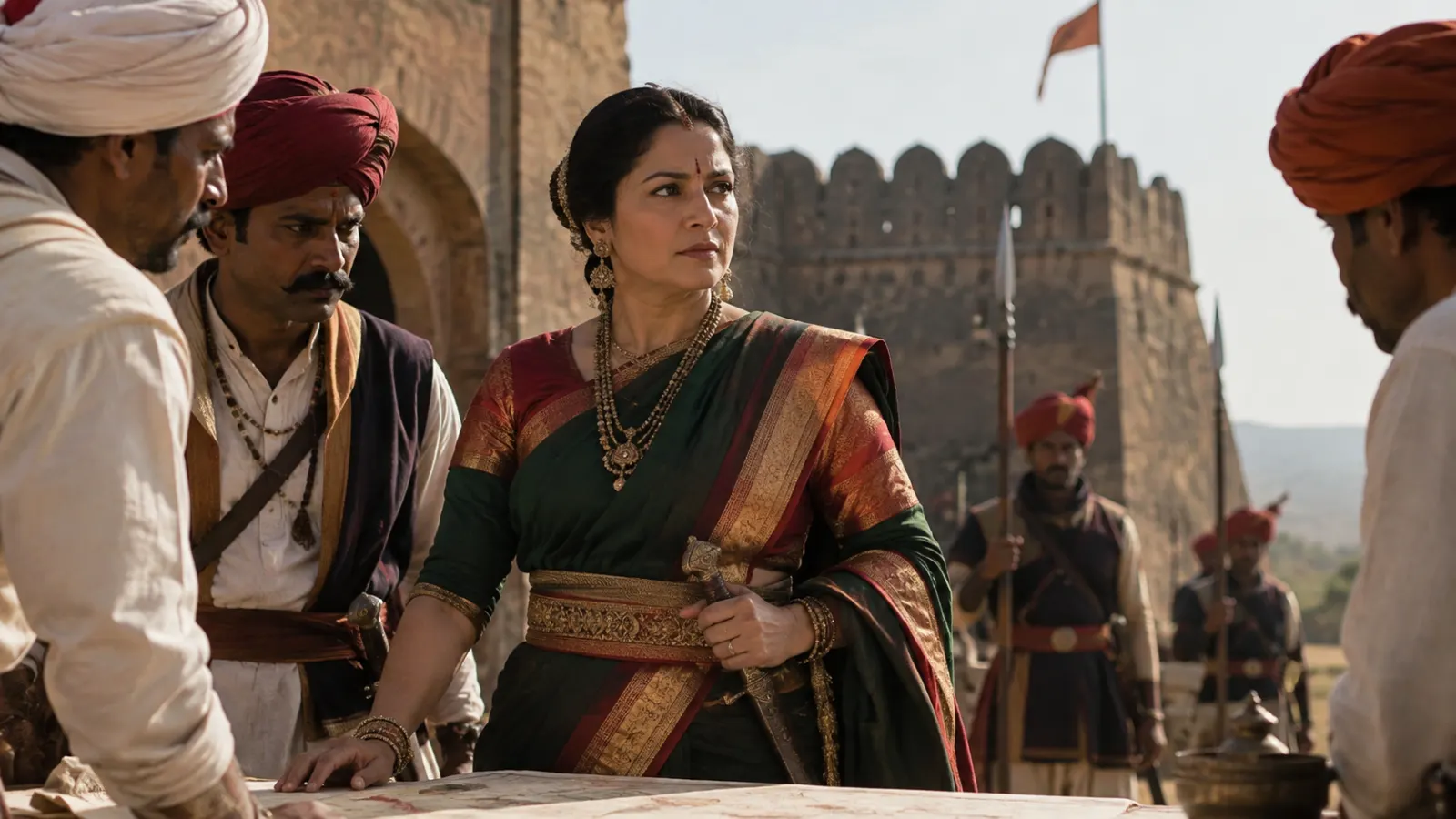
Lakshmibai’s leadership during the uprising was remarkable because she had to govern, negotiate, and fight under extreme pressure. Jhansi was not a modern nation-state with a professional bureaucracy and regular army at her command. It was a contested kingdom in a violent theatre of rebellion, surrounded by hostile forces, uncertain allies, and shifting loyalties. Her achievement lay in turning a vulnerable fort-city into a centre of resistance. She organised defence, dealt with local elites, and became the rallying figure for soldiers and civilians who saw British return as political defeat. The queen’s authority was both practical and symbolic. She had to command obedience, but she also had to embody confidence.
Military leadership in her case was not just battlefield courage. It required resource management, discipline, and the ability to maintain morale when defeat was possible. Women in nineteenth-century South Asian courts sometimes exercised political influence, especially as regents or guardians of heirs, but Lakshmibai’s situation pushed that influence into open warfare. Her gender intensified her legend because colonial and patriarchal expectations underestimated her. British officers could admire her bravery while still treating her resistance as rebellion. Indian memory elevated her because she shattered the assumption that political courage belonged only to men. Her leadership became a grammar through which later generations would discuss women, nationalism, and sacrifice.
The Siege of Jhansi: Resistance Under Fire
The siege of Jhansi in 1858, led by British forces under Sir Hugh Rose, became the defining military episode of Lakshmibai’s life. The fort of Jhansi was strong, but it faced an organised imperial army determined to crush rebellion across central India. The siege compressed every aspect of her life into one test: the adopted heir whose claim had been rejected, the state that had been annexed, the subjects who looked to her for protection, and the colonial power that considered her defiance unacceptable. Accounts of the siege describe intense bombardment, desperate defence, and the queen’s refusal to submit when surrender might have meant humiliation, imprisonment, or death.
The fall of Jhansi did not end her struggle. Her escape from the fort, often retold in legendary form, became part of nationalist mythology. Stories describe her leaving with her adopted son, riding through danger, and refusing capture. Some details belong to folklore, but the larger historical point remains powerful: she did not allow the fall of her capital to become the end of her political agency. She moved from a besieged ruler to a mobile rebel commander. In doing so, she transformed defeat into continuation. This ability to survive catastrophe without surrendering purpose is one reason her biography retains emotional force.
Kalpi, Gwalior, and the Final Campaign
After leaving Jhansi, Lakshmibai joined other rebel forces, including those associated with Tatya Tope and the wider anti-British resistance in central India. The theatre of conflict shifted to Kalpi and then toward Gwalior. These campaigns showed both the courage and the limitations of the rebellion. The rebels could inspire loyalty and seize opportunities, but they often lacked the coordination, supplies, and unified command structure needed to defeat a disciplined imperial army over time. Lakshmibai’s presence nevertheless gave the resistance a moral centre. Her name carried the memory of Jhansi and the injustice of annexation into every new battlefield.
Her final moments near Gwalior, commonly placed at Kotah-ki-Serai in June 1858, have been retold in many forms. British accounts recognised her bravery even when condemning her rebellion. Indian memory turned her death into martyrdom. The historical Lakshmibai was likely killed in combat while still very young, perhaps around her late twenties. The symbolic Lakshmibai became ageless: the queen who chose death over submission, action over resignation, and honour over safe compromise. Her end mattered because it gave her life narrative a complete dramatic arc. She had been denied a kingdom by law; she answered by defending sovereignty with her body.
Character: Courage, Discipline, and Political Intelligence
Lakshmibai’s courage is obvious, but courage alone does not explain her legacy. Many people are brave in crisis; fewer are able to convert bravery into leadership. Her political intelligence lay in understanding that the issue of Jhansi was not merely a private inheritance dispute. It was part of a larger pattern of British expansion. She used legal petitions before using arms, which shows that she was not driven by impulsive violence. She respected procedure until procedure became an instrument of dispossession. This distinction is crucial. It prevents her from being reduced to a romantic warrior and allows us to see her as a ruler who understood legitimacy.
She also possessed the discipline required to act under surveillance, suspicion, and grief. The death of her husband, the rejection of her adopted son’s rights, the loss of sovereignty, and the military crisis of 1857 could have broken her. Instead, they sharpened her role. Her ability to command men in battle and inspire civilians in crisis suggests a personality that combined emotional force with administrative seriousness. Even her enemies found it difficult to deny her extraordinary determination. This is why she has remained larger than any single ideology. Monarchists, nationalists, feminists, regional historians, and popular artists have all found in her a figure who speaks to their concerns.
The Woman Question: Gender and the Politics of Memory
Lakshmibai’s legacy is inseparable from gender. In nineteenth-century colonial writing, Indian women were often portrayed either as oppressed victims needing rescue or as exotic figures outside political modernity. Lakshmibai disrupted both images. She was neither passive nor merely symbolic. She acted as regent, claimant, commander, and rebel. Later nationalist memory used her to prove that Indian womanhood could be brave, self-sacrificing, and patriotic. Poems, plays, school lessons, and public statues helped turn her into a model of feminine courage. The famous image of the queen on horseback became a visual argument: women were not outside the nation; they could defend it.
At the same time, modern readers must be careful not to trap her inside a simple slogan. Lakshmibai was not a modern feminist in the contemporary sense, and her struggle was not primarily framed as a campaign for women’s rights. She fought as a queen defending sovereignty and dynastic justice. Yet historical significance often exceeds self-description. By acting with authority in a world that expected female dependence, she expanded the imagination of what women could do in public life. Her memory has inspired women in politics, the armed forces, education, literature, and activism because she represents courage without apology.
Complexity and Historical Debate
Like all major historical figures, Lakshmibai has been surrounded by debate. Colonial records, Indian nationalist narratives, local oral traditions, and later literary works do not always agree. Some British narratives tried to connect her directly with violence against Europeans in Jhansi; nationalist narratives often cleared her entirely and presented her as a flawless heroine. A mature biography must recognise that sources from periods of war are rarely neutral. British officers wrote from the standpoint of imperial authority. Indian memories developed under the emotional pressure of colonial rule and nationalist mobilisation. Folklore preserved emotional truth even when it embellished detail.
This complexity does not weaken her stature. It deepens it. Historical greatness does not require the absence of ambiguity. What can be stated with confidence is that Lakshmibai became a central figure in armed resistance to the Company, that the annexation of Jhansi through the Doctrine of Lapse was a decisive grievance, and that her death in battle gave the rebellion one of its most powerful symbols. The challenge is to honour her without turning history into myth alone. She deserves not only admiration, but serious study. Her life sits at the intersection of gender, empire, law, military history, and political legitimacy.
Legacy: From Jhansi to the Indian Imagination
Lakshmibai’s legacy grew steadily after her death. In the late nineteenth and early twentieth centuries, as Indian nationalism developed, she became a usable memory of resistance. Her story allowed writers and activists to claim that opposition to British rule had deep roots and that courage had not been confined to one region, caste, religion, or gender. The poem associated with Subhadra Kumari Chauhan fixed her in popular Hindi imagination with emotional force, but her memory travelled far beyond literature. Statues, schoolbooks, military units, postage stamps, films, and public speeches have repeatedly returned to the image of the fearless queen of Jhansi.
Her legacy also belongs to Bundelkhand, where local memory gives texture to national legend. Jhansi is not merely a backdrop; it is the space that made her political identity possible. The fort, the city, and the region preserve a memory of resistance that is both local and national. In modern India, she represents the refusal to accept injustice merely because it is legalised by power. That is why her story continues to matter. In every generation, institutions can misuse law, powerful actors can deny dignity, and vulnerable communities can be told to accept their fate. Lakshmibai’s answer remains unsettling and inspiring: dignity sometimes requires resistance.
Conclusion: The Queen Who Refused Erasure
Rani Lakshmibai’s life was brief, but historical influence is not measured by length. It is measured by the intensity with which a life reveals the conflicts of its age. She lived at a time when the East India Company was turning commercial power into territorial empire, when Indian rulers were being judged by colonial doctrines, and when women were expected to remain peripheral to formal politics. She confronted all three conditions. As a widow, she defended adoption and succession. As a queen, she defended Jhansi. As a woman, she entered the masculine theatre of war and changed the emotional vocabulary of Indian resistance.
Her courage should not be reduced to a single battlefield image. It began in the refusal to accept injustice, continued through petitions and administration, and reached its final form in battle. She remains one of the most compelling figures in Indian history because she combines vulnerability and force, grief and command, myth and document, local loyalty and national symbolism. The life of Lakshmibai reminds us that empire often begins by denying people the right to define their own legitimacy. Her legacy survives because she refused that denial. Jhansi was taken from her, but historical memory was not.
Present Relevance: What Lakshmibai Teaches Modern India
The present relevance of Lakshmibai lies in the way she connects law, legitimacy, and moral courage. Modern India does not face the Doctrine of Lapse, but it still faces questions about how power uses procedure, how institutions treat the vulnerable, and how communities remember injustice. Her life teaches that legality and justice are not always the same. A decision may be written in official language and still violate the ethical expectations of a people. Jhansi’s annexation became explosive because it converted a living political tradition into a technical colonial file. This is why Lakshmibai remains more than a battlefield figure. She represents the duty to ask whether power has respected dignity, voice, and historical context.
Her example also matters for leadership studies. She did not inherit an easy moment. She inherited bereavement, suspicion, political uncertainty, and military danger. Yet she acted with composure. Modern leadership is often discussed in terms of strategy, communication, and crisis management; Lakshmibai’s life contains all three. She argued before she fought, organised before she charged, and turned personal injury into collective purpose. That movement from private grief to public responsibility is the mark of a historical leader. Her memory endures because it allows India to imagine courage not as noise or anger, but as disciplined refusal to accept humiliation.