Tea Culture Explained: Hospitality, Identity and Everyday Ritual
A cup of tea can be so ordinary that its cultural importance is easy to overlook. It appears at breakfast tables, workplace breaks, roadside stalls, family gatherings, religious settings, weddings, business conversations and quiet visits between neighbours. The drink may be simple, but tea culture is rarely only about thirst. In many societies, preparing and offering tea creates a small social ceremony through which people communicate welcome, respect, familiarity or a willingness to spend time together.
There is no single global tea culture. The leaves may come from the same plant, but societies have developed different ways of growing, processing, brewing, serving and sharing them. Some traditions emphasise particular vessels or carefully controlled preparation, while others revolve around strongly boiled tea, milk, spices, sugar or an informal glass passed across a shop counter. What makes these practices cultural is not one correct recipe but the meanings communities attach to repeated actions around tea.
UNESCO’s recognition of tea-related heritage makes this broader role unusually visible. In 2022, China’s traditional tea-processing techniques and associated social practices were inscribed on the Representative List of the Intangible Cultural Heritage of Humanity. UNESCO describes knowledge extending from plantation management and leaf picking to processing, drinking and sharing, and notes that tea is served in homes, workplaces, tea houses, restaurants and temples and is used to greet guests and maintain relationships. The same year, the culture of çay in Azerbaijan and Türkiye was recognised explicitly as a practice connected with identity, hospitality and social interaction.
These examples demonstrate an important point: tea becomes culturally powerful because it connects material things with social behaviour. Leaves, water, kettles and cups matter, but so do the rules about who prepares the drink, who receives it first, where people sit, how long they stay and what kinds of conversations become possible while the tea is being served. A beverage can therefore become both an everyday habit and a form of social infrastructure.
Tea turns hospitality and conversation into something people can perform
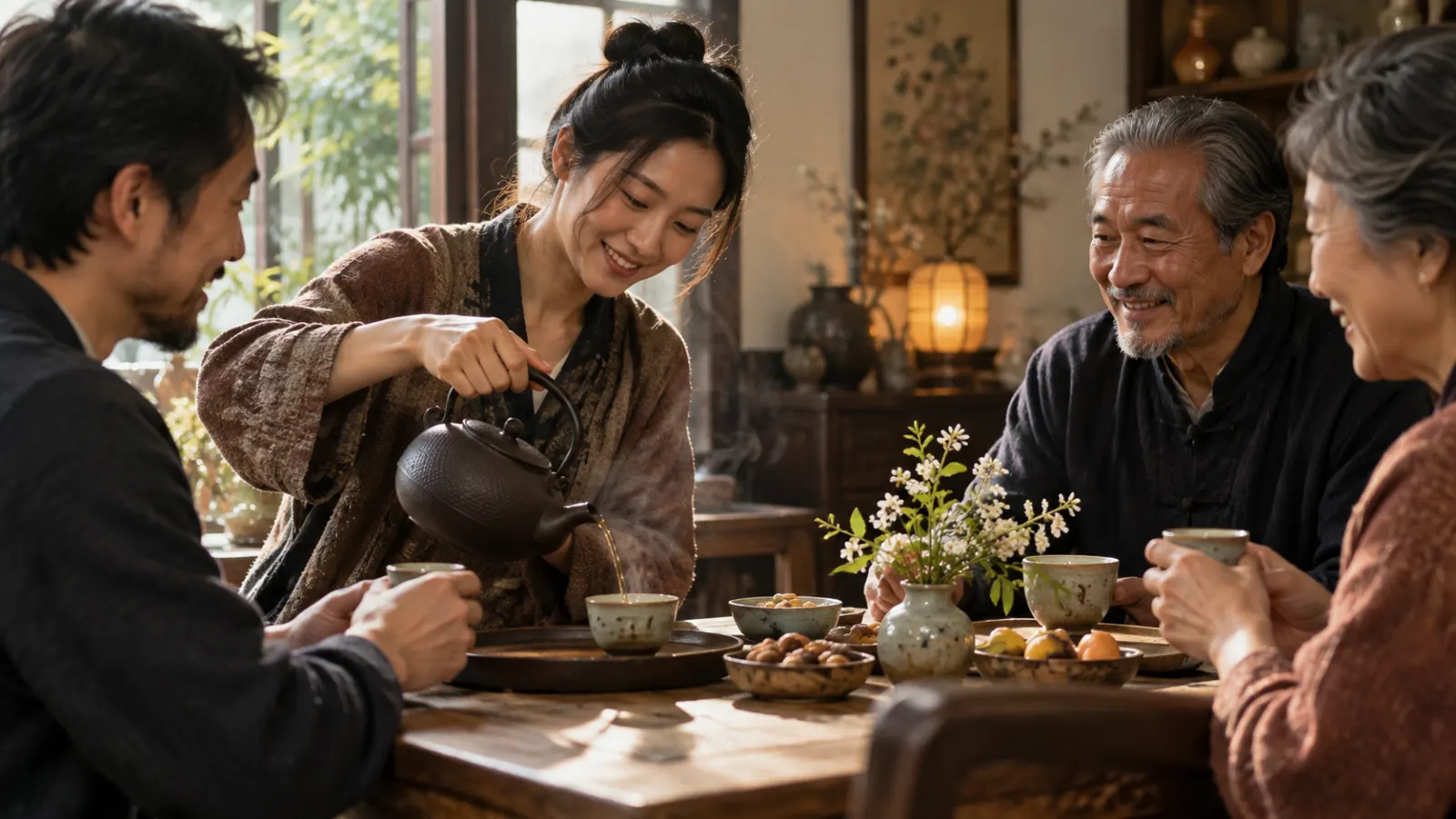
Hospitality is an abstract value until someone does something that makes another person feel received. Tea provides a simple way to make that value visible. Heating water, choosing a cup, preparing the drink and placing it in front of someone can communicate attention without requiring a formal declaration of welcome. The sequence varies enormously between communities, but the social principle is recognisable: offering tea transforms hospitality from an intention into an action.
UNESCO describes tea culture in Azerbaijan and Türkiye as important to everyday social life and to celebrations and significant moments. Tea is commonly served hot in distinctive vessels and accompanied by foods such as sugar, lemon, jams, sweets or dried fruit, but the heritage element is broader than the objects themselves. UNESCO emphasises that the practice builds and maintains social ties and contributes to cultural identity across different parts of society.
Tea also gives people an acceptable reason to pause. Daily life is usually organised around tasks—work, travel, cooking, shopping, study or household responsibilities—whereas a tea break creates a small interval in which conversation becomes legitimate. In a workplace, asking someone to have tea can create a more informal conversation than scheduling a meeting. In a household, the evening cup can become the moment when family members return to the same room after separate days.
This is one reason tea stalls and tea houses can become socially important even when the drink itself is inexpensive. People do not necessarily have to announce that they want companionship, advice, gossip, negotiation or simply a few minutes away from work; ordering tea supplies the reason for staying. Repeated visits can turn commercial spaces into places of recognition where customers know the owner, familiar groups meet at particular times and local news circulates through ordinary conversation.
The accessibility of these spaces should not be romanticised as universal equality. Tea houses and stalls can bring together people who might not otherwise share private space, but class, gender, caste, ethnicity, occupation and local convention can affect who feels welcome and who participates comfortably. A tea stall can simultaneously function as a neighbourhood commons for some people and a socially restricted environment for others.
Tea therefore creates opportunities for connection without guaranteeing that every participant enters on equal terms. Cultural practices always operate inside wider social structures, and the rituals around tea are no exception.
Tea gains meaning through vessels, techniques, places and memory
Tea culture is partly intangible because it consists of knowledge: how leaves should be processed, how hot the water should be, how long the tea should brew, which ingredients should be added and how guests should be served. Yet these traditions also produce distinctive material worlds of kettles, glasses, bowls, teapots, trays, strainers, samovars, porcelain and clay. The objects are not merely decorative because they shape how the drink is prepared and how the social interaction unfolds.
Different brewing methods create different rhythms. A preparation involving several infusions invites repeated pouring and a longer encounter, while strong tea made quickly at a roadside stall fits another pace of life. Some traditions emphasise colour and transparency in a glass; others emphasise aroma, the feel of a bowl, the sound of pouring or the sequence in which people are served. Milk, spices, butter, salt, sugar and herbs can transform not only flavour but the identity of the beverage within a particular community.
China’s UNESCO-listed tea heritage demonstrates how extensive this variation can be. Its recognised practices include knowledge surrounding six broad tea categories—green, yellow, dark, white, oolong and black tea—alongside many reprocessed teas and local techniques. The cultural tradition encompasses not only production but the ways tea is shared in everyday life and ceremonies, with knowledge transmitted through families and apprenticeships.
A particularly striking example is the Cultural Landscape of Old Tea Forests of the Jingmai Mountain in Pu’er, which UNESCO inscribed on the World Heritage List in 2023. The landscape combines old tea groves, traditional villages, forests and cultivation practices developed by Blang and Dai communities over more than a thousand years. UNESCO’s description links the tea landscape to local governance, ecological knowledge, cultural beliefs, ceremonies and relationships between communities and their mountain environment.
This demonstrates why tea cannot always be separated neatly into “the drink” and “the culture around the drink.” Cultivation methods can be cultural knowledge, landscapes can contain historical memory, processing can become inherited craft and the act of serving can reproduce social values. Tea culture can therefore stretch from the field where leaves are grown to the cup placed in front of a guest.
Regional identity can become especially strong when a tea is associated with a particular landscape. In India, names such as Darjeeling, Assam, Nilgiri and Kangra communicate more than geographical origin; they evoke different growing conditions, production histories and expectations about taste and quality. Tea Board India describes Darjeeling as a protected Geographical Indication and notes that the Darjeeling word and logo were the first geographical indications registered in India in the Board’s name.
A geographical name can therefore connect agriculture, reputation and cultural identity. Darjeeling tea is legally protected because consumers expect tea bearing the name to originate in the defined region and meet particular production requirements. At the same time, the cultural meaning of tea need not follow the location where leaves are grown: a community can make imported tea thoroughly local by changing how it is prepared, served and incorporated into everyday life.
This helps explain why masala chai in India, çay in Türkiye, British milk tea and Chinese tea practices should not be flattened into a generic idea of “the world’s tea ceremony.” Tea travels, but communities repeatedly localise it. Recipes, vessels and etiquette can change while the broader social function—creating a pause, welcoming someone or maintaining continuity—remains recognisable.
Memory strengthens that cultural role because tea is repetitive. People may remember exactly how a parent brewed it, how sweet a grandparent preferred it, which cup belonged to a particular family member or what kind of tea appeared during examinations, long train journeys, illness, courtship or mourning. Everyday repetition turns smell and taste into triggers for autobiographical memory.
Migration can make those associations even stronger. Preparing tea in a familiar way may provide continuity when someone moves to another region or country, yet ingredients, appliances, work schedules and the people sharing the drink inevitably change. What emerges is often not the preservation of an untouched tradition but an adapted one, carrying elements of home into a new environment.
Tea’s global history also includes empire, trade and labour
It is difficult to understand modern tea culture without looking beyond the table to the systems that moved tea across continents. European engagement with tea expanded through maritime trade from the seventeenth century, when the beverage remained expensive and was initially associated with wealth and elite consumption. Institutions such as the Dutch and British East India Companies became central to the movement of tea and other Asian goods into European markets, linking changing consumer habits to expanding commercial and imperial power.
Over time, tea became far less exclusive in Britain and developed into an everyday domestic drink, but the growth of mass consumption depended on large production and trading systems elsewhere. British colonial rule encouraged commercial tea cultivation in South Asia as imperial businesses sought supplies outside China. Tea Board India notes that commercial production developed in Assam during the nineteenth century, with an English tea garden established at Chabua in 1837 and the Assam Tea Company beginning commercial production soon afterward.
Darjeeling developed as another major tea-growing region during the nineteenth century. Tea Board India traces tea cultivation there to the 1800s and today treats Darjeeling tea as both a geographically protected product and a significant part of India’s tea identity. The region’s reputation demonstrates how colonial-era commodity production could later become embedded within postcolonial regional branding and cultural heritage.
This history complicates comfortable stories in which tea travels around the world simply because people enjoy its flavour. Plantation agriculture depended on land, labour, transport networks, regulation and commercial power. A ritual that became associated with comfort and respectability for consumers could be connected to very different experiences for the people cultivating and processing the crop.
That labour history has not become irrelevant simply because colonial rule ended. The International Labour Organization has documented persistent challenges in parts of South Asia’s plantation sector, including occupational hazards, low wages, limited worker voice and inadequate living or health conditions. Its work in Assam has specifically examined conditions in tea plantations, while more recent South Asian programmes have focused on occupational safety and the vulnerabilities faced by plantation workers, including women.
The purpose of acknowledging this is not to suggest that every tea estate or every worker faces identical conditions. The tea industry contains large plantations, small growers, different national regulatory systems and substantial variation between regions. The more important cultural point is that tea has a social world on both sides of the cup: consumers create rituals around drinking it, while growers, pluckers, factory workers, traders and their families create communities around producing it.
India’s tea sector illustrates the scale of that connection. Tea Board India describes tea as a major labour-intensive industry and has historically regulated production, trade and promotion under the Tea Act. Tea-growing regions are therefore not simply scenic backdrops for packaging; they are places where employment, housing, local economies and generations of specialised knowledge have developed around cultivation and processing.
A credible account of tea culture should hold these two realities together. Tea can genuinely embody hospitality, memory and social connection while also belonging to commodity chains shaped by inequality, labour politics and global markets. Appreciating the cultural significance of tea does not require ignoring those tensions; understanding them makes the culture more complete.
Tea culture keeps changing because culture itself keeps changing
Traditional practices survive partly because they are adaptable. Tea bags, electric kettles, bottled tea, bubble tea, speciality shops, café chains, wellness branding and social-media aesthetics have changed the way many people encounter tea, especially in urban and younger consumer cultures. These changes can simplify older preparation methods, but they can also generate entirely new social rituals.
Bubble tea provides an obvious example of a beverage style that emerged in Taiwan and spread through global youth and café culture. In another setting, a traditional production region may increasingly market terroir, origin and artisanal processing to speciality consumers who want to distinguish teas much as they distinguish wine or coffee. A household accustomed to strong boiled milk tea may simultaneously experiment with green tea, matcha or oolong without abandoning its established family routine.
These overlapping practices show why globalisation does not necessarily replace local culture with one uniform international style. A person can participate in several tea cultures at once: a family habit inherited from parents, a regional or national tradition, an office tea break and a global café trend. Cultural identity is often layered rather than exclusive.
Commercialisation can also change the meanings attached to older practices. A tea once consumed mainly as an ordinary household drink may be repackaged as a premium wellness product, while a regional style may become an international lifestyle aesthetic. Some of these transformations preserve knowledge and create new markets for producers; others can detach imagery from the communities that developed the traditions.
The heritage process itself raises similar questions. UNESCO recognition can increase visibility and encourage safeguarding, but a living tradition cannot be preserved simply by freezing one approved version of it. Tea culture survives precisely because people continue to prepare, modify, teach and reinterpret it within changing circumstances.
The Jingmai Mountain landscape makes this tension visible at the level of place. UNESCO recognises a tea-growing system that has endured for centuries through the interaction of cultivation, forest ecology, villages, belief and local governance, while also noting pressures from modernisation, development, tourism and climate change. Heritage is therefore not a guarantee that a cultural landscape will remain unchanged; it is a framework for recognising why continuity matters while the surrounding world keeps changing.
This is also why the ordinary household cup should not be dismissed simply because it lacks elaborate ceremony. Ritual is not defined only by complexity. Repetition can give simple acts symbolic weight: the person who always makes evening tea, the cup kept for a particular relative, the habit of serving a visitor before discussing business or the expectation that difficult news should be accompanied by something warm to drink.
Such practices form what might be called the social grammar of everyday life. They tell people when to sit, when to speak, how to welcome someone and how to create a small interval of care without requiring a formal occasion. Their significance often becomes most visible when the routine disappears—after migration, bereavement, family change or the loss of a familiar home.
Why tea remains culturally powerful
Tea has endured across very different societies because it is flexible enough to carry many meanings. It can signify hospitality in one context, discipline or attentiveness in another, family routine somewhere else and regional pride in a production landscape. It can accompany work breaks, negotiations, ceremonies, religious practice, mourning, celebration or casual conversation without requiring the meanings of those events to be identical.
Its cultural strength also comes from scale. Tea is inexpensive enough in many places to belong to ordinary daily life, yet structured enough to support elaborate etiquette and specialised craft. It can be consumed alone but repeatedly becomes an excuse for social interaction, allowing something as simple as preparing a drink to organise time between people.
The cup itself is therefore only part of the story. Tea culture includes the knowledge of growing and processing leaves, the objects used in preparation, the rules of hospitality, the places where people gather, the memories attached to repeated consumption and the labour systems that make the beverage available. It also includes the historical forces through which tea travelled and the contemporary forces that continue transforming how it is produced and consumed.
This broader perspective prevents tea culture from becoming either sentimental nostalgia or a catalogue of exotic ceremonies. Tea can be comforting and political, domestic and commercial, local and global at the same time. A family ritual can coexist with a worldwide commodity chain, and an inherited tradition can continue changing without becoming culturally meaningless.
Perhaps that is why offering tea remains such a durable social act. It asks very little materially—a drink, a vessel and a few minutes—but can communicate considerably more. When someone prepares tea, places it before another person and allows the conversation to continue, the drink becomes a way of saying that the encounter deserves time.
That social possibility, more than any single recipe or ceremony, is what makes tea culturally significant.