Sleep looks simple from the outside. A person lies down, closes the eyes, becomes still, and wakes up later. But inside the brain and body, sleep is not one flat state. It is a repeating architecture made of stages. These stages change brain-wave patterns, muscle tone, breathing, heart rate, temperature, dreaming, memory processing, and the feeling of being restored in the morning. Understanding the stages of sleep helps explain why eight hours in bed may not always feel like eight hours of rest.
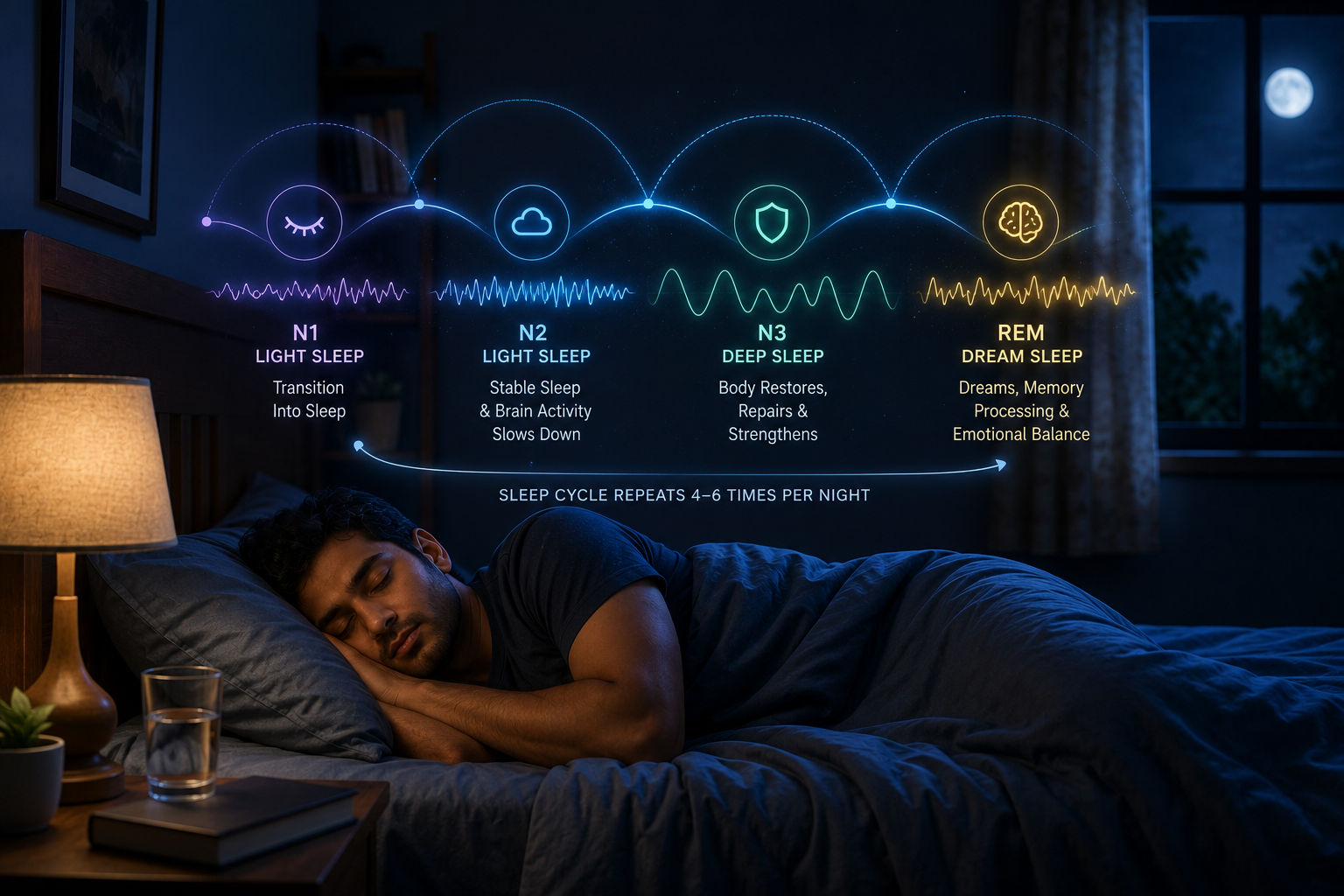
Modern sleep science usually describes sleep through two broad types: non-rapid eye movement sleep, called non-REM or NREM sleep, and rapid eye movement sleep, called REM sleep. Non-REM sleep has three stages, moving from light sleep into deep sleep. REM sleep is the stage most strongly associated with vivid dreaming, active brain patterns, and temporary muscle paralysis that prevents most dream enactment. Through the night, the brain cycles through these stages several times. A full cycle often lasts roughly 90 to 110 minutes, though this varies.
The first stage, N1, is the doorway between wakefulness and sleep. It is light, brief, and easy to interrupt. During this stage, the heartbeat, breathing, and eye movements begin to slow. Muscles relax, sometimes with small twitches. Many people awakened from this stage say they were not really asleep. This is why drifting in and out can feel confusing. N1 is not useless; it is a transition. But if a person spends too much of the night hovering in light sleep because of noise, stress, pain, caffeine, or sleep disorder, they may wake up feeling as if sleep never fully happened.
The second stage, N2, is still considered light sleep, but it is more stable than N1. The body continues to slow down. Eye movements stop. Body temperature drops. Brain activity slows and shows features known in sleep studies as sleep spindles and K-complexes. You do not need to memorise these terms to understand the point: the brain is not simply “off.” It is organising activity in structured patterns. N2 often occupies a large portion of total sleep time. It acts like the main corridor of sleep architecture, connecting lighter sleep, deeper sleep, and REM sleep across the night.
The third non-REM stage, N3, is deep sleep or slow-wave sleep. This is the stage many people think of when they imagine “proper sleep.” Heart rate and breathing reach some of their lowest sleep levels. Muscles are relaxed. It is more difficult to wake someone from this stage. If awakened, the person may feel groggy or disoriented for a while. Deep sleep is especially concentrated in the first half of the night. It is associated with physical restoration, immune processes, tissue repair, growth-related hormonal activity, and the feeling of being physically refreshed. This does not mean deep sleep is the only important stage, but it is one reason early-night sleep matters.
REM sleep is different. The brain becomes more active, closer in some ways to waking patterns. Breathing can become faster and irregular. Heart rate and blood pressure may rise toward waking levels. The eyes move rapidly behind closed eyelids. Most vivid dreaming occurs during REM sleep, though dreams can also happen in non-REM sleep. The body temporarily reduces movement in major voluntary muscles, which helps prevent acting out dreams. REM sleep is linked with emotional processing, learning, memory consolidation, and brain development. It usually appears for the first time around 90 minutes after falling asleep, then returns cyclically.
The distribution of these stages changes through the night. Early cycles usually contain more deep non-REM sleep. Later cycles tend to contain longer REM periods. This is why sleep is not only about total hours. Cutting sleep short from the front end or back end may affect different parts of the architecture. Someone who goes to bed very late after being awake for a long time may fall quickly into deep sleep but lose some later REM-rich sleep if they wake early. Someone who sleeps long but with repeated interruptions may spend enough time in bed but fail to maintain smooth cycles.
The stages also help explain why sleep quality matters as much as sleep quantity. A person may lie in bed for eight hours but wake repeatedly because of snoring, breathing pauses, pain, reflux, anxiety, noise, alcohol, or a baby crying. Each awakening can fragment the architecture. Even short awakenings that are not remembered may push the brain into lighter stages. The result can be a morning that feels unrested despite apparently adequate time. This is why sleep medicine pays attention not only to hours but also to continuity, breathing, movement, and daytime symptoms.
Sleep stages are measured most accurately in sleep studies using tools such as electroencephalography, which records brain activity, along with measures of eye movement, muscle activity, breathing, oxygen levels, and heart rhythm. Consumer sleep trackers estimate stages using movement and heart-rate patterns. They can be useful for recognising broad habits, such as very short sleep, irregular timing, or frequent waking. But their stage labels should be interpreted cautiously. A watch may suggest that your deep sleep was poor, but it cannot replace a clinical sleep study when symptoms are significant. The danger is that people begin chasing perfect graphs instead of noticing how they function.
Each stage contributes differently, but they work as a system. Light sleep is not a failure. It is part of the transition and cycling process. Deep sleep is important, but more is not always better in a simplistic way. REM sleep is important, but obsessing over exact minutes can create anxiety. The healthiest goal is not to micromanage stages directly. It is to create conditions in which the brain can cycle naturally: enough time in bed, regular schedule, low sleep disruption, safe breathing, and supportive lifestyle habits.
Age changes sleep architecture. Babies spend a very large portion of sleep in active, REM-like sleep because the developing brain is highly active. Children and teenagers have different sleep needs and often need more total sleep than adults. Adults generally need sufficient, regular sleep, while older adults may experience lighter sleep, earlier wake times, more awakenings, and changes in deep sleep. These changes are common, but severe daytime sleepiness, loud snoring, confusion, falls, or depression should not be dismissed as “just ageing.” Normal change and treatable sleep problems can look similar from the outside.
Stress also changes the way sleep feels. When the nervous system remains alert, a person may enter sleep later, wake more easily, or experience lighter sleep. The brain may remain threat-sensitive, scanning for problems even in bed. This is why relaxation is not merely a mood suggestion; it changes the conditions under which the stages unfold. A calm wind-down, journaling, prayer, breathing exercises, cognitive behavioural therapy for insomnia when needed, and reducing late-night work stimulation can help the brain stop treating bedtime like a danger zone.
Alcohol offers another lesson in sleep stages. It can make people feel sleepy and fall asleep faster, but it may fragment sleep later and interfere with normal architecture. Many people recognise this pattern after a night of drinking: they fall asleep quickly, then wake at 3 or 4 am with thirst, heat, anxiety, or restlessness. Sedation is not the same as healthy sleep. Similarly, some medicines can affect sleepiness, dreaming, or REM patterns. Medication questions should be discussed with a clinician rather than adjusted independently.
Sleep disorders often disturb stages indirectly. Obstructive sleep apnea can repeatedly interrupt breathing, reducing oxygen and causing micro-awakenings. Restless legs syndrome or periodic limb movements can disrupt continuity. Chronic insomnia can keep the person in a state of conditioned arousal, making the bed feel like a place of struggle. Narcolepsy affects REM regulation and daytime sleepiness. Depression, anxiety, chronic pain, acid reflux, menopause symptoms, and urinary issues can also change sleep continuity. Understanding stages should therefore create compassion: poor sleep is not always laziness or lack of discipline.
What can someone do practically with this knowledge? First, protect enough sleep opportunity. You cannot complete healthy cycles if you do not give the brain enough time. Second, keep sleep timing regular enough that the internal clock can predict rest. Third, reduce stage disruption by limiting late caffeine, heavy late meals, alcohol near bedtime, and high-stimulation screens. Fourth, make the bedroom quiet, dark, comfortable, and cool. Fifth, seek medical evaluation if symptoms suggest a disorder: loud snoring, pauses in breathing, choking, severe daytime sleepiness, morning headaches, uncontrolled blood pressure, unusual movements, acting out dreams, or insomnia that persists.
It also helps to stop judging every awakening as a disaster. Brief awakenings between cycles are normal. Many people wake, turn, adjust a pillow, and return to sleep without remembering much. The problem is when awakenings become prolonged, frequent, distressing, or associated with breathing or safety concerns. A person who wakes once at night and sleeps again may be perfectly normal. A person who wakes ten times gasping or cannot function the next day needs attention.
Dreaming is another common misunderstanding. REM sleep is strongly associated with vivid dreams, but not remembering dreams does not prove you had no REM sleep. Dream recall depends on waking timing, attention, stress, and memory. Some people remember dreams often; others rarely do. Similarly, nightmares, intense dreams, or sleep paralysis can be frightening, and frequent distressing episodes may deserve professional support. Sleep experiences exist on a spectrum, and context matters.
The idea of sleep stages should make sleep feel more intelligent, not more intimidating. Your body is not wasting time when it moves through light sleep. Your brain is not inactive during deep sleep. Dreams are not random entertainment only. Across the night, the system moves through changing modes that support physical restoration, mental processing, memory, emotional balance, and readiness for the next day.
The final takeaway is simple: good sleep is architecture, not just duration. Hours matter, but so do timing, continuity, breathing, and the ability to move naturally through N1, N2, N3, and REM. You do not need to control every stage. You need to respect the conditions that allow them to happen. A regular routine, enough sleep opportunity, a calming environment, and medical help when warning signs appear are the practical ways to protect the structure your brain builds every night.
Sleep stages also remind us why naps can feel different. A short nap of 10 to 20 minutes may keep a person mostly in lighter sleep and improve alertness without much grogginess. A longer nap can enter deeper sleep, which may be useful when sleep-deprived but may also create sleep inertia, the heavy confused feeling after waking from deep sleep. Very late naps can reduce sleep pressure before night and make bedtime harder. This does not mean naps are bad. It means they should be matched to the purpose: brief alertness, recovery after sleep loss, or medically guided rest in special conditions.
Another useful idea is sleep regularity. Two people may both average seven hours, but one sleeps from 11 pm to 6 am most days while the other alternates between 10 pm, 2 am, 1 am, and weekend oversleeping. The second person may experience more circadian disruption even if the weekly total looks acceptable. Stages unfold best when the brain can predict the timing of sleep. This is why consistent sleep is not only a discipline issue; it is a biological signal.
Finally, the stages of sleep should change how we talk about productivity. Deep sleep and REM sleep are not passive gaps between work sessions. They are part of learning, emotional recovery, immune defence, and body maintenance. A person who repeatedly steals the last two hours of sleep may be stealing from later REM-rich periods. A person whose early night is repeatedly delayed by work may reduce deep-sleep opportunity. The architecture is invisible, but the consequences show up in attention, patience, cravings, memory, and resilience.
One more point is especially important: no sleep stage should be treated like a supplement to maximise. People sometimes ask how to get only more deep sleep or only more REM sleep, as if the brain were a menu. In reality, the body balances stages according to age, prior sleep loss, timing, health, and biology. The practical target is not a perfect percentage. It is sufficient, regular, mostly uninterrupted sleep with good daytime functioning. When that is missing, the answer is usually not a single hack but a review of routine, stress, environment, breathing, medicines, and medical warning signs.
Approximate article word count: 2,071 words
Key Evidence Bullets
NINDS and NHLBI describe two broad types of sleep: REM sleep and non-REM sleep; non-REM sleep includes three stages.
Typical sleep cycles repeat several times during the night, with deeper non-REM sleep concentrated earlier and longer REM periods later.
Sleep trackers estimate stages and can show patterns, but clinical sleep studies are needed for suspected disorders.
Source / Fact-Check Links
CDC – About Sleep: https://www.cdc.gov/sleep/about/index.html
NINDS/NIH – Brain Basics: Understanding Sleep: https://www.ninds.nih.gov/health-information/public-education/brain-basics/brain-basics-understanding-sleep
NHLBI/NIH – How Sleep Works: Sleep Phases and Stages: https://www.nhlbi.nih.gov/health/sleep/stages-of-sleep