Sir Syed Ahmad Khan: Education, Reform and the Aligarh Movement
Sir Syed Ahmad Khan is remembered most visibly as the founder of the educational movement that eventually produced Aligarh Muslim University, but that description captures only part of his historical importance. He was also a colonial official, historian, journalist, religious thinker, social reformer and political controversialist who spent much of his life asking how Indian Muslims should respond to a world transformed by British power, modern science, English education and the destruction of older political institutions. His answer placed education at the centre of social reconstruction, but education for Sir Syed was never simply about classrooms. It involved translating knowledge, reforming social attitudes, rethinking religious interpretation and creating institutions capable of producing a new educated class.
Born in Delhi on 17 October 1817, Sir Syed grew up within the cultural world of the late Mughal elite at a time when Mughal political authority was rapidly contracting and the East India Company was becoming the decisive power in northern India. His family had connections with the Mughal court, and his early education reflected the Persianate and Islamic intellectual traditions of the period. Yet his working life took him into the expanding colonial administrative system, where he served in judicial and revenue-related positions. That combination—cultural roots in a declining old order and professional experience inside the emerging colonial one—would shape many of the tensions in his later thought. (amu.ac.in)
He was intellectually active well before the crisis of 1857. His interest in Delhi’s architecture, history and monuments showed a concern with documenting a civilisation whose political setting was disappearing. But Sir Syed did not respond to historical loss by arguing for a simple restoration of the past. Increasingly, he concluded that Indian Muslims would have to master new forms of knowledge and build new institutions if they were to remain intellectually, economically and politically relevant.
That conviction became much stronger after 1857. The uprising and its suppression shattered the political assumptions under which he had grown up and fundamentally changed the relationship between British rulers and many sections of Indian society. Sir Syed’s subsequent career can be understood as an attempt to answer a difficult post-1857 question: how could a community that had lost political power acquire the educational and institutional resources necessary to function in the new order without believing that modernisation required complete cultural surrender?
1857 changed Sir Syed’s understanding of power, education and reform
Sir Syed was serving at Bijnor when the uprising of 1857 spread across northern India. The rebellion, the violence committed during it and the severe British reprisals that followed transformed political relations across the region. Muslims in particular were often viewed with intense suspicion in sections of British official and public opinion, partly because the revolt had invoked the symbolic authority of the Mughal emperor Bahadur Shah Zafar.
Sir Syed did not respond by becoming a revolutionary opponent of British rule. Instead, he increasingly argued that reconciliation with the new rulers and engagement with their institutions were necessary. Yet his position was more complicated than simple loyalty. In Asbab-e-Baghawat-e-Hind, commonly translated as The Causes of the Indian Revolt, he examined the uprising as a political and administrative failure rather than reducing it to inherent Indian disloyalty or a single conspiracy. He argued that defects in British governance, lack of consultation and failures to understand Indian society had contributed to the crisis.
This combination became characteristic of his post-1857 politics. He believed Muslims needed to work within the colonial order, learn English and gain access to modern education, but he was also willing to criticise British policy. Cooperation did not require him to claim that colonial administration was infallible. His political strategy was based on what he regarded as the realities of power after the collapse of the old order.
Education became central because he believed political weakness was increasingly connected with intellectual and institutional weakness. English had become important for government service, professional advancement and access to modern academic knowledge, while scientific and European intellectual developments were reshaping education. AMU’s own institutional history describes Sir Syed as having concluded after 1857 that Muslims, particularly in northern India, needed proficiency in English and modern science if they were to retain social and political influence. (amu.ac.in)
His diagnosis focused particularly on sections of the Muslim elite that had been connected to Persianate administrative culture and were reluctant to embrace institutions associated with British rule. From Sir Syed’s perspective, that reluctance risked turning political defeat into a longer-lasting educational disadvantage. The answer was not merely to tell people to attend existing colonial schools; he wanted to create educational institutions in which modern learning could be made compatible with Muslim social and religious identity.
He began establishing schools at Moradabad in 1858 and Ghazipur in 1863, but his ambitions soon became larger. In 1864, the Scientific Society developed into one of the most important early institutions of what would later be called the Aligarh Movement. Its purpose was to translate works of modern knowledge into Indian languages and make scientific and intellectual material accessible to readers who were not proficient in English. AMU describes translation as a means of preparing the community for Western education and encouraging scientific thought. (amu.ac.in)
The importance of this initiative lies in its method. Sir Syed did not treat “modern education” as an abstract slogan. He tried to create a system through which knowledge could circulate: translation, publication, schools, debate and eventually a residential college. The Scientific Society also involved Hindu as well as Muslim collaborators, reminding us that the Aligarh project, although increasingly centred on Muslim educational advancement, operated within a wider north Indian intellectual environment. (amu.ac.in)
The Aligarh project combined education, print and religious reform
Sir Syed’s educational programme cannot be separated from his work as a writer and religious reformer. In December 1870, after returning from a journey to Britain, he founded Tahzib-ul-Akhlaq, a journal devoted to educational, ethical and social reform. AMU’s history of the publication describes it as an important vehicle for his programme of intellectual and social change. (amu.ac.in)
Through print, Sir Syed could criticise attitudes that he believed prevented educational advancement and could address readers far beyond the institutions he personally controlled. His reformism therefore worked in two directions: he challenged British assumptions about Indians, but he also criticised habits within Muslim society that he believed encouraged stagnation. Education required new schools, but in his view it also required a willingness to reconsider established attitudes toward knowledge.
This brought him directly into religious controversy. Sir Syed argued broadly that genuine religious truth and genuine reason could not ultimately contradict one another. When apparently established knowledge and traditional interpretations of scripture seemed to conflict, he was willing to reconsider interpretation rather than conclude automatically that scientific inquiry had to be rejected.
That position made him one of the major Muslim modernist thinkers of nineteenth-century South Asia. It also generated substantial opposition from traditional scholars who disagreed with his interpretive methods and with the authority he gave to reason and modern scientific knowledge. Recent scholarship on the intellectual divide between Aligarh and Deoband emphasises that these disagreements were not simply a contest between “modern” and “backward” thinking; they involved sophisticated disputes over theology, interpretation and the sources of religious authority under colonial modernity. (cambridge.org)
This makes Sir Syed’s religious thought important even apart from his educational institutions. He was confronting a question faced by reformers across many religious traditions in the nineteenth century: how should inherited systems of belief respond to rapidly changing forms of historical, scientific and philosophical knowledge? His answer was not to remove Islam from public or intellectual life. He attempted instead to construct an interpretation of Islam that would allow educated Muslims to engage modern science and rational inquiry without concluding that doing so required abandoning faith.
The attempt pleased neither side completely. To some conservative critics he seemed to reinterpret too much, while to more radical Westernisers he remained deeply committed to religious identity. That tension was not an accidental weakness in his programme; it was the central balancing act through which Aligarh modernism developed.
His visit to Britain in 1869–70 gave that programme a more concrete institutional model. Sir Syed studied British educational institutions and became particularly interested in the residential culture associated with Oxford and Cambridge. On returning to India, he began developing plans for a college that could provide modern academic education while maintaining an environment compatible with Muslim cultural and religious life. AMU records that he returned from England in October 1870 and soon began organising the committees and fundraising needed to turn the project into an institution. (amu.ac.in)
The resulting project was neither a conventional madrasa nor simply a British college transplanted intact to India. Sir Syed wanted to create a bridge between different educational worlds. This capacity to turn an intellectual argument into an institutional structure would become the most durable feature of his career.
MAO College turned reform into an institution
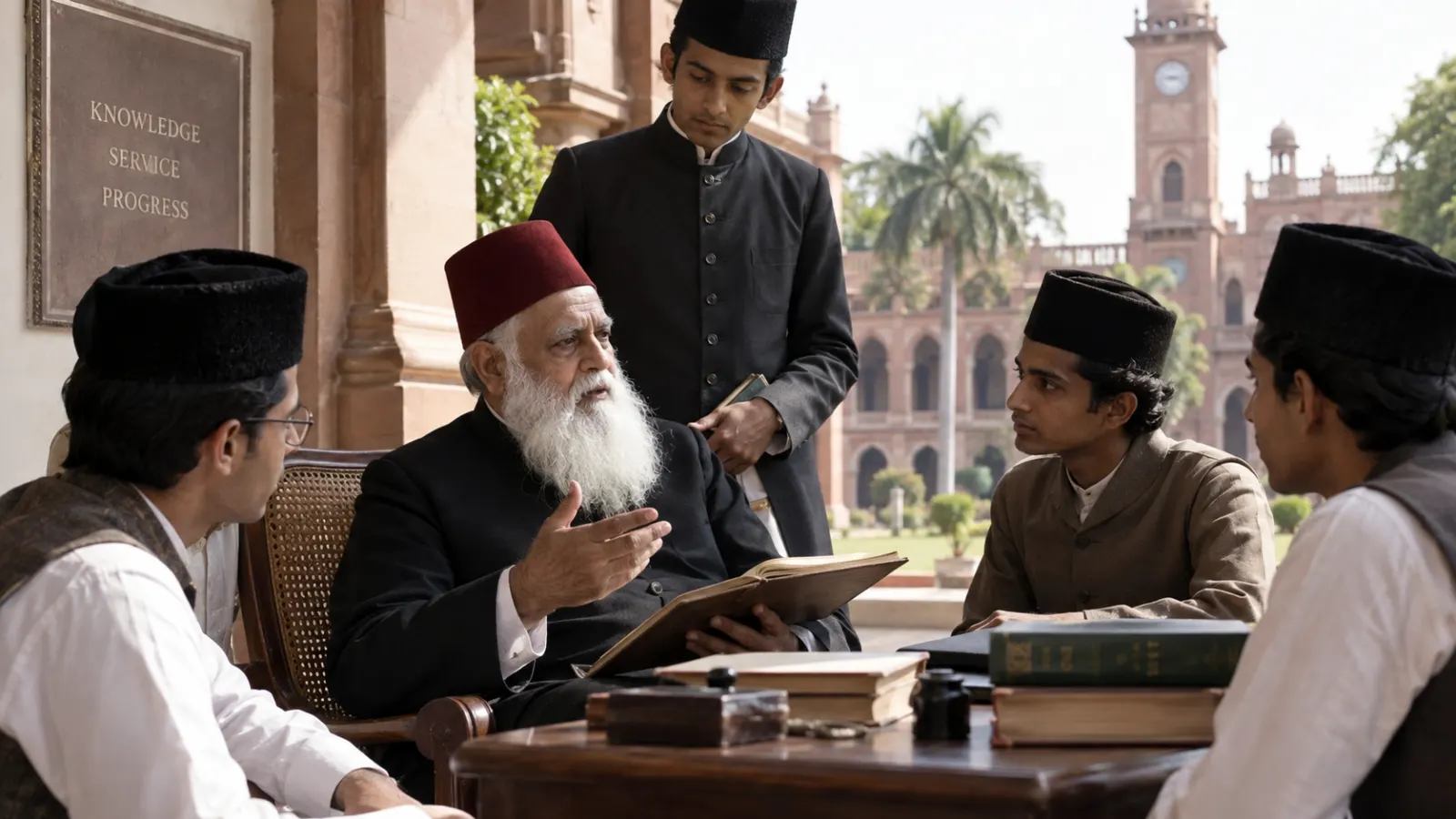
On 24 May 1875, the school known as Madrasatul Uloom was inaugurated at Aligarh. The institution developed into the Muhammadan Anglo-Oriental College, whose formal foundation is associated with January 1877. AMU describes the college as modelled in important respects on Oxford and Cambridge while attempting to combine the British system of modern education with Islamic values. (amu.ac.in)
The residential element mattered because Sir Syed wanted education to shape more than examination performance. A college could create habits, networks, confidence, language skills and a shared social environment. It could produce graduates who were familiar with English and modern subjects and who could enter administration, law, scholarship and other professions without viewing their education as a rejection of Muslim identity.
The college also made Sir Syed’s programme durable in a way that speeches and essays alone could not. Teachers had to be hired, students recruited, donors persuaded, curricula organised and buildings maintained. Once these structures existed, the movement could continue beyond the life of its founder.
This is why the term Aligarh Movement came to mean more than the creation of one college. The Scientific Society had built translation networks; Tahzib-ul-Akhlaq had created a forum for social and religious argument; MAO College created an educational centre; and the Muhammadan Educational Conference, inaugurated in 1886, helped spread the case for Muslim-managed modern education across a wider geographical area. (amu.ac.in)
The conference was particularly significant because Sir Syed understood that one institution in Aligarh could not educate an entire population. It encouraged the establishment of schools and educational organisations elsewhere and helped build networks of teachers, donors, intellectuals and public figures. Education gradually created a broader social constituency.
Those networks also had political consequences. Institutions produce graduates, associations and leadership, and educated groups eventually enter debates over representation and power even when their original institutions were founded around education. The later political influence of Aligarh cannot therefore be separated completely from Sir Syed’s educational work, but neither should the college be treated as if it had been created primarily to achieve twentieth-century political outcomes that did not yet exist.
The distinction becomes particularly important because MAO College did not become Aligarh Muslim University during Sir Syed’s lifetime. Sir Syed died on 27 March 1898; the college was transformed into AMU in 1920. (amu.ac.in) The university was therefore an institutional descendant of his project, but its later political and intellectual history belonged to generations that encountered circumstances he never lived to see.
Sir Syed’s educational reform also had clear limits. His initial movement was oriented strongly toward male education and toward sections of society capable of participating in an emerging educated elite. The broader problem of mass literacy, poverty and access to education could not be solved simply by creating an elite residential college, and the development of Muslim women’s formal education at Aligarh accelerated more substantially in the generations after him. AMU records that a girls’ school was established in 1907, nine years after his death. (amu.ac.in)
That limitation should not erase the importance of what he built, but it prevents the Aligarh project from being treated as a complete solution to every educational inequality. Sir Syed’s strategy was essentially reform through institution-building and the formation of an educated leadership. Later reformers had to extend that vision toward social groups and educational questions the original movement addressed less fully.
Language, Muslim identity and the limits of representative politics
Sir Syed’s intellectual project was educational, but it increasingly became entangled with questions of language and political representation. The Hindi–Urdu controversy of the nineteenth century was particularly important because language was connected with much more than literary preference. Language affected courts, education, employment, print culture and claims about which communities should receive institutional recognition.
Sir Syed strongly defended Urdu, which he viewed as a major language of north Indian culture and as particularly important to Muslim educational and intellectual life. When organisations began pressing for greater official use of Hindi written in Devanagari, he increasingly interpreted the controversy as evidence that cultural interests could become organised along religious lines. Recent scholarship stresses that the Hindi movement itself helped differentiate Hindi and Urdu more sharply as symbols connected with Hindu and Muslim constituencies, even though the linguistic history of north India was much more interconnected than later nationalist narratives sometimes suggested. (cambridge.org)
Language disputes contributed to Sir Syed’s growing concern about representative politics. When the Indian National Congress was founded in 1885, he opposed Muslim participation in the organisation and became increasingly critical of its political programme. His objections reflected several concerns: he believed educational and social development should precede confrontational politics, feared that agitation against British authority could damage the progress he was trying to achieve and worried that representative institutions based heavily on numerical majorities might leave Muslims politically disadvantaged.
This position is among the most controversial parts of his legacy. Later nationalist critics regarded his opposition to Congress as politically conservative and as encouraging separate communal political identities. From their perspective, his emphasis on cooperation with British rule and separate Muslim interests weakened the development of a unified anti-colonial national movement.
Yet understanding his position requires placing it in the politics of the 1880s rather than reading it solely through events after 1900. Sir Syed had experienced the consequences of 1857, regarded the British Empire as the dominant political reality of his lifetime and believed his community was educationally unprepared for rapid representative politics. His political strategy was therefore built around securing education and influence before pursuing forms of political competition he feared might leave Muslims weaker.
His thinking was also not perfectly consistent across his life. At different moments he used language emphasising shared Indian identity and Hindu-Muslim cooperation, while at other moments he spoke forcefully about separate communal interests. Scholarship on his political thought treats these apparent contradictions as requiring historical context rather than simply choosing one quotation and making it represent his entire career. (cambridge.org)
The tension reflects a wider problem in colonial politics. A person could think of Hindus and Muslims as inhabitants of the same country while simultaneously believing that different communities required institutional protections or separate representation in particular circumstances. Modern political categories often make these positions appear mutually exclusive, but nineteenth-century political vocabulary was still evolving.
Sir Syed’s response to Congress therefore cannot be separated from his educational strategy, the Urdu question or his fear of political marginalisation. He did not believe political equality would automatically follow from introducing representative institutions into a society marked by unequal education, different community organisations and colonial control. Whether his solution ultimately reduced or intensified communal political divisions is a legitimate historical question, but the problem he was trying to address was real.
Was Sir Syed the founder of the “two-nation theory”?
Few labels have produced more distortion in discussions of Sir Syed than the claim that he was simply the originator or “father” of the two-nation theory that eventually led to Pakistan. The label appears attractive because Sir Syed defended Muslim political interests, opposed Congress and increasingly worried about Hindu-majority representative politics. Yet it risks turning a nineteenth-century thinker into an actor in political events that developed decades after his death.
Sir Syed died in 1898. The All-India Muslim League was founded in 1906, the demand for Pakistan emerged much later, and the partition of British India occurred in 1947. He therefore could not have formulated his politics in response to institutions, political movements and constitutional crises that did not yet exist.
Modern historiography has interpreted him very differently depending on national and ideological perspective. The Cambridge Companion to Sayyid Ahmad Khan notes that Indian nationalist narratives have sometimes emphasised his early language of Hindu-Muslim unity, whereas Pakistani historiography has often presented him as an intellectual ancestor of the two-nation theory. Both interpretations select genuine aspects of his career, but neither alone captures its full evolution. (cambridge.org)
It would be equally misleading to respond by claiming that Sir Syed had nothing to do with the later development of Muslim political consciousness. The institutions and networks associated with Aligarh helped produce educated Muslim elites, and his arguments about language, political representation and community interests influenced subsequent debates. Later politicians could draw on concepts and institutions shaped by the Aligarh Movement even when they used them for purposes Sir Syed himself never formulated.
Historical influence is not the same as authorship of future events. A thinker can help create intellectual categories, institutions or constituencies that later generations transform in directions the original thinker did not anticipate. Sir Syed’s educational and political work forms part of the prehistory of twentieth-century Muslim politics, but a straight line from Aligarh in the 1870s to partition in 1947 eliminates almost seventy years of political change.
The more useful historical question is therefore not whether Sir Syed can be assigned a twentieth-century label. It is why a nineteenth-century Muslim reformer became increasingly worried about majoritarian representative politics and how those worries interacted with educational inequality, colonial rule and language conflict. That question explains more than simply declaring him either a nationalist hero or a separatist villain.
It also reveals one of the central tensions in his thought. Sir Syed wanted Indian Muslims to acquire the educational tools required to function confidently in modern public life, yet he was sceptical of political mobilisation that he thought could expose their weakness before that educational transformation had occurred. The same commitment to community advancement that produced an ambitious modern college also contributed to a politics that emphasised communal safeguards.
Sir Syed’s greatest legacy was the infrastructure of reform
Sir Syed Ahmad Khan’s historical importance ultimately rests less on any single political quotation than on his ability to convert ideas into institutions. He did not merely argue that modern knowledge was valuable; he established organisations to translate it. He did not merely complain that social attitudes needed reform; he created a journal through which those attitudes could be debated. He did not merely call for Muslims to embrace modern education; he spent years raising money, building networks and creating a residential college.
The Scientific Society, Tahzib-ul-Akhlaq, MAO College and the Muhammadan Educational Conference formed an interconnected infrastructure of reform. Together they allowed knowledge, people and money to circulate through a movement rather than depending entirely on Sir Syed’s personal presence. This institutional quality explains why his influence continued after his death.
It also explains why Aligarh became much more than a university campus. It developed into an intellectual reference point in debates over Muslim education, social reform, religion, language and politics. Its graduates and associated thinkers did not all share one ideology. Some participated in forms of Indian nationalism, others supported separate Muslim political organisation, while scholars and reformers used the institutional world of Aligarh for purposes that changed across generations.
That diversity is itself evidence of institutional success. A durable educational institution cannot permanently control the politics of everyone it educates. Once students and intellectuals are trained to participate in public life, they enter arguments the founder cannot determine.
Sir Syed’s legacy also remains contested because the questions he confronted are not dead historical problems. Communities still debate whether educational reform should precede political mobilisation, how minority interests should be represented in democratic systems, whether religious interpretation can adapt to scientific knowledge and how language becomes connected with identity and power.
His answers were shaped by British India after 1857 and therefore cannot simply be transplanted into the present. His confidence in cooperation with colonial authority, his elite-oriented model of reform and the limits of his early programme in areas such as women’s education invite legitimate criticism. At the same time, his insistence that social decline could not be reversed by nostalgia alone gave his movement unusual practical force.
Sir Syed believed communities needed institutions capable of teaching new knowledge, translating unfamiliar ideas and creating people equipped to navigate a transformed political order. That conviction led from schools and translation societies to MAO College and eventually, after his death, to Aligarh Muslim University in 1920. (amu.ac.in)
His life therefore resists the neat labels often imposed on it. He was loyal to British rule but critical of British failures; deeply concerned with Muslim identity but capable of speaking in broader Indian terms; committed to Islam while willing to challenge inherited interpretations; and devoted to modern education while politically suspicious of some forms of modern representative politics.
Those contradictions are not reasons to avoid evaluating him. They are the reason his biography matters. Sir Syed Ahmad Khan stood at the intersection of empire, religious reform, modern education and emerging mass politics, and he tried to build a path through changes for which inherited institutions offered no simple answer.
The most enduring part of that attempt was his wager on education. He believed that a community confronted by historical dislocation required more than memory of its former status. It required access to science and language, intellectual debate, organised educational networks and institutions able to survive their founder.
That wager became the Aligarh Movement. Its political consequences would remain contested, but its impact on the educational and intellectual history of modern South Asia is difficult to separate from the world that followed.