
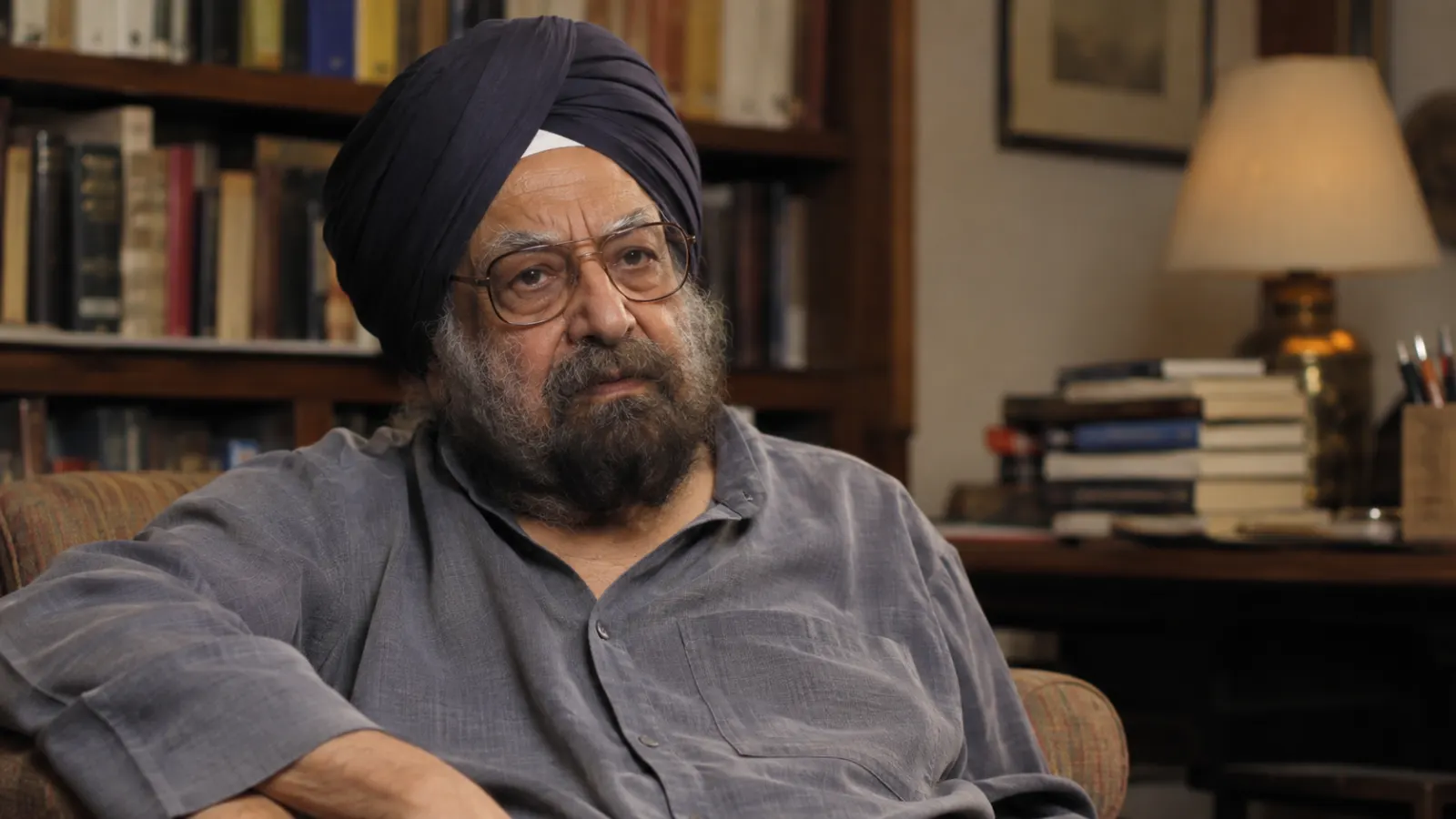
The Writing of Khushwant Singh: Wit, History and Contradiction
Khushwant Singh built a public identity around saying what respectable society often preferred to leave unsaid. He wrote about sex, religion, politicians, communal prejudice, old age, drinking, hypocrisy and his own weaknesses with a candour that became inseparable from his name. Yet the familiar image of the irreverent columnist can obscure the range and seriousness of his work. He wrote Train to Pakistan, one of the defining Indian novels about Partition; produced a major two-volume history of the Sikhs; edited some of India’s most influential publications; served in government and Parliament; and became a newspaper voice recognised across generations.
The contradictions were equally important. Singh was secular but spent years studying Sikh history. He was close enough to political power to serve as a nominated member of the Rajya Sabha, yet publicly returned a major state honour after Operation Blue Star. He supported Indira Gandhi’s Emergency and continued to defend aspects of that judgment decades later, while also becoming an outspoken critic of communal violence and the failures surrounding the anti-Sikh massacres of 1984. To reduce him to novelist, historian, editor, provocateur or political contrarian is therefore to lose precisely what made him interesting: he occupied all those roles, sometimes uncomfortably, at the same time.
Partition Turned Geography Into Memory
Singh was born in 1915 in Hadali, in the Punjab of British India, now in Pakistan. He studied in Lahore before going to Britain, where he was a law student at King’s College London and later trained at the Inner Temple. King’s College records him as having entered the institution as a law undergraduate in 1934. He eventually returned to Lahore and practised at the Lahore High Court before entering Indian government service after independence.
Those places matter because the political map of Singh’s youth did not survive intact. Partition in 1947 divided Punjab between India and Pakistan, sending millions across new borders and accompanying migration with massacres, abductions and the destruction of mixed communities. Lahore, where Singh had studied and practised law, became part of Pakistan. Hadali too was now across an international frontier. Partition was therefore not merely a historical subject available to him as a writer; it had reorganised the geography of his own life.
That experience later gave Train to Pakistan much of its emotional force. Singh did not tell Partition primarily through negotiations in Delhi, speeches by national leaders or constitutional arrangements. He reduced the scale to the fictional village of Mano Majra and asked what political division looks like when it enters a community in which Sikh and Muslim lives had previously been intertwined. Penguin describes the novel around precisely this transformation: a village accustomed to coexistence is pulled into religious hatred after the arrival of a train carrying the dead. The novel was first published in 1956.
The choice of scale is crucial. National history tends to organise Partition around states, borders and political movements. Singh’s fiction instead follows trains, rumours, relationships, fear, revenge and individual decisions. People who had known one another as neighbours become vulnerable to being seen primarily as members of religious communities. Political abstractions acquire bodies.
That is one reason Train to Pakistan has survived many of the author’s more topical writings. Singh avoids constructing a neat moral arrangement in which one community possesses innocence while another carries guilt. Violence contaminates the social world more broadly. Institutions prove fragile, communal categories become stronger, and individual choices remain morally significant even when circumstances have narrowed the range of possible action.
Singh’s secularism is easier to understand against that background. It was not simply the cosmopolitan preference of an English-language intellectual. His writing repeatedly returned to the knowledge that religious identity could coexist with ordinary social intimacy and could also, under political pressure, be converted into an instrument of fear. Partition became one of the experiences through which he judged both communal politics and the promises of independent India.
The Historian Behind the Popular Columnist
The newspaper persona eventually became so dominant that it is easy to overlook how much serious historical work preceded it. A History of the Sikhs first appeared in 1963 and developed into a two-volume account covering Sikh religious formation, political development, colonial rule and the modern community. Oxford University Press describes the work as based on scholarly archival research while deliberately written for a general rather than exclusively academic readership. Its first volume draws on material in Persian, Gurmukhi and English and follows Sikh history through the rise of Ranjit Singh; the second extends the account into the modern period.
This work reveals a side of Singh that does not fit comfortably with the caricature of the whisky-drinking newspaper wit. He belonged to the community whose history he was writing, but he did not treat historical writing as devotional affirmation. He approached Sikhism as a religion, community and political tradition that could be studied through documents, institutions and historical change.
That position inevitably produced tension. Writing about a community to which one belongs can generate competing expectations: some readers want sympathetic representation, some want reverence, and scholars want claims to survive scrutiny against evidence. Singh attempted to combine belonging with scepticism. He could be emotionally invested in Sikh history without believing that historical inquiry should be protected from criticism.
The same combination later shaped his politics. His response to Operation Blue Star in 1984 was not the sudden awakening of a man who had previously been indifferent to Sikh identity. It came from someone who had spent decades studying the history of the community while repeatedly describing himself in secular terms. Religion for Singh could be an object of historical inquiry, cultural inheritance and personal attachment without requiring theocratic politics.
His historical work also helps explain his prose. Singh rarely aspired to make difficulty itself a mark of seriousness. Even when dealing with large subjects, he generally preferred direct sentences, chronological movement and concrete description. Accessibility was not an accidental simplification imposed by journalism; it was one of his recurring literary choices.
Train to Pakistan and the Strength of Restraint
Singh’s best fiction demonstrates what direct prose can achieve when the subject itself is overwhelming. Train to Pakistan contains violence, communal hatred and moral crisis, but it does not depend on constant rhetorical declaration. The horror often emerges through what people discover, hear, fear or decide rather than through the narrator insisting on the magnitude of events.
That restraint gives the novel its power. A train is ordinarily a technology of connection and movement. In the novel, the railway becomes a carrier of evidence that the surrounding moral order is collapsing. A village that had previously understood itself through local relationships is forced to confront the industrial scale of killing occurring beyond it.
Singh understood that history becomes emotionally intelligible when large forces alter ordinary routines. This pattern appears elsewhere in his writing as well: political grandiosity is frequently placed beside bodily need, private desire, gossip, fear or domestic inconvenience. He had little patience for narratives that allowed public language to float above lived experience.
His other fiction ranged much more widely. Short stories moved between communal conflict, sexuality, satire and social observation, while the later novel Delhi mixed centuries of history with a deliberately unruly narrator. Not every work has the discipline of Train to Pakistan, and Singh’s enormous output inevitably produced uneven results. He wrote too much, and too publicly, to maintain the polished distance of an author who produces a carefully guarded novel every decade.
Yet that abundance was itself part of his literary philosophy. Singh enjoyed being read. He valued story, anecdote, personality, accessibility and the comic turn. Writers who believe seriousness must announce itself through formal difficulty may find his manner too straightforward. His strongest work suggests the opposite: plain language can carry profound subjects when observation and structure are strong enough.
The Editor Who Helped Turn Himself Into a Public Character
Singh’s transformation from writer into national media personality accelerated when he became editor of The Illustrated Weekly of India in 1969. Contemporary records place his tenure broadly between 1969 and 1978, and Singh himself later recalled taking over in 1969 and holding the position for nine years.
Editing required a different kind of authority from authorship. An editor decides not only what he will say but what an entire publication will consider worth attention. Subjects must be selected, writers commissioned, visual material chosen and competing demands for seriousness, popularity and commercial appeal negotiated. Under Singh, the Weekly became closely identified with a livelier mixture of politics, literature, culture, personality and provocation.
The period also demonstrated one of his most important instincts: intellectual content did not have to be presented solemnly to matter. He wanted readers to turn pages. He was willing to use humour, curiosity, photography, controversy and personality to make that happen. In later recollections, writers and editors credited his tenure with changing expectations around Indian magazine journalism, although dramatic circulation claims repeated in secondary accounts should be treated cautiously unless tied to contemporary audited figures.
Singh did not pretend that editors were neutral conduits. He had preferences, favourites, dislikes and strong judgments about what interested readers. That could open doors for emerging writers and previously neglected subjects, but editorial taste is also a form of gatekeeping. The same confidence that made the Weekly vivid concentrated considerable cultural power in one personality.
After the Weekly, Singh worked with publications including the National Herald and Hindustan Times. His column, “With Malice Towards One and All,” eventually became perhaps the most recognisable expression of his public voice. The column suited his strengths perfectly: short observations, jokes, character sketches, literary references, political opinions and glimpses of personal life could coexist without the architecture required by a novel or historical study. The Library of Congress describes it as one of the most popular columns of its period.
The columnist also became a character called Khushwant Singh. His habits, appetites, irritations, jokes and prejudices were continually recycled as material. Readers were invited into a relationship that felt less formal than the relationship between novelist and audience. Each instalment renewed the impression that this was not merely an author delivering an argument but an eccentric acquaintance speaking directly to them.
That intimacy made him enormously memorable. It also distorted his legacy. A reader could know his jokes without knowing his historical scholarship, recognise the famous caricature associated with the column without reading A History of the Sikhs, or remember the sexual provocations more readily than the moral economy of Train to Pakistan. Popularity expanded his reach while compressing a complicated writer into a marketable persona.
The Emergency and the Limits of Contrarianism
The most difficult part of Singh’s political record is his support for the Emergency imposed by Prime Minister Indira Gandhi in 1975. This should not be treated simply as another example of his taste for holding unpopular opinions. The Emergency involved suspension of civil liberties, censorship, detention of political opponents and an extraordinary concentration of state power. Coercive sterilisation drives and forced slum clearances became among the period’s most notorious abuses.
Singh nevertheless supported the Emergency and remained unusually willing to say so. Decades later, an anthology carried the title Why I Supported the Emergency, and in a 2010 NDTV interview he again defended his admiration for Sanjay Gandhi, saying he saw him as someone who got things done. Contemporary reporting also records Singh saying that he did not regret supporting Sanjay Gandhi.
This matters because Singh cannot easily be explained as a conventional authoritarian. He valued secularism, mocked political sanctimony and was capable of attacking governments. His position demonstrates a broader danger: intellectuals who value administrative efficiency can become willing to tolerate coercive power when democratic disorder appears frustrating enough.
The appeal of “getting things done” is politically seductive precisely because democratic restraint often looks slower than executive command. Yet institutions that protect rights are designed partly to prevent efficiency from becoming a justification for unchecked authority. Singh’s Emergency position therefore deserves criticism on substantive grounds, not merely description as evidence of his unpredictability.
His candour does deserve one distinction. Singh did not spend the rest of his life pretending that he had secretly opposed the Emergency all along. He defended the position publicly, allowing later readers to judge both his reasoning and its weaknesses. Intellectual honesty about a mistaken judgment does not erase the judgment, but it leaves a clearer historical record than retrospective self-exoneration would have done.
Operation Blue Star, 1984 and a Collision of Loyalties
The contradictions became sharper in 1984. In June that year, the Indian Army entered the Golden Temple complex in Amritsar during Operation Blue Star. Singh returned the Padma Bhushan, which he had received in 1974, in protest. The Library of Congress records both the award and its return, while later accounts likewise connect his decision directly to the military action at the Golden Temple.
The act complicates any straightforward portrayal of Singh as a Congress loyalist. He had supported Indira Gandhi during the Emergency and had been nominated to the Rajya Sabha, where he served from 1980 to 1986. Yet there was clearly a point at which his relationship with the political establishment collided with his judgment about the treatment of a place central to Sikh religious life.
That rupture became still more personal after Indira Gandhi was assassinated by two Sikh bodyguards on 31 October 1984 and anti-Sikh violence spread through Delhi and other places. Years later, Singh recalled that during the violence he had sought refuge at the Swedish Embassy and described the experience as feeling like a refugee in his own country.
For someone whose youth had already been marked by Partition, the historical echo was severe. Citizenship had supposedly replaced the insecurity of communal belonging with the equal protection of a secular republic. Yet Sikhs in the capital could again find themselves classified, threatened and attacked primarily through identity.
Singh did not respond by abandoning secularism for an argument of permanent communal separation. His position remained closer to critical belonging: the Indian state and political system could fail terribly without making plural citizenship an unworthy ideal. That distinction is important. Secularism for Singh was not an assertion that religious identities did not matter; it was a demand that those identities should not determine whose life, dignity or citizenship deserved protection.
His later reception of the Padma Vibhushan in 2007 added another layer to the story. India Today records the 1974 Padma Bhushan, its return in 1984 and the later Padma Vibhushan. There is no need to force these acts into a perfectly consistent ideological journey. Singh’s life is more revealing when the tensions remain visible.
Clear Prose, Provocation and the “Dirty Old Man” Trap
Singh’s prose was built around readability. He preferred clarity to elaborate abstraction, anecdotes to theoretical display and comic timing to ornamental rhetoric. The apparent simplicity could make the writing look easier than it was. Plain prose exposes weak thinking because there are fewer stylistic barriers behind which an argument can hide.
His humour often worked by reducing the distance between the grand and the ordinary. Politicians spoke about national destiny while behaving out of vanity. Moralists preached restraint while privately pursuing desire. Communities imagined themselves uniquely virtuous while reproducing familiar prejudices. Singh’s most effective satire did not need complicated machinery; it placed public respectability beside private motive and allowed the contrast to do the work.
But the same method had limitations. Brevity can become simplification. The demand for a memorable punch line can overpower nuance. A writer who has trained readers to expect provocation may eventually feel obliged to produce one even when a quieter conclusion would be more accurate.
This problem is clearest in Singh’s sexual persona. He deliberately cultivated the image of a lustful, irreverent older man and used sexual jokes to attack prudishness. In a conservative public culture, that willingness to write openly about desire could feel liberating. At the same time, some of his descriptions of women were unmistakably shaped by a male gaze that now reads as dated or objectifying.
Both truths should be retained. Treating every sexual joke as courageous anti-puritanism is too generous; dismissing the entire persona as mere vulgarity misses its function in challenging a highly moralised public language. Singh made Indian English journalism less ceremonious about the body, but he also demonstrated how a writer can become trapped inside a successful self-caricature.
The caricature became commercially useful because audiences knew what kind of Khushwant Singh they were going to receive. That predictability is powerful in mass media: the writer becomes a brand. But branding narrows literary identity. The “dirty old man” persona may have sold columns and generated anecdotes, yet it is inadequate as a description of the author who wrote about Partition, Sikh history, communalism, memory and state violence.
Writing the Self—and Understanding the Legacy
Singh applied some of the same irreverence to autobiography. Truth, Love and a Little Malice turned his own life into material through confession, anecdote, relationships and self-mockery rather than the stately progression of an official memoir. The approach strengthened the impression that he had nothing to hide.
Yet self-disclosure is not the same thing as transparent truth. Memoir is a constructed form. The writer chooses which weaknesses to confess, which embarrassments to convert into jokes, which relationships to emphasise and which conflicts to explain. A strategically candid narrator can appear more trustworthy precisely because he volunteers flaws.
Singh understood the performance instinctively. The man who mocked himself was also shaping the version of himself readers would remember. His autobiographical writing is therefore useful on two levels: it records a remarkable literary and journalistic life, and it demonstrates how public personalities participate in producing their own myths.
His broader legacy should be judged with the same care. Train to Pakistan remains a major literary interpretation of Partition because it gives communal violence a human rather than triumphalist scale. A History of the Sikhs, first published in 1963 and later revised, represents decades of engagement with religious and political history and was designed to make archival scholarship accessible beyond specialists. His editorship of The Illustrated Weekly of India helped establish a more energetic model of English-language magazine journalism, while his columns demonstrated how an individual newspaper voice could become a national cultural institution.
His political judgments were much less dependable. His defence of the Emergency deserves serious criticism because admiration for administrative action led him to underestimate the dangers of concentrated power and coercion. His response to Operation Blue Star and the anti-Sikh violence of 1984 revealed another side of his politics: a fierce awareness of what happens when the state or political society fails to protect citizens from communal injury.
The temptation with famous writers is to make the final verdict simple. Admirers want consistency that confirms greatness; critics want contradictions that invalidate the whole career. Khushwant Singh resists both approaches.
He was capable of serious scholarship and disposable jokes, moral insight and political misjudgment, secular conviction and strong attachment to Sikh history, establishment access and public dissent. He could puncture hypocrisy while remaining vulnerable to prejudices of his own. He could use candour as genuine self-criticism and as part of a carefully maintained public performance.
That complexity is not an obstacle to evaluating him. It is the material from which the evaluation must be made.
Khushwant Singh died in New Delhi in March 2014 at the age of 99, after a career extending across colonial Punjab, Partition, independent India, diplomacy, literature, journalism and Parliament. By then his bibliography ran to scores of books, his column had made him familiar far beyond literary circles, and King’s College London had honoured its former law student with a Fellowship shortly before his death.
What survives most strongly is not simply the cultivated irreverence. It is his ability to move between the intimate and the historical—to understand that Partition could be explained through a village, communalism through a neighbour, politics through vanity, and public hypocrisy through ordinary human appetite. At his best, Singh made large subjects readable without pretending they were simple.
His writing also leaves a warning relevant well beyond his own generation. Accessibility can become simplification, contrarianism can become an excuse for bad judgment, proximity to power can compromise independence, and a successful public persona can eventually obscure the work that made the persona worth noticing.
The most useful way to read Khushwant Singh today is therefore neither as an infallible national sage nor merely as the irreverent columnist of popular memory. Read the historian beside the humorist, Train to Pakistan beside the political essays, the defender of the Emergency beside the man who returned his Padma Bhushan, and the public provocateur beside the writer preoccupied with the destruction caused by communal hatred.
The contradictions do not disappear when placed together. They become the clearest way of understanding him.


