Sarojini Naidu: Poet, Freedom Fighter and Political Leader
Sarojini Naidu occupies an unusual place in modern Indian history because the two careers for which she is remembered—lyric poetry and nationalist politics—were not as separate as they first appear. Before she became a major political speaker, the first Indian woman to preside over the Indian National Congress, a participant in mass civil disobedience and a governor after independence, she had already established an international literary reputation as an English-language poet.
Her first major collection, The Golden Threshold, appeared in London in 1905. The Bird of Time followed in 1912 and The Broken Wing in 1917. Her poems drew on love, death, nature, Hyderabad, Indian occupations, bazaars, religious imagery and an increasingly explicit language of nationalism. Yet as politics claimed more of her time, sustained poetic publication largely receded.
It would be misleading, however, to describe this simply as the disappearance of a poet. Naidu transferred many of the qualities that had defined her poetry—rhythm, imagery, wit, emotional compression and a strong awareness of audience—into speeches and political performance. Modern scholarship has consequently described her as a cosmopolitan nationalist, someone whose public identity was formed simultaneously within English literary culture and Indian anti-colonial politics.
The poet learned how language could produce feeling. The political leader learned how feeling could help people imagine themselves as part of a common cause.
From Hyderabad to the Literary World of London
Sarojini Chattopadhyay was born in Hyderabad on 13 February 1879 into an unusually intellectual family. Her father, Aghorenath Chattopadhyay, was a scientist and educationist associated with the founding of Nizam's College, while the wider Chattopadhyay family would produce several figures active in literature and politics. Contemporary introductory material to The Golden Threshold confirms that Sarojini received an unusually intensive education and passed the Madras University matriculation examination at a young age.
Accounts of her childhood often emphasise extraordinary precocity, including stories of very early literary composition. Some of these details have acquired the polished form characteristic of famous-person biographies and should not all be treated with equal evidentiary confidence. What is securely established is that she entered literary culture remarkably young and travelled to Britain for further study while still in her teens.
King's College London records that she studied there from the age of sixteen before continuing at Girton College, Cambridge. Her time in Britain exposed her to literary circles as well as debates about women's rights and political representation.
This experience placed Naidu in a complicated cultural position. English was the language in which she developed her literary reputation, but she was writing from within an empire in which Indians were politically subordinated and Indian culture was routinely represented to British audiences by Europeans. The problem facing an Indian writer in London was therefore not simply how to write good English poetry. It was also how to enter an English literary marketplace without becoming merely an object of metropolitan ideas about what “India” was supposed to look like.
Arthur Symons became one of the important figures in her early literary career and wrote the introduction to The Golden Threshold. The volume itself was dedicated to Edmund Gosse. Symons recalled encountering Naidu's poems in England in the 1890s and encouraging their eventual publication.
Gosse has often been credited with encouraging Naidu to move away from imitation of European settings and use Indian subjects more directly. Government cultural material similarly records his later account of advising her to root her verse more firmly in Indian landscapes.
But the standard version of this story can be misleading if it makes Naidu sound like a passive student who required a British critic to teach her how to become culturally Indian. Scholars such as Sheshalatha Reddy have instead examined how Naidu actively constructed a literary identity that was both internationally legible and nationalist. Her situation was shaped by a colonial publishing market in which an Indian writer was expected to demonstrate command of English literary form while also appearing sufficiently distinctive from English writers.
The resulting poetry combined both worlds rather than belonging completely to either.
Poetry, Hyderabad and the Politics Hidden Inside Description
The Golden Threshold established the characteristic features of Naidu's early poetry: musical rhythm, compressed lyric forms, sensuous imagery and Indian settings. Its poems include fishermen, weavers, palanquin bearers, dancers, religious figures and the streets and landscapes of Hyderabad. The volume's contents themselves demonstrate how consistently she placed Indian subjects at the centre of English-language lyric poetry.
This style later became a source of criticism. As twentieth-century literary taste shifted toward modernism, Naidu's musicality and decorative imagery could appear old-fashioned. Postcolonial criticism added another concern: some descriptions of India seemed to reproduce the colourful, picturesque or exotic images that metropolitan audiences already expected.
Those criticisms should be taken seriously, but historical context changes the interpretation. At a time when colonial literature frequently allowed Europeans to describe India for European readers, Naidu made Indian speakers, workers, religious practices, places and landscapes subjects of English poetry from the position of an Indian author.
Her celebrated “In the Bazaars of Hyderabad” illustrates the point. The poem builds a marketplace through merchants, vendors, craftsmen, flowers, jewellery, food and objects used in celebration and mourning. It is often taught primarily as an exercise in sensory description, yet its celebration of a self-sufficient world of Indian production has also encouraged readings connecting it with the wider Swadeshi-era valorisation of indigenous goods.
The connection should not be overstated. The poem is not an economic programme disguised as verse. Its political force is subtler: the bazaar needs no colonial observer to make it meaningful. Indian makers, buyers and rituals occupy the centre of their own world.
Naidu's later poetry could be much more openly national in tone. The Bird of Time, published in 1912, and The Broken Wing in 1917 expanded the political dimension of her literary voice. Government archival material describes The Broken Wing as containing overtly nationalist writing, while poems such as “Awake!” presented India through a language of unity, sacrifice and political awakening.
Her First World War poem “The Gift of India” similarly complicated imperial narratives of military sacrifice. Indian soldiers had fought and died across overseas battlefields under the British Empire. Naidu's poem insists that those dead belong to India's memory rather than disappearing into a purely British account of wartime heroism.
This was characteristic of her political imagination. India often appears in her writing not merely as territory but as a voice capable of mourning, remembering and demanding recognition.
Her personal life also crossed established boundaries. She married physician Govindarajulu Naidu in 1898 after returning from Britain. Arthur Symons' contemporary introduction to The Golden Threshold describes the marriage as crossing caste boundaries and as having encountered social opposition.
Later biographies sometimes transform this into a perfectly modern story of individual rebellion. The historical reality was probably more complicated, but the marriage does show that Naidu's life did not fit comfortably within some of the social expectations applied to educated women of her background. Their children included Padmaja Naidu, who later became a nationalist activist and eventually governor of West Bengal.
The Poet Became One of Nationalism's Most Recognisable Speakers
By the 1910s, Naidu increasingly transferred her energies from sustained literary production to public political life. Her political career developed through relationships with figures including Gopal Krishna Gokhale, Annie Besant, Mahatma Gandhi and later Jawaharlal Nehru, but she should not be remembered merely through the more famous men around her.
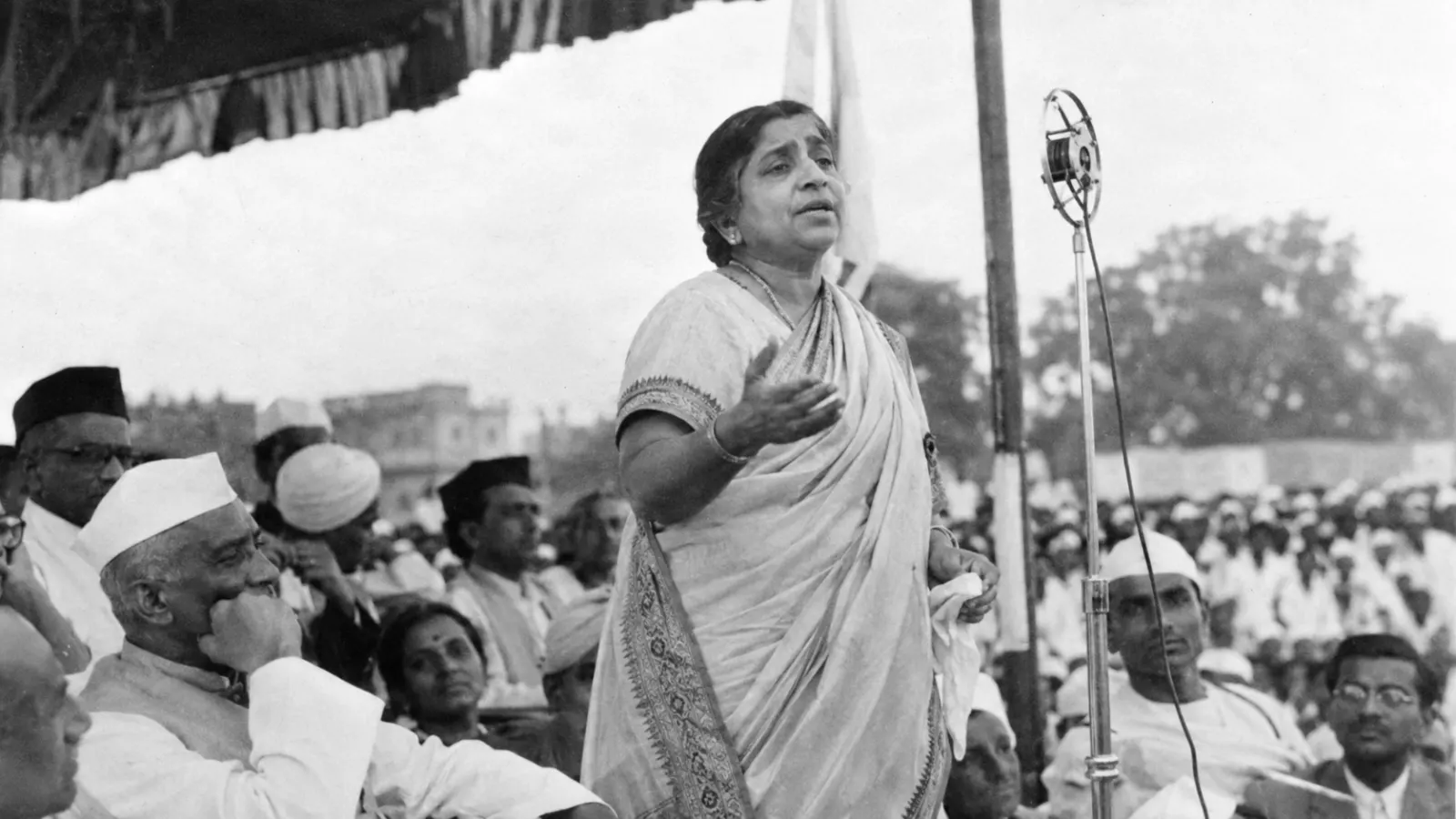
Naidu became a political asset in her own right because she could speak to audiences with unusual theatrical and emotional force. Her speeches used metaphor, humour, rhythm and moral appeal rather than relying only on constitutional detail. The transition from poetry to oratory was therefore less radical than it appears.
Poetry and political speech both depend on audience.
Nationalist politics also required more than policy analysis. A movement seeking to persuade millions of people to imagine a political future that did not yet exist needed symbols, stories, emotional identification and memorable language. Naidu's literary training equipped her unusually well for that task.
Her nationalism combined independence with recurrent appeals for religious coexistence and political unity. Government archival material preserves a 1917 speech in which she presented patriotism as an inclusive principle transcending communal divisions.
Her politics were also international. Naidu travelled beyond India, spoke to overseas audiences and communicated Indian political claims in the language of liberal constitutionalism, equality and freedom that imperial Britain itself professed to value. Recent scholarship on Indian women's “cosmopolitan nationalism” places her squarely within transnational networks through which anti-colonial women addressed audiences in Britain, North America, Africa and elsewhere.
This complicates simplistic distinctions between supposedly “Westernised” Indians and authentic nationalists. Naidu's education within imperial institutions gave her tools that she could turn against imperial political authority.
She could make an anti-colonial argument in the language of the empire.
Women's Political Rights Were Part of Her Nationalism
Naidu's role in the history of Indian women's political participation deserves more attention than the familiar “Nightingale of India” label usually receives.
In December 1917, she led an all-India delegation of women that met Edwin Montagu, the Secretary of State for India, and Viceroy Lord Chelmsford. The delegation demanded that women be recognised as political persons within the emerging constitutional framework and sought voting rights on terms comparable to those available to men under the restricted franchise of the period. Cambridge scholarship identifies this deputation as an important opening in the organised struggle for women's political and civil rights in colonial India.
This was not Naidu's achievement alone.
The campaign emerged through organisations and activists including the Women's Indian Association and figures such as Margaret Cousins and Annie Besant, alongside Indian women working in different regions and reform networks. Famous biographies can easily turn collective movements into the accomplishments of whichever individual later became best known.
Naidu's importance lay partly in visibility. A nationally recognised Indian woman publicly demanding political agency challenged the widespread assumption that constitutional politics was properly a male sphere.
Yet even here, historical nuance matters. Later scholarship describes Naidu as exceptional and in some respects more conservative on women's rights than younger activists who emerged during the 1930s. Her feminism operated within an elite nationalist framework and did not necessarily challenge every hierarchy of caste, class or family power with equal force.
That does not diminish her contribution. It locates it.
Women's political history in India was not one unified movement progressing along a single ideological path. Women entered political life from different social positions and pursued different combinations of nationalism, social reform, suffrage and economic change.
Naidu represented one influential route: elite education combined with literary visibility, women's political advocacy and participation in a mass nationalist organisation.
Congress Leadership, Gandhi and Civil Disobedience
Naidu's political stature became unmistakable when she was elected president of the Indian National Congress at its Kanpur session in 1925.
The distinction is often stated incorrectly. She was not the first woman to preside over the Congress. Annie Besant had done so earlier. Naidu was the first Indian woman to hold the presidency and the second woman overall. The Congress's own historical record confirms this chronology.
The difference is not pedantic. Accurate history does not need inflated firsts to make an achievement important.
Naidu's presidency placed an Indian woman at the formal head of the most important nationalist political organisation in the country. Nationalist rhetoric frequently celebrated women symbolically—as mothers, embodiments of the nation or figures of sacrifice—while organisational leadership remained overwhelmingly male. Her presidency made female authority visible at the highest level of Congress politics.
Her relationship with Gandhi deepened as mass mobilisation became central to nationalism. Naidu became associated with Non-Cooperation, Civil Disobedience and later Quit India. Their relationship is often remembered through affectionate anecdotes and her habit of joking about Gandhi's carefully cultivated austerity, but humour should not obscure her political work.
She travelled, addressed meetings, organised, represented the movement abroad and repeatedly accepted arrest.
Her role during the Salt Satyagraha provides one of the clearest examples. After Gandhi's arrest in May 1930, Abbas Tyabji initially led volunteers toward the Dharasana Salt Works before he too was arrested. The Gandhi Heritage Portal records that volunteers under Naidu's leadership then moved toward Dharasana on 15 May and that she was arrested during the continuing campaign on 21 May.
The Dharasana protests became internationally significant because reports of police violence against nonviolent demonstrators exposed the coercive reality behind British claims to legitimate rule. Naidu's prominence gave the campaign an internationally recognisable figure, but the episode should not be reduced to her biography. Its power came from large numbers of volunteers prepared to endure repression without retaliating.
That distinction matters throughout nationalist history. Famous leaders make movements easier to remember; movements are actually carried by far more people than biographies can name.
Naidu remained active through later phases of the struggle. Congress records note further imprisonment in the 1930s and during the Quit India Movement of 1942, when she was detained for an extended period alongside leading nationalist figures.
By this point the young lyric poet who had entered British literary circles in the 1890s had become one of the most recognisable women in anti-colonial politics.
From Anti-Colonial Agitation to Constitution-Making
Naidu's career did not end with protest. She participated in the transition from opposition to governance, a shift that required a different kind of political imagination.
She became a member of the Constituent Assembly, representing Bihar. The Assembly's records preserve her speeches and interventions, allowing the older political Naidu to be heard directly rather than reconstructed only through later biography.
One especially valuable surviving record dates from 11 December 1946, when she congratulated Rajendra Prasad after his election as permanent chairman of the Assembly. An audio recording preserved through Prasar Bharati Archives and reproduced by the Constitution of India project captures the speech.
The speech demonstrates the same qualities that had characterised Naidu for decades: humour, affection, metaphor and performance. The Constituent Assembly transcript even records laughter during her remarks.
That continuity matters. Naidu had not stopped being literary when she stopped publishing major volumes of poetry.
Her genre had changed.
The political problem had changed as well. Before independence, the principal question was how to challenge foreign rule and create unity around the demand for self-government. In the Constituent Assembly, nationalism had to become constitutional design. Leaders were now confronting the problem of how an independent country containing profound religious, linguistic, regional, caste and economic divisions could govern itself.
Naidu's rhetoric increasingly stressed unity, responsibility and the symbolic creation of a shared political community.
After independence on 15 August 1947, she became governor of the United Provinces, the territory later renamed Uttar Pradesh. Constitution of India records that she held the office from independence until her death on 2 March 1949.
She was the first woman to serve as a governor in independent India.
The office was constitutionally different from leading an elected ministry, so its importance should not be exaggerated as executive political control. Its significance in her biography lies in the transition it represented. A woman who had spent decades challenging colonial authority now occupied one of the constitutional offices inherited from the colonial state and transformed within independent India.
The journey from imprisoned nationalist to governor compressed the political transformation of India into one life.
The “Nightingale of India” Can Hide as Much as It Reveals
Sarojini Naidu is still introduced more often by a nickname than by an argument: the “Nightingale of India” or Bharat Kokila.
The title reflects something real. Her poetry was intensely musical, and contemporaries themselves emphasised its song-like quality. Arthur Symons highlighted the lyrical character of her verse in the introduction to The Golden Threshold.
But the nickname can also narrow her.
A nightingale sings. It does not lead political delegations, demand women's franchise, preside over the Congress, organise civil disobedience, endure imprisonment, participate in constitution-making or govern a province.
This is a broader problem in the historical memory of prominent women. Women can be celebrated as mothers, queens, muses, poets or symbols in ways that make them culturally revered while reducing attention to the institutional substance of their political activity.
Naidu herself certainly cultivated charm, lyricism and theatricality. Those qualities were part of her political effectiveness. The problem begins when musicality is treated as the whole person.
Modern literary criticism has also reconsidered her poetry more seriously. Her reputation declined during periods when modernist aesthetics made ornate lyric verse appear outdated, and postcolonial critics correctly questioned the extent to which her “Indian” imagery could conform to expectations produced by the imperial literary market.
But scholars such as Sheshalatha Reddy have shown that Naidu's position was more complicated than either celebration or dismissal allows. She operated within metropolitan conventions while simultaneously constructing herself as an Indian nationalist author. Her cultural identity was not simply dictated by British editors, nor was it untouched by their expectations.
Both things can be true.
She worked inside a colonial literary system.
She also used that system to create an Indian presence within the English-language public sphere.
Her political career followed a remarkably similar pattern. British education and the English language were products of the imperial environment in which she lived, but they became instruments through which she challenged imperial authority.
Sarojini Naidu's Limits Are Part of Her History
Naidu's extraordinary visibility should not be confused with representativeness.
She came from a highly educated family, studied in Britain and had access to political and literary networks unavailable to the great majority of Indian women. Her route into public life was profoundly shaped by class privilege.
Her advocacy of women's political rights was historically important, but it did not represent every current within Indian feminism. Anti-caste reformers, working-class organisers and women emerging from different regional and religious movements approached inequality from other social locations and sometimes identified problems that elite nationalist politics treated less directly.
Her nationalist rhetoric could also idealise Indian unity and womanhood in ways that made internal differences less visible.
Such limitations should not be added to a biography merely as a ritual criticism at the end. They help explain what kind of political figure Naidu actually was.
She was neither a universal representative of Indian women nor merely an elite ornament of nationalism. She was an unusually influential participant in a specific strand of nationalist politics: cosmopolitan, English-educated, reformist, emotionally expressive and increasingly Gandhian.
The fact that she was exceptional was itself politically consequential. Her presence expanded what many contemporaries could imagine an Indian woman doing in public life.
Why Sarojini Naidu Still Matters
Sarojini Naidu died on 2 March 1949, less than two years after independence and before India's Constitution came fully into force. When the Constituent Assembly met again after her death, Rajendra Prasad remembered a life dedicated to national service and the independence struggle.
Her historical importance cannot be captured by deciding whether she was primarily a poet or primarily a politician.
She belongs to both histories.
As a writer, she was among the prominent early Indian authors who made English into a medium for representing Indian voices, occupations, landscapes, emotions and political aspirations. Her poetic style was shaped by British literary conventions, yet she used those conventions to create an Indian cultural presence within a language associated with imperial authority.
As a political figure, she helped carry nationalism into public speech, women's political organisation, international advocacy, Congress leadership, civil disobedience, constitution-making and finally constitutional office.
Her career also reveals something important about how politics works.
Movements are not constructed through programmes and institutions alone. People must be persuaded to imagine themselves as part of a community large enough to act together. That requires facts and organisation, but it also requires language capable of creating memory, emotion and identification.
Naidu understood that because she had learned it first as a poet.
It is therefore misleading to say that politics simply silenced her literary career. Her major poetry collections became fewer as political work expanded, but her verbal creativity continued through speeches, public performance, humour and political imagery.
The more accurate description is that the lyric poet became an orator without entirely ceasing to be a poet.
That continuity explains the unusual shape of Sarojini Naidu's life. In poetry, she tried to make Indian experience audible within English literature. In politics, she helped make Indian demands audible within the institutions and public spheres of empire.
Remembering only the “Nightingale of India” leaves half the story untold.
Remembering only the nationalist leader misses what made her political voice distinctive.
Sarojini Naidu mattered because, for her, language was never merely decorative. It was a way of entering public life—and eventually of helping to change it.