A Subcontinent of Many Sovereignties
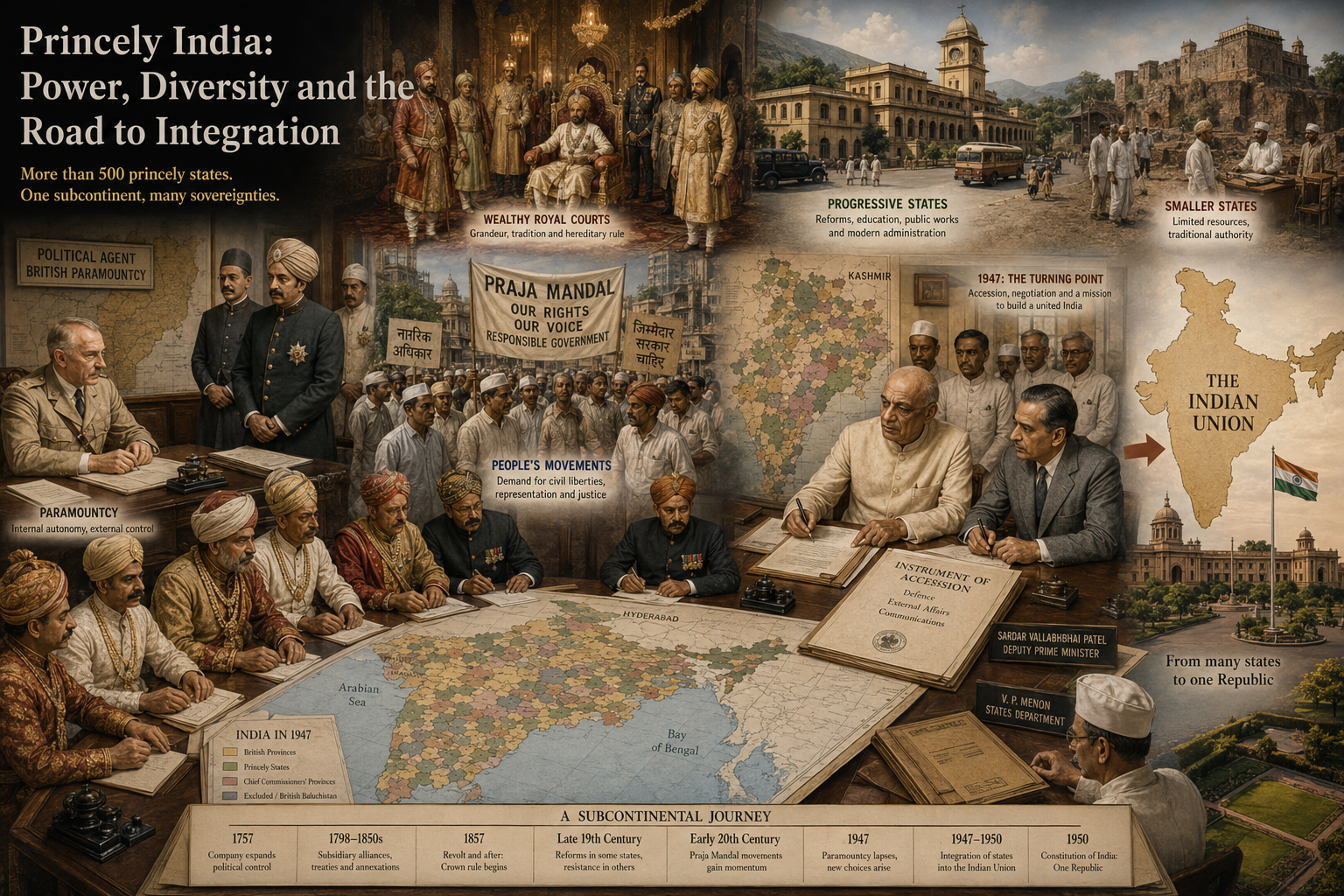
When India became independent in August 1947, it did not inherit a politically simple map. British India was only one part of the subcontinent’s political geography. Alongside directly ruled provinces stood more than five hundred princely states, varying enormously in size, power, wealth, administrative sophistication, and political ambition. Some were vast territories such as Hyderabad, Jammu and Kashmir, Mysore, Baroda, and Travancore. Others were tiny estates, sometimes no larger than a cluster of villages.
What Were Princely States?
Princely states were territories ruled by hereditary Indian rulers under British paramountcy. They were not fully sovereign in the modern sense, nor were they directly governed like British Indian provinces. Their rulers retained internal authority over administration, revenue, law, and court culture, but external affairs, defence, and often succession questions were shaped by British power.
This arrangement allowed the British to govern India through a dual system. In directly ruled provinces, British officials exercised formal authority. In princely states, local rulers maintained thrones under British supervision. This arrangement reduced administrative costs, preserved allied elites, and gave the empire political flexibility. It also produced a complicated constitutional situation: the British Crown claimed paramountcy, but the people of princely states often lacked the representative institutions emerging in British India.
The Making of Paramountcy
The princely order developed gradually through conquest, treaty, alliance, and political manipulation. The subsidiary alliance system associated with Lord Wellesley compelled Indian rulers to accept British troops, pay for their maintenance, and surrender control over external relations. The doctrine of lapse under Lord Dalhousie allowed the Company to annex states where rulers died without a natural male heir, though this policy later became deeply controversial.
After the Revolt of 1857, British policy shifted. The Crown became more cautious about annexing princely states. Loyal princes were rewarded, and princely India became a pillar of imperial stability. British officials presented the princes as traditional guardians of Indian society, while nationalist critics often viewed them as feudal allies of empire. In reality, princely states were diverse. Some were conservative and autocratic; others pursued administrative modernisation, education, industrial projects, and social reform.
Diversity Within Princely India
No single description fits all princely states. Mysore became known for administrative reforms, public works, education, and economic development. Baroda under Sayajirao Gaekwad III supported education and social reforms. Travancore had strong traditions of temple wealth, literacy, public administration, and later political conflict. Hyderabad was wealthy, culturally complex, and strategically important. Many smaller states, however, remained marked by courtly privilege, limited public participation, and dependence on British political agents.
This diversity shaped their role in Indian unity. Some states had the administrative capacity to imagine a semi-independent future. Others lacked the resources to survive outside a larger union. Some rulers wanted autonomy. Some sought favourable terms. Some people’s movements within the states demanded democratic rights and merger with India. Indian unity therefore required not only negotiation with princes but also engagement with populations living under princely rule.
Nationalism and the Princely States
The Indian National Congress initially focused on British India, partly because direct agitation in princely states could trigger legal and diplomatic complications. But as nationalism expanded, the question of princely states became unavoidable. Could India become free if large territories remained outside democratic national control? Could people living under princes be excluded from rights demanded by Indians elsewhere?
The All India States People’s Conference gave political expression to subjects of princely states. It demanded civil liberties, responsible government, and integration with the wider nationalist movement. Leaders such as Jawaharlal Nehru were sympathetic to these struggles, seeing princely autocracy as incompatible with democratic freedom. Yet Congress also had to avoid alienating princes whose cooperation would be needed at independence.
The British Withdrawal and the Constitutional Problem
The end of British rule created a dramatic legal problem. British paramountcy was to lapse. Once that happened, the princely states would no longer be bound to the British Crown. Some British officials and princes imagined that states could become independent or negotiate separately with India and Pakistan. Such a scenario would have left the subcontinent politically fragmented, with enclaves, corridors, rival sovereignties, and potential foreign influence.
For Indian leaders, this was unacceptable. A newly independent country emerging from Partition could not afford political Balkanisation. The problem was not simply sentimental unity; it was strategic survival. Defence, railways, communications, trade routes, rivers, law and order, and citizenship all required territorial coherence. If every princely state claimed independent sovereignty, India would become a patchwork rather than a viable state.
Patel, Menon and the Strategy of Integration
Sardar Vallabhbhai Patel, as the head of the States Department, and V.P. Menon, a skilled civil servant, played decisive roles in persuading princely states to accede to India. Their strategy combined firmness, diplomacy, reassurance, and speed. The Instrument of Accession allowed rulers to accede on three subjects: defence, external affairs, and communications. This limited arrangement made accession easier because it did not immediately abolish internal autonomy.
Patel appealed to geography, history, practical necessity, and patriotism. Menon handled the detailed negotiations. Many rulers understood that independence was impractical. Some were reassured by promises of privy purses, titles, and internal privileges. Others faced pressure from popular movements. The overwhelming majority of states acceded to India before or soon after independence. This was one of the most remarkable achievements of state formation in the twentieth century.
Why Princely States Mattered to Unity
The princely states mattered because they covered a large part of the subcontinent and contained millions of people. Without their integration, India’s map would have been fractured. Rail lines might have crossed foreign or semi-foreign territory. Military movement would have been complicated. Economic planning would have been weakened. Regional identities could have been manipulated by external powers.
They also mattered symbolically. India’s unity was not merely anti-British; it required the transformation of inherited political structures. A democratic republic could not permanently preserve hundreds of hereditary sovereignties as independent political entities. Integration brought the people of princely states into a common constitutional order, though the process was uneven and sometimes conflict-ridden.
The People’s Movements in Princely States
The role of ordinary people in princely states must not be ignored. In many regions, Praja Mandal movements demanded responsible government, civil rights, and an end to arbitrary rule. These movements challenged both princely authority and colonial protection. They made it clear that princely states were not simply private properties of rulers.
In states such as Travancore, Hyderabad, Kashmir, Rajkot, and others, political mobilisation showed that people wanted participation in the future of India. National unity therefore came not only from palace negotiations but also from popular pressure from below. The people of princely India helped convert territorial accession into democratic integration.
Difficult Cases: Hyderabad, Junagadh and Kashmir
Some princely states created serious challenges. Junagadh had a Muslim ruler and a largely Hindu population; its ruler chose accession to Pakistan despite geographical discontinuity. India intervened after political unrest, and a plebiscite supported accession to India. Hyderabad, ruled by the Nizam, sought independence despite being surrounded by Indian territory. The rise of the Razakars, internal unrest, and strategic concerns led to Indian military action in 1948, known as Operation Polo.
Kashmir became the most complex and enduring dispute. Maharaja Hari Singh initially hesitated between independence, India, and Pakistan. After tribal forces backed from Pakistan entered Kashmir in October 1947, the ruler signed the Instrument of Accession to India. The issue soon entered war, international diplomacy, and a long unresolved conflict. These cases show that princely integration was not only administrative; it involved questions of demography, geography, force, legitimacy, and international politics.
From Accession to Merger
Accession was only the first stage. Many states later signed merger agreements. Smaller states were grouped into unions such as Saurashtra, Madhya Bharat, Patiala and East Punjab States Union, and Rajasthan. Over time, princely administrations were absorbed into the Indian Union. The Constitution of India transformed subjects of princely rulers into citizens of a republic.
Privy purses and privileges were initially retained as part of the political settlement. They were later abolished in 1971, reflecting the republic’s move away from hereditary privilege. The integration process therefore moved in stages: accession, administrative merger, constitutional incorporation, democratic restructuring, and eventual symbolic equalisation.
Historical Debates: Diplomacy, Pressure and Democracy
Historians debate whether the integration of princely states was a triumph of diplomacy, a necessary use of pressure, or an incomplete democratic process. Supporters of Patel’s approach emphasise the urgency of the moment and the danger of fragmentation. Critics note that some integrations involved coercion, limited consultation, or suppression of local aspirations. Kashmir remains especially contested.
A balanced view recognises both the achievement and the tensions. The integration of princely states prevented political fragmentation and made Indian unity possible. At the same time, it was shaped by power, negotiation, elite bargains, people’s movements, and security calculations. It was not a simple moral story; it was statecraft under extreme historical pressure.
Legacy: Unity as a Constructed Achievement
The role of princely states in Indian unity teaches that nations are not born fully formed. They are constructed through negotiation, conflict, imagination, compromise, and institutional design. India’s unity after 1947 was not inevitable. It required leaders who understood maps, military risk, public emotion, constitutional law, and political psychology.
The integration of princely states turned a subcontinent of layered sovereignties into a federal democratic republic. It brought millions into a common citizenship. It also left behind unresolved questions about regional identity, autonomy, royal memory, and centre-state relations. The princely states disappeared as sovereign units, but their histories remain embedded in India’s political geography, cultural memory, architecture, and regional pride.