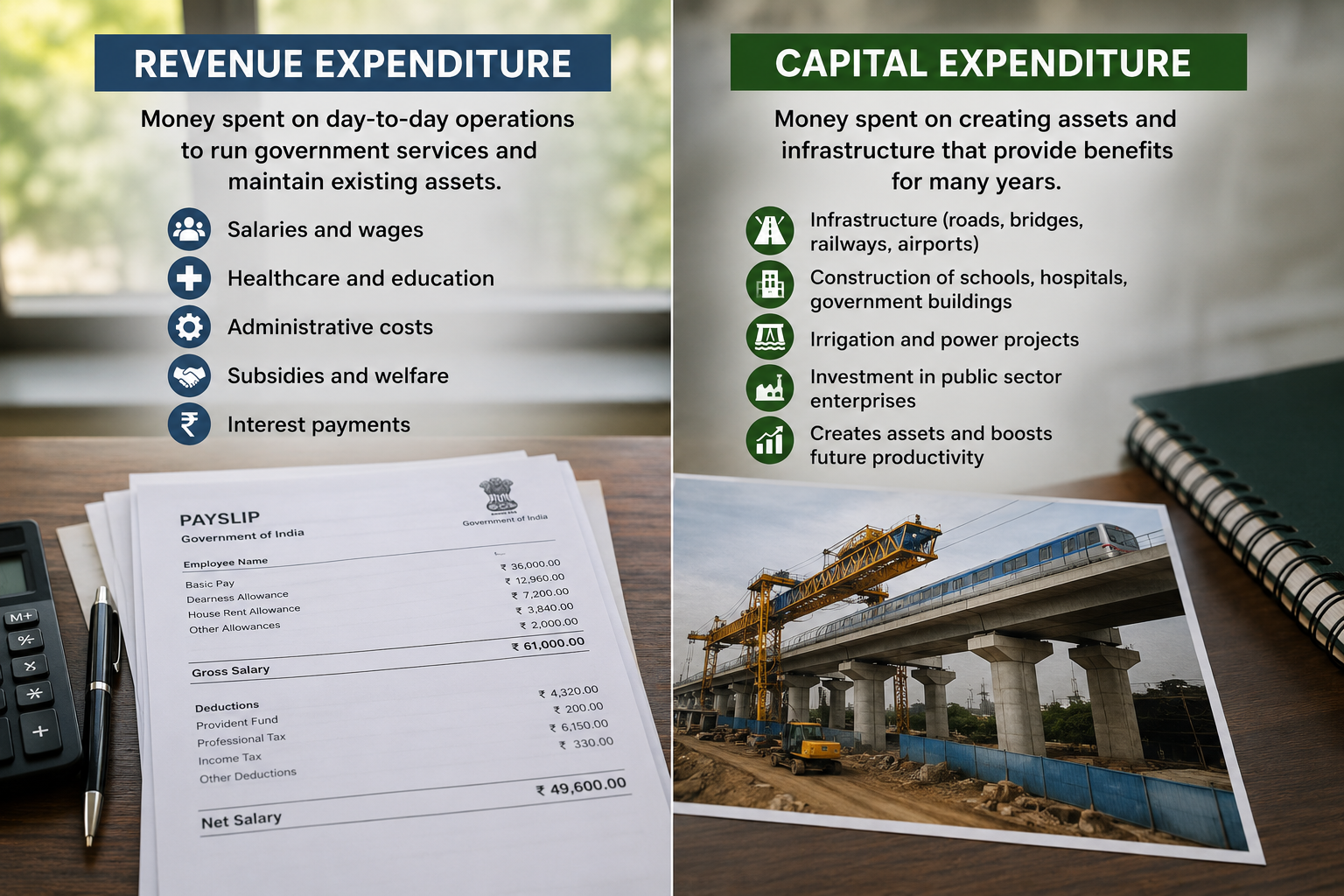
A government can spend money in many ways, but not all spending has the same economic meaning. Some expenditure keeps the state functioning today. Some expenditure builds assets for tomorrow. Some supports vulnerable households. Some pays past obligations. Some creates future productivity. This is why public finance distinguishes between revenue expenditure and capital expenditure.
The difference sounds technical, but it is one of the most important distinctions in budget analysis.
Revenue expenditure broadly refers to spending that does not create a durable asset or reduce a liability. It includes salaries, pensions, subsidies, interest payments, grants, administrative costs, routine maintenance and many forms of current spending. It is the expenditure needed to run government programmes, deliver services and meet regular obligations.
Capital expenditure broadly refers to spending that creates assets, improves long-term capacity or reduces liabilities. It includes expenditure on roads, railways, bridges, ports, power systems, irrigation, defence equipment, public buildings, digital infrastructure and loans for asset creation. It is often called capex, and governments highlight it because it can support long-term growth.
A simple analogy helps. If a household pays electricity bills, school fees, rent and groceries, that is current spending. If it buys a house, constructs a shop, pays down a loan or purchases productive equipment, that is closer to capital spending. The analogy is imperfect because governments are not households, but the distinction helps explain the idea of maintenance versus asset creation.
Revenue expenditure is often criticised because it does not create assets. This criticism is partly valid, but it can become misleading. Many revenue expenditures are essential. A hospital building is a capital asset, but doctors, nurses, medicines, electricity and cleaning services keep it useful. A school building is capital expenditure, but teacher salaries and learning material are revenue expenditure. A police station can be built through capital expenditure, but policing requires personnel, training, vehicles, fuel and administrative support.
Therefore, revenue expenditure is not waste by definition. The real question is whether it creates public value. A teacher salary that improves learning is productive. A health worker's salary that supports vaccination is productive. A maintenance budget that keeps roads usable protects past capital investment. By contrast, poorly targeted subsidies, inefficient administrative spending or rising interest payments can weaken fiscal flexibility.
Capital expenditure is also not automatically good. A road to nowhere, a delayed project, an underused airport or a politically motivated building can waste public money. Capital expenditure should be judged by project quality, execution speed, cost control, demand, environmental impact and social return. The label "capital" does not guarantee development.
The strength of capital expenditure lies in its multiplier effect. When the government builds infrastructure, it directly creates demand for materials, labour, engineering, logistics and services. Over time, the completed asset can reduce transport costs, improve connectivity, raise productivity and attract private investment. A railway line, port or power project can change the economics of an entire region.
This is why governments often use capital spending to support growth. During periods of weak private investment, public capex can act as a catalyst. It gives firms orders today and confidence for tomorrow. A contractor hires workers, a cement company sees demand, a logistics firm gets business, and a manufacturing cluster may become more viable after connectivity improves.
But the multiplier is not automatic. It depends on speed, quality and relevance. If projects face land delays, litigation, cost overruns or poor coordination, the benefits are reduced. If capital expenditure is funded through excessive borrowing without future revenue gains, debt pressure may rise. Productive capex must be connected to a credible development strategy.
Revenue expenditure has a different kind of economic impact. It can support consumption, welfare and service delivery. Food subsidies, rural employment payments, pensions and health spending may directly improve household stability. During a crisis, revenue expenditure can prevent distress. A family that receives food support may avoid hunger. A small farmer receiving timely support may avoid a debt spiral. A subsidy may cushion a temporary price shock.
The risk is that revenue expenditure can become politically sticky. Once a benefit is promised, withdrawing it becomes difficult. Salaries, pensions, interest payments and subsidies can become committed expenditure. When committed expenditure rises, governments have less room to fund new priorities. This can create a situation where the budget is large but flexible spending is small.
Interest payments are especially important. They are revenue expenditure because they service past borrowing. They do not create a new asset today. If interest payments consume a large share of revenue, the government has less space for health, education, defence, infrastructure or tax relief. This is why public debt and revenue expenditure are linked.
The composition of expenditure matters more than the headline expenditure number. A budget may announce high total spending, but if much of it goes to interest, pensions and subsidies, the development impact may be limited. Another budget may spend less overall but allocate more to high-quality infrastructure and human-capital delivery. Serious analysis looks inside the spending.
The revenue-capital distinction also matters for fiscal deficit analysis. A fiscal deficit used to finance productive capital expenditure may be more defensible than a deficit used mainly to finance consumption or poorly targeted current spending. Borrowing to build a productive asset can be justified if the asset increases future income. Borrowing merely to meet routine expenditure can become risky if repeated year after year.
However, policymakers must avoid a false binary. Human capital does not always appear as capital expenditure even though it builds long-term capacity. Spending on nutrition, primary education, disease prevention and skill development may be classified as revenue expenditure, but it can produce enormous future returns. A child who receives nutrition and education is not a physical asset in the budget, but the economic return can be real.
This is why modern budget analysis must go beyond accounting labels. It should ask: Does this spending improve productivity? Does it reduce vulnerability? Does it create assets or preserve existing assets? Does it improve human capability? Does it crowd in private investment? Does it create future obligations? Does it reach intended beneficiaries? Does it produce measurable outcomes?
For taxpayers, the distinction helps evaluate whether public money is being used responsibly. If a government raises taxes and spends heavily without improving services or assets, citizens will question the value of taxation. If spending creates visible infrastructure, better schools, reliable healthcare and efficient administration, tax compliance trust improves.
For investors, the distinction signals growth orientation. High-quality capital expenditure can improve logistics, reduce business costs and raise long-term output. But investors also watch whether capex is crowding out fiscal stability. A country cannot build confidence with ambitious projects and weak debt discipline at the same time.
For students and economy readers, the key lesson is this: public spending is not one thing. Revenue expenditure keeps the system alive. Capital expenditure expands the system's capacity. Both are necessary. Both can be productive. Both can be wasteful. The difference lies in design, targeting, execution and outcomes.
A mature budget does not worship capex or demonise revenue expenditure. It balances immediate needs with future capacity. It pays teachers and builds schools. It maintains roads and constructs new highways. It supports vulnerable households and invests in productivity. It manages debt while financing development.
The real test of expenditure is not classification alone. It is whether the spending makes the economy stronger, society more secure and the state more capable. That is the standard by which revenue expenditure and capital expenditure should ultimately be judged.
A useful way to understand the distinction is through outcomes. Capital expenditure should not be measured only by kilometres of roads built, megawatts added or buildings completed. It should be measured by whether logistics costs fall, electricity reliability improves, hospital access expands or private investment increases. Revenue expenditure should not be measured only by the number of beneficiaries or salary payments. It should be measured by whether children learn, patients recover, farmers receive timely support and administrative systems perform better.
This outcome view prevents two common errors. The first error is accounting romanticism: assuming every capital rupee is productive. The second is accounting prejudice: assuming every revenue rupee is unproductive. Both are lazy. Development often requires a combination. A new hospital without doctors is a stranded asset. A nutrition scheme without monitoring is weak revenue spending. A highway without maintenance deteriorates. A school without teachers fails. Public value comes from the system, not the label.
For India, this distinction is especially important because development needs are large and fiscal space is limited. The country needs infrastructure, but it also needs human capability. It needs capex-led growth, but also reliable public services. It needs disciplined revenue spending, but not blind cuts to social sectors. The serious budget question is not simply revenue versus capital. It is whether every rupee, whatever its classification, is improving long-term national capacity.
Disclaimer
This article is for general educational and editorial use. It is not accounting, tax, investment, government-contracting or policy advice. Public expenditure classifications depend on official Budget documents and accounting rules. Verify current figures, scheme allocations and expenditure classifications from official government sources before publication or financial interpretation.