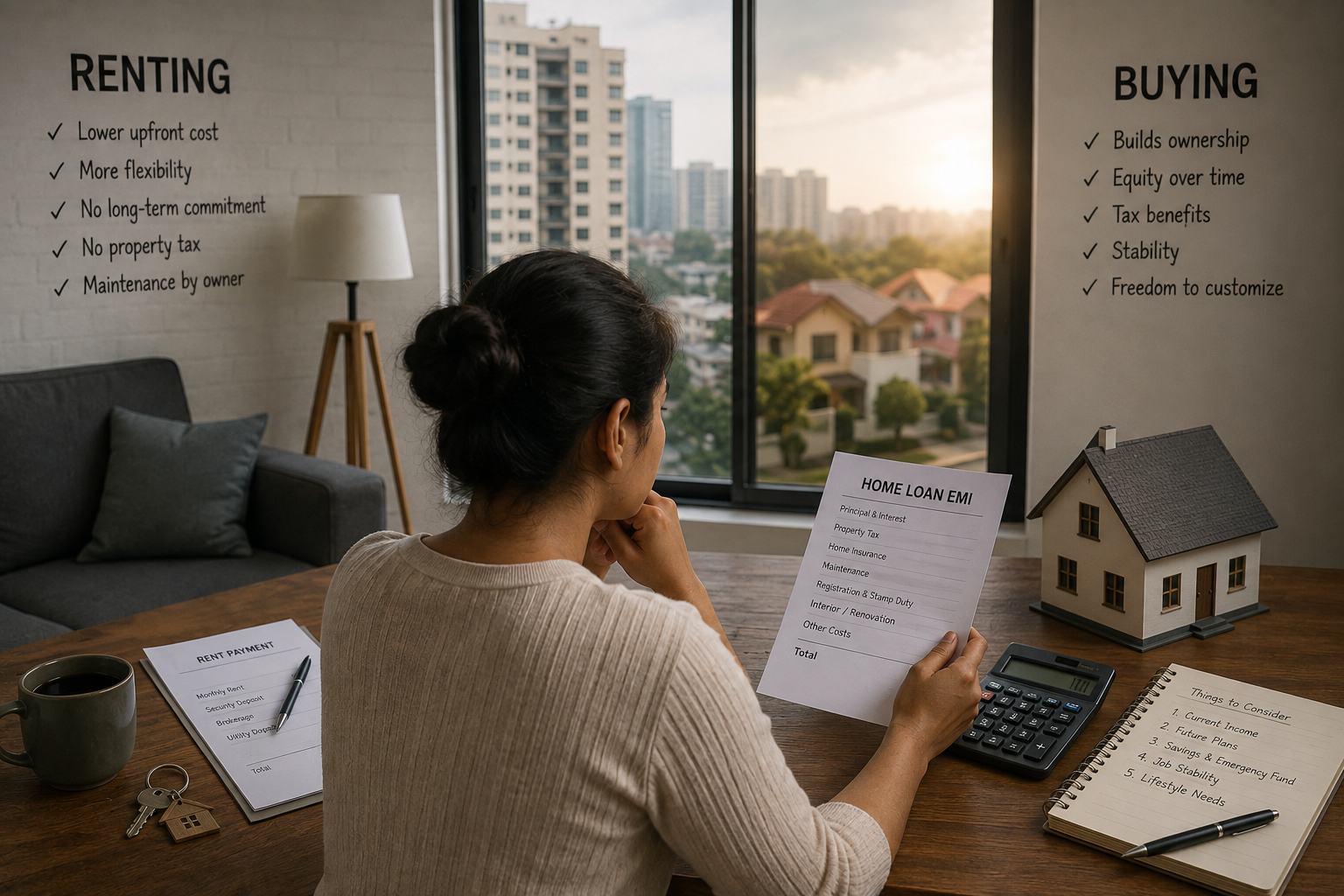
The most emotional financial decision
Few financial decisions are as emotional as the decision to rent or buy a home. Renting is often seen as temporary. Buying is seen as arrival. A home is not just an asset in India; it is security, family status, social respect and psychological comfort. This emotional power makes the decision difficult because the financial logic and social expectation often move in different directions.
The debate is usually oversimplified. Some people say renting is throwing money away. Others say buying is a trap because EMIs lock people into debt. Both statements are incomplete. Renting can be wise or wasteful depending on the situation. Buying can create stability or financial stress depending on price, loan, location and life stage.
The correct question is not whether renting or buying is universally better. The correct question is: which choice fits your income, goals, city, family needs, job mobility and long-term financial plan?
The real meaning of renting
Renting gives access without ownership. The tenant pays for the right to use a home but does not build equity in the property. This is why renting is criticised. But rent also buys flexibility. A tenant can move cities, change neighbourhoods, adjust house size, live closer to work and avoid large upfront costs.
Renting also avoids many ownership expenses. The tenant does not usually pay stamp duty, registration, major structural repairs, property tax or long-term maintenance capital expenditure. Some maintenance costs may still be passed through, but the biggest ownership burden remains with the landlord.
For people early in careers, uncertain about location, saving for future goals or living in very expensive cities, renting can preserve financial flexibility. It is not automatically a sign of weakness. It can be a strategic choice.
The real meaning of buying
Buying gives control and long-term stability. The homeowner does not face annual rent negotiations, landlord uncertainty or sudden eviction risk. The home can be customised, emotionally rooted and passed to the next generation. Over time, the loan gets repaid and the household owns an asset.
But buying also concentrates wealth. A large down payment, stamp duty, registration charges, brokerage, interiors, maintenance and EMI can consume financial capacity. The home may appreciate, but that appreciation is not guaranteed equally across locations and projects. A home is also illiquid. Selling can take time, negotiation and transaction cost.
Buying is most suitable when the household has stable income, long-term location certainty, adequate emergency fund, manageable EMI and strong reason to stay. Buying purely because society says "owning is better" can create decades of stress.
The EMI vs rent comparison is incomplete
Many people compare rent and EMI directly. If rent is Rs 35,000 and EMI is Rs 70,000, buying appears costly. If EMI is close to rent, buying appears attractive. But this comparison is incomplete.
Buying requires down payment. That money has opportunity cost. It could have been invested elsewhere. Buying also requires stamp duty, registration, furnishing, maintenance and insurance. Renting may require security deposit, shifting cost and annual rent escalation. The real comparison is not rent versus EMI. It is total cost of renting versus total cost of owning.
A proper comparison should include property price, loan amount, interest rate, tenure, down payment, expected rent, maintenance, taxes, appreciation assumption, investment return on the down payment, mobility needs and emotional value. Without these, the debate becomes slogan-driven.
Opportunity cost of buying
The biggest hidden cost of buying is opportunity cost. Suppose a buyer uses Rs 20 lakh as down payment. If that money was invested elsewhere, it could have grown over time. Buying a house locks the amount into an illiquid asset. The benefit may be stability and potential appreciation, but the cost is reduced flexibility.
This is not an argument against buying. It is an argument for honest comparison. A home can be a good asset if bought at the right price in the right location with a manageable loan. But if the buyer empties savings, stops investing for retirement and becomes EMI-stressed, the opportunity cost is high.
A home should not consume the entire financial life of a family. It should support life, not dominate it.
Mobility and career flexibility
Renting is often better for people whose career or family situation may change. A young professional may shift cities for better opportunities. A growing family may need a larger home. A business owner may need to stay flexible. A person unsure about long-term location should avoid buying too early.
Buying reduces mobility. If the job changes, the homeowner may need to rent out the property, manage tenants, sell under pressure or commute long distances. The emotional comfort of ownership can become practical rigidity.
This is why time horizon matters. If you are likely to stay in the same location for many years, buying becomes more reasonable. If your future city, job or family size is uncertain, renting can protect optionality.
Maintenance and responsibility
Homeowners pay for more than the loan. They pay property tax, society maintenance, repairs, renovations, insurance, appliances, plumbing, electrical work and long-term upkeep. Buildings age. Interiors wear out. Lifts, parking, water systems and common facilities require maintenance.
Tenants face fewer long-term maintenance responsibilities. However, they may face restrictions from landlords, rent increases and relocation inconvenience. Renting has uncertainty; owning has responsibility.
The financial difference is that ownership costs can be lumpy. A major repair or renovation can arrive suddenly. Home buyers should maintain a home maintenance fund, not assume that EMI is the only recurring expense.
Emotional security and social pressure
The emotional value of owning a home is real. A house can give psychological security, especially to families with children, elderly parents or unstable rental experiences. It can create belonging and reduce anxiety about displacement. This value cannot be fully captured in a spreadsheet.
But social pressure can distort the decision. Families may push young earners to buy before they are ready. People may buy oversized homes to signal success. Couples may take heavy loans because peers are buying. The emotional value of a home should be respected, but it should not be used to justify financial overextension.
A good home decision balances emotion with sustainability. Security purchased through excessive debt can become insecurity of another kind.
India angle: why the debate is so strong
In India, home ownership carries cultural weight. For many families, buying a home is seen as proof of settlement. Real estate is also viewed as safe because it is visible. Unlike stocks or mutual funds, a house can be seen, touched and socially recognised.
At the same time, property prices in many urban centres have risen faster than incomes. Rental yields in some cities are low, meaning the rent paid may be much lower than the EMI required to buy the same property. In such markets, renting and investing the difference may be financially rational. In other locations, where prices are reasonable and the family intends to stay, buying may be sensible.
This is why local data matters. The rent-versus-buy decision in Mumbai, Delhi NCR, Bengaluru, Lucknow, Indore or a smaller town can be very different. No universal rule can replace city-level analysis.
A practical decision framework
A household should ask five questions. First, will we stay in this city and locality for at least several years? Second, can we make the down payment without destroying emergency savings? Third, will EMI remain comfortable even if income is disrupted or interest rates rise? Fourth, is the property legally clear, well-located and reasonably priced? Fifth, what goals will be delayed by buying now?
If the answers are strong, buying may be reasonable. If the answers are weak, renting may be better. Renting is not failure if it protects financial flexibility. Buying is not success if it creates debt stress.
The best decision is the one that keeps both life and balance sheet stable.
Final takeaway
Renting versus buying is not a moral contest. It is a financial and life-stage decision. Renting gives flexibility, lower upfront cost and mobility. Buying gives stability, control and long-term ownership. Both can be wise. Both can be foolish.
The danger lies in slogans. "Rent is wasted money" ignores flexibility and opportunity cost. "Buying is always a trap" ignores emotional security and long-term stability. A serious decision must include numbers, goals and life plans.
A home should be a place of peace. Whether rented or owned, it should not become a financial burden that damages the rest of life. The right answer is not the one society applauds. It is the one your finances can sustain.