Regional Cuisines of India: Why Indian Food Is Not One Cuisine
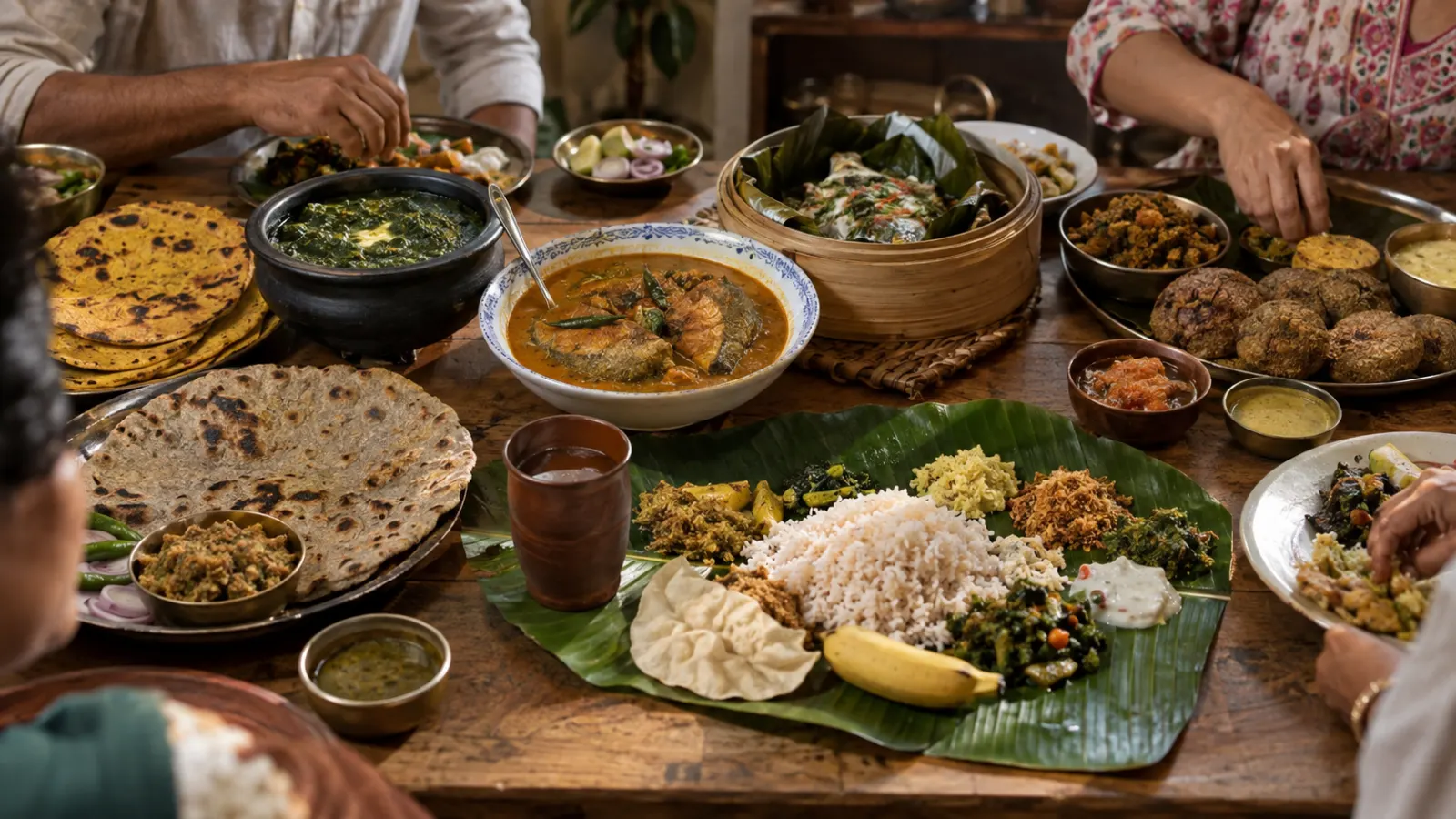
The regional cuisines of India are difficult to compress into a single idea of “Indian food.” A restaurant outside India may reasonably place butter chicken, dosa, biryani, samosa and vindaloo beneath one national heading, but those dishes emerged from very different ecological, religious, political and historical settings. India contains Himalayan valleys, river plains, deserts, tropical coasts, islands, forested hills and enormous cities, and communities within those landscapes developed different relationships with grains, meat, fish, dairy, fermentation, spices and seasonal food.
The Ministry of Tourism's Incredible India platform itself describes Indian food as exceptionally diverse and shaped by regional ingredients and culinary heritage. Official regional guides move from sorghum breads in North Karnataka to seafood and coconut on the Karnataka coast, mustard greens and maize in Punjab, fish traditions in Bengal, fermented foods in the Northeast and the contrasting vegetarian and meat traditions of Rajasthan. (incredibleindia.gov.in)
The more accurate picture is therefore not one national cuisine divided into minor regional variants. India is better understood as a network of overlapping food cultures. Geography provides ingredients, climate shapes techniques, religion and caste influence rules around eating, courts develop specialised cuisines, trade introduces new foods, migration moves dishes between regions and cities transform all of them again.
That does not make the phrase “Indian food” meaningless. It makes it an umbrella.
Geography Helps Explain Why India Eats So Differently
Cuisine begins partly with what can be grown, raised, gathered or caught.
Rice became central across many wetter and riverine regions, while wheat has long been important across much of northern and northwestern India. Millets have historically supported communities in drier and semi-arid environments because many millet crops require less water and tolerate difficult growing conditions. NITI Aayog and the Indian Council of Agricultural Research continue to emphasise the importance of millets in rain-fed and climate-stressed regions, reflecting an ecological relationship that predates their recent revival as fashionable “nutri-cereals.” (icar.gov.in)
This environmental logic becomes visible in regional staples. Jolada rotti, a sorghum flatbread, is strongly associated with North Karnataka, while coastal Karnataka developed rice-based foods such as neer dosa alongside seafood preparations. Incredible India's Karnataka guide explicitly divides dishes among coastal, northern and southern parts of the state, an important reminder that even a single state can contain several culinary systems. (incredibleindia.gov.in)
Punjab offers a different agricultural relationship. Wheat, dairy and seasonal crops are central to much Punjabi food culture, while sarson da saag with makki di roti connects a celebrated meal directly with winter mustard greens and maize. Government tourism material describes the combination specifically as a celebration of winter crops rather than simply another restaurant speciality. (incredibleindia.gov.in)
Rajasthan shows the opposite environmental pressure. Its arid landscapes encouraged durable ingredients and preparations suited to limited water, seasonal scarcity and storage. Gram flour, lentils, millet, dried desert produce, ghee and preserved foods appear repeatedly, although the state also contains royal and non-vegetarian traditions. Dishes such as dal baati churma, gatte ki sabzi, ker sangri, bajra-based foods and laal maas demonstrate that environmental constraint does not generate one diet; communities respond to the same landscape in different ways. (incredibleindia.gov.in)
Along India's coasts, water changes the menu again. Kerala's abundance of coconut and access to the Arabian Sea contribute to the importance of rice, coconut, fish, seafood and spices. Official Kerala material highlights coconut milk and oil, seafood and the elaborate vegetarian sadya, demonstrating immediately why describing Kerala cuisine as simply “fish curry” would be inadequate. (incredibleindia.gov.in)
Bengal's riverine and delta geography similarly made freshwater fish important to many Bengali food traditions. West Bengal's tourism material places fish alongside rice, vegetables and milk-based sweets, while Kolkata's culinary landscape adds layers created by migration and urban history. (incredibleindia.gov.in)
The first principle of Indian culinary diversity is therefore straightforward: landscape creates possibilities, but culture decides what communities do with them.
Climate Shapes Preservation, Fermentation and Culinary Technique
Ingredients tell only part of the story. Climate also shapes what people must do to make food usable, storable and safe.
Hot, humid environments encourage different preservation problems from dry deserts or cold mountain regions. Across India, communities developed fermentation, pickling, drying, smoking and souring techniques suited to local foods and conditions. Those techniques often become so culturally important that they remain desirable even after refrigeration reduces the original practical necessity.
The Northeast makes this especially visible. Simplified representations of Indian cuisine often concentrate on wheat breads, rich gravies, paneer, dosa or biryani, leaving many northeastern food traditions almost invisible. Yet the region contains a remarkable range of rice-based foods, fermented ingredients, bamboo shoots, smoked meats, local herbs, fish and forest produce.
Even “Northeastern cuisine” is far too broad. In Manipur, official tourism material identifies dishes such as eromba, incorporating vegetables and fermented fish, and singju, a vegetable preparation that can also use fermented fish. Nagaland's Ao food traditions include smoked pork, bamboo shoots, axone or fermented soybean, anishi and locally gathered ingredients. Assamese cuisine includes foods as distinct as masor tenga, khar and festival pitha. (incredibleindia.gov.in) (incredibleindia.gov.in) (incredibleindia.gov.in)
These cuisines challenge another stereotype: that “Indian flavour” is primarily created by using large quantities of ground spices in thick gravies. Fermentation, smoke, acidity, bitterness, fresh herbs and the flavour of local produce can be just as important.
Kerala provides another example of technique responding to local ecology. Coconut appears in many forms, while souring ingredients such as kudampuli are important in particular fish and seafood preparations. On the Malabar coast, biryani traditions coexist with pathiri, seafood and coconut-rich dishes, reflecting both regional ingredients and centuries of interaction across the Arabian Sea. (incredibleindia.gov.in)
A cuisine is therefore not merely a list of ingredients. It is a culinary grammar: what is roasted before grinding, what is fermented, when spices enter the pan, how grain is transformed into bread or batter, which souring agent is preferred and which combinations are regarded as proper.
Religion, Caste and Community Create Overlapping Food Worlds
Geography does not explain why people living in the same city can eat very differently.
Religion, caste, sect, household tradition and ideas about purity or ritual obligation have long shaped Indian food practices. Hindu, Muslim, Sikh, Jain, Buddhist, Christian, Jewish and other communities developed distinctive relationships with fasting, meat, alcohol, festival foods, ritual kitchens and rules governing who may prepare or share food.
These traditions are themselves internally diverse. A Muslim household in Kerala does not necessarily cook like one in Lucknow, Kashmir or Hyderabad. Christian food traditions in Goa, Kerala and the Northeast developed in very different regional environments. Hindu vegetarianism differs across caste, sect and geography, while many Hindu communities consume meat or fish.
National survey evidence illustrates how misleading universal claims can be. Pew Research Center found substantial variation in vegetarianism and meat restrictions by religion and region, including dramatic differences among Hindus in northern, southern, eastern and northeastern India. (pewresearch.org)
Caste adds another historically important layer. Food has been closely connected with ideas of purity, pollution, commensality and social hierarchy, including rules about whose food could be accepted and which foods marked particular social identities. Contemporary scholarship continues to document how food practices can reproduce caste boundaries and how supposedly neutral ideas of “proper” Indian food can privilege particular upper-caste culinary traditions. (academic.oup.com) (cambridge.org)
This is important because discussions of Indian cuisine often turn food into harmless cultural colour. Eating is also social power. Who cooks, who eats together, which foods are treated as respectable and whose food is described as impure or unpleasant can reveal caste, class, gender and religious boundaries.
Religion therefore does not sit above geography as a separate explanation. It intersects with it. A regional ingredient enters different religious kitchens and acquires different rules, techniques and meanings.
Courts, Empires and Trade Added New Culinary Layers
Indian cuisines were never isolated from the wider world.
For centuries, ports on the western and eastern coasts connected the subcontinent with Arabia, Persia, East Africa and Southeast Asia. Merchants moved spices, textiles, people, religious communities and culinary practices through these networks long before European colonialism.
Kerala's pepper trade became particularly important in global commercial history. Cambridge scholarship on early modern India describes the Portuguese arrival at Calicut at the end of the fifteenth century as an attempt to insert themselves into an already profitable pepper trade involving Indian, Arab, Iranian and Mediterranean commercial networks. (cambridge.org)
European expansion then brought another set of transformations. The Portuguese presence had particularly visible culinary consequences in Goa, where vinegar, pork preparations, breads and Indo-Portuguese dishes developed through centuries of adaptation. Vindaloo, for example, is now recognised as a Goan dish with Portuguese roots but was extensively transformed through local ingredients and tastes. (incredibleindia.gov.in)
The Columbian exchange also altered Indian food profoundly. Chilli peppers originated in the Americas yet became so thoroughly integrated into Indian cooking that imagining many regional cuisines without them is now difficult. Potatoes, tomatoes and other globally travelled crops were similarly absorbed into local food systems and eventually came to feel indigenous to the dishes using them. A socio-historical review of Indian cuisine describes this incorporation of new crops as one of the major transformations in the subcontinent's food history. (link.springer.com)
Courtly kitchens created another form of exchange. Sultanates, Mughal courts, Deccan states, Rajput courts and other royal centres employed specialised cooks, supported expensive ingredients and brought culinary influences together across enormous distances. Techniques associated with slow cooking, aromatic rice dishes, meat preparations, breads, sweets and elaborate presentation developed differently from one court to another and later moved into urban and restaurant cooking.
Hyderabad demonstrates this layered history particularly clearly. The city's food reflects Nizam-era court culture as well as Telugu, Marathwada, Persianate and other influences. Even the apparently simple category “Hyderabadi biryani” contains different techniques, including kachchi and pakki preparation. (incredibleindia.gov.in)
Courtly food should not be mistaken for the everyday diet of entire regions. Elite kitchens had access to labour, meat, spices, nuts, dried fruit and specialised techniques beyond the means of many ordinary households. Yet dishes can migrate socially. Foods once associated with palaces, aristocrats or ceremonial occasions can become restaurant standards and eventually symbols of an entire city.
A State Is Rarely a Single Cuisine
Modern political maps encourage people to speak about “Kerala cuisine,” “Karnataka cuisine” or “Rajasthani cuisine” as though every state contained one coherent food tradition.
Reality is messier.
Karnataka is one of the clearest examples. Coastal Karnataka contains seafood, rice, coconut and preparations such as neer dosa. North Karnataka is strongly associated with sorghum foods including jolada rotti. Southern Karnataka includes bisi bele bath, Mysuru's sweet traditions and other dishes shaped by different agricultural and courtly histories. Kodagu possesses another distinctive culinary identity. Udupi cuisine developed through particular temple and institutional traditions. (incredibleindia.gov.in)
Kerala is equally resistant to one-line description. The sadya represents an elaborate vegetarian feast associated particularly with festivals and celebrations. Malabar cooking includes distinctive biryani, pathiri and meat traditions. Coastal and backwater environments support numerous seafood preparations, while Syrian Christian and Mappila Muslim communities developed culinary histories shaped by religion and long-distance exchange. Coconut may connect many dishes, but it does not make them one cuisine. (incredibleindia.gov.in)
Punjab's global restaurant image also illustrates the problem. Butter chicken, dal makhani and tandoori dishes became extraordinarily successful representatives of “North Indian food,” but everyday Punjabi food also includes pulses, yoghurt, pickles, seasonal vegetables, breads and agricultural combinations such as sarson da saag with makki di roti. International familiarity with one commercial strand of Punjabi cooking should not be confused with the totality of Punjabi foodways. (incredibleindia.gov.in)
Rajasthan contains strong vegetarian traditions shaped partly by ecology and community, while Rajput and other meat-eating traditions produced dishes such as laal maas. Bengal includes multiple regional and religious food cultures divided today between India and Bangladesh, demonstrating that culinary geography does not necessarily follow political borders.
Even “the Northeast” is an administrative umbrella containing numerous peoples and food systems. Assam's sour fish dishes, Manipuri fermented fish preparations and Naga smoked pork with bamboo shoot belong to different culinary traditions rather than variations of one northeastern menu. (incredibleindia.gov.in)
The closer one looks, the less useful broad labels become.
Migration and Cities Constantly Create New Indian Food
Regional cuisine does not develop only when people remain in one place. Migration can be one of the most powerful forces transforming food.
Cities bring together people who would otherwise live hundreds or thousands of kilometres apart. Delhi contains Punjabi, Mughlai, Old Delhi Muslim, refugee, regional migrant, street-food and contemporary restaurant traditions. Mumbai combines Maharashtrian, Gujarati, Parsi, coastal, migrant-worker and global influences. Kolkata adds Bengali food to Chinese-Indian, colonial, migrant and cosmopolitan layers. Hyderabad combines Deccan courtly history with continual migration from surrounding regions.
Partition in 1947 transformed this process dramatically. Millions of people crossed the new borders, carrying tastes, cooking skills and commercial experience with them. Punjabi refugees became particularly influential in Delhi's post-Partition restaurant economy, helping reshape the city's food culture and popularising dishes that later travelled nationally and internationally.
This history helps explain why the modern geography of a dish may differ from its older geography.
A cuisine can become more visible after displacement.
A household recipe becomes restaurant food. Restaurant food is modified for commercial consistency. Customers from other communities adopt it. A dish once associated with one migrant group becomes part of the identity of the city in which that group settled.
Kolkata offers another example of urban culinary layering. Official tourism material places Bengali fish, sweets and biryani beside the city's long-established Chinese-Indian food culture, demonstrating how cities accumulate rather than simply replace cuisines. (incredibleindia.gov.in)
Street food accelerates this process because vendors adapt quickly to price, mobility and changing customer tastes. Urban dishes can therefore be relatively young while appearing deeply traditional within a few generations.
Tradition does not always require antiquity.
Spices Connect India, but They Do Not Make Indian Food Uniform
Spices are among the most internationally recognisable features of Indian food, yet even this apparent national commonality reveals regional diversity.
The Spices Board of India currently lists 52 spices under its statutory remit and maintains specialised development agencies in different growing regions. Its own geographical structure shows striking regional associations: cumin and fennel in western and northwestern areas, chilli and turmeric in southern production zones, pepper and cardamom in parts of the south, large cardamom and ginger in the Northeast and saffron in Kashmir. (indianspices.com) (indianspices.com)
Geographical-indication registrations reinforce this relationship between place and flavour. The Board lists products including Malabar Pepper, Coorg Green Cardamom, Byadgi Chilli, Guntur Sannam Chilli, Naga Mirchi, Sikkim Large Cardamom and Kashmir Saffron among India's GI-linked spices. (indianspices.com)
But knowing which spices grow where still does not explain cuisine.
Mustard seed can be tempered in oil in one tradition, ground into a paste in another or appear much less prominently elsewhere. Cumin may flavour a bread, lentil dish, meat preparation or spice blend depending on region and community. Chilli can be dried, fresh, smoked, ground, stuffed or combined with souring agents.
Indian regional difference lies not in possessing entirely separate spice cabinets but in how ingredients are combined, processed and sequenced.
Calling Indian cuisine “spicy” therefore communicates almost nothing about its actual structure.
Media and Restaurants Can Preserve Cuisine—and Flatten It
Cookbooks, television, packaged spice mixes, restaurant chains, food delivery apps and social media allow regional dishes to travel farther than ever before.
This circulation can preserve awareness. Someone in Delhi can encounter Naga food; a Bengaluru resident can order Bengali dishes; a regional sweet can become nationally recognised. Migrants can find ingredients that help them maintain culinary traditions far from home.
But national circulation also creates pressure for standardisation.
A packaged product called “sambar powder” implies that one stable flavour can represent an enormous family of regional preparations. “Biryani” becomes a single menu category despite major differences among Hyderabad, Lucknow, Kolkata, Malabar and other traditions. “South Indian food” is often reduced to a restaurant combination of dosa, idli, vada and sambar despite the extraordinary range of cuisines across Tamil Nadu, Kerala, Karnataka, Andhra Pradesh and Telangana.
The same process occurs internationally. Certain Punjabi-derived restaurant dishes became so successful abroad that they came to represent “Indian food” for customers who may never encounter Assamese, Konkani, Chettinad, Kashmiri, Goan, Kodava, Bengali or Manipuri cooking.
Commercial success creates visibility, but visibility is not the same as representativeness.
There is also a social dimension to which foods get documented. Scholarship on Indian cookbooks has shown how upper-caste and urban middle-class ideas of respectable food entered print more readily than many marginalised food traditions. What becomes “classic Indian cuisine” can therefore reflect the power to publish, market and define taste as much as demographic prevalence. (cambridge.org)
A national cuisine is partly produced by selection.
Indian Food Is Connected Without Being Uniform
Rejecting the idea of one homogeneous Indian cuisine does not require pretending India's food traditions have nothing in common.
Centuries of migration, pilgrimage, trade, empire, religious exchange, railways, cinema, restaurants and national media created extensive culinary circulation. Rice, wheat, pulses, yoghurt, ghee, spices, pickles, flatbreads and sweets appear in numerous regions, although their preparation and social meaning can differ dramatically.
People also routinely eat foods that originated outside their own linguistic or regional backgrounds. Dosa travels north. Punjabi restaurant food travels south and overseas. Momos have become urban street food far beyond the Himalayan regions with which they were historically associated. Biryani has multiple regional lives. Tea, coffee and packaged snacks circulate nationally.
India therefore has culinary connections without culinary uniformity.
A useful metaphor is not one cuisine divided into branches but a federation of food traditions. They exchange ingredients and techniques, overlap at borders and in cities, borrow from one another and continue developing distinct local identities.
That is why debates about whether a dish is “authentically Indian” can be historically misleading. Indian food has been shaped by movement for centuries. Persianate courts, Arab merchants, Portuguese colonisers, Central Asian migrants, indigenous agricultural communities and global crops all contributed elements that later became deeply local.
Authenticity does not have to mean isolation from outside influence.
Often it means that a community has made something its own.
Frequently Asked Questions
Why is Indian cuisine so diverse?
India's cuisine varies because climate, geography, crops, religion, caste, trade, migration, courtly history and local communities differ substantially across the country. Even individual states can contain several distinct culinary traditions.
What are the main regional cuisines of India?
There is no universally accepted short list because broad labels such as North Indian, South Indian, Bengali, Punjabi or Northeastern cuisine contain considerable internal diversity. More precise descriptions often refer to regions, communities or cities such as Malabar, Chettinad, Udupi, Awadhi, Goan, Naga, Assamese, Kashmiri or Hyderabadi traditions.
Is all Indian food spicy?
No. Indian cuisines use spices in very different ways, and “spicy” can mean aromatic as well as chilli-hot. Some regional dishes are intensely hot, while others rely on sourness, fermentation, smoke, sweetness, bitterness, dairy or relatively subtle seasoning.
Why do different parts of India eat different grains?
Agriculture responds to ecology. Rice is suited to many wetter regions, wheat became important across large northern areas and millets have long been valuable in many arid and semi-arid landscapes because of their ability to grow under lower-water conditions. (icar.gov.in)
How has religion influenced Indian food?
Religious and sectarian practices influence fasting, vegetarianism, meat restrictions, festival meals and food-sharing rules. But religious food traditions also vary by geography, caste and household, so there is no single Hindu, Muslim, Sikh or Christian Indian cuisine.
Did foreign trade change Indian food?
Yes. Indian food has long been connected with global trade. The subcontinent exchanged spices and other goods through Indian Ocean networks, while later Portuguese and other colonial connections introduced or accelerated the spread of ingredients that became deeply integrated into regional cuisines. (cambridge.org)
Why does Indian restaurant food abroad look less diverse?
Restaurant economies favour dishes that are commercially successful, familiar and easy to reproduce consistently. Punjabi and other North Indian restaurant traditions became especially influential internationally, which can make a small part of India's culinary diversity appear representative of the whole country.
The Better Question Is Not “What Is Indian Food?”
The phrase Indian food remains useful. Nations create shared cultural labels, and India's regions are connected through centuries of exchange.
The problem begins when the label is mistaken for a precise description.
To understand the regional cuisines of India, better questions are required.
Which region produced the dish? Which community cooks it? Which grain grows locally? Is it everyday food, festival food, street food or former court cuisine? Which religion or caste traditions shaped it? Did migration move it somewhere new? Has the restaurant version changed what people now consider authentic?
Those questions reveal that cuisine is a historical record.
Rajasthan's dried desert ingredients preserve an environmental story. Punjab's winter saag reflects agriculture. Kerala's coconut and spice traditions reveal tropical ecology and maritime exchange. Goan vindaloo carries evidence of Portuguese colonial contact and local adaptation. Northeastern fermented foods challenge national assumptions about what Indian flavour is supposed to taste like. Hyderabad's food preserves traces of Deccan court culture, while Delhi's restaurants carry memories of migration and Partition.
The diversity does not weaken Indian culinary identity.
It is the identity.
Indian cuisine is powerful precisely because it has never been only one cuisine.