
Guru Dutt: Films, Songs, Style and the Craft Behind the Legend
Guru Dutt is often remembered through melancholy: the rejected poet of Pyaasa, the fading filmmaker of Kaagaz Ke Phool, a face isolated by shadow, or a beam of studio light cutting through darkness. That image is grounded in his work, but it is incomplete. Dutt was also an exceptionally practical maker of popular Hindi cinema who understood comedy, romance, suspense, music, star chemistry and commercial rhythm. Aar-Paar and Mr & Mrs '55 are witty and energetic; C.I.D., which he produced, works as a brisk crime thriller; and Chaudhvin Ka Chand, another production rather than a directorial credit, helped restore his company's commercial position after the failure of Kaagaz Ke Phool.
The better way to understand Guru Dutt is therefore through cinematic form rather than through the tragedy of his biography. His films demonstrated that songs could carry arguments, lighting could organise social relationships, comedy could sharpen rather than weaken sorrow, and the conventions of mainstream Hindi cinema could accommodate unusually concentrated emotional and social criticism. Recent retrospectives from the British Film Institute and Criterion have similarly stressed the breadth of his work beyond the familiar image of the doomed auteur.
From dance and choreography to a new kind of popular cinema
Born in 1925 as Vasanth Kumar Shivashankar Padukone, Guru Dutt entered cinema through movement rather than conventional film-school training. He studied at Uday Shankar's dance centre in Almora before joining Pune's Prabhat Film Company, where he worked in choreography and assisting roles and learned the mechanics of studio filmmaking. He also met Dev Anand during this period. Anand later brought him into Navketan to direct Baazi in 1951, Dutt's first feature as director.
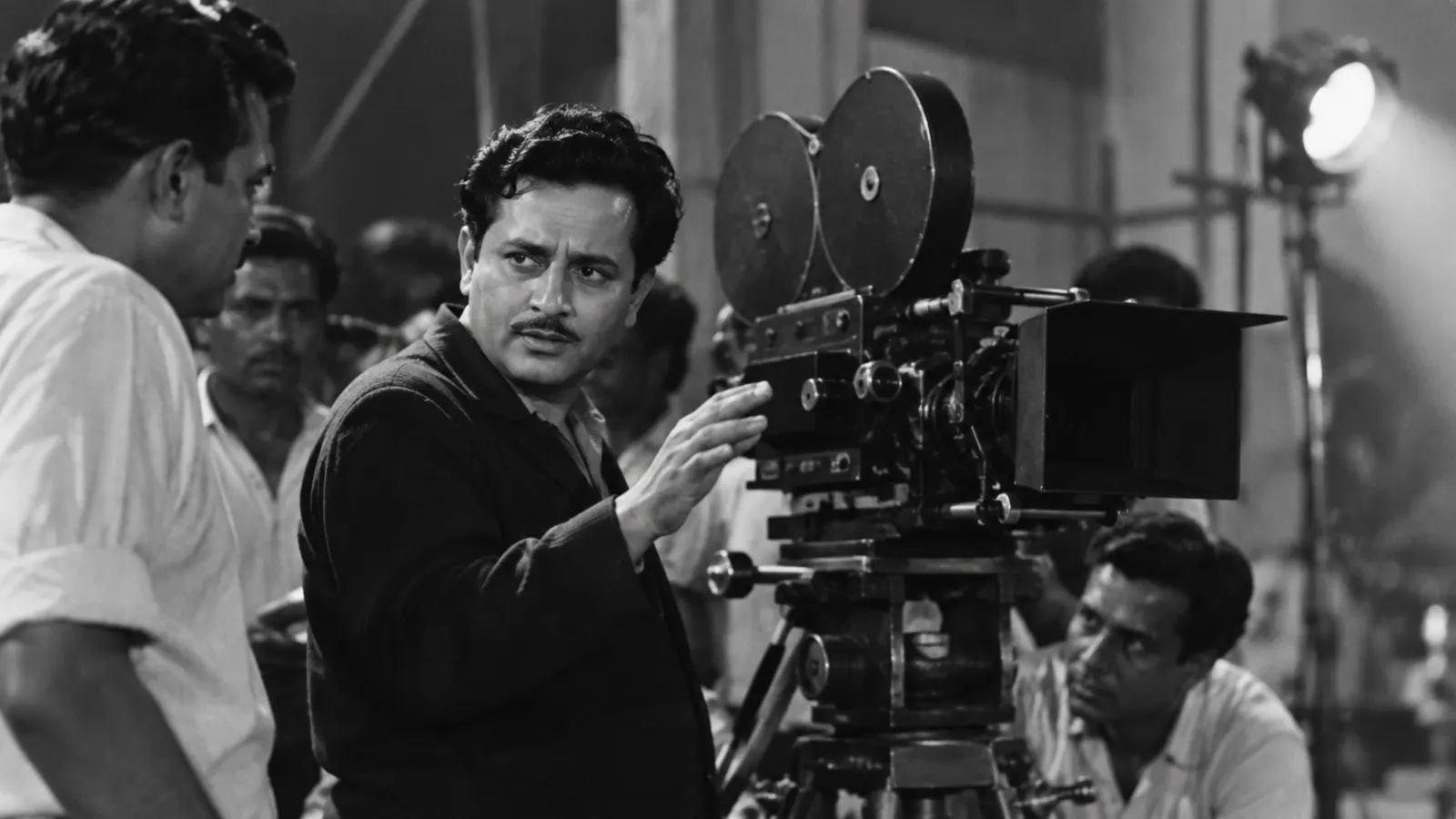
That dance background remained visible even when nobody on screen was literally dancing. Dutt's staging depends repeatedly on movement through space: how someone enters a room, the distance between two bodies, the direction of a glance, the position of a crowd around an isolated protagonist, and the movement of the camera through sets. Criterion's retrospective has specifically connected his choreographic background with the emotional force of his musical sequences.
Baazi introduced a director already comfortable borrowing from film noir while adapting it to Bombay popular cinema. Shadows, nightclubs, moral ambiguity and crime existed alongside songs and star performance rather than in opposition to them. BFI describes the film as an important starting point for Dutt's noir aesthetic, while his subsequent films show him testing how far genre conventions could be stretched.
The films that followed—Jaal, Baaz, Aar-Paar and Mr & Mrs '55—should not be treated merely as preliminary exercises before the supposedly serious work of Pyaasa. They reveal a filmmaker learning to alternate comedy and melancholy, move between streets and controlled studio interiors, and build stories in which songs were structural rather than decorative.
Guru Dutt was an auteur, but never a solitary one
Guru Dutt's films are recognisable enough to justify the language of authorship, but the familiar idea of the lone cinematic genius can obscure how his work was actually made. His production company developed a recurring group of collaborators whose contributions were fundamental to what audiences now identify as the "Guru Dutt style."
Cinematographer V. K. Murthy was indispensable to the architecture of light and shadow. Abrar Alvi contributed screenplays, dialogue and direction. S. D. Burman and O. P. Nayyar created very different musical worlds, while lyricists such as Sahir Ludhianvi supplied songs with unusual dramatic and political density. Geeta Dutt and Mohammed Rafi gave those words voices that became inseparable from the characters on screen. Johnny Walker, Waheeda Rehman, Rehman, Madhubala, Meena Kumari and other performers repeatedly expanded the tonal range of the films.
This matters particularly when discussing cinematography. The celebrated shafts of light, silhouettes, deep shadows and frames-within-frames associated with Dutt were not spontaneous manifestations of a melancholy personality. They were engineered effects involving lenses, exposure, smoke, set construction, blocking and camera movement. Criterion's overview explicitly pairs Dutt's visual direction with Murthy's virtuoso cinematography, while BFI likewise treats their collaboration as central to the films' distinctive look.
The same caution applies to Sahib Bibi Aur Ghulam in 1962. Guru Dutt produced the film and starred in it, but Abrar Alvi is its credited director. Later debate about how much Dutt may have shaped particular sequences should not erase that credit. The more interesting conclusion is that the creative culture of Guru Dutt Films had become coherent enough for visual and thematic continuities to remain visible even when another collaborator occupied the director's chair.
Authorship here is best understood as orchestration. Dutt's achievement included selecting collaborators, creating conditions in which their work reinforced one another and combining cinematography, music, acting, writing and production design into an unusually unified emotional system.
Why Pyaasa became the essential Guru Dutt film
Released in 1957, Pyaasa brought the elements of Dutt's cinema together with extraordinary concentration. Vijay, played by Dutt, is an unemployed poet whose work is rejected by publishers, dismissed by his family and valued most sincerely by Gulabo, a sex worker played by Waheeda Rehman. The immediate story concerns an unsuccessful artist, but the film's target is broader: a society capable of ignoring a person when he has no market value and celebrating the same person once his image becomes profitable.
BFI describes the film as a post-independence melodrama centred on an unemployed poet seeking publication, while its 2022 Sight and Sound critics' poll placed Pyaasa among the ranked films in its international survey of cinema history.
The songs are crucial to why the film works. Sahir Ludhianvi's lyrics address desire, poverty, hypocrisy, respectability and social indifference rather than merely providing romantic interludes. S. D. Burman's compositions and Mohammed Rafi's playback voice enlarge Vijay beyond the boundaries of Dutt's physical performance. Hindi playback cinema divides the character across several artists—the actor's face and body, the singer's voice, the lyricist's language and the composer's musical structure—yet the result feels like a single dramatic consciousness.
The climactic rejection of public acclaim works because the film has spent its running time demonstrating how institutions classify people. Vijay has seen publishers determine which writing has value, families decide which relatives deserve respect, and polite society decide which women count as respectable. Recognition arrives only after the world believes that the poet is dead and his work can be commodified.
That is why Pyaasa does not deliver the reassuring artist narrative in which neglected genius is eventually recognised and justice is restored. By the time Vijay receives acclaim, acclaim itself has become morally suspect. The triumph has been contaminated by the machinery that produced it.
Kaagaz Ke Phool: masterpiece, failure and dangerous autobiography
Two years later, Dutt directed Kaagaz Ke Phool, a film about a successful filmmaker, Suresh Sinha, whose professional authority, family relationships and private life deteriorate. It became the last film for which Guru Dutt took an official directing credit.
The film was also a technical landmark. BFI and Criterion both identify it as the first Indian film shot in CinemaScope. The significance of the widescreen format is not merely historical. Dutt and Murthy use the enlarged frame to transform the film studio into something monumental: giant sound stages, elevated walkways, pools of darkness and shafts of light make human beings appear vulnerable inside the machinery that manufactures their images.
The film was poorly received commercially at the time. Criterion records reports of hostile audience reactions and notes that the failure effectively ended Dutt's directing career, although he continued producing and acting. Chaudhvin Ka Chand in 1960 was subsequently commercially successful and helped his company recover financially.
What happened later is almost as significant as the original failure. Kaagaz Ke Phool underwent a major critical reappraisal and became internationally recognised as one of Dutt's defining works. The failure-to-classic trajectory encouraged viewers to read it retrospectively as prophecy: a filmmaker creates a film about a filmmaker destroyed by an industry, suffers a major professional setback himself and dies only a few years later.
The parallels are difficult to ignore, but they can become a trap. Kaagaz Ke Phool should not be treated as a coded diary in which Suresh Sinha simply equals Guru Dutt and every relationship corresponds neatly to someone in his private life. The film also examines celebrity, labour, reputation, family status, spectatorship and the instability of a business that can manufacture prestige and then withdraw it.
Reading the movie only as autobiography reduces both the artwork and the historical world it describes.
Comedy, women and the films that disrupt the tragic myth
The conventional Guru Dutt narrative often moves directly from Pyaasa to Kaagaz Ke Phool because those films fit the image of the melancholic auteur. But Aar-Paar and Mr & Mrs '55 reveal a filmmaker with a considerably wider tonal range.
Mr & Mrs '55, starring Madhubala and Dutt, uses romantic comedy to negotiate changing ideas about marriage, women's independence, law and urban modernity. Some of its treatment of feminism now appears dated and contradictory, but the contradiction itself is historically useful. The film comes from a society debating women's employment, companionate marriage, divorce and changing family authority while still carrying deeply patriarchal assumptions. BFI describes it as one of Dutt's most commercial films, combining romantic comedy with commentary on modernity and gender expectations.
Aar-Paar is equally important. Its city feels mobile and contemporary, supported by O. P. Nayyar's rhythmic music, street-level settings and rapid dialogue. The movie demonstrates that Dutt could create buoyancy, flirtation and comic timing with the same formal control later associated with despair.
Johnny Walker's recurring presence across this cinema also deserves more attention than the label "comic relief" suggests. His characters often inhabit a parallel social universe in which survival depends on wit, improvisation and an ability to negotiate everyday life. Comedy can briefly release the pressure generated by Dutt's central characters, but it can also make their inability to adapt appear more painful.
The women in Guru Dutt's films similarly deserve to be discussed as performers and characters rather than primarily as extensions of his biography. Geeta Dutt was a major playback singer whose voice became part of Hindi cinema's musical vocabulary. Waheeda Rehman's performances helped create some of Dutt's most memorable screen relationships. Madhubala's comic timing drives much of Mr & Mrs '55, while Meena Kumari's Chhoti Bahu dominates the emotional centre of Sahib Bibi Aur Ghulam.
Gulabo in Pyaasa is particularly important because she understands the economics of humiliation more clearly than Vijay initially does. Her social position exposes the hypocrisy of the respectable world around her. In Sahib Bibi Aur Ghulam, Chhoti Bahu's alcoholism is inseparable from marital abandonment and the decay of a feudal domestic order.
The personal lives of Guru Dutt, Geeta Dutt and Waheeda Rehman have been repeatedly used to explain these films. Biography can provide context where reliable evidence exists, but gossip becomes reductive when it is made the master key to the work. It diminishes the agency of the women involved and converts collaborative filmmaking into a story about one man's private suffering.
Songs, light and the architecture of feeling
The most distinctive feature of Guru Dutt's cinema may be the way separate elements of popular filmmaking become inseparable from narrative thought.
Songs are the clearest example. In many commercial films, a song can be removed and enjoyed independently without changing the underlying story very much. Dutt's strongest musical sequences often perform narrative functions dialogue cannot. They change point of view, suspend ordinary time, transform private emotion into public accusation or allow a character to articulate what social convention makes difficult to say directly.
This helps explain why songs from his films remain powerful even after musical fashions have changed. Audiences remember not only the melody but the image attached to it: a face inside a crowd, bodies positioned at different depths of a set, a camera moving toward an isolated character, or light gradually revealing someone whose emotional position has changed.
The contrast between O. P. Nayyar's rhythmic modernity in Aar-Paar and S. D. Burman's more lyrical world in Pyaasa also demonstrates Dutt's flexibility. He did not impose one musical mood on every film. He built different cinematic systems with different collaborators.
Lighting performs a similar function. Murthy's black-and-white cinematography uses illumination to organise relationships. A person can be physically surrounded by others yet appear isolated because light separates the face from the room. Doorways, windows, columns and shadows divide characters who technically occupy the same space. Deep darkness can make luxury feel imprisoning, while an exposed face can turn emotional vulnerability into something architectural.
Kaagaz Ke Phool provides the most famous examples, but the underlying visual grammar appears throughout the work. The celebrated beam of light matters not because it is beautiful in isolation but because human relationships are staged inside it.
This is why describing Dutt simply as someone who photographed sadness is insufficient. Sadness is a subject; cinema requires a form. His films and collaborators found technical ways to convert emotion into space, sound, movement and rhythm.
The city, the market and institutions that manufacture loneliness
Guru Dutt's protagonists are frequently described as lonely men, but their loneliness rarely exists in a vacuum. It is produced by institutions.
In Pyaasa, publishers decide whether poetry deserves circulation. Families determine which members merit affection or respect. Markets discover Vijay only when his apparent death makes his writing valuable. In Kaagaz Ke Phool, the studio creates a director's celebrity and later proves equally capable of making him irrelevant.
Seen this way, Dutt's cinema is not merely about unusually sensitive individuals who cannot cope with the world. It is about systems that assign value to people.
The city becomes part of that machinery. Offices, studios, clubs, streets, publishing houses, mansions and rented rooms organise people according to profession, gender, class, reputation and economic usefulness. Even his comedies understand modern urban life through jobs, money, housing, marriage and mobility.
This institutional reading makes the films larger than autobiography. Dutt may have drawn upon private emotions, as artists routinely do, but the films remain durable because they transform those emotions into structures audiences recognise. The problem is not simply that one artist is hurt. It is that social institutions can convert talent, intimacy and dignity into commodities.
Death and the creation of the doomed auteur
Guru Dutt died in Bombay on 10 October 1964 at the age of thirty-nine after consuming alcohol and sleeping medication. Accounts have differed over whether his death was intentional or accidental. Criterion describes it as a suspected suicide while explicitly noting that the precise cause remains disputed.
That uncertainty matters. A responsible account should not convert incomplete evidence into psychological certainty.
What is easier to establish is what his death did to the reception of his films. Once Dutt had died young, works such as Pyaasa and Kaagaz Ke Phool could be reorganised retrospectively into a single tragic biography. Images of isolation looked prophetic. Fictional artistic failure appeared autobiographical. Melancholic performances became evidence about the performer.
Criterion has explicitly argued that Dutt's early death cast a melancholic shadow over his legacy while also warning that reducing him to an artist of misery does not capture the range of his work.
The danger is not merely historical inaccuracy. The doomed-genius story can romanticise suffering, as though psychological pain itself produced artistic greatness. Dutt's films offer a better explanation for their own quality: craft. Their emotional force was built through writing, rehearsal, cinematography, music, set design, editing, acting and the organisation of collaborators.
Tragedy may have shaped the mythology. It did not operate the camera.
From Hindi popular cinema to the world canon
Guru Dutt's international reputation expanded substantially after his death through retrospectives, film criticism, restorations, television, home video and later streaming. The BFI continues to programme and write about his work, while Criterion has presented a dedicated World of Guru Dutt programme containing films including Baaz, Aar-Paar, Mr & Mrs '55, Pyaasa, Kaagaz Ke Phool, Chaudhvin Ka Chand and Sahib Bibi Aur Ghulam.
This international canonisation has helped place his cinema within broader histories of film modernism, melodrama, noir and auteur cinema. Yet comparisons with Orson Welles, Hollywood noir or European art cinema can become limiting if they imply that Guru Dutt requires a Western equivalent in order to be understood.
His films emerged from a specific Hindi-Urdu popular cinematic system: playback singing, lyric poetry, stars, studio production, melodrama, multilingual creative teams and audiences accustomed to songs carrying narrative and emotional meaning. Those conventions are not obstacles that his artistry transcended. They are the materials from which it was built.
Guru Dutt can therefore belong to world cinema without being extracted from Bombay cinema.
What remains after the legend
Guru Dutt left behind a relatively small filmography, but the films remain unusually open to rediscovery. One viewer may begin with the despair of Pyaasa. Another may notice the gender politics of Mr & Mrs '55. A cinematographer may study V. K. Murthy's handling of light, while a musician may enter through S. D. Burman, O. P. Nayyar, Geeta Dutt or Mohammed Rafi. Someone else may discover the decaying feudal household of Sahib Bibi Aur Ghulam and encounter Dutt primarily as producer and actor rather than director.
That multiplicity is itself part of the legacy.
His cinema challenged several false oppositions. Popular entertainment did not have to be visually careless. A song did not have to stop the story. Melodrama did not require simple morality. Commercial production did not prevent social criticism. Personal themes did not mean that a film was created by one person.
Most importantly, darkness was never his only register. The same filmmaker associated with doomed poets and abandoned studios understood flirtation, rhythm, comedy, suspense and the pleasures of a popular song.
The famous beam of light in Kaagaz Ke Phool remains one of the enduring images of Indian cinema, but its importance is not the light alone. People enter it, move through it, look toward one another and fail to reach one another inside the space that Dutt and Murthy constructed.
Guru Dutt's achievement was not simply that he photographed melancholy. He made feeling architectural.


