Role of Predators in Ecosystems: How Predation Shapes Food Webs, Trophic Cascades and Biodiversity
A predator catching prey is one of the most visible events in nature, but ecology is interested in much more than the kill itself.
Predators can influence prey abundance, animal behaviour, competition between carnivores, scavenger communities, vegetation and the movement of energy through food webs. In some ecosystems, their effects remain relatively close to the predator-prey interaction. In others, changes near the top of the food web can spread through several trophic levels and reshape parts of the ecosystem.
This is why the role of predators in ecosystems cannot be reduced to the statement that predators “control prey.”
Predation is better understood as a network of direct and indirect effects whose strength depends on habitat, productivity, alternative prey, climate, competing predators and human activity.
What Is the Role of Predators in an Ecosystem?
Predators are organisms that capture and consume other organisms.
Their most direct ecological effect is mortality: prey animals are removed from populations. But predators can also change where prey move, when they feed, how they group together and how much time they spend avoiding danger.
They may suppress smaller predators, create carcasses used by scavengers and sometimes trigger trophic cascades that influence plants or other organisms several steps away in the food web.
A useful summary is:
| Predator effect | Possible ecosystem consequence |
|---|---|
| Predation | Changes prey survival and population growth |
| Selective hunting | Alters prey age, condition or behaviour |
| Perceived risk | Changes where and when prey feed |
| Competition among predators | Reshapes carnivore communities |
| Trophic cascades | Indirectly affects vegetation or lower trophic levels |
| Carrion production | Provides food for scavengers and decomposers |
| Changes in host abundance | Can sometimes influence disease dynamics |
Not every predator produces all of these effects.
The ecological importance of a predator has to be demonstrated within a particular system.
Predators Can Regulate Prey Populations
The simplest predator-prey relationship involves mortality.
A predator kills prey, reducing the number of individuals that remain alive.
In some ecosystems, this mortality can meaningfully reduce prey abundance or slow population growth.
But predator numbers do not determine prey numbers by themselves.
Prey populations are also affected by:
- food availability,
- reproduction,
- disease,
- competition,
- weather,
- drought,
- habitat quality,
- migration,
- human hunting.
A predator may strongly influence one prey population while having only a modest effect on another.
The scientifically useful question is therefore not:
Do predators kill prey?
They clearly do.
The more important question is:
Does predator-caused mortality substantially change prey population dynamics at the scale being studied?
That distinction prevents ecological explanations from becoming overly simplistic.
Predators Do Not Usually Remove Prey at Random
Predation is often selective.
Large carnivores may disproportionately capture animals that are young, old, injured, isolated or in poor physical condition because those individuals can be easier to catch.
Other predators specialise in particular prey sizes, behaviours or habitats.
Selection can influence more than population size.
It can affect:
- age structure,
- prey behaviour,
- habitat use,
- reproductive success,
- and over longer periods, evolutionary adaptations.
This also means that a simple subtraction model can be misleading.
The death of one prey animal to a predator does not necessarily mean the population is exactly one individual smaller than it otherwise would have been indefinitely.
Some prey would have died later from starvation, disease, competition or other causes.
Ecologists therefore distinguish between predation that adds mortality and predation that may partly replace mortality that would have occurred anyway.
Fear Can Change Ecosystems Even Without a Kill
Predators influence prey not only through consumption but through risk.
An animal that senses danger may:
- avoid exposed habitat,
- feed at different times,
- move in larger groups,
- spend more time scanning for threats,
- leave food-rich but dangerous locations.
These are often called non-consumptive effects of predators.
The predator changes prey behaviour without actually consuming the animal.
Such behavioural changes can alter where grazing or browsing occurs.
If herbivores avoid particular areas, vegetation there may experience less feeding pressure.
This idea is sometimes described as a landscape of fear.
However, the phrase should be used carefully.
Prey do not respond to risk in a uniform way. Their decisions depend on hunger, season, habitat cover, predator activity and the availability of safe alternatives.
Fear is one ecological influence among several.
What Is a Trophic Cascade?
A trophic cascade occurs when ecological effects at one trophic level spread indirectly to other levels of a food web.
Consider a simplified system:
Predator → herbivore → vegetation
If predators reduce herbivore abundance or cause herbivores to avoid certain areas, plants may experience less grazing.
That produces a possible chain:
More predators → fewer or more cautious herbivores → reduced grazing → more vegetation
When predators disappear, the pattern can sometimes reverse:
Fewer predators → more herbivores → greater grazing → vegetation decline
Trophic cascades are important because they demonstrate that a predator can affect organisms it never directly eats.
But not every predator produces a strong trophic cascade.
Food webs contain many overlapping interactions, and the strength of top-down effects depends heavily on ecological context.
Yellowstone Wolves: A Famous Example That Is More Complicated Than the Popular Story
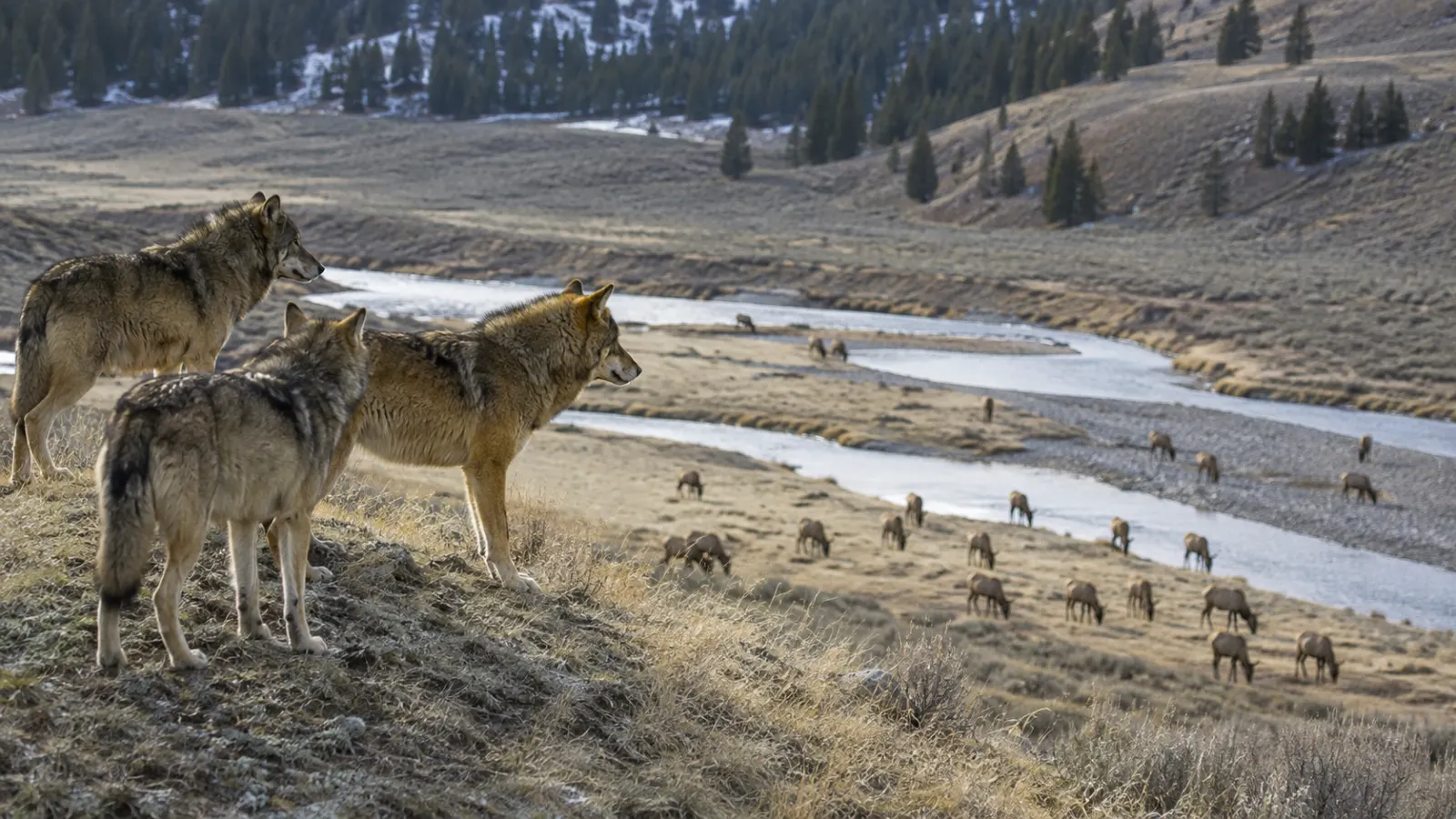
The reintroduction of wolves to Yellowstone National Park is one of the world's best-known examples of predator restoration.
The simplified story often says:
wolves returned → elk changed → vegetation recovered → the ecosystem was restored.
The actual ecological story is more complicated.
Wolves contributed to changes in elk abundance and behaviour, but vegetation dynamics in Yellowstone are also affected by:
- groundwater,
- climate,
- beavers,
- other predators,
- browsing pressure,
- habitat conditions,
- management outside the park.
Willow and aspen responses have not been uniform everywhere.
Yellowstone is therefore valuable partly because it demonstrates how difficult ecological causation can be.
Predators can matter substantially without being the only explanation for every environmental change observed after their return.
Good ecology asks how multiple forces interact rather than searching for one dramatic cause.
Predators Can Affect Other Predators
Carnivores do not interact only with prey.
Larger predators can kill, displace or intimidate smaller predators.
They may compete for food or force other carnivores into different habitats.
When a large predator disappears, smaller predators can sometimes increase.
This phenomenon is known as mesopredator release.
A simplified pathway might be:
Top predator declines → medium-sized predator increases → greater pressure on smaller prey
Those smaller prey could include rodents, reptiles, birds or other animals.
The outcome depends on the ecosystem, but the broader lesson is important:
predator communities are structured horizontally as well as vertically.
Food webs contain competition among carnivores, not just feeding relationships between predator and prey.
Predator Kills Become Food for Scavengers
The ecological effect of predation does not end when the predator finishes feeding.
Carcasses can become important resources for:
- vultures,
- ravens,
- eagles,
- foxes,
- insects,
- beetles,
- flies,
- microbes,
- other scavengers and decomposers.
Predators therefore redistribute energy across the landscape.
A large carcass can provide a concentrated pulse of nutrients and food, particularly during seasons when other resources are scarce.
The location of kills can also matter.
Predation near rivers, forests or open landscapes may deliver food to different scavenger communities.
In this way, predator-prey interactions connect carnivores to organisms that may never interact with live prey directly.
Can Predators Reduce Disease?
Sometimes—but this claim requires caution.
Predators may preferentially capture weak or visibly sick individuals in some systems.
They may also reduce host population density or change host behaviour, potentially affecting disease transmission.
However:
“Predators prevent disease” is not a universal ecological rule.
Predators do not always target infected animals.
Changes in movement or grouping can sometimes increase rather than decrease disease contact.
Different pathogens have different transmission pathways.
The more defensible conclusion is:
Predators can influence disease ecology through changes in host abundance, prey selection and behaviour, but the direction and magnitude of that effect must be demonstrated for each system.
This is another reason ecological claims should not be generalised from one example to all ecosystems.
Top-Down vs Bottom-Up Control
Predator effects are often called top-down control because ecological influence moves from consumers toward lower trophic levels.
But ecosystems are also shaped from the bottom up.
Bottom-up control begins with resources.
Plant growth depends on factors such as:
- water,
- sunlight,
- nutrients,
- temperature,
- soil conditions.
Greater plant productivity may support more herbivores.
More herbivores may then support more predators.
The two processes can operate simultaneously.
| Top-down control | Bottom-up control |
|---|---|
| Begins with predators or consumers | Begins with resources and primary production |
| Can influence prey and vegetation | Influences how much energy enters the food web |
| Often associated with trophic cascades | Often associated with nutrients, climate and productivity |
| Strength varies by ecosystem | Strength also varies through time and space |
During severe drought, reduced plant production may dominate ecosystem dynamics regardless of predator abundance.
At another time, predator recovery may strongly influence herbivore behaviour.
Ecological control can therefore shift through time.
Predators Are Not Automatically Keystone Species
Predators are frequently described as keystone species, but the two concepts are not interchangeable.
A keystone species has an ecological influence that is disproportionately large relative to its abundance.
Some predators meet that definition.
Many do not.
If several predators perform similar functions, losing one species may be partly compensated by another.
In other ecosystems, one predator may strongly regulate an herbivore or competitor and have a much larger community effect.
The distinction is:
Predator describes a feeding relationship.
Keystone species describes the magnitude of ecological influence relative to abundance.
Whether a predator qualifies as a keystone must therefore be tested rather than assumed.
Predator Effects Can Change Across Space
Predators are rarely distributed evenly across a landscape.
Terrain, roads, human settlements, prey migration, water availability and territorial behaviour can create areas of high and low predator activity.
That spatial pattern can influence ecological effects.
Suppose wolves frequently use one river valley but rarely visit a nearby plateau.
Herbivores may use those areas differently.
Vegetation could therefore experience different browsing pressure even though both places belong to the same larger ecosystem.
Modern tracking technologies such as GPS collars allow ecologists to study these patterns much more precisely.
Instead of simply asking whether predators occur within a national park, researchers can investigate:
Where are predators spending their time, and where are ecological effects actually occurring?
Predator Effects Also Change Through Time
Predator-prey systems naturally fluctuate.
A study lasting only a few years can accidentally capture:
- an unusually wet period,
- a severe winter,
- a drought,
- a prey-population peak,
- or the early phase of a predator recovery.
That can create misleading conclusions.
Long-term monitoring helps researchers distinguish persistent relationships from temporary coincidence.
Yellowstone's wolf research is useful partly because wolf and elk populations, predation rates and ecosystem conditions have been monitored across many years.
Long datasets allow researchers to determine whether an apparent trophic effect remains strong over time or changes as the ecosystem adjusts.
Predator Removal Can Produce Unexpected Results
Removing predators may initially appear beneficial when humans value the same prey.
For example, fewer predators might temporarily mean more deer or other game animals.
But ecological responses can become more complicated later.
Higher prey abundance can contribute to:
- overbrowsing,
- habitat degradation,
- competition,
- disease transmission,
- food shortages.
Likewise, restoring a predator does not automatically return an ecosystem to its historical state.
The habitat may have changed.
Climate conditions may be different.
Other species may have disappeared.
Human development may prevent former migration patterns.
This is why predator management increasingly relies on monitoring and adaptive management rather than assumptions about restoring a fixed “balance of nature.”
Ecosystems are dynamic networks, not machines with one permanently correct setting.
Why Predator Conservation Can Create Human-Wildlife Conflict
Ecological benefits do not eliminate social costs.
Large predators can kill livestock.
They may prey on animals valued by hunters.
They can threaten pets.
In rare circumstances, some species can pose safety risks to people.
Communities living alongside recovering carnivore populations may therefore bear costs that distant conservation supporters do not.
This makes predator conservation a governance problem as well as an ecological one.
Possible conflict-reduction strategies include:
- livestock guarding,
- stronger enclosures,
- changes in grazing practices,
- early-warning systems,
- compensation or insurance,
- zoning,
- targeted responses to repeatedly problematic animals.
The goal cannot realistically be to eliminate all conflict.
The more achievable objective is to reduce risk and distribute conservation costs more fairly.
Predator recovery is more durable when communities have credible reasons to tolerate the animals living around them.
Why Predator Conservation Matters for Biodiversity
Predator conservation is sometimes justified solely by the survival of charismatic species.
The ecological argument is broader.
Predators can influence:
prey populations, prey behaviour, competing carnivores, scavengers, food webs and sometimes vegetation.
Their loss may therefore affect several other species simultaneously.
However, this does not mean every ecosystem needs a particular predator at a predetermined population level.
Management should be based on evidence about ecological function, prey populations, habitat, social conditions and conservation objectives.
The strongest conservation approach asks:
What ecological interactions are being lost when the predator disappears?
That question is more useful than assuming predators are valuable merely because they occupy the top of a food chain.
How Scientists Study Predator Effects
Predator ecology increasingly combines several research methods.
GPS collars reveal predator and prey movement.
Camera traps provide information on occurrence, activity and interactions.
Kill-site investigations help determine predation rates and prey selection.
Population monitoring tracks predator and prey abundance.
Vegetation surveys test whether changes in herbivory translate into plant responses.
Genetic analysis can identify diet, population structure and movement.
Long-term ecological studies help separate persistent relationships from short-term variability.
Researchers also use natural experiments.
A predator may disappear from one region while remaining in another, or return to an ecosystem after decades of absence.
Comparing those situations can reveal relationships that would be unethical or impossible to test through deliberate large-scale predator removal.
Frequently Asked Questions About Predators in Ecosystems
What role do predators play in ecosystems?
Predators consume prey but can also influence prey behaviour, competing carnivores, scavengers, food webs and sometimes vegetation through indirect ecological effects.
Do predators control prey populations?
Sometimes. Predator mortality can regulate prey abundance in some systems, but food, climate, disease, competition, reproduction and human activity can also strongly influence prey populations.
What is a trophic cascade?
A trophic cascade occurs when changes at one trophic level indirectly affect organisms at other levels of a food web. For example, predators may reduce herbivore pressure and indirectly influence vegetation.
What is the landscape of fear?
The landscape-of-fear concept describes how perceived predation risk can influence where and when prey move or feed, even when predators do not actually kill them.
Are all predators keystone species?
No. A predator is a keystone species only when its ecological influence is disproportionately large relative to its abundance.
What is mesopredator release?
Mesopredator release occurs when the decline of a larger predator allows smaller or medium-sized predators to increase, sometimes increasing pressure on their prey.
Do predators help prevent disease?
They can influence disease dynamics in some systems through prey selection, host abundance or behaviour, but the effect is not universally beneficial and must be demonstrated case by case.
Why are wolves important in Yellowstone?
Wolves influence elk and interact with other species, but Yellowstone's ecosystem changes also depend on climate, groundwater, beavers, other predators and management. The Yellowstone example is therefore more complex than a simple predator-restoration story.
Why can predator conservation create conflict?
Large predators may kill livestock, affect game populations, threaten pets or occasionally create risks to people. Effective conservation therefore requires social and economic measures as well as ecological management.
Predators Are Part of a Network, Not Masters of the Ecosystem
Predators matter because they connect many ecological processes.
They consume prey.
They alter behaviour.
They compete with other carnivores.
They create food for scavengers.
They can influence disease processes.
And in some ecosystems, their effects travel through food webs and contribute to major changes at lower trophic levels.
But none of those effects should be treated as universally dominant.
Predator influence depends on interaction strength, prey availability, habitat, climate, productivity, other predators and human management.
The scientifically useful view therefore lies between two extremes.
Predators do not simply remove animals without wider consequences.
But neither do they automatically control entire ecosystems.
Their importance comes from the web of relationships they participate in.
Understanding those relationships—and measuring when and where they are strong—is what turns a dramatic story of predator and prey into a rigorous understanding of ecology.