Hindi on Government Medicine Packets Sparks Political Row in Tamil Nadu
A fresh language controversy has erupted in Tamil Nadu after medicine covers carrying instructions in Tamil, English and Hindi were distributed at government hospitals in Karur and Coimbatore, prompting the opposition DMK to accuse the ruling Tamilaga Vettri Kazhagam government of allowing Hindi into a state system that officially follows a two-language policy.
Former Tamil Nadu industries minister and senior DMK leader T R B Rajaa shared images of the packets and questioned whether the state was quietly moving towards a three-language formula. The ruling TVK government rejected the accusation, saying the controversial packaging had actually been approved and used during the previous DMK administration and had not been introduced by the current government.
The dispute quickly became larger than the medicine packets themselves. Tamil Nadu has a long and politically sensitive history of resisting what many parties in the state describe as Hindi imposition, making even relatively small administrative uses of Hindi capable of triggering a much wider political confrontation.
What happened at the government hospitals
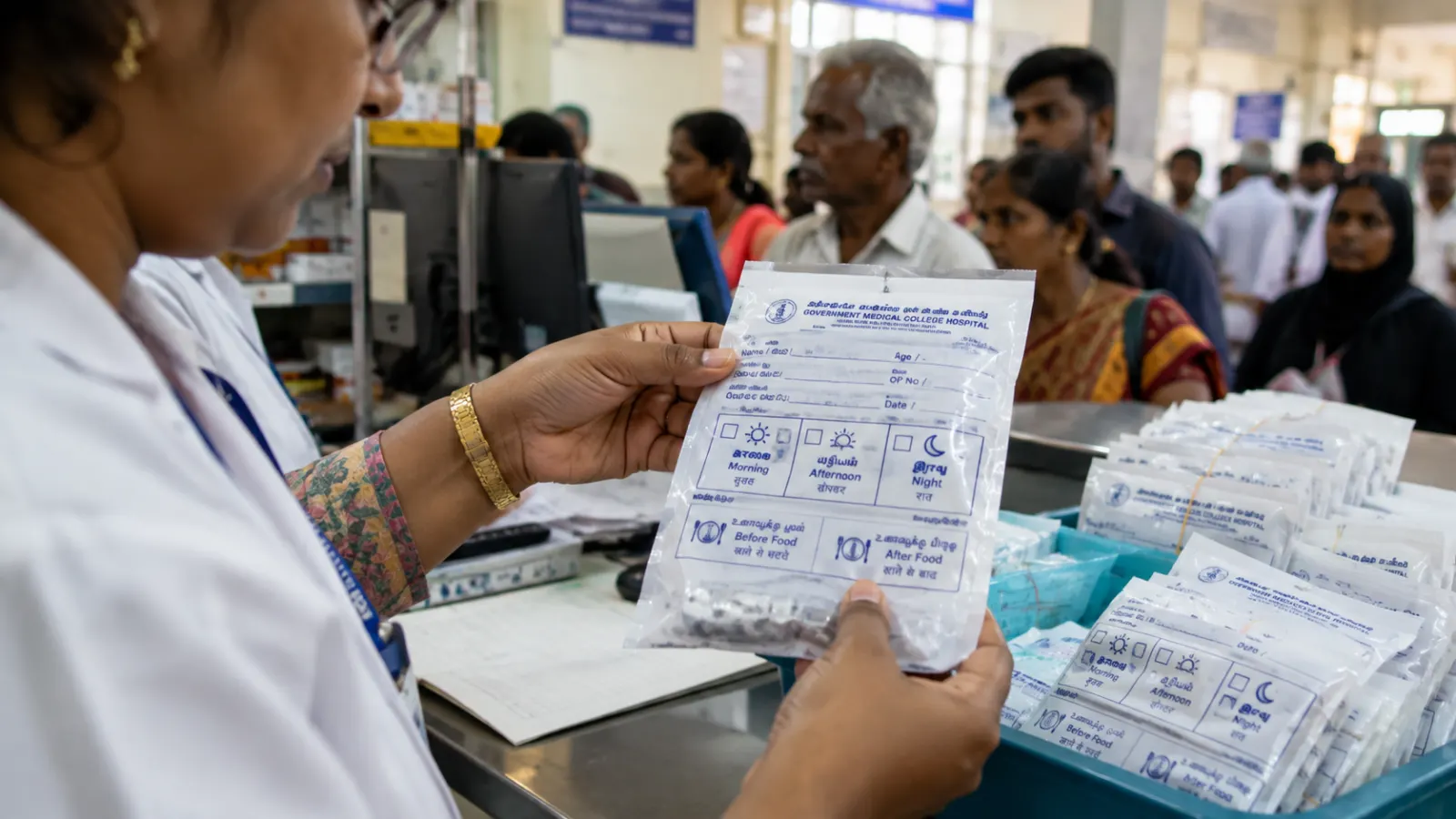
The controversy emerged after patients at government medical facilities in Karur and Coimbatore received medicine covers with dosage instructions printed in three languages.
The packets reportedly included directions relating to when medicines should be taken, including morning, afternoon and night, as well as instructions linked to food intake. Tamil and English appeared alongside Hindi, prompting immediate criticism from DMK leaders.
Following the backlash, hospital authorities in both cities halted further distribution of the trilingual covers.
Officials said the packaging was not newly introduced. In Coimbatore, authorities said similar pouches had been in circulation for more than 18 months, including during the previous government’s tenure.
The state government has since said that new covers carrying only Tamil and English are being used.
DMK accuses TVK government of allowing Hindi imposition
The opposition DMK seized on the episode as evidence that Tamil Nadu’s two-language policy was being weakened.
Rajaa questioned whether the three-language formula was effectively being introduced through government hospitals, pointing first to Karur and then to Coimbatore.
The political significance of that criticism is clear. Tamil Nadu has historically opposed compulsory Hindi and has maintained Tamil and English as the principal languages used in state education and administration.
For the DMK, language politics is also deeply tied to its ideological history. Resistance to Hindi has been central to the Dravidian political movement for decades.
That makes the use of Hindi on even routine government material politically sensitive.
TVK says the packets originated under DMK rule
The TVK government responded aggressively to the criticism.
Health and Family Welfare Minister K G Arunraj said the packaging design containing Hindi had been approved during the previous DMK government and accused the opposition of creating political controversy over a system it had itself allowed.
According to the minister, medicine covers at Karur Government Medical College Hospital are normally procured from the Central Prison and carry instructions in Tamil. However, when supplies ran short in December 2025, an order for four lakh covers was placed with the Erode District Printing Industrial Co-operative Society.
The government’s argument is therefore that the Hindi-bearing packets were inherited stock rather than evidence of a new policy.
Arunraj also said the current administration remains committed to Tamil Nadu’s two-language policy.
Hospitals stop using the trilingual covers
Authorities moved quickly to contain the controversy after it attracted political attention.
Government hospitals in Karur and Coimbatore were directed to stop distributing the trilingual medicine covers, according to local reporting. New packaging using only Tamil and English is now being supplied.
That administrative response appears designed to prevent the issue from escalating further.
However, the political dispute is unlikely to disappear immediately because both parties are using the episode to question the other’s credibility on language policy.
The DMK is portraying the packets as evidence that the current government has failed to protect the state’s linguistic position, while TVK is using procurement records to argue that the controversy originated under the previous administration.
Why language politics is so sensitive in Tamil Nadu
Tamil Nadu’s resistance to compulsory Hindi has shaped its politics for generations.
Anti-Hindi agitations during the 20th century played a major role in the rise of Dravidian parties and remain an important part of the state’s political memory.
Tamil Nadu has consistently supported a two-language formula based on Tamil and English rather than the three-language approach promoted in various forms at the national level.
Supporters of the state’s position argue that compulsory Hindi disadvantages non-Hindi-speaking communities and threatens linguistic diversity.
The central government and supporters of the three-language approach have generally argued that multilingual education expands opportunities and does not necessarily diminish regional languages.
Because of this history, language disputes in Tamil Nadu often become symbolic contests over state identity, federalism and political autonomy.
The row follows another recent Hindi-language controversy
The medicine-packet dispute has arrived shortly after another controversy involving Hindi on a government signboard.
In Sathankulam in Thoothukudi district, a state highway sign carrying place names in Tamil, English and Hindi triggered criticism. Two highways department engineers were subsequently suspended, and the Hindi wording was removed.
The Tamil Nadu government said at the time that there would be no compromise on its two-language policy.
That earlier episode has made the latest controversy even more politically charged.
Opposition parties can now point to more than one instance of Hindi appearing on government material, while the government must show that these are isolated administrative lapses rather than a change in official policy.
Is this actually a change in Tamil Nadu’s language policy?
Based on the available evidence, there is no indication that Tamil Nadu has formally abandoned its two-language policy.
The current dispute centres on the use of pre-existing medicine covers at specific hospitals, not on a statewide order introducing Hindi into government healthcare.
The government has explicitly denied adopting a three-language policy and has stopped use of the contested packaging.
That distinction is important because political rhetoric around “Hindi imposition” can sometimes move faster than the underlying administrative facts.
At the same time, the incident illustrates why state agencies need consistent procurement and communication rules if the government wants to avoid repeated language controversies.
Why the issue matters politically
The dispute is particularly significant because Tamil Nadu’s political landscape has changed.
TVK, led by actor-turned-politician Vijay, is now in government, while the DMK is in opposition. Language politics therefore gives the DMK an opportunity to challenge TVK on an issue historically associated with the Dravidian movement.
TVK, in turn, has an incentive to demonstrate that it is equally committed to Tamil linguistic identity while portraying the DMK’s criticism as hypocritical.
The dispute is therefore about more than packaging.
It is becoming a test of which party can more convincingly claim to defend Tamil Nadu’s established language policy.
What happens next
The immediate administrative problem appears to have been addressed, with the disputed medicine covers removed from circulation at the hospitals involved.
The larger political argument, however, may continue.
DMK leaders are likely to keep using the episode to question TVK’s commitment to the two-language system, while the government will continue emphasising that the packets were approved during the previous regime.
The controversy may also prompt health authorities to standardise packaging across government hospitals to ensure that future medicine instructions follow the state’s language policy consistently.
For patients, the issue is straightforward: medicine instructions need to be clear and accessible.
For Tamil Nadu politics, however, the appearance of Hindi on a medicine cover carries a much larger symbolic meaning — one tied to identity, political history and the state’s long-running debate over the role of Hindi in public life.