IAF Chief Says Indian Air Force Has Evolved Into a Network-Centric Force
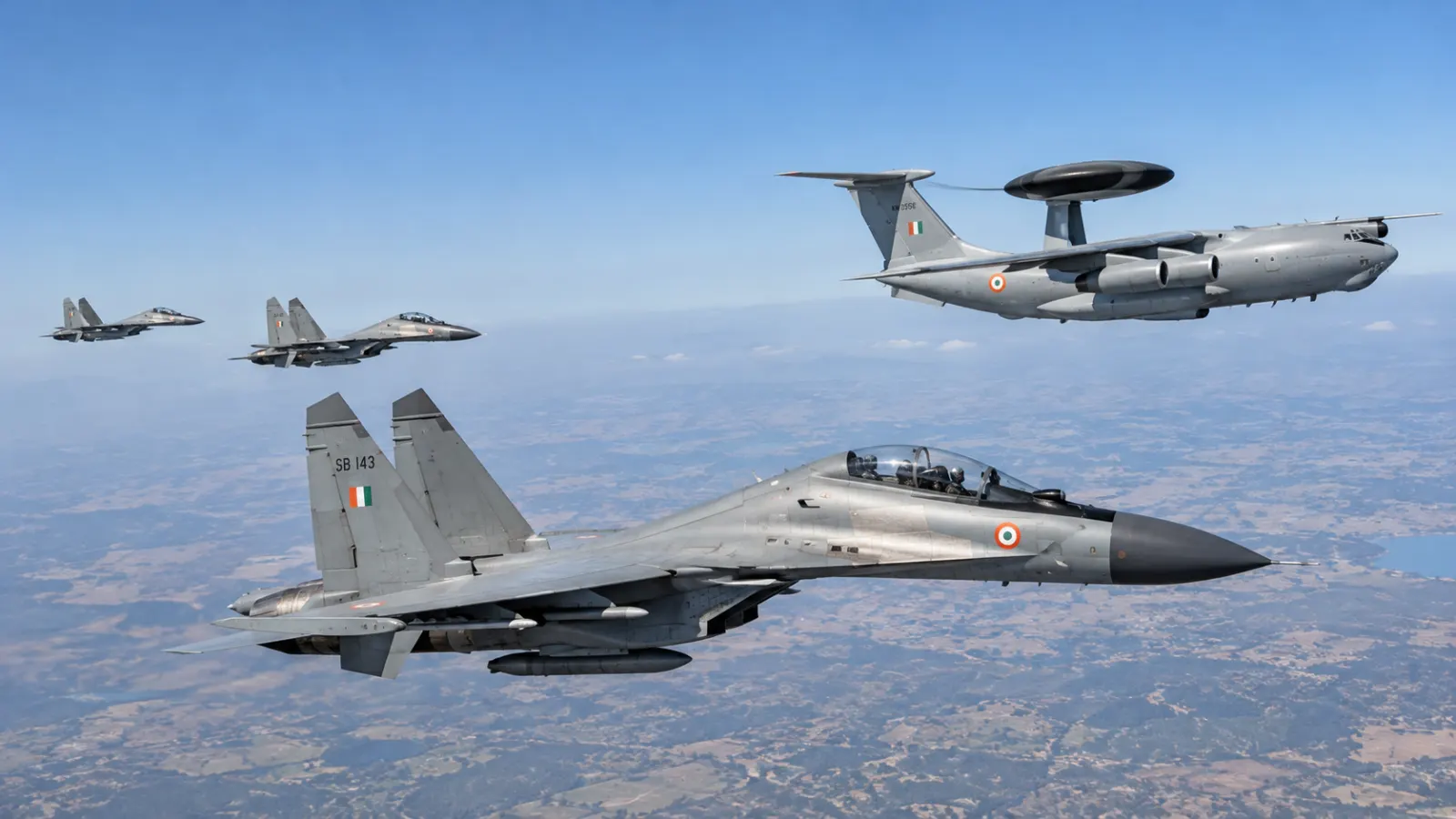
Indian Air Force Chief Air Chief Marshal A P Singh has said the IAF has evolved from a small aviation arm into a network-centric, multi-domain fighting force, highlighting how modern warfare increasingly depends on the integration of aircraft, sensors, communications, air-defence systems, drones and decision-making networks rather than individual combat platforms operating in isolation.
Speaking as the Indian Air Force marked its 94th anniversary on October 8, Singh said the service had transformed dramatically since its establishment in 1932 and now ranks among the world’s most capable professional air forces. He also emphasised that technology alone does not determine combat effectiveness, arguing that trained airmen and airwomen remain at the centre of the IAF’s operational capability.
The remarks come as India attempts to modernise its air power while simultaneously confronting a shortage of fighter squadrons, delays in aircraft induction and increasingly sophisticated military capabilities being developed by neighbouring China and Pakistan.
What a network-centric Air Force actually means
A network-centric force is designed to connect different military assets so that information gathered by one platform can immediately be used by others.
In a traditional model, a fighter aircraft, radar installation, missile battery or surveillance aircraft might operate largely through its own sensors and command channels. In a network-centric system, these assets share information continuously.
A ground radar detecting an incoming aircraft, for example, can feed that information into a wider command network. Fighter aircraft, airborne warning systems and surface-to-air missile units can then receive the same operational picture and respond accordingly.
This reduces reaction time and allows commanders to use the most suitable weapon or platform against a threat without requiring every aircraft to independently locate the target.
Modern air warfare therefore increasingly depends on the quality of the network connecting sensors, weapons and commanders.
IAF says Operation Sindoor demonstrated faster combat response
Operation Sindoor featured prominently in the Air Chief’s assessment of the force’s development.
Singh highlighted the speed with which the IAF was able to move from a high state of alert to combat operations, presenting the operation as evidence of improved readiness and coordination.
The experience has also influenced how the Air Force thinks about future conflicts.
Modern wars can develop extremely quickly, with drones, missiles, electronic warfare systems and long-range precision weapons reducing the time available for commanders to make decisions.
An air force that takes hours to assemble information from different sensors may therefore be at a significant disadvantage.
Networked command-and-control systems are intended to compress that decision cycle by giving commanders a more complete operational picture in near real time.
Air power is moving beyond fighter-versus-fighter combat
The transformation also reflects a broader change in how air warfare is conducted.
Fighter aircraft remain central to the IAF, but contemporary operations increasingly involve a much larger ecosystem.
Airborne early-warning aircraft can detect targets hundreds of kilometres away. Ground-based radars provide additional surveillance. Satellites support communications and intelligence. Electronic-warfare systems attempt to disrupt enemy radars and communications, while drones can conduct reconnaissance or strike missions without exposing pilots.
Long-range surface-to-air missile systems add another layer by allowing targets to be engaged without fighters physically approaching them.
The effectiveness of all these systems increases when they operate as parts of a single network rather than separate platforms.
This is why the IAF increasingly describes itself as a multi-domain force rather than simply a fleet of combat aircraft.
Integrated air command systems are becoming critical
India has spent years developing systems designed to connect its air-defence assets.
The IAF’s Integrated Air Command and Control System links radar stations, air-defence weapons, command centres and other sensors into a common operational network.
Such integration enables military commanders to track aircraft and other aerial threats across large areas while coordinating the response from multiple locations.
The challenge is becoming increasingly complex because the threat environment now includes far more than conventional aircraft.
Cruise missiles can fly at low altitude to avoid radar detection. Ballistic missiles can travel at extreme speeds. Small drones can appear in large numbers, while electronic-warfare systems can attempt to jam sensors or communications.
A modern air-defence network must therefore detect, classify and prioritise many different threats simultaneously.
Fighter shortage remains a serious challenge
The IAF’s technological transformation is occurring while its fighter strength remains under pressure.
The service currently operates around 29 fighter squadrons, substantially below its authorised strength.
A number of older aircraft have been retired or are approaching retirement, while replacements have not entered service quickly enough to maintain squadron numbers.
Singh has said India needs to induct approximately 36 to 40 fighter aircraft every year for several years if the IAF is to rebuild its combat strength.
The Tejas Mk1A programme is expected to play an important role, while India is also pursuing additional Rafale aircraft and developing the indigenous Advanced Medium Combat Aircraft.
However, delays in production and development remain a concern.
Network-centric warfare can make existing aircraft more effective, but connectivity cannot fully compensate for an insufficient number of combat platforms.
Pakistan-China military cooperation adds urgency
The modernisation effort is also being shaped by developments across India’s borders.
Pakistan’s growing defence relationship with China is an important concern for the IAF, particularly as Islamabad explores fifth-generation fighter technology and other advanced Chinese military systems.
Fifth-generation aircraft combine stealth, advanced sensors, data fusion and networked operations, allowing them to detect and engage adversaries while reducing their own visibility.
The IAF chief has acknowledged that Pakistan’s movement towards fifth-generation capability is a development India must closely monitor.
However, Singh has also argued that one platform alone does not determine the outcome of modern warfare.
A sophisticated aircraft becomes substantially more effective when connected with radars, satellites, electronic-warfare systems and other combat assets.
That is precisely why the IAF’s emphasis on network integration has become increasingly important.
India’s AMCA programme will be central to future air power
India’s indigenous Advanced Medium Combat Aircraft is expected to become a major component of the IAF’s future force structure.
The AMCA is being developed as a fifth-generation stealth fighter with advanced sensors and the ability to operate within a networked battlefield.
But the programme will take time to move from development into large-scale squadron service.
The IAF has indicated that delays could force India to consider interim foreign options if necessary.
This creates a strategic balancing problem.
India wants greater self-reliance in defence manufacturing, but military capability cannot wait indefinitely for domestic platforms to mature.
The coming decade will therefore require the IAF to simultaneously operate existing aircraft, induct new fourth-generation fighters, develop fifth-generation platforms and maintain interoperability across all of them.
Drones and unmanned systems will become increasingly important
The rapid expansion of unmanned warfare represents another major element of the IAF’s transformation.
Recent conflicts have shown that inexpensive drones can threaten military installations, air-defence systems and expensive combat platforms.
At the same time, advanced unmanned aircraft can perform surveillance, electronic warfare and strike missions over long distances.
Future air operations are therefore likely to involve combinations of crewed fighters and unmanned systems.
Artificial intelligence may eventually help these platforms identify threats, prioritise targets and coordinate operations more quickly.
For the IAF, integrating such systems into its command network will be as important as acquiring them.
Human capability remains central despite technological change
Despite the focus on technology, Singh emphasised that the Air Force’s strength ultimately depends on its personnel.
Modern aircraft and command networks require pilots, engineers, technicians, air-traffic specialists, cyber professionals and intelligence officers capable of operating increasingly complex systems.
Technology can accelerate decision-making, but military effectiveness still depends on training, judgement and operational discipline.
This becomes particularly important in network-centric warfare because an interconnected force can only function effectively if personnel across different units understand the same procedures and operational doctrine.
A sophisticated network with poorly trained users provides little advantage.
The IAF is preparing for a different kind of war
The Air Chief’s remarks point to a broader change in India’s understanding of air power.
The future IAF is unlikely to be judged simply by how many fighter aircraft it operates.
Combat capability will increasingly depend on how effectively fighters, missiles, drones, radars, satellites and command centres communicate with one another.
The goal is to detect threats earlier, share information faster and make decisions before an adversary can respond.
That transformation does not eliminate traditional problems such as fighter shortages or delayed procurement. Instead, it creates an additional requirement: every new platform must fit into a larger digital combat architecture.
As the Indian Air Force approaches its centenary, its challenge will therefore be twofold — rebuilding the physical strength of its fleet while simultaneously creating the networks needed to fight increasingly complex, technology-driven wars.
The shift from an aircraft-centric force to a network-centric, multi-domain force may ultimately prove as important to the IAF’s future as the acquisition of any individual fighter jet.