Who should control your financial data?
A bank knows how much you earn, how much you spend, where your salary comes from, which bills you pay, which EMIs leave your account and whether your business cash flows are stable. For decades, this information remained locked inside banks and financial institutions. If a customer wanted to apply for a loan elsewhere, they printed statements, uploaded PDFs or shared documents manually. Financial data existed, but it did not move easily with the customer's permission.
Open banking changes that idea. It asks a simple but powerful question: if the data is about the customer, should the customer be able to share it securely with another regulated financial provider? If yes, banking becomes less closed. Data becomes portable. Competition improves. Credit assessment can become faster. Personal finance tools can become more useful. Small businesses can access services based on real cash flows rather than paperwork.
But open banking also creates a serious responsibility. Financial data is sensitive. If shared carelessly, it can expose a person to fraud, profiling, predatory lending or privacy loss. The future of open banking therefore depends on consent, security and accountability. It is not about making data open to everyone. It is about making data shareable under the user's informed control.
What open banking means
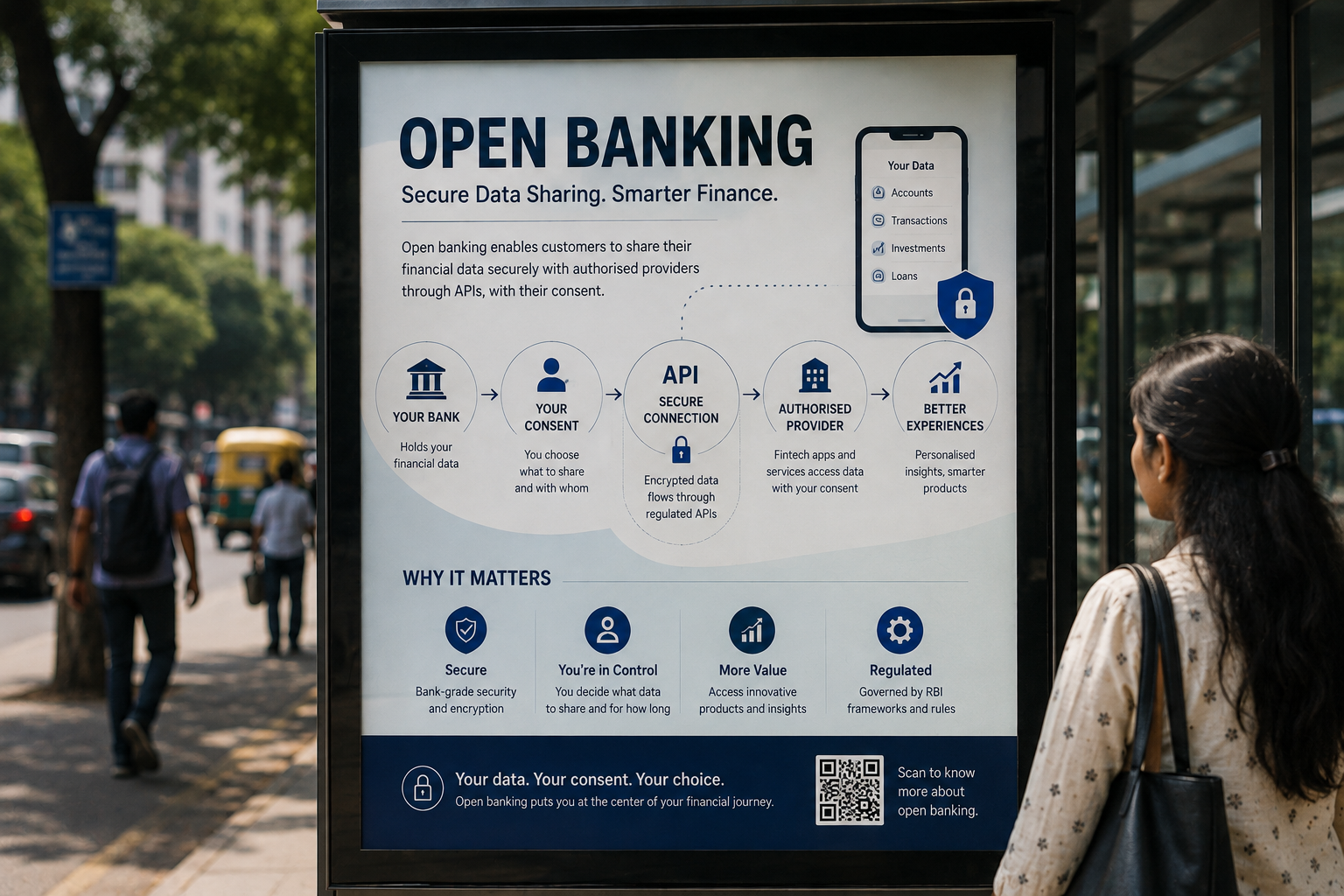
Open banking refers to a system where banks and financial institutions allow customer-authorised data sharing with third-party providers through secure technology interfaces, usually APIs. The customer gives consent for specific data to be shared for a specific purpose and duration. The third party then uses that data to provide services such as credit assessment, budgeting, wealth management, accounting, payments or financial comparison.
The phrase can sound as if banks are opening their systems freely. That is not the idea. Open banking should be controlled, consent-based and regulated. It is not a public release of private information. It is structured data portability.
In many countries, open banking is built around APIs. In India, the account aggregator framework is a major consent-based data-sharing architecture. It allows financial data to move between regulated financial information providers and financial information users through licensed account aggregators, based on the customer's consent.
Why open banking matters
Open banking matters because financial data shapes opportunity. A salaried employee can prove income through bank statements. A small business can prove cash flow through transaction history. A borrower with limited collateral but consistent receipts can demonstrate repayment capacity. A personal finance app can give better advice if it understands actual spending patterns.
Without data portability, customers remain dependent on the institution that holds their information. Switching providers becomes difficult. Loan applications become document-heavy. Financial advice becomes generic. Small businesses struggle to prove reliability. Open banking can reduce this friction by allowing users to carry their financial history digitally and securely.
The deeper point is competition. When data is locked inside one institution, the institution has power. When customers can share data safely, new providers can compete to offer better products. Open banking shifts finance from institution-owned data to user-controlled data.
APIs and the technical layer
The technical backbone of open banking is the API, or application programming interface. An API allows two software systems to communicate in a structured way. Instead of users downloading statements and uploading files manually, an authorised system can fetch specific data through secure channels after consent.
This improves accuracy and reduces fraud. A PDF bank statement can be altered. API-based data sharing can provide verified information directly from the source. It can also reduce repetitive paperwork because users do not need to submit the same documents again and again.
But APIs are only tools. Their value depends on governance. Who can access the API? What data can be shared? How is consent recorded? Can consent be revoked? Is the data encrypted? Who is liable if data is misused? Open banking is therefore as much about rules as technology.
The India model: account aggregators
India's account aggregator framework is one of the most important open-finance experiments in the world. An account aggregator is a licensed entity that acts as a consent manager for financial data. It does not read or store the data for its own use. It facilitates secure transfer of data between a financial information provider, such as a bank, and a financial information user, such as a lender or wealth adviser, based on customer consent.
The model is designed around user control. The customer chooses what data to share, with whom, for what purpose and for how long. Consent can be time-bound and revocable. This is different from the older method of handing over physical statements or sharing login credentials, both of which create risks.
For India, the framework matters because it can support credit inclusion, personal finance, SME lending and efficient financial services without forcing users to repeatedly submit documents. It is open banking with a consent architecture.
How open banking improves credit access
Credit access depends on information. A lender wants to know whether the borrower can repay. Traditional lending relies on income documents, collateral, credit history and relationship data. Many individuals and small businesses do not fit neatly into those boxes. They may have irregular income, limited collateral or weak credit bureau history but healthy cash flows.
Open banking can help lenders evaluate real transaction data with user permission. A small business may show consistent receipts. A freelancer may show recurring client payments. A household may demonstrate stable income and manageable expenses. This can improve underwriting and reduce dependence on informal judgment.
However, better data should not become reckless lending. If lenders use data only to push more loans, open banking can create over-borrowing. Responsible credit must combine data access with affordability assessment, fair pricing and consumer protection.
Personal finance and wealth management
Open banking can also improve personal finance. Budgeting apps, wealth platforms and advisory tools can provide better insights if they see actual financial flows. Instead of asking users to manually enter expenses, a consent-based system can categorise transactions, identify savings gaps, track subscriptions, detect unusual spending and suggest financial actions.
This can be powerful for financial literacy. Many people do not know where their money goes. Open banking can convert scattered transactions into understandable patterns. It can show whether lifestyle inflation is rising, whether emergency funds are weak, whether EMIs are too high or whether investment discipline is inconsistent.
But personal finance tools must be careful. Insight can become manipulation if apps use data to push unnecessary products. A good open-banking ecosystem should help users make better decisions, not simply monetise their vulnerabilities.
Risks: privacy, consent and misuse
The biggest risk in open banking is not that data moves. The risk is that data moves without meaningful understanding. Consent can become a formality if users click approve without knowing what they are sharing. Companies may request more data than needed. Users may not know how to revoke consent. Data may be used for profiling, cross-selling or exclusion.
Financial data reveals intimate details about life: health payments, religious donations, political contributions, salary, debt, family responsibilities and personal habits. Misuse of such data can cause serious harm. Open banking must therefore apply data minimisation: collect only what is necessary, for a defined purpose, for a limited time.
Consent must be granular, revocable and understandable. A long legal document is not meaningful consent if ordinary users cannot understand it. Trust requires simplicity.
Open banking vs screen scraping
Before structured open banking, some apps relied on screen scraping or asked users to share credentials or upload statements. These methods are risky. Sharing login credentials can compromise security. Uploaded documents can become outdated or misused. Screen scraping may violate terms and expose users to fraud.
Open banking attempts to solve this by using secure, consent-based data flows. The third party does not need the user's password. Data can come from the source through authorised channels. Consent can be recorded and revoked. This is a better model because it reduces both operational friction and security risk.
The public should understand this distinction. A service that asks for bank login credentials is not the same as a regulated consent-based data-sharing flow. The safer model is one where the user authorises specific data sharing without surrendering account control.
Impact on banks
Open banking challenges banks because it weakens their monopoly over customer data. A customer may hold an account at one bank but use another platform for credit, investments, budgeting or business analytics. Banks become part of a wider ecosystem rather than the sole owner of the customer relationship.
This can feel threatening, but it can also create opportunity. Banks can use open banking to offer better products, partner with fintechs, improve underwriting and serve customers more intelligently. Institutions that adapt can benefit. Institutions that depend only on data lock-in may struggle.
The future bank may not win by hiding data. It may win by being the most trusted institution in an open-data environment.
India angle: from open banking to open finance
India's account aggregator framework points beyond open banking toward open finance. Open banking usually begins with bank-account data. Open finance can include insurance, pension, mutual funds, tax data and other financial information categories as the ecosystem evolves within regulation.
This can be transformative for India's households and small enterprises. A borrower may share bank, GST and investment data to obtain better credit. A financial planner may create a fuller picture of household finances. A small business may use verified cash flows to negotiate working capital. Financial inclusion can move from account access to data-enabled opportunity.
But the framework must preserve trust. If users experience data misuse, aggressive cross-selling or unclear consent flows, adoption will suffer. Open finance must be built slowly, transparently and with strong grievance systems.
What users should check before giving consent
Users should check who is requesting data, what data is requested, why it is needed, how long access will last and whether consent can be revoked. They should avoid sharing more data than necessary. They should not provide bank passwords to third-party apps. They should verify whether the consent flow uses authorised account aggregator channels where applicable.
Users should also ask whether the benefit is worth the data shared. A loan application may require income and transaction verification. A budgeting tool may need spending data. But a casual offer or unclear service may not justify broad access to financial history.
In open banking, the user is not passive. The user becomes the permission-giver. That power must be used carefully.
Final takeaway
Open banking is one of the most important shifts in modern finance because it changes the ownership logic of financial data. It says that customers should be able to share their financial information securely, with consent, to access better services. This can improve competition, credit access, personal finance and business efficiency.
But open banking is not a slogan for unlimited data sharing. It is a disciplined system of consent, security, purpose limitation and accountability. Without these safeguards, open banking can become open exploitation.
The real promise of open banking is user control. When customers can move their data safely, institutions must compete on service rather than captivity. That is a healthier financial system. But it will work only if technology, regulation and consumer awareness move together.