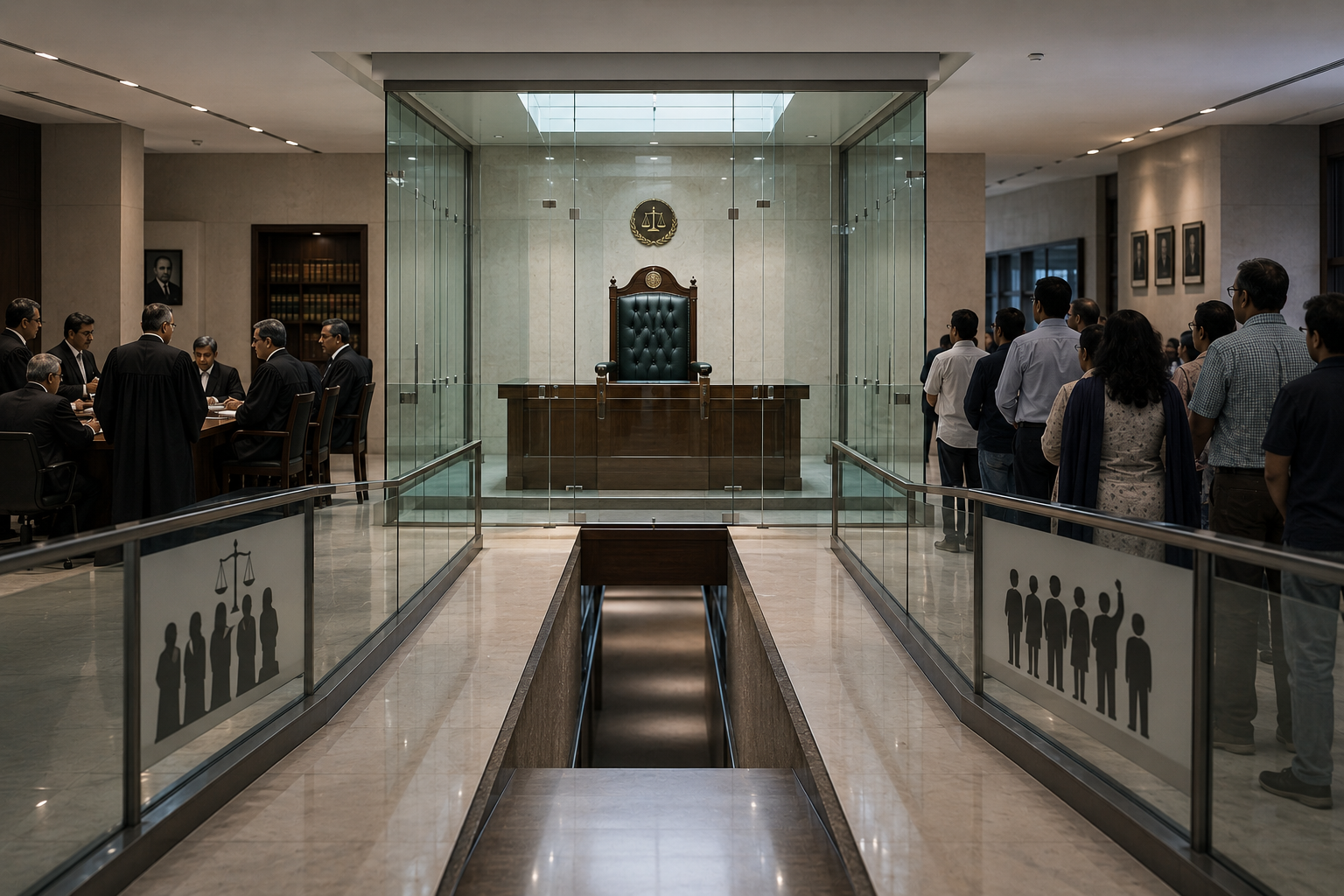
The question behind the debate
Few institutional questions are as sensitive as this one: who should choose the judges who will later decide whether the government itself has acted constitutionally? Judicial appointments are not ordinary administrative appointments. They shape the independence of courts, the quality of justice, the balance between branches of government and the public’s faith in constitutional democracy.
The National Judicial Appointments debate in India is the debate over how judges of the Supreme Court and High Courts should be appointed. At its centre are two competing concerns. One concern is judicial independence: judges must not be chosen in a way that makes them dependent on the executive. The other concern is accountability and transparency: the appointment process should not become closed, opaque or detached from public confidence.
Constitutional basis of judicial appointments
The constitutional text begins with Articles 124 and 217. Article 124 deals with the establishment and constitution of the Supreme Court and includes provisions relating to appointment of Supreme Court judges. Article 217 deals with the appointment and conditions of the office of a judge of a High Court.
Originally, these provisions used the language of appointment by the President after consultation with constitutional authorities such as the Chief Justice of India, judges of the Supreme Court and High Courts, and Governors in the case of High Courts. Over time, Supreme Court interpretation transformed the practical meaning of consultation in higher judicial appointments.
This is where the collegium system emerged. It is not written in one article as a complete code. It developed through judicial interpretation in the Judges Cases, especially the Second Judges Case and the Third Judges Case, which gave primacy to the judiciary in appointments to the higher judiciary.
What is the collegium system?
The collegium system is the present process through which appointments and transfers of judges in the higher judiciary are recommended. In broad terms, appointments to the Supreme Court are recommended by a collegium led by the Chief Justice of India and senior judges of the Supreme Court. High Court appointments also involve consultations within the higher judiciary, including the High Court collegium and the Supreme Court collegium.
The collegium system was developed to protect judicial independence. The reasoning is that if the executive had decisive control over judicial appointments, judges might feel pressure while deciding cases involving government power. Judicial primacy was therefore seen as a safeguard against executive dominance.
However, the collegium system has also been criticised for opacity. Critics argue that the public often does not know why one candidate is recommended and another is not, why names are delayed, or what objective criteria are used.
What was the NJAC?
The National Judicial Appointments Commission, or NJAC, was Parliament’s attempt to replace the collegium system with a constitutional body for judicial appointments. It was introduced through the Constitution (Ninety-ninth Amendment) Act, 2014 and the National Judicial Appointments Commission Act, 2014.
The proposed NJAC would have included judicial members, the Union Law Minister and eminent persons. Supporters argued that this would make appointments more broad-based, transparent and accountable. They said that judges appointing judges without outside participation created an appearance of institutional self-selection.
Opponents argued that executive participation in the appointments body could compromise judicial independence. They feared that the government, which is often a litigant before courts, could gain influence over who becomes a judge.
Why the Supreme Court struck down NJAC
In 2015, the Supreme Court struck down the 99th Constitutional Amendment and the NJAC Act by a majority in Supreme Court Advocates-on-Record Association v. Union of India. The Court held that the NJAC damaged the independence of the judiciary, which is part of the basic structure of the Constitution.
The judgment revived the collegium system. The Court’s central concern was not that reform was impossible, but that the reform adopted through the NJAC did not sufficiently preserve judicial independence.
This judgment itself became controversial. Supporters saw it as a defence of constitutional independence. Critics saw it as the judiciary protecting its own institutional control. This is why the appointments debate continues even after the NJAC decision.
The transparency problem
The strongest criticism of the collegium system is opacity. Judicial appointments affect the entire Republic, but the public often receives limited information about evaluation criteria, objections, reconsideration, diversity concerns or reasons for delay.
Transparency matters because secrecy can weaken trust. If people do not know why judges are chosen, they may suspect favouritism, nepotism, ideological preference or institutional bias, even when those suspicions are not proved.
At the same time, complete transparency may also create problems. Judicial candidates may be unfairly damaged by public disclosure of confidential inputs. Intelligence reports, professional assessments and personal reputation issues may require confidentiality. The challenge is to design meaningful transparency without turning appointments into public trials.
The independence problem
The strongest argument for judicial primacy is independence. Courts decide cases involving arrests, censorship, taxation, elections, federal disputes, executive action and constitutional amendments. If judges owe their appointments to the political executive, public confidence in judicial neutrality may suffer.
Judicial independence is not a privilege of judges. It is a protection for citizens. A citizen challenging government action needs a court that can decide without fear of political retaliation or expectation of reward.
This is why the debate cannot be reduced to judiciary versus government. It is really about how to protect citizens from both executive control and institutional opacity.
Citizen impact
For ordinary citizens, judicial appointments may seem distant. But they affect every area of life. Judges decide bail, free speech, privacy, property, taxation, environmental protection, elections, labour rights, personal liberty and government accountability.
If appointments are weak, justice suffers. If appointments are delayed, vacancies increase and cases pile up. If appointments lack diversity, courts may miss important social perspectives. If appointments are politicised, judicial independence weakens. If appointments are opaque, public trust declines.
Therefore, the appointments debate is not an internal dispute among lawyers and judges. It is a constitutional issue that affects the quality of justice.
Limits and misconceptions
One misconception is that the collegium system is written word-for-word in the Constitution. It is not. It developed through constitutional interpretation.
Another misconception is that any executive role automatically destroys judicial independence. Many democracies include executive or legislative participation in appointments. The real question is design, safeguards and constitutional culture.
A third misconception is that transparency alone solves everything. Transparency is essential, but appointments also require merit, integrity, diversity, independence, institutional memory and timely decision-making.
Final takeaway
The National Judicial Appointments debate is a debate about the balance between independence and accountability. The collegium system protects judicial primacy but faces criticism for opacity. The NJAC attempted wider participation but was struck down because the Supreme Court found it damaging to judicial independence.
India’s challenge is not merely to choose between secrecy and political control. The real challenge is to build an appointments process that is independent, transparent, diverse, timely and trusted.