Mustafa Kemal Atatürk: Founder of Modern Turkey, His Reforms, Rule and Contested Legacy
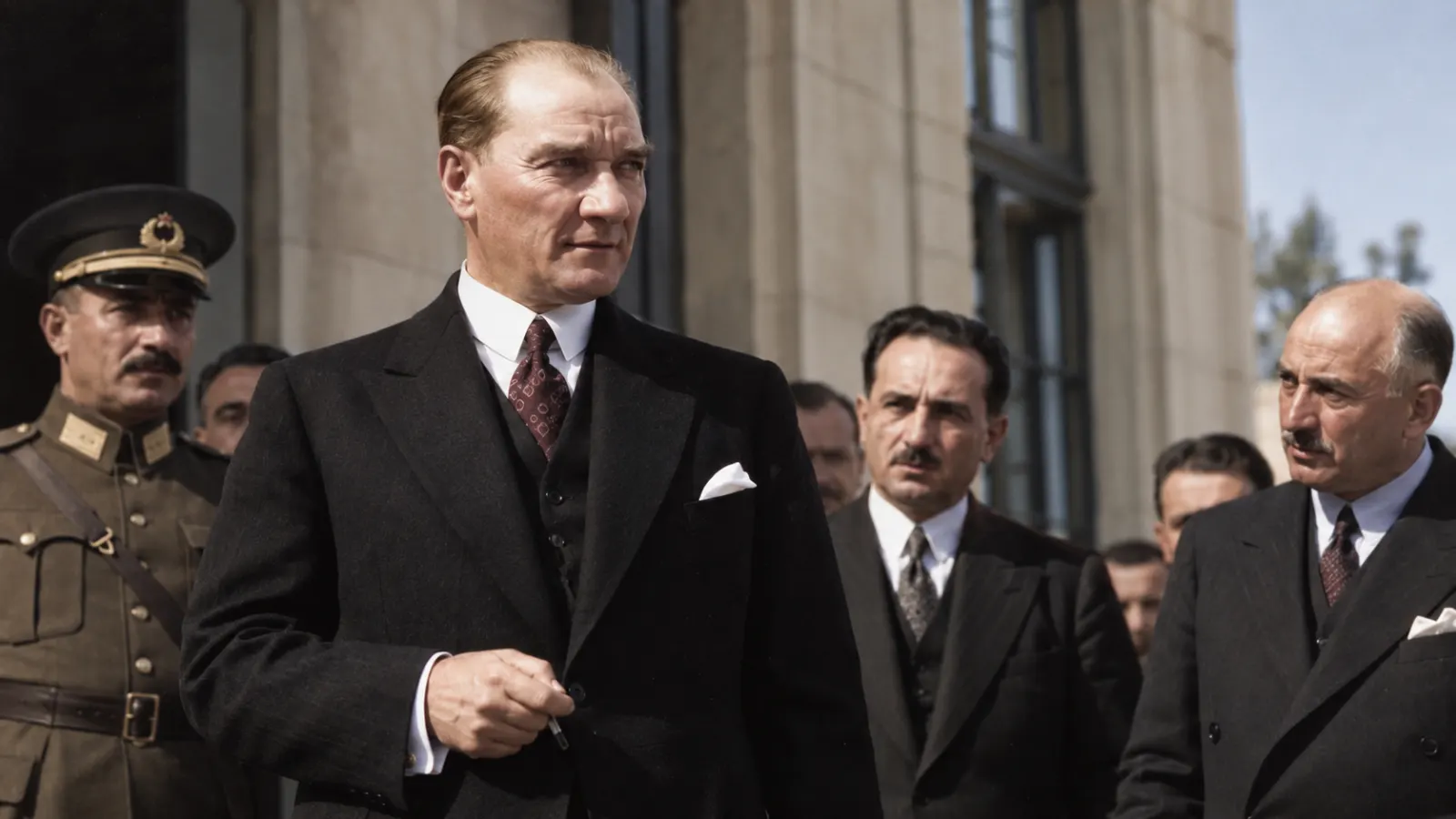
Mustafa Kemal Atatürk became the central figure in the creation of modern Turkey because he achieved something that looked far from inevitable when the First World War ended. The Ottoman Empire had been defeated, Istanbul and other strategic areas were occupied by Allied forces, Greek troops had landed at Smyrna—today İzmir—and the postwar settlement proposed at Sèvres would have drastically restricted Turkish sovereignty. Within five years, a nationalist movement based in Ankara had defeated its principal military rivals, displaced the authority of the Ottoman government, secured a new international settlement at Lausanne and proclaimed a republic with Mustafa Kemal as its first president.
That alone would have made him one of the defining political figures of the twentieth-century Middle East. But Atatürk did not stop after creating a new state. During his presidency from 1923 until his death in 1938, Turkey underwent sweeping political, legal, educational, linguistic, cultural and economic reforms. The sultanate and caliphate disappeared, religious institutions were subordinated to the republican state, European-derived legal codes replaced important elements of Ottoman-Islamic law, a Latin-based Turkish alphabet replaced the Ottoman script, women gained expanded civil and political rights, and the government attempted to build a secular national identity around citizenship, language and loyalty to the republic.
These transformations made Atatürk an enduring symbol of sovereignty and modernisation for supporters in Turkey and beyond. They also produced a political system in which the Republican People's Party dominated organised politics, opposition parties disappeared after brief experiments, exceptional courts and emergency laws were used against opponents, and state-building increasingly favoured cultural uniformity. Assimilationist policies toward Kurds and the violent campaign in Dersim in 1937–38 remain among the most difficult parts of the early republic's record.
Understanding Atatürk therefore requires holding two realities together. He helped rescue political sovereignty from imperial collapse and created institutions that profoundly changed Turkish society. He also believed that the state could impose transformation rapidly from above and that pluralism could be restricted when leaders considered national unity or revolutionary change to be at risk.
From Salonica and Military School to Gallipoli
Mustafa Kemal was born in 1881 in Salonica, now Thessaloniki in Greece, then one of the Ottoman Empire's most cosmopolitan cities. His father was Ali Rıza Efendi and his mother was Zübeyde Hanım. His exact date of birth is not securely documented, although 1881 is universally accepted in standard biographies. Salonica's mixture of Muslim, Jewish and Christian communities, commercial networks and political movements exposed young Ottomans to an unusually intense environment of nationalism, constitutionalism and imperial reform.
Mustafa's education gradually became military. He attended military schools in Salonica and Monastir before entering the Ottoman Military Academy and Staff College in Istanbul. He became an officer at a time when the empire was losing territory, facing nationalist movements and debating how to survive European pressure. Reformist military schools exposed officers to mathematics, modern military science and political ideas including constitutionalism, positivism, Ottoman patriotism and increasingly Turkish nationalism.
He opposed the autocratic politics associated with Sultan Abdülhamid II and became involved in reformist circles, though his relationship with the Committee of Union and Progress—the dominant Young Turk organisation—was complicated. He shared its desire for constitutional reform and state modernisation but clashed with important Unionist leaders and disliked excessive political involvement by serving military officers.
The wars of the early twentieth century transformed his career. He served in Libya during the Italo-Turkish War of 1911–12 and during the Balkan conflicts that stripped the Ottoman Empire of most of its remaining European territories. Those defeats deeply influenced the generation of officers who later constructed the Turkish republic: imperial weakness, displacement of Muslim populations and repeated foreign intervention encouraged the belief that political survival required a stronger and more disciplined state.
Mustafa Kemal's national reputation grew dramatically during the Gallipoli campaign of 1915. Allied forces attempted to seize the Dardanelles and create a route toward Istanbul, but Ottoman resistance stopped the operation. Mustafa Kemal, then a divisional commander, played an important role at critical moments in the land campaign and emerged as one of the Ottoman commanders most closely associated with the victory.
Gallipoli later became foundational to several national memories. Australians and New Zealanders remembered the ANZAC experience as a formative national episode, while in Turkey the campaign became inseparable from Mustafa Kemal's rise. His wartime record gave him military prestige that would become politically crucial after the empire itself collapsed.
From Samsun to Ankara: How Mustafa Kemal Built a Rival State
The Ottoman Empire signed the Armistice of Mudros on 30 October 1918, ending its participation in the First World War. Allied occupation expanded afterward, and Greek forces landed in İzmir in May 1919. The Ottoman government in Istanbul remained formally sovereign but operated under increasing Allied pressure.
Mustafa Kemal travelled to Samsun on 19 May 1919 as an army inspector. Republican memory later made the date the symbolic beginning of the Turkish national struggle, but organised resistance was already developing across Anatolia. Local defence organisations, former military officers, provincial elites and civilians had begun responding to occupation and possible territorial partition.
Mustafa Kemal's distinctive contribution was political coordination. The Amasya Circular of June 1919 argued that national independence would be secured through the determination of the nation itself and called for broader organisation. Congresses at Erzurum and Sivas brought regional resistance organisations into a more coherent nationalist movement.
This gradually created a rival centre of sovereignty. When Allied occupation of Istanbul intensified and the Ottoman parliament ceased functioning, the Grand National Assembly opened in Ankara on 23 April 1920. Mustafa Kemal became its first speaker and dominant political leader. From that moment, Ankara increasingly claimed to represent national sovereignty independently of the sultan's government.
The nationalist movement fought on several fronts, but the conflict with Greece became decisive. The Ottoman government had signed the Treaty of Sèvres in 1920, a settlement that envisaged extensive territorial losses and limitations on Ottoman sovereignty. Ankara rejected it and never accepted the treaty as the legitimate basis of the new political order.
Military victories at Sakarya in 1921 and during the Great Offensive of 1922 changed the balance decisively. Mustafa Kemal served as commander-in-chief at crucial stages, while commanders including İsmet İnönü and Fevzi Çakmak played major roles in building and directing the nationalist army. The Greek military position in Anatolia collapsed, forcing a new diplomatic settlement.
The resulting Treaty of Lausanne, signed on 24 July 1923, internationally recognised the sovereignty of the new Turkish state within borders much closer to those claimed by the Ankara movement. Lausanne therefore replaced the unrealised Sèvres settlement and became one of the foundational documents of republican Turkey.
The victory was accompanied by enormous human displacement. The 1923 convention between Greece and Turkey mandated a compulsory population exchange based primarily on religion, with exceptions including established Greek Orthodox residents of Constantinople and Muslims of Western Thrace. The republic therefore emerged not only from military victory but from the wider demographic transformation of the former Ottoman lands.
From Empire to Republic: Sultanate, Presidency and the End of the Caliphate
Military victory left a constitutional question unresolved. Ankara had defeated rival claims to sovereignty, but the Ottoman dynasty still formally existed.
The Grand National Assembly abolished the sultanate on 1 November 1922. Mehmed VI, the last Ottoman sultan, left Istanbul later that month. The institution of the caliphate was initially separated from the monarchy and retained temporarily under Abdülmecid II.
On 29 October 1923, parliament formally proclaimed the Republic of Turkey. Mustafa Kemal was elected its first president, while İsmet İnönü became the first prime minister. Ankara had already become the political centre of the national movement and was deliberately established as the new capital rather than returning national government to imperial Istanbul.
The break with the Ottoman political order accelerated in 1924. On 3 March, parliament abolished the caliphate, exiled members of the Ottoman dynasty, unified education under state authority and reorganised institutions previously responsible for religious affairs.
Atatürk's secularism therefore should not be understood simply as the state withdrawing from religion. The republican model was more interventionist. Independent religious authority was reduced while religious affairs themselves became increasingly regulated through national institutions. The Directorate of Religious Affairs was created within this new framework.
Further secularisation came gradually. The 1924 Constitution initially still declared Islam the religion of the state. That provision was removed in 1928, and in 1937 secularism was formally incorporated into the constitutional definition of the republic alongside other Kemalist principles.
The political philosophy that eventually became associated with Atatürk was commonly summarised through six principles: republicanism, nationalism, populism, statism, secularism and reformism or revolutionism. They were not a perfectly systematic philosophy created all at once; rather, they became a retrospective framework for the direction in which the new state had developed.
Atatürk's Reforms: Law, Education, Alphabet, Women and the Economy
The scale of reform after 1923 was exceptional because the government attempted to transform not one institution but the entire architecture of public life. Law, education, language, dress, names, measurement systems and political culture were all treated as legitimate areas of state-directed modernisation.
Legal reform was among the most consequential. The republic abolished religious courts and introduced new secular codes inspired substantially by European models. The 1926 Turkish Civil Code, based largely on the Swiss code, transformed civil marriage, divorce and family law, prohibited polygamy in civil law and strengthened women's legal position. Other European-derived commercial and criminal codes were introduced as part of a wider effort to create a unified secular legal system. Official Turkish histories identify the 1924–37 period as the decisive transition toward this new juridical structure.
The transformation should not be described as though Ottoman law had remained unchanged for centuries until Atatürk appeared. Nineteenth-century Tanzimat reforms had already created secular courts, administrative codes and modern educational institutions. The republic accelerated and ideologically redirected processes that had begun during the empire.
Education became a central instrument of nation-building. The Law on the Unification of Education of 3 March 1924 brought educational institutions more directly under national control. Republican leaders regarded mass schooling not simply as a service but as a mechanism for producing citizens capable of participating in a secular national culture.
The most visible educational reform came in 1928, when Turkey replaced the Ottoman Turkish Arabic-based script with a Latin-derived alphabet adapted to Turkish sounds. Parliament approved the new alphabet on 1 November, and the government then created Nation Schools to teach it rapidly to adults.
Atatürk became personally identified with the campaign, appearing publicly with blackboards and demonstrating the letters. The change was intended to simplify literacy and align the writing system more closely with spoken Turkish. It also produced a radical cultural rupture: future generations who learned only the new script could no longer read most Ottoman documents, newspapers or literature without specialised training.
Claims that alphabet reform by itself caused Turkey's subsequent rise in literacy should be treated cautiously. Literacy also benefited from expanding schools, teacher training, urbanisation and the increasing administrative reach of the state. The alphabet was part of a larger mass-education programme rather than an isolated technological fix.
Language policy subsequently became more ambitious. The Turkish Language Association promoted the replacement of many Arabic and Persian elements with words identified or created as Turkish. Meanwhile, state-sponsored historical projects such as the Turkish History Thesis attempted to construct deeper pre-Islamic and Central Asian narratives of national achievement. Some linguistic reforms became permanent; some more speculative theories, particularly the Sun Language Theory, are now remembered largely as examples of ideology influencing scholarship.
Reform also entered clothing and public identity. The Hat Law of 1925, closure of dervish lodges and restrictions on particular religious dress symbolised the state's desire to transform visible public culture. The Surname Law of 1934 required hereditary surnames, and on 24 November 1934 parliament granted Mustafa Kemal the surname Atatürk, conventionally translated as “Father of the Turks.”
Women's rights formed another important component of the republican programme. Legal reform strengthened women's civil status, while political rights expanded in stages. Women gained municipal voting and eligibility rights in 1930, additional local rights in 1933 and the right to vote and stand in national parliamentary elections on 5 December 1934. Eighteen women entered parliament following the 1935 election.
These reforms were substantial, particularly when compared internationally during the interwar period. But describing them simply as rights “given by Atatürk” erases earlier Ottoman and Turkish women's activism. Women had already organised associations, published newspapers and demanded educational and political rights. Republican legislation greatly expanded the legal opportunities available to women while the one-party system simultaneously restricted independent political organisation generally.
Economic policy changed as well. Early republican leaders sought domestic entrepreneurship and greater economic sovereignty, but after the global depression the government increasingly adopted statism. State enterprises, industrial investment, railways, banking and planning became central to development. Statism did not eliminate private ownership; it combined private economic activity with direct state investment in sectors where national leaders believed private capital was too weak to industrialise quickly.
A Modernising Republic Without Competitive Democracy
One of the most important distinctions in assessing Atatürk is between national sovereignty and liberal democracy. Republican institutions formally transferred sovereignty from dynasty to nation, but political competition remained severely restricted during his presidency.
The Republican People's Party dominated the political system. Several former nationalist leaders, including Kâzım Karabekir, Rauf Orbay and Ali Fuat Cebesoy, created the Progressive Republican Party in 1924, offering the first organised opposition to Atatürk's political leadership. It was closed in 1925 amid the aftermath of the Sheikh Said rebellion and growing government claims that opposition networks threatened the republic. Even an official Turkish historical account acknowledges the party's emergence as a significant challenge during the early constitutional period.
The Sheikh Said rebellion of 1925, centred in eastern Turkey and involving Kurdish, religious and regional grievances, became a decisive turning point. The government adopted the Law on the Maintenance of Order, expanded extraordinary powers and used Independence Tribunals against rebellion and opposition. Political and press freedoms narrowed considerably.
A second attempt at organised opposition came with the Free Republican Party in 1930, established under Atatürk's encouragement and led by his associate Fethi Okyar. The new party quickly attracted unexpectedly large opposition support, particularly from citizens dissatisfied with economic conditions and the government's reform programme. It dissolved within months amid mounting political tension.
Turkey therefore remained effectively a one-party system for the remainder of Atatürk's presidency. Genuine competitive multiparty politics emerged only after his death, and the Republican People's Party eventually lost power peacefully to the Democratic Party in the 1950 election.
The regime's authoritarianism should be described precisely. Atatürk's Turkey was not identical to Nazi Germany, fascist Italy or Stalin's Soviet Union. It did not build the same totalitarian mobilisation or racial-extermination machinery, and significant constitutional and parliamentary institutions continued to exist. But neither was it a competitive liberal democracy.
A useful description is an authoritarian modernising republic. Leaders believed that Turkey's recent experience of war, occupation, separatism and imperial collapse justified strong executive direction and that rapid transformation could not be left to unrestricted political competition. This produced major reforms while also giving government elites extensive power to decide which forms of disagreement counted as legitimate.
That tension remains central to Atatürk's legacy. The republic proclaimed national sovereignty while its ruling elite often distrusted the electorate's capacity to determine the direction or speed of revolutionary reform.
Nationalism, Kurds, Minorities and the Hardest Parts of the Atatürk Era
Atatürk's nationalism sought to create a unified political community from the surviving Anatolian core of a multiethnic empire. Republican citizenship could be presented in civic terms, but the state increasingly privileged Turkish language and Turkish national identity as the cultural norm.
This had significant consequences for communities whose identities did not fit comfortably within that framework.
Kurds had participated in the nationalist struggle under circumstances in which Muslim solidarity and shared resistance to foreign occupation could sometimes take precedence over ethnic distinction. As the republic consolidated, however, the state became increasingly resistant to separate Kurdish political identity. Modern scholarship has documented important continuities between late Ottoman and early republican settlement policies intended to assimilate Kurdish populations into a Turkish national framework.
The suppression of the Sheikh Said rebellion was followed by population resettlement and tighter state control in eastern regions. Conflict continued intermittently.
The most controversial episode of Atatürk's final years was Dersim in 1937–38, a predominantly Kurdish/Zaza-Alevi region in eastern Anatolia. A state campaign against local resistance developed into a much broader military operation involving civilian deaths, destruction and forced displacement. A recent study in the International Journal of Transitional Justice describes the Dersim violence as causing approximately 14,000 civilian deaths and the displacement of about 12,000 people, while scholarly work characterises the campaign as part of a coercive effort to incorporate and assimilate the region.
The terminology remains politically contested in Turkey, and responsibility has been debated intensely. What is not credible is leaving Dersim out of an assessment of Atatürk's state-building merely because it conflicts with celebratory narratives.
The position of non-Muslim communities was also complicated. The Treaty of Lausanne established minority protections, but the new republic emerged from a decade of catastrophic demographic upheaval involving war, expulsions, population exchange and mass violence.
The Armenian genocide of 1915–16 occurred under the wartime Committee of Union and Progress before the foundation of the republic and before Atatürk became the leader of the nationalist state. He should therefore not simply be described as the architect of that genocide. The scholarly consensus nevertheless recognises the genocide as a central event in the collapse of the Ottoman Empire, and historical research has documented continuities in personnel, property relations, demographic engineering and nationalist policies between the late Ottoman and early republican periods.
This distinction matters. Saying that Atatürk did not direct the 1915 genocide is historically necessary. Pretending that the republic appeared in 1923 with no connection to the transformed demography, expropriations or political personnel of the preceding decade is equally misleading.
The population exchange with Greece further transformed the new state. More religiously homogeneous nation-states emerged through forced movement on both sides of the Aegean. The creation of modern Turkey therefore belonged to the broader twentieth-century transition from multinational empires toward nation-states—a process that could produce political sovereignty while inflicting enormous human costs.
Foreign Policy: Revolutionary at Home, More Cautious Abroad
Atatürk's domestic politics were radical, but his foreign policy after the War of Independence was generally more cautious. Having overturned the postwar settlement by force, the new state usually prioritised international recognition, secure borders and diplomatic independence rather than permanent military expansion.
The Treaty of Lausanne settled most of the fundamental sovereignty questions. Turkey subsequently normalised relations with former enemies and participated in regional arrangements including the Balkan Entente.
One of the most important diplomatic achievements came with the Montreux Convention of 1936. It revised the earlier regime governing the Turkish Straits and strengthened Turkish sovereignty and control while maintaining an internationally regulated system for maritime passage. The convention remains in force and continues to influence Black Sea security ninety years later.
Atatürk's frequently associated principle “peace at home, peace in the world” captures the official memory of this cautious orientation. Like most political slogans, it should not be treated as a complete description of every policy, but it reflects an important strategic distinction: the revolutionary state concentrated much of its transformational energy inside its borders rather than seeking to rebuild the Ottoman Empire territorially.
The status of Hatay, then under French influence through Syria, remained an important exception. Atatürk strongly supported its incorporation into Turkey, but the final annexation occurred in 1939, after his death.
Atatürk's Death, Kemalism and the Politics of Memory
Atatürk's health deteriorated seriously in 1938. He died at Dolmabahçe Palace in Istanbul on 10 November 1938, aged 57. İsmet İnönü succeeded him as president.
His political influence continued far beyond his lifetime. The Republican People's Party institutionalised the principles usually represented as the Six Arrows—republicanism, nationalism, populism, statism, secularism and reformism—and several were incorporated into the constitutional order in 1937. Later political and military elites frequently presented themselves as guardians of the Kemalist republic.
Atatürk's remains were ultimately placed in Anıtkabir, the monumental mausoleum in Ankara that became one of Turkey's most important civic sites. Portraits, monuments, school curricula and commemorations helped create an unusually powerful public memory around the republic's founder.
That memory has had two opposite effects on historical debate.
The first is hagiography: Atatürk becomes an almost flawless founder who single-handedly liberated Turkey, created women's rights, invented secular modernity and transformed society without serious contradiction or coercion.
The second is inverse simplification: every republican achievement is dismissed because the regime was authoritarian.
Neither approach explains the period well.
Atatürk did not create the national resistance entirely by himself. The independence movement depended on thousands of officers, politicians, local organisations and civilians. Republican reform drew heavily on debates and institutions that had already begun during the late Ottoman period.
Yet leadership still mattered enormously. Mustafa Kemal proved unusually effective at coordinating the nationalist coalition, securing military authority at critical moments, transferring sovereignty toward Ankara and then using the prestige of victory to overcome resistance to reforms that might otherwise have taken decades.
Likewise, the political repression of the period was not an accidental detail unrelated to modernisation. State coercion was one of the mechanisms through which the transformation proceeded.
That is precisely why Atatürk remains historically difficult and politically important.
What Did Mustafa Kemal Atatürk Actually Change?
Atatürk's greatest achievement was not the alphabet, one military battle or one law. It was the consolidation of a new sovereign state from the Anatolian core of a defeated empire and the rapid reorganisation of that state's institutions.
The scale can be summarised clearly:
| Area | Major transformation under Atatürk |
|---|---|
| Political system | Sultanate abolished in 1922; republic proclaimed in 1923 |
| Religion and state | Caliphate abolished in 1924; religious institutions brought more directly under state control; constitutional secularism consolidated by 1937 |
| Law | European-derived secular civil, penal and commercial codes replaced major parts of the previous legal order |
| Education | Education unified under national state institutions |
| Writing system | Latin-based Turkish alphabet adopted in 1928 |
| Women's civil status | Civil-law reform expanded rights in marriage, divorce and family law |
| Women's political rights | Municipal rights in 1930; full parliamentary voting and candidacy rights in 1934 |
| National identity | Language, history, surnames, public rituals and institutions were reshaped around Turkish republican nationalism |
| Economy | State-supported industrialisation and statism expanded during the 1930s |
| Foreign policy | Lausanne secured international recognition; Montreux strengthened control of the Turkish Straits |
| Political competition | Opposition remained tightly constrained; competitive multiparty democracy did not develop during Atatürk's presidency |
The table makes the contradiction visible. The political project simultaneously expanded some forms of citizenship and restricted others.
Women received political rights while organised opposition remained weak. Religious authority lost political power while the state acquired greater power to regulate religion. National sovereignty replaced dynastic rule while minority identities faced pressures to assimilate.
Modernisation was therefore not synonymous with liberalisation.
Frequently Asked Questions About Mustafa Kemal Atatürk
Who was Mustafa Kemal Atatürk? Mustafa Kemal Atatürk was an Ottoman military officer who became the leading political figure of the Turkish nationalist movement after the First World War and the founder and first president of the Republic of Turkey. He served as president from 1923 until his death in 1938.
When and where was Atatürk born? He was born in 1881 in Salonica, then part of the Ottoman Empire and now Thessaloniki, Greece.
Why was Mustafa Kemal famous before becoming president? His military reputation grew particularly through his role as an Ottoman commander during the Gallipoli campaign of 1915.
What happened when Mustafa Kemal arrived in Samsun? His arrival on 19 May 1919 became the symbolic beginning of the Turkish national struggle. He subsequently helped coordinate regional resistance and develop a rival political centre based in Ankara.
What was the Turkish War of Independence? It was the conflict through which the Ankara-based nationalist movement resisted foreign occupation and the postwar settlement imposed on the defeated Ottoman state. Turkish nationalist victories eventually produced the Lausanne settlement.
Did Atatürk found Turkey by himself? No. He was the dominant political leader, but the national movement involved many military commanders, politicians, provincial organisations and civilians.
When was the Republic of Turkey founded? The republic was proclaimed on 29 October 1923, and Mustafa Kemal became its first president.
When was the Ottoman sultanate abolished? The Grand National Assembly abolished the sultanate on 1 November 1922.
When did Turkey abolish the caliphate? Parliament abolished the caliphate on 3 March 1924.
What were Atatürk's most important reforms? Major reforms included secularisation of state institutions and law, legal reform, unification of education, adoption of the Latin-based Turkish alphabet, women's civil and political rights, the Surname Law and state-directed industrialisation.
Why did Turkey change its alphabet? Republican leaders argued that a Latin-based alphabet adapted to Turkish sounds would simplify literacy and support mass education. The change also symbolised a cultural break with the Ottoman order.
When did Turkish women receive voting rights? Women gained municipal political rights in 1930 and full voting and eligibility rights for national parliamentary elections in 1934. Eighteen women entered parliament after the 1935 election.
Was Atatürk secular? Yes, secularism became one of the defining principles of the republic. However, the Turkish model involved state regulation of religion rather than a complete institutional separation in the American sense.
Was Atatürk democratic? His political system was republican and based ideologically on national sovereignty, but competitive multiparty democracy did not function during most of his presidency. Turkey remained effectively under one-party rule, with opposition organisations existing only briefly.
Was Atatürk a dictator? Historians more commonly describe the early republic as authoritarian or one-party rather than treating it as a conventional liberal democracy. The term “dictator” can be used broadly, but it can obscure differences between Kemalist Turkey and the totalitarian regimes of interwar Europe.
What is Kemalism? Kemalism is the political tradition associated with Atatürk's republican state-building. Its six commonly identified principles are republicanism, nationalism, populism, statism, secularism and reformism.
What was Atatürk's policy toward Kurds? The early republic increasingly promoted a unified Turkish national identity and pursued assimilationist policies toward Kurdish populations. Kurdish rebellions were suppressed militarily, and settlement policies sought stronger state integration.
What happened at Dersim? In 1937–38, state military operations against resistance in the predominantly Kurdish/Zaza-Alevi Dersim region caused large-scale civilian deaths and displacement. Modern scholarship treats the episode as one of the darkest aspects of early republican national consolidation.
Was Atatürk responsible for the Armenian genocide? The Armenian genocide occurred primarily in 1915–16 under the wartime Committee of Union and Progress, before Atatürk led the nationalist state. He was not one of its principal architects. However, scholars have identified important political, demographic and institutional continuities between late Ottoman and republican Turkey, so the histories cannot be treated as completely disconnected.
What was the Treaty of Lausanne? The 1923 treaty internationally recognised the sovereignty of the new Turkish state and replaced the postwar Sèvres framework rejected by the nationalist movement.
What was the Montreux Convention? Signed in 1936, it strengthened Turkish sovereignty over the Turkish Straits while establishing rules governing international passage. It remains in force today.
When did Atatürk die? Mustafa Kemal Atatürk died on 10 November 1938 at Dolmabahçe Palace in Istanbul.
Why Mustafa Kemal Atatürk Still Matters
The easiest biographies of Mustafa Kemal Atatürk choose between admiration and condemnation. The more useful history asks why both reactions have remained so powerful.
His achievements were substantial. The Ottoman state had been defeated in 1918, its sovereignty deeply compromised and its future uncertain. Within five years, the Ankara movement had defeated its most important military opponent, replaced the postwar settlement, abolished the monarchy and established an internationally recognised republic.
During the next fifteen years, the new state altered law, education, language, religion-state relations, women's citizenship, public culture and economic institutions with extraordinary speed. Many of those changes proved durable. Turkey remains a republic, Ankara remains its capital, the Latin-based alphabet remains in use, the legal order remains fundamentally secular and the institutions created or transformed during the Kemalist period continue to shape national life.
But durability should not erase the method.
Atatürk and the republican elite frequently believed that they understood Turkey's required direction more clearly than political opponents or much of the population. They were willing to use state power to close organisations, prosecute dissent, regulate cultural practice and impose a unified national identity. The same revolutionary capacity that made rapid institutional transformation possible also made coercive assimilation and political exclusion possible.
This is why describing Atatürk simply as a “moderniser” is inadequate. Modernisation tells us what direction the state sought to travel; it does not tell us how political power was exercised during the journey.
Describing him only as an authoritarian is similarly incomplete. It does not explain why the state he helped create survived, why many reforms developed broad social constituencies or why his leadership became closely associated in Turkish political memory with independence from foreign occupation.
The most accurate interpretation is therefore one that the simplified historical debate often resists.
Mustafa Kemal Atatürk was both a revolutionary state-builder and an authoritarian political leader.
He expanded women's formal citizenship while restricting competitive party politics. He weakened inherited religious authority while dramatically strengthening the secular state. He replaced imperial sovereignty with national sovereignty while pursuing a narrow conception of national cultural unity. He helped prevent the partition envisioned after Ottoman defeat while governing a society already transformed by war, displacement and violence.
These are not contradictions that must be solved by choosing the “real” Atatürk.
They are the historical Atatürk.
His central political conviction appears to have been that sovereignty alone was insufficient. Turkey had to possess institutions, education, economic capacity and a national identity strong enough that foreign powers could never again determine its political fate. The state therefore became the main instrument through which society itself would be transformed.
That project succeeded in one unmistakable sense: the republic proved durable.
It also left Turkey with arguments that remain unresolved more than a century after its foundation—how secularism should relate to religious freedom, whether nationalism can accommodate strong minority identities, whether the state should protect citizens from political instability or protect political pluralism from the state, and how much authority modernisation ever justifies concentrating in the hands of an elite.
Those questions explain why Atatürk belongs not only to the history of Turkey's foundation but to its continuing political life.
His legacy is neither simply the story of a nation rescued by one heroic founder nor simply the story of an authoritarian ruler imposing Westernisation.
It is the story of how a defeated empire's Anatolian core was transformed into a sovereign nation-state—and how the extraordinary power required to carry out that transformation shaped both the achievements and the unresolved tensions of modern Turkey.