Mother Teresa Biography: Service, Faith, Controversy and Legacy
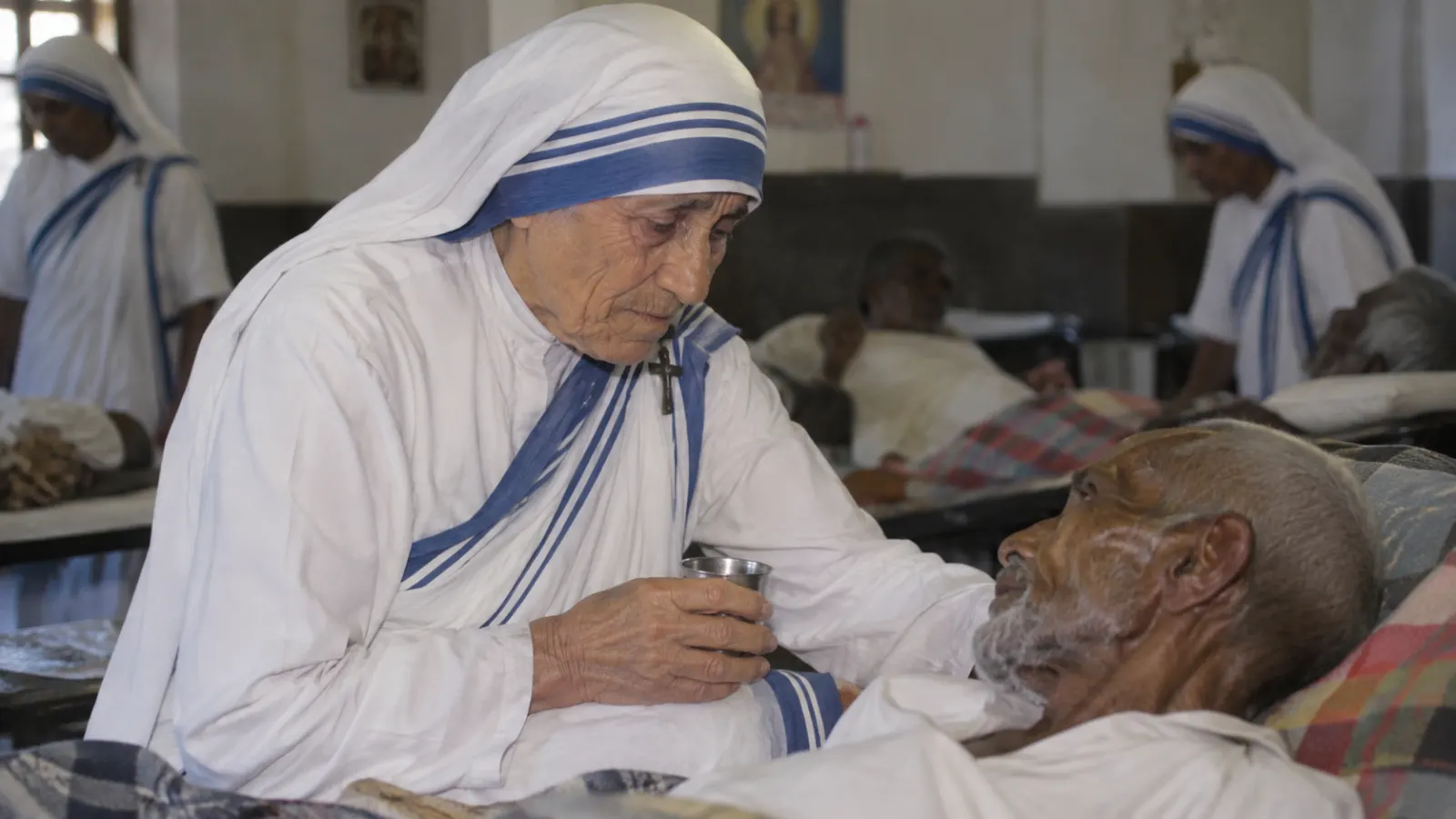
Few twentieth-century religious figures developed a public image as instantly recognisable as Mother Teresa. The white sari edged with blue became almost a uniform of compassion, while photographs of a small elderly nun holding children, touching the sick or sitting beside dying people circulated around the world. Presidents received her, popes praised her, donors supported her work and in 1979 she received the Nobel Peace Prize for her service to people living in extreme poverty and abandonment.
But a public symbol is not a complete biography. Before she became Mother Teresa of Calcutta, Agnes Gonxha Bojaxhiu spent almost two decades as a teacher and religious sister. Before the Missionaries of Charity became a global organisation, she had to obtain church approval, learn basic medical care, recruit followers and build institutions in Kolkata. Her work was explicitly Catholic rather than secular, and the international authority she gained through humanitarian service also gave enormous visibility to her conservative positions on abortion, family life and religion.
Her legacy is therefore difficult to reduce to either admiration or condemnation. The Missionaries of Charity undeniably created homes, shelters, schools and service networks for people whom other institutions often ignored. At the same time, credible questions have been raised about clinical standards, pain management, financial transparency, religious practice and the relationship between spiritual ideas about suffering and modern standards of care. A serious biography has to hold those realities together rather than choosing between the flawless saint and the fraudulent celebrity.
From Skopje to Calcutta
Mother Teresa was born Agnes Gonxha Bojaxhiu on 26 August 1910 in Uskup, then part of the Ottoman Empire and now Skopje in North Macedonia. Her family was Albanian and Roman Catholic, and after her father died while she was still young, her mother became the central influence in a strongly religious household. Later biographies describe Agnes as developing a missionary vocation during adolescence.
At eighteen she left home to join the Sisters of Loreto, an Irish Catholic congregation with missionary work in India. She travelled first to Ireland, where she learned English, and then to India in 1929. After religious formation in Darjeeling, she took the name Sister Mary Teresa after Thérèse of Lisieux, made her first vows in 1931 and her final vows in 1937, after which she became known as Mother Teresa within the Loreto community.
The familiar public story often jumps immediately from Europe to Calcutta's streets, but Mother Teresa actually spent roughly two decades inside the structured world of Catholic education. She taught at St Mary's School for girls in Calcutta and later became headmistress. Those years gave her experience in teaching, organisation, discipline and religious community life long before she founded an independent congregation.
Calcutta in the 1940s also exposed her to severe human suffering. The Bengal famine, wartime disruption and communal violence surrounding the end of British rule intensified poverty and displacement across the region. On 10 September 1946, while travelling by train to Darjeeling, Mother Teresa later said she experienced a decisive spiritual moment that she described as a “call within a call”—a conviction that she should leave the relative security of the convent and serve people living in extreme poverty directly.
She could not simply abandon her religious vows and begin independently. After seeking permission from church authorities, she left the Loreto convent in 1948 while remaining a Catholic nun. She adopted the simple white sari with blue border, completed basic medical training with the Medical Mission Sisters in Patna and returned to Calcutta, where she began teaching children in poor neighbourhoods, visiting families and caring for sick people. Former students and local women gradually joined her, and in 1950 the Missionaries of Charity was formally established in Calcutta.
The new congregation was humanitarian and religious at the same time. Its members took the traditional vows of poverty, chastity and obedience along with an additional commitment to serve what Mother Teresa called the “poorest of the poor.” She understood service to abandoned human beings as service to Christ himself. That theology helps explain both the extraordinary intensity of her commitment and some of the later controversies surrounding suffering, medicine and conversion.
Building the Missionaries of Charity and a global public image
One of the institutions most closely associated with Mother Teresa was the home for destitute and dying people established in 1952 near the Kalighat temple, commonly known as Nirmal Hriday. Its basic promise was simple: people who might otherwise die on the streets could be brought somewhere they would be washed, fed, sheltered and accompanied. The moral force of that promise should not be underestimated. Providing dignity, touch and companionship to people whom others avoided was itself meaningful.
At the same time, it is important to identify the institution accurately. Nirmal Hriday was not a modern tertiary hospital with specialist physicians, advanced diagnostics, laboratories and intensive care. It functioned much more like a religious charitable home for severely ill and dying destitute people. That distinction explains some of its limitations, but it does not remove the responsibility to ask whether people with treatable conditions were appropriately diagnosed, referred or given adequate pain relief.
The Missionaries of Charity expanded far beyond one home. The congregation developed services for children, homeless people, people affected by leprosy, people living with HIV/AIDS and others facing severe social exclusion. Over time it established houses across India and eventually around the world, together with branches for brothers, contemplative communities, priests, lay associates and volunteers.
Mother Teresa's international fame cannot be explained by organisational growth alone. Journalism, photography and television transformed her into a global symbol, with British writer and broadcaster Malcolm Muggeridge playing a particularly important role in introducing her work to Western audiences. Images of Mother Teresa holding a child or sitting beside a dying person made extreme poverty emotionally immediate to viewers thousands of kilometres away.
That media language was powerful because it reduced an enormous social problem to one recognisable moral action: help the person in front of you. It also had limitations. Questions about housing, public health, wages, caste, state capacity, inequality and social policy are much harder to communicate through a single photograph. Mother Teresa rarely presented herself as a political theorist or economic reformer; her method was deliberately personal, charitable and religious.
Supporters saw moral clarity in that approach. Critics sometimes saw a failure to confront the structural causes of poverty. Both perspectives identify something real. Structural reform can change conditions for millions of people, while it may still leave an abandoned individual needing food, shelter and companionship tonight. Mother Teresa largely chose the second field of action.
Her fame brought honours and a much larger platform. She received India's Padma Shri in 1962, the Nobel Peace Prize in 1979 and the Bharat Ratna in 1980. The Nobel Prize in particular transformed her from a famous religious worker into an international moral authority whose views were sought on questions far beyond poverty.
Those views were unmistakably Catholic. Mother Teresa strongly opposed abortion and spoke about family, sexuality and reproduction through conservative Catholic teaching. At the Nobel ceremony she used the global platform to present abortion as a profound threat to peace, a position strongly rejected by supporters of reproductive rights. A historically accurate biography should neither hide those beliefs nor assume disagreement with them invalidates every aspect of her humanitarian work.
Compassion, suffering and the controversy over medical care
The most serious criticism of Mother Teresa's institutions concerns the quality of medical care provided to gravely ill people. In 1994, Robin Fox, then editor of The Lancet, visited the Home for the Dying in Calcutta and published observations that later became central to debate about the Missionaries of Charity. He acknowledged the importance of accepting people whom other institutions had rejected, but he also raised concerns about limited investigation, inconsistent clinical decision-making and inadequate access to strong analgesia.
The surrounding debate needs context. India at the time had major barriers to opioid availability and severe limitations in palliative-care infrastructure. Strong pain medicines such as morphine were difficult to obtain in many parts of the country because of regulation and supply problems. Mother Teresa's facilities were also not designed or staffed as conventional hospitals. Those facts explain part of the environment in which care occurred, but they do not make questions about diagnosis, pain relief and referral irrelevant.
The most defensible conclusion is therefore specific rather than sensational. The Missionaries of Charity provided shelter, food, companionship and basic care to people who might otherwise have received almost nothing, while credible medical observers raised legitimate concerns about the clinical quality of some of that care. Both statements can be true.
A stronger allegation is frequently repeated online: that Mother Teresa deliberately withheld pain relief because she wanted people to suffer. Her spiritual language unquestionably assigned religious meaning to suffering, and some of her statements can sound disturbing to readers approaching pain entirely through modern clinical ethics. But interpreting suffering spiritually is not the same as proving deliberate infliction of preventable pain. Historical criticism is strongest when it remains tied to documented issues such as analgesia, investigation, referral and institutional standards.
This distinction points to a broader ethical problem that remains relevant far beyond Mother Teresa. Compassion and clinical competence are not substitutes. A dying person may need someone to hold their hand, but they may also need morphine. A homeless person may need food and acceptance while also having an infection that requires professional treatment. Refusing to abandon someone is morally important, but institutions caring for seriously ill people must also ask what competent medical care requires.
Religion, money and the responsibilities of a global institution
Mother Teresa's personal style was austere, but the organisation built around her became internationally powerful. Donations arrived from around the world, political leaders sought association with her and media attention gave the Missionaries of Charity enormous moral visibility. The congregation nevertheless remained organised primarily as a Catholic religious order rather than as a modern humanitarian NGO centred on extensive public reporting, impact metrics and contemporary financial disclosure.
That difference generated questions about accountability. Critics asked how donations were allocated and why some facilities remained materially basic despite the order's global fundraising power. Such questions are legitimate, but they should not automatically become allegations of personal theft or enrichment without supporting evidence. The more defensible issue is institutional: what level of transparency should be expected when a religious charity acquires international fundraising power and assumes responsibility for extremely vulnerable people?
Mother Teresa's relationships with controversial donors created a similar ethical problem. She accepted donations, honours or public association from people whose political or financial conduct attracted criticism. Defenders argued that money used to care for poor people should not be rejected merely because the donor was morally compromised. Critics argued that accepting support could confer legitimacy on people seeking reputational benefit through association with her.
That dilemma is not unique to Mother Teresa. Universities, hospitals, museums and charities still confront the same question: can questionable money be morally separated from the person who gives it? Receiving a donation does not automatically establish political agreement, but powerful institutions still need principles for deciding which relationships compromise their own moral credibility.
Religion created another layer of controversy. The Missionaries of Charity was a missionary Catholic organisation, and its humanitarian work cannot be separated historically from its religious purpose. Critics have alleged inappropriate conversion practices, including baptism around the time of death. Evidence is uneven across decades, countries and thousands of individual encounters, so sweeping claims are difficult to sustain.
The safest conclusion is that Mother Teresa's work was both humanitarian and evangelical. Service was offered through a specifically Christian understanding of human dignity and salvation. Evangelisation is not automatically equivalent to forced conversion, but neither should the religious purpose be erased in order to present the Missionaries of Charity as a secular welfare organisation.
Private spiritual darkness behind public certainty
One of the most striking complications in Mother Teresa's biography emerged only after her death. Publicly, she appeared almost completely certain of God's presence and spoke with great confidence about Christ, prayer and religious vocation. Private letters later revealed that she experienced long periods of what she described as spiritual darkness—an absence of felt divine consolation and a painful sense of separation from God.
These writings do not demonstrate that her public faith was fraudulent. Within Catholic spirituality, church interpreters understood the experience through traditions of spiritual desolation or the “dark night,” arguing that continuing to serve without emotional consolation demonstrated unusual fidelity. Secular readers may interpret the letters differently, but they clearly reveal a psychologically more complicated person than the uncomplicated icon of constant religious certainty.
The contrast also helps explain the severity of her religious discipline. Her vocation did not appear to depend on continually feeling rewarded by faith. She continued working while describing profound interior emptiness. That same spiritual framework placed sacrifice, suffering and self-denial within a religious meaning that can be difficult to reconcile with modern assumptions that suffering should always be minimised whenever possible.
This does not resolve the controversy surrounding her institutions, but it does make simplistic explanations less convincing. Mother Teresa was not merely promoting suffering from a comfortable distance; she understood suffering through a demanding theology that also shaped her own life. Whether that theology always produced appropriate institutional decisions is a separate question.
Death, sainthood and a legacy that resists simple verdicts
Mother Teresa died in Kolkata on 5 September 1997, aged 87. Her funeral became a major public event and reflected the unusual position she occupied in India and internationally. Although born in the Balkans, she had become an Indian citizen, spent most of her adult life in Kolkata and received both the Bharat Ratna and a state funeral.
Her place in Indian memory nevertheless remains contested. For many people, she represents service without regard to caste, wealth or religion. Some critics view her international image as reinforcing a foreign representation of India centred disproportionately on poverty and helplessness, while others connect criticism of her to wider political arguments over Christianity, missionary work and national identity.
A balanced history should avoid turning her into a proxy for all those debates. Kolkata's poverty and abandoned populations were real. So were India's enormous scientific, political, cultural and economic achievements beyond the images foreign media chose to emphasise. Mother Teresa served one part of Indian reality; she never represented the whole country.
The Catholic Church moved quickly toward formal sainthood after her death. Pope John Paul II allowed the process to begin sooner than the normal waiting period, she was beatified in 2003 and Pope Francis canonised her on 4 September 2016 as Saint Teresa of Calcutta. Catholic canonisation includes investigation of a candidate's life and, in relevant cases, reported miracles attributed to intercession.
Journalistically, those miracle claims should be described according to their evidentiary category. The Catholic Church accepts them through its canonical process and believers may understand them as supernatural events. A secular historical article should report that religious judgment without presenting it as a scientific conclusion binding on every reader.
Mother Teresa's broader legacy deserves the same evidentiary discipline. Her organisations served people who were frequently ignored or rejected, and thousands of sisters, volunteers and supporters were inspired by her example. At the same time, critics forced important questions about the difference between compassionate intention and clinical quality, simplicity and inadequate resources, spiritual authority and institutional accountability.
The strongest assessment therefore resists verdict culture. Mother Teresa was neither reducible to the saintly photograph nor disproved by every accusation made against her. She was a Catholic religious founder who built an extraordinary global charity, devoted enormous attention to abandoned people, promoted moral positions many readers reject and governed institutions whose medical practices have faced credible criticism.
Her life ultimately raises a question larger than one woman: what does compassion require once compassion becomes an institution?
At the level of a personal encounter, her moral principle remains powerful. Do not leave someone alone because they are dirty, sick, dying or unwanted. Do not decide that a human being has no value because society has stopped paying attention to them.
At the institutional level, however, love is not the only obligation. Pain relief matters. Diagnosis matters. Referral matters. Transparency matters. Ethical use of money matters. Religious freedom matters. Accountability matters.
That is why Mother Teresa's historical legacy remains difficult and compelling. She gave the twentieth century one of its simplest moral images: one human being refusing to abandon another. Her biography becomes more complicated—and more meaningful—when we ask what responsibilities follow once that act of mercy grows into a powerful global institution.