Mahatma Gandhi remains one of the rare modern political figures whose influence cannot be measured only by office, territory, law, or military victory. He never became prime minister, never commanded an army, and never built a state through force. Yet he altered the moral vocabulary of politics in India and far beyond it. His public life made a difficult proposition visible: that mass politics could be organised around conscience, discipline, self-suffering, and non-violent resistance rather than fear, revenge, or armed insurrection. For India, Gandhi became inseparable from the struggle against British rule. For the wider world, he became a symbol of how the weak could confront concentrated power without surrendering their humanity.
Gandhi’s legacy is also complicated because he was not merely a nationalist leader. He was a lawyer, organiser, religious seeker, social reformer, political strategist, writer, experimenter, and critic of modern civilisation. He spoke the language of truth, but his truth was not abstract. It had to be tested in the body, in the village, in food, in labour, in clothing, in prison, and in public action. His politics asked Indians not only to demand independence from the British but also to examine their own society: caste oppression, untouchability, communal hatred, economic exploitation, dependence on foreign goods, and moral cowardice. This is why Gandhi cannot be reduced to the image of a saint with a spinning wheel. He was a restless political worker who turned ordinary habits into instruments of resistance.
Mohandas Karamchand Gandhi was born on 2 October 1869 in Porbandar, in present-day Gujarat. He grew up in a family connected to princely administration, where public duty, religion, and social discipline formed part of everyday life. His father, Karamchand Gandhi, served as a diwan, while his mother, Putlibai, left a deep impression on him through devotional practices, fasting, and ethical seriousness. Gandhi’s childhood did not announce greatness. He was shy, often anxious, and not an especially brilliant student. But the habits of introspection that later shaped his politics were present early. He watched himself closely. He treated failures not as private embarrassments but as material for moral education. This tendency would become central to his public life: Gandhi constantly narrated his own experiments so that others could treat politics as a process of self-correction.
In 1888, Gandhi travelled to London to study law. London exposed him to a wider world of ideas, manners, and debates. He experimented with diet, dress, religion, and self-discipline. He read Hindu, Christian, and other ethical literature and began to develop a habit of comparing civilisations without fully surrendering to any one of them. When he returned to India as a barrister, he did not immediately succeed. He was hesitant in court and uncertain about his professional future. The decisive turn came not in India but in South Africa, where he went in 1893 for a legal assignment. What began as a professional opportunity became the laboratory in which Gandhi discovered his political vocation.
South Africa changed Gandhi because it forced him to confront racial humiliation and legalised inequality directly. The famous railway incident at Pietermaritzburg, where he was removed from a first-class compartment despite holding a valid ticket, became a defining moment not because it was the only injustice he faced but because it exposed the structure of empire in everyday life. Indians in South Africa were merchants, labourers, clerks, and professionals, but colonial society treated them through racial hierarchy. Gandhi first responded as a lawyer defending community rights, but gradually his work expanded into public mobilisation. He organised petitions, meetings, newspapers, legal campaigns, and disciplined protests. He learned how to negotiate with authorities, how to hold together diverse Indian communities, and how to turn humiliation into organised resistance.
It was in South Africa that Gandhi developed satyagraha, a term often translated as “truth-force” or “soul-force.” Satyagraha was not passive submission. It required courage, restraint, willingness to suffer, and refusal to hate the opponent. Gandhi’s idea was that unjust law could be opposed openly and non-violently by accepting punishment rather than obeying immoral authority. This transformed the meaning of political strength. A satyagrahi did not seek to destroy the adversary but to appeal to conscience, public reason, and moral pressure. The method was difficult because it demanded discipline from participants. Violence could destroy the moral legitimacy of a campaign. Fear could break it. Ego could corrupt it. Gandhi’s later Indian politics drew deeply from this South African apprenticeship.
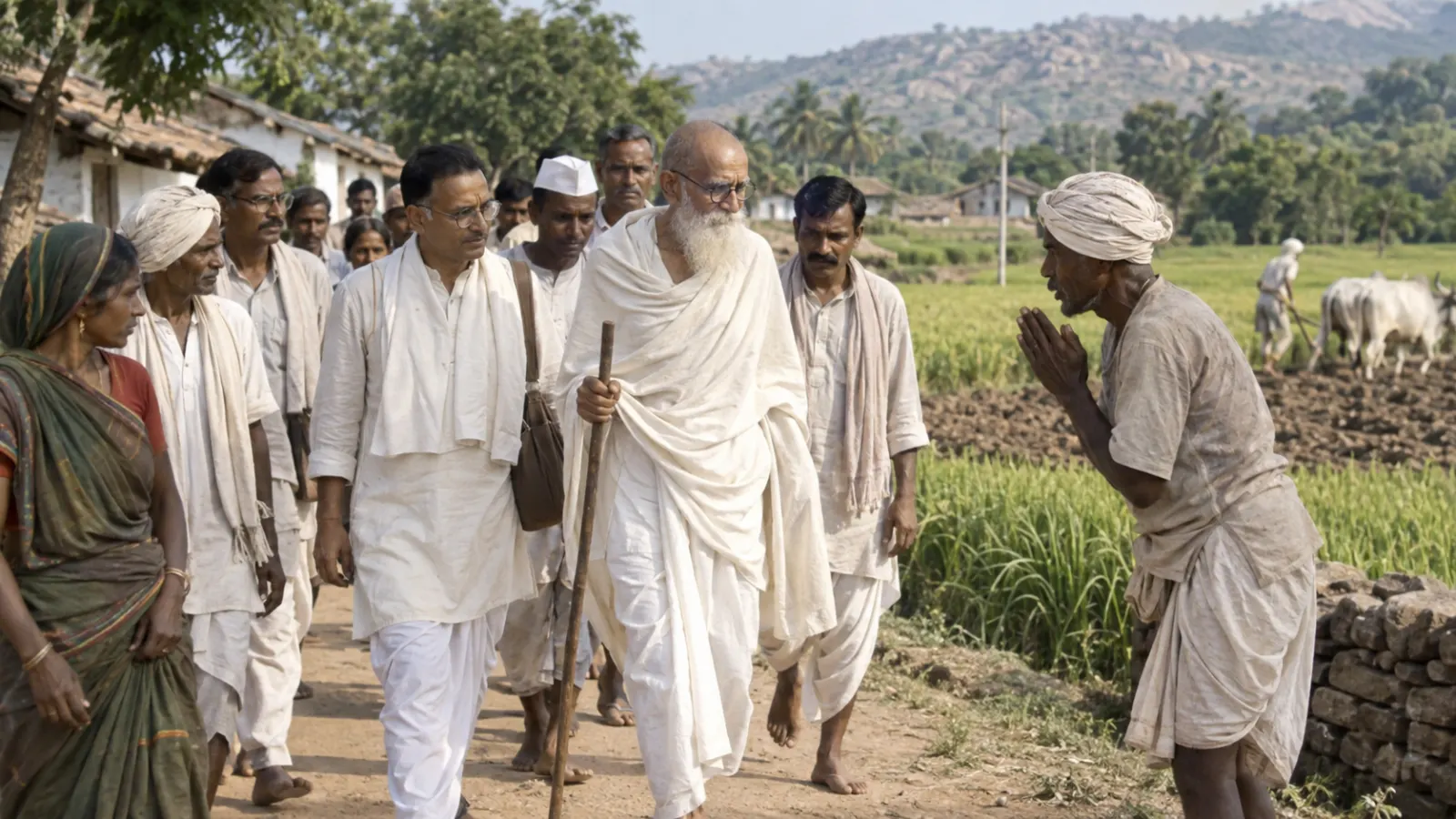
When Gandhi returned to India in 1915, he was already known among nationalists, but he did not immediately take command of the freedom movement. He travelled, observed, listened, and learned from Indian conditions. Gopal Krishna Gokhale’s influence encouraged him to understand the country before leading it. Gandhi’s early interventions in India were local, practical, and rooted in specific grievances. Champaran in 1917, Kheda in 1918, and Ahmedabad mill workers’ dispute showed his method in action. In Champaran, indigo cultivators suffered under oppressive plantation arrangements. Gandhi turned inquiry into mobilisation and made the suffering of peasants a national political issue. In Kheda, he supported peasants facing revenue demands despite crop failure. In Ahmedabad, he mediated between mill workers and owners while using fasting as moral pressure.
These early struggles mattered because they changed the social base of Indian nationalism. Before Gandhi, much of nationalist politics was dominated by educated elites, petitions, constitutional demands, and urban leadership. Gandhi did not reject leadership or institutions, but he expanded the arena of politics. Peasants, workers, women, students, merchants, and village communities could become participants in the national struggle. He also changed the symbols of politics. Khadi, the spinning wheel, salt, fasting, prayer meetings, marches, and jail-going became political acts. His genius lay in making complex political questions understandable through simple actions. A poor person who could not write a constitutional argument could still spin, boycott foreign cloth, join a procession, or refuse cooperation with injustice.
The Non-Cooperation Movement, launched after the trauma of the First World War, the Rowlatt Acts, and the Jallianwala Bagh massacre, demonstrated Gandhi’s ability to convert public anger into organised national action. He called upon Indians to withdraw cooperation from British institutions: titles, schools, courts, councils, and foreign goods. The movement gave millions a sense that empire depended not only on British power but also on Indian participation. If Indians withdrew consent, the moral and administrative foundation of colonial rule would weaken. Yet Gandhi suspended the movement after the violence at Chauri Chaura in 1922, where protesters killed policemen. This decision shocked many nationalists who felt the movement was near success. But for Gandhi, means and ends were inseparable. Freedom achieved through uncontrolled violence would reproduce domination in another form.
The suspension of Non-Cooperation reveals one of the central tensions in Gandhi’s career. He was a mass leader, but he feared the destructive power of undisciplined mass anger. He wanted to awaken the people, yet he insisted that awakening must be morally trained. Critics saw this as excessive moralism and sometimes as strategic weakness. Revolutionaries argued that colonial violence could not be defeated by self-suffering alone. Constitutionalists worried about instability. Socialists later found Gandhi’s economic ideas insufficiently structural. Ambedkar challenged Gandhi sharply on caste and the representation of the oppressed. These critiques are essential to understanding Gandhi seriously. He was not beyond debate. His leadership existed within intense arguments about the meaning of freedom, justice, and modernity.
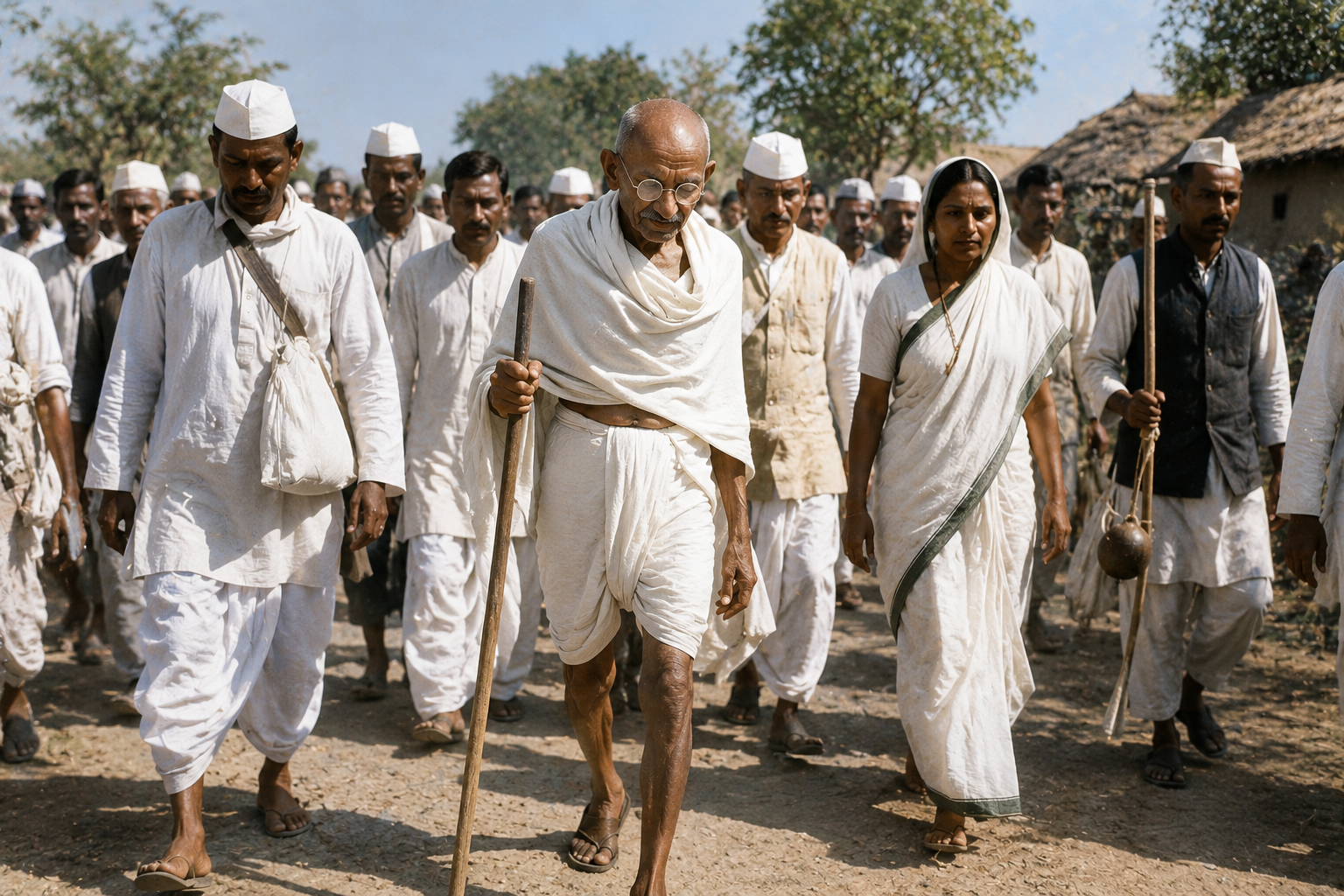
The Salt March of 1930 remains one of the most powerful acts of political theatre in modern history. By choosing salt, Gandhi selected a substance used by rich and poor alike. The British salt tax was not the largest injustice of empire, but it symbolised the intrusion of colonial authority into basic life. Gandhi and his followers walked from Sabarmati Ashram to Dandi, where he broke the salt law by making salt from seawater. The act was simple, visual, and impossible to ignore. It spread across India and drew global attention. The march showed Gandhi’s extraordinary ability to select symbols that compressed economics, law, dignity, and mass participation into a single gesture. It also showed his understanding of media and moral spectacle. Empire appeared powerful; Gandhi made it look morally absurd.
Gandhi’s politics was never only anti-British. He repeatedly insisted that swaraj meant more than transfer of power. Swaraj meant self-rule at multiple levels: personal self-control, village autonomy, communal harmony, social equality, and national independence. His constructive programme included khadi, village industries, basic education, sanitation, Hindu-Muslim unity, prohibition, women’s participation, and the campaign against untouchability. The constructive programme is sometimes treated as secondary to the dramatic movements, but Gandhi saw it as the foundation of freedom. A nation that merely expelled foreign rulers while keeping internal oppression intact would not be truly free. For him, political independence without social reform would be hollow.
His campaign against untouchability was one of the most visible parts of his social reform. Gandhi called the oppressed castes “Harijan,” a term later criticised and rejected by many Dalit thinkers, but his intention was to attack social stigma within Hindu society. He opened ashram life to those considered untouchable, travelled widely to campaign against the practice, and linked social reform with national morality. Yet this is also an area where Gandhi’s legacy faces serious critique. B R Ambedkar argued that caste oppression required political safeguards, legal rights, representation, and annihilation of caste hierarchy, not merely reform of Hindu conscience. The Poona Pact of 1932, reached after Gandhi’s fast against separate electorates for the depressed classes, remains one of the most debated episodes in modern Indian history. Gandhi feared social fragmentation; Ambedkar feared continued caste domination. Their conflict shows that Indian freedom was not a single moral project but a field of competing emancipations.
Gandhi’s relationship with religion also shaped both his appeal and controversy. He was deeply religious, but not in a narrow sectarian sense. He drew from the Bhagavad Gita, Jain and Vaishnava traditions, Christianity, Islam, and other ethical sources. His public prayers included multiple traditions, and he repeatedly argued that true religion required humility, service, and respect for others. However, his use of religious vocabulary in politics has been debated. Supporters argue that he translated politics into an ethical language accessible to ordinary Indians. Critics argue that religious idiom could blur the line between public reason and spiritual authority. What is clear is that Gandhi fought communal hatred with unusual persistence. During Partition, when large parts of North India burned with violence, Gandhi walked through riot-torn communities, fasted, prayed, and pleaded for sanity. At a moment when many celebrated independence, he was absorbed by the moral wound of communal bloodshed.
The Quit India Movement of 1942 marked Gandhi’s final major mass confrontation with British rule. With the Second World War underway and Britain claiming to defend freedom globally while denying it in India, Gandhi gave the call of “Do or Die.” The British responded with immediate arrests of Gandhi and Congress leaders. The movement became decentralised and often turbulent. Gandhi spent much of the period in detention, facing personal loss, including the death of his wife Kasturba in 1944. Quit India did not immediately remove British rule, but it made clear that India could no longer be governed indefinitely without Indian consent. It also revealed the limits of colonial legitimacy after decades of nationalist mobilisation.
Gandhi’s personal life was inseparable from his political experiments, and it remains one of the most debated parts of his biography. His vows regarding diet, celibacy, simplicity, manual labour, and bodily discipline were meant to align life with truth. Yet some of his experiments, especially in later years, have drawn ethical criticism. A mature biography cannot hide these controversies. Gandhi invited scrutiny because he made his life public. He believed leaders must subject themselves to discipline before asking sacrifice from others. But the same openness exposes him to questions about authority, gender, emotional demands on associates, and the boundaries of moral experimentation. His greatness does not require ignoring these questions. In fact, his life becomes more historically meaningful when seen as a field of struggle rather than as a flawless monument.
Gandhi was assassinated on 30 January 1948 in Delhi by Nathuram Godse, a Hindu extremist who opposed Gandhi’s approach to Muslims and Pakistan. The assassination came only months after independence and Partition. It revealed the depth of ideological hatred Gandhi had resisted. His death shocked India and the world, but it also froze him into a symbol. The living Gandhi was argumentative, strategic, demanding, and experimental. The posthumous Gandhi became easier to praise and easier to simplify. Nations put him on currency, statues, stamps, and school walls. But the harder task is to understand what his method demands: courage without hatred, politics without dehumanisation, criticism without revenge, and freedom without moral laziness.
Globally, Gandhi’s influence travelled through movements for civil rights, anti-colonial liberation, peace activism, and non-violent resistance. Martin Luther King Jr., Nelson Mandela, and many other leaders engaged with Gandhi’s example, though each adapted it to different historical conditions. Gandhi did not invent non-violence, but he gave it a modern political architecture. He showed that disciplined non-cooperation could challenge systems that appeared invincible. His influence also extended to debates on development, ecology, decentralisation, and critique of consumerism. Long before climate anxiety became mainstream, Gandhi warned against unlimited wants and exploitative industrial civilisation. His famous moral economy asked whether the earth could satisfy need rather than greed.
For contemporary India, Gandhi remains both foundational and uncomfortable. He is invoked by almost every political tradition, yet his actual ideas challenge many forms of politics. He would be uncomfortable with communal hatred, political cruelty, caste arrogance, mindless consumption, and public life without truthfulness. He would also challenge citizens, not only rulers. Gandhi did not believe that the people were innocent by default. He expected self-discipline, courage, service, and willingness to confront injustice without becoming unjust. This is why his legacy cannot be reduced to nostalgia. Gandhi is not merely part of India’s past; he is a test of India’s public ethics.
The life of Mahatma Gandhi is ultimately the story of a person who converted vulnerability into power. His thin body, simple dress, and quiet speech became instruments of mass mobilisation because they carried moral meaning. He understood that empire ruled through law, violence, prestige, economics, and psychological submission. Against this he placed truth, non-cooperation, sacrifice, and collective awakening. He did not win every argument. He did not solve every contradiction. But he changed the scale of what politics could mean. He made freedom a moral discipline rather than only a constitutional demand. That is why Gandhi’s legacy continues to matter: not because he was perfect, but because he forced politics to answer a question it often avoids—what kind of human beings do we become while fighting for power?
Another reason Gandhi’s life continues to invite study is the way he redefined leadership itself. He did not present leadership as command from above. He tried to make leadership visible through personal example. If he asked Indians to wear khadi, he wore it himself. If he criticised untouchability, he brought the question into ashram life. If he demanded restraint from protesters, he accepted restraint as a personal discipline. This did not make him free from contradiction, but it created a rare form of political credibility. People who disagreed with Gandhi still had to confront the fact that he was willing to suffer for what he preached. In colonial India, where many leaders spoke of sacrifice, Gandhi turned sacrifice into daily method.
His ashrams were also political institutions, though they did not look like parties or offices. Sabarmati and Sevagram were places where ideas were tested through routines: prayer, spinning, sanitation, collective labour, education, diet, and inter-caste living. The ashram was a miniature republic of discipline. It trained workers for movements, but it also exposed tensions between Gandhi’s ideals and human complexity. Associates sometimes found his expectations severe. Yet the ashrams show that Gandhi did not imagine politics as an event that happened only in legislatures or protests. For him, the future nation had to be rehearsed in small communities before it could be demanded from the state.
Gandhi’s communication style deserves equal attention. He wrote constantly: letters, articles, statements, appeals, and reflections. Through journals such as Young India and Harijan, he spoke to supporters, critics, officials, and ordinary readers. His prose was usually direct rather than ornamental. He explained why he acted, admitted errors, clarified principles, and responded to objections. This habit made his politics transparent in an unusual way. It also allowed him to guide movements even when not physically present. In an age before television and social media, Gandhi understood that political authority depends on narrative. He shaped the story of each campaign so that participants understood its moral purpose.
His influence on women’s political participation was also significant. Gandhi’s movements brought many women into public protest, picketing, spinning, boycott campaigns, and jail-going. Leaders such as Sarojini Naidu, Kasturba Gandhi, Kamaladevi Chattopadhyay, Sucheta Kripalani, and countless unnamed local workers became part of a broader transformation in nationalist public life. Gandhi did not hold modern feminist views in every respect, and his ideas on gender often carried assumptions about sacrifice, purity, and maternal strength. But his mass politics opened spaces for women to enter anti-colonial action in unprecedented numbers. This changed both the freedom movement and the social imagination of citizenship.
Finally, Gandhi’s relevance rests on the fact that he treated moral means as political infrastructure. Modern politics often excuses cruelty by invoking necessity. Gandhi reversed that logic. He argued that the road to freedom shapes the character of freedom itself. If a movement normalises hatred, it may inherit power without healing society. If it trains people in courage, restraint, and truthfulness, it may create citizens capable of sustaining freedom. This is the deepest reason his legacy survives beyond the end of British rule. Gandhi matters whenever politics faces the temptation to win by destroying the humanity of the opponent.
This is why any serious profile of Gandhi must hold together admiration and scrutiny. The safest Gandhi is the simplified Gandhi: harmless, smiling, detached from conflict. The historical Gandhi was far more demanding. He asked the colonised to stop cooperating with domination; he asked privileged Indians to confront social injustice; he asked religious communities to control hatred; he asked political workers to accept prison; and he asked himself to turn life into an experiment. His legacy begins where comfortable praise ends.