Vinoba Bhave: Bhoodan, Sarvodaya and Non-Violent Reform
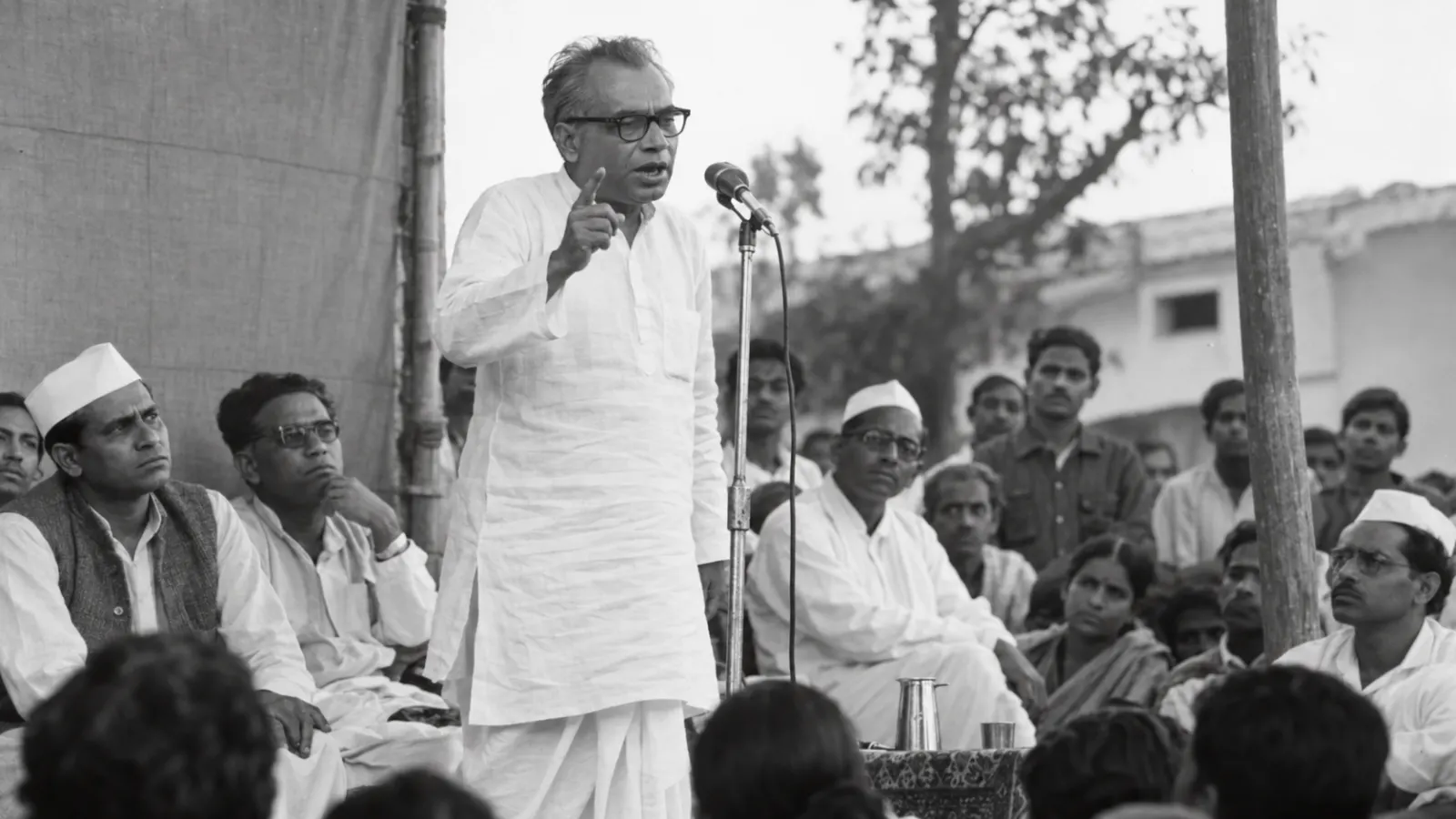
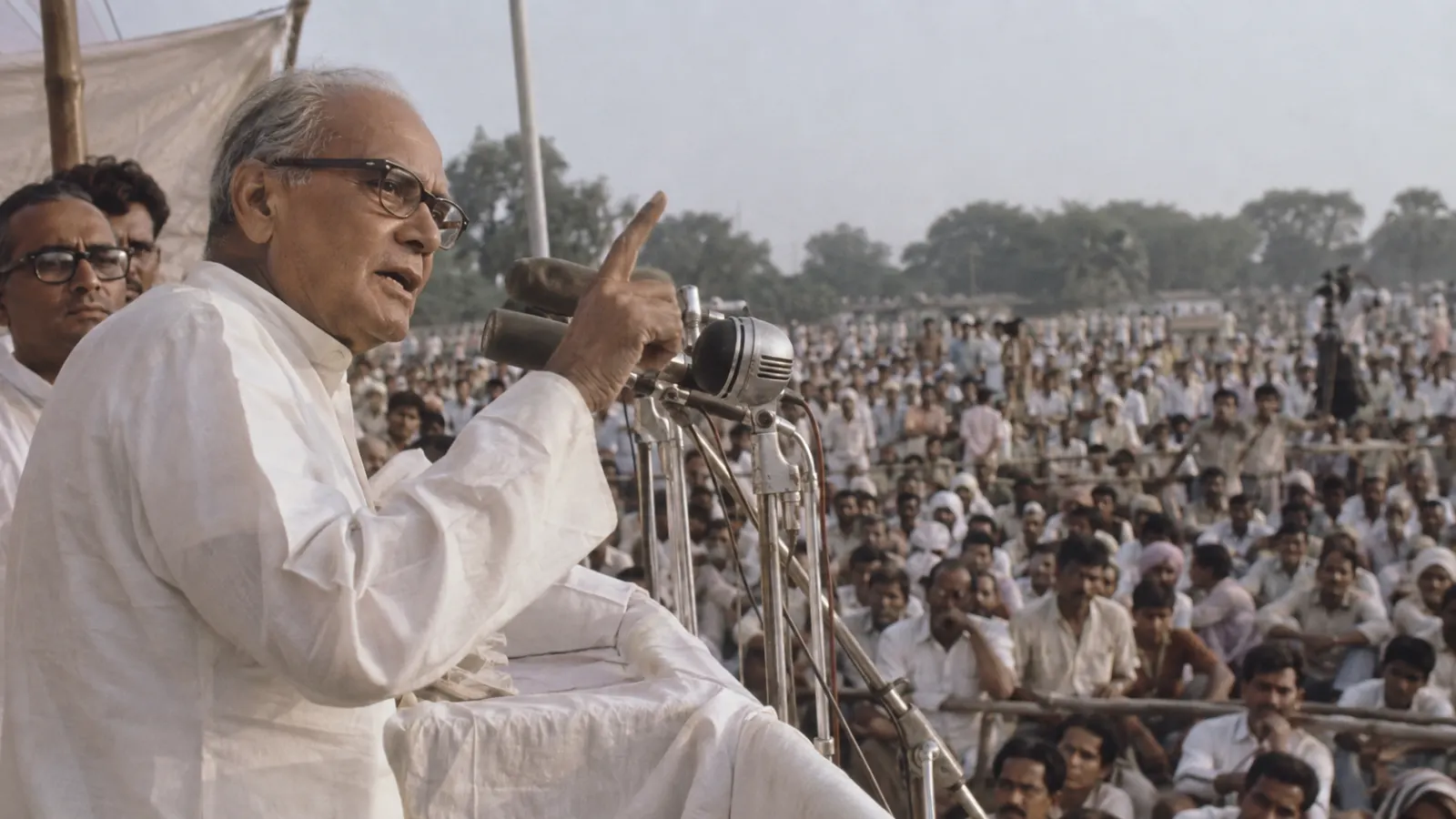
Vinoba Bhave became one of the most distinctive political activists of independent India by attempting something that appeared almost impossible: walking from village to village and persuading landowners to give part of their land to people who had none. The Bhoodan movement that emerged from this method was neither a conventional government redistribution programme nor a revolutionary seizure of private property. It relied on persuasion, public moral pressure, Gandhian non-violence, religious language and the symbolic power of asking property owners face to face whether land carried obligations beyond legal ownership.
The scale of that experiment made Vinoba the most prominent Gandhian activist in India after Gandhi's death, but Bhoodan was only one part of his life. He was also a religious thinker, translator, educator, organiser of constructive work, freedom fighter, prison teacher and theorist of Sarvodaya, the welfare or uplift of all. Across these roles ran one persistent conviction: political institutions could change laws, but durable social change also required changes in conduct, desire and relationships.
That conviction gave his activism unusual moral force. It also exposed its greatest weakness. Voluntary action can mobilise conscience where law cannot, but conscience alone cannot resolve every conflict involving property, caste, class, administration and unequal power.
Vinoba's political significance lies precisely in that tension.
He spent his life asking whether justice could be pursued without hatred, whether ownership could be redistributed without violent seizure and whether moral transformation could do political work normally assigned to the state.
His answers were incomplete.
The experiment was not.
From Gandhi's Ashram to a Politics of Constructive Work
Vinayak Narhar Bhave was born in 1895 at Gagode in Maharashtra's Konkan region and spent much of his student life in Baroda. Accounts preserved in the Vinoba archive emphasise the influence of both parents: a rational and scientific disposition associated with his father, and a devotional, sharing-oriented outlook associated with his mother. He read widely, developed an intense interest in spiritual discipline and increasingly felt that conventional education was inadequate for the life he wanted to pursue.
In 1916, he left the expected academic path and travelled toward Varanasi, where religious study overlapped with growing nationalist politics. The decisive turn came when he encountered Gandhi's attempt to unite personal discipline, public service and political struggle. Vinoba met Gandhi in Ahmedabad in June 1916 and joined the ashram world that would shape the rest of his life.
Ashram activity could appear modest compared with elections, mass rallies or legislative battles. It involved spinning, sanitation, manual labour, teaching, study and village work. But Gandhian politics treated these activities as part of freedom itself. Colonial rule, caste hierarchy and dependence had weakened social capacities; self-rule therefore required people capable of cooperation, manual dignity, self-discipline and local organisation.
Gandhi later sent Vinoba to Wardha, where he became deeply involved in education and village-service work. He avoided conventional political celebrity and formal office, but that did not mean withdrawal from politics. His theory of power was simply different. Authority, in his view, could be built through disciplined service rather than captured only through institutions.
This approach remained visible during the freedom struggle. Vinoba was imprisoned several times and, in 1940, Gandhi selected him as the first individual satyagrahi in a campaign challenging restrictions on anti-war speech. The choice was symbolically important because Vinoba was not then one of the Congress's most famous public politicians. Gandhi presented him instead as a representative of principled non-violence and constructive work.
Prison became another site of political education. At Dhulia jail in 1932, Vinoba delivered discourses on the Bhagavad Gita that later circulated widely as Gita Pravachane. His Marathi rendering, Gitai, and other writings reflected an effort to make religious and philosophical ideas accessible beyond scholarly elites. Scripture, for Vinoba, was not a retreat from politics. Ideas such as non-possession, discipline, duty and self-control became part of his understanding of social transformation.
After Gandhi's assassination in 1948, the question facing his followers was difficult: could Gandhian methods remain politically relevant after colonial rule had ended and democratic state institutions had acquired legitimacy?
Vinoba's answer was Sarvodaya.
Sarvodaya sought a social order that rejected both extreme economic concentration and authoritarian revolution. It emphasised decentralisation, voluntary cooperation, trusteeship, village self-rule and non-violence. Vinoba did not believe that capitalism's inequalities could simply be accepted, but he was equally suspicious of revolutionary politics built around coercion and class hatred.
His alternative was radical in ambition and deliberately non-coercive in method.
That would soon be tested through land.
Pochampalli and the Birth of Bhoodan
The moment that transformed Vinoba's public life came on 18 April 1951 at Pochampalli in Telangana. The region had recently experienced deep agrarian conflict and communist-led insurgency. Landlessness was therefore not an abstract ethical problem; it was embedded in poverty, caste, tenancy, political violence and struggles over rural power.
During Vinoba's visit, landless Dalit families raised their need for land. A local landowner responded by offering 100 acres.
Vinoba interpreted the offer as more than charity.
If one landowner could voluntarily transfer land after public moral appeal, perhaps the act could be repeated. From that encounter emerged Bhoodan Yajna, the land-gift movement.
The language of yajna, or sacrifice, was important. Vinoba did not want land donation understood simply as benevolence toward the poor. His rhetoric questioned the moral absolutism of private property. Land, like other essential natural resources, carried social obligations. The owner was not being asked merely to become generous; he was being asked to recognise a claim of justice.
This linked Bhoodan to Gandhi's concept of trusteeship, though Vinoba developed the argument in his own way. Legal ownership could exist, but ownership did not eliminate social responsibility. A person's right to possess had to be considered alongside another person's need to live.
The distinction between charity and justice was philosophically powerful.
Administratively, however, it was also the beginning of Bhoodan's central problem.
A moral claim is not the same thing as a legally enforceable right.
Vinoba's response was to take the movement onto the road.
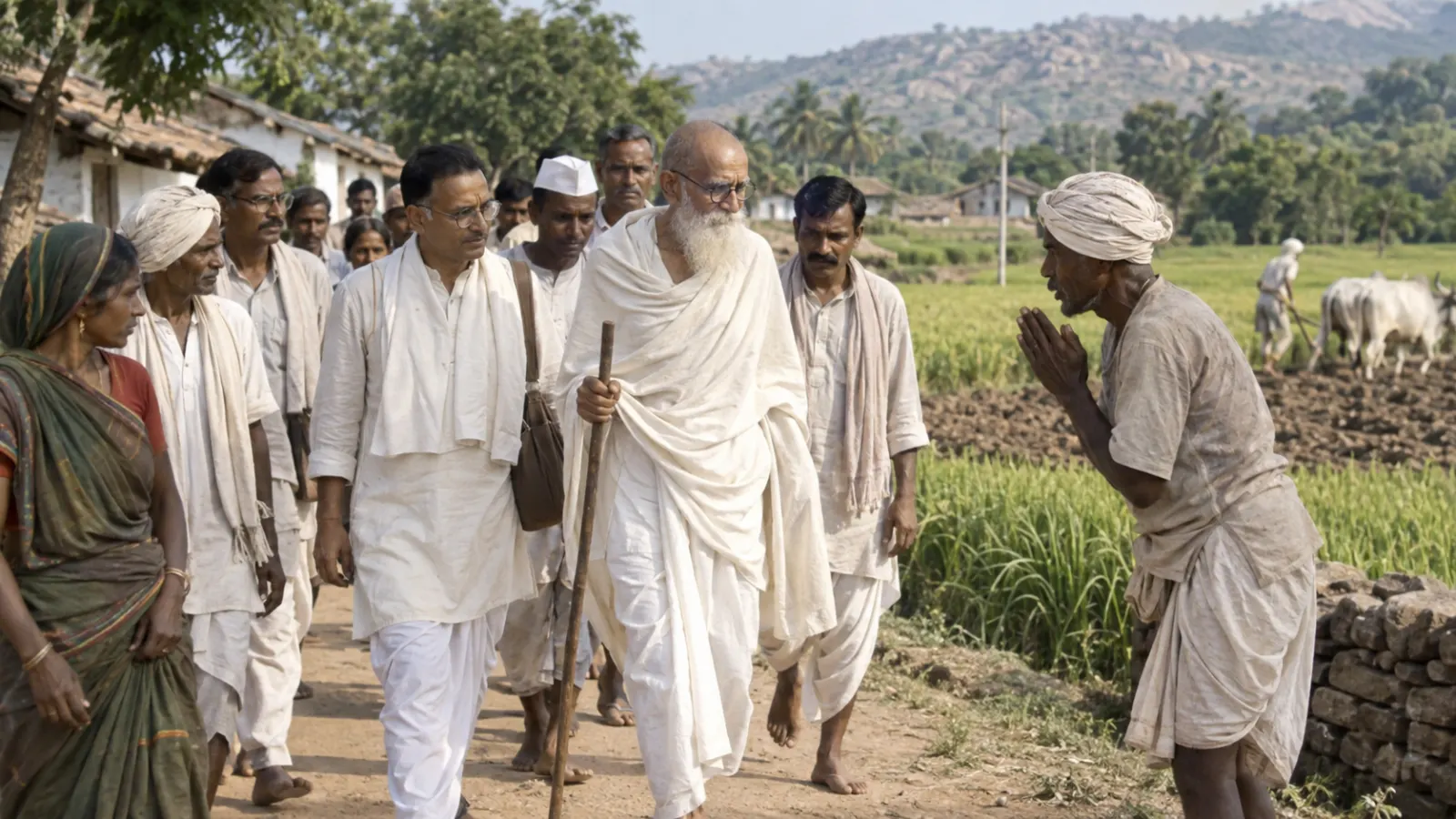
The official archive records a padayatra lasting roughly thirteen years and covering around 65,000 kilometres. Walking was not merely transportation. It was the movement's political technology.
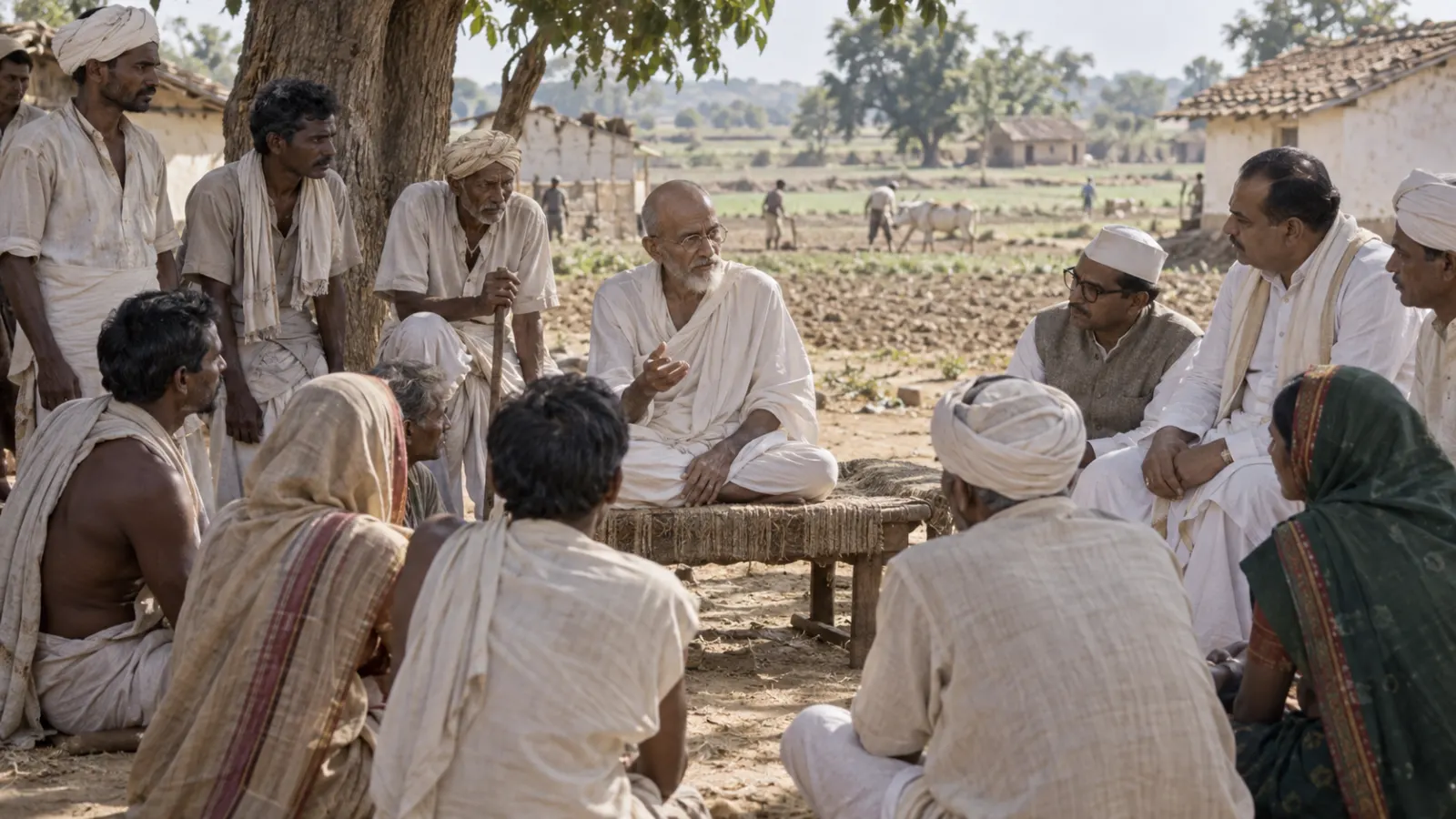
A padayatra slowed politics down to a human scale. Villagers could see Vinoba, question him, attend meetings and watch landowners make commitments publicly. Instead of a distant organisation issuing instructions, the movement travelled physically through village society.
Walking also drew on older traditions of pilgrimage, but Vinoba transformed pilgrimage into social action. The journey created a moving political institution held together by persuasion rather than bureaucracy.
That method produced extraordinary mobilisation.
It also created a gap between commitment and implementation.
A promise made in a village meeting still had to become a legally transferable, cultivable and usable plot in the possession of a landless family. Records had to be verified. Ownership disputes had to be resolved. Land might be barren, encumbered or otherwise unsuitable. Beneficiaries needed access not only to title but often to credit, irrigation, markets and local institutions.
The strength of padayatra was moral mobilisation.
The weakness was what came after the meeting ended.
From Bhoodan to Gramdan: Can Voluntary Ethics Become Institutions?
As the movement expanded, Vinoba moved beyond individual land gifts toward the more ambitious idea of Gramdan, or village gift. Instead of asking isolated landowners to surrender particular plots, Gramdan encouraged entire communities to reconsider landownership within a collective village framework.
The idea reflected Vinoba's broader political philosophy. Redistribution alone was insufficient if the underlying relationship between individuals, property and community remained unchanged. Gramdan therefore aimed at decentralised self-rule and cooperative management, not simply transfer of acreage.
This ambition also revealed an important paradox.
A movement defined by voluntary action increasingly needed law.
Several states passed legislation connected with Bhoodan and Gramdan because promises had to be recorded, transfers legally recognised and beneficiaries protected. Voluntary moral commitment required institutional form if it was to survive beyond the moment of persuasion.
That interaction with the state complicates the familiar image of Vinoba as someone simply offering a non-governmental alternative to land reform. In practice, voluntary mobilisation and public authority became intertwined.
The figures associated with Bhoodan demonstrate both the scale of the mobilisation and the need for caution. The official Vinoba archive reports roughly 4.8 million acres received and around 2.5 million acres distributed. These numbers are substantial, but they should not be treated as if every pledged acre immediately became secure and productive land in the hands of a landless cultivator.
“Received” could encompass land moving through different stages under different state arrangements. Some plots were disputed, unsuitable or difficult to transfer. The gap between promised land and effective possession became one of the central criticisms of the movement.
The strongest assessment therefore lies between celebration and dismissal.
Bhoodan did transfer substantial land in some places and transformed land inequality into a national moral issue. It demonstrated that property owners could, under particular social pressure, voluntarily surrender land on an enormous scale.
It did not create a complete substitute for statutory land reform, revenue administration or long-term rural development.
Jawaharlal Nehru understood this tension clearly. He publicly praised Vinoba and the moral importance of Bhoodan, but in 1953 warned that governments should not treat the movement as an excuse to avoid legislation.
The contrast between them captures a larger democratic question.
What kinds of change should movements produce, and what requires institutions?
Vinoba believed deeply in society's capacity for self-transformation. Nehru's position recognised that land records, enforcement and durable rights also require public authority.
The history of Bhoodan suggests that both were partly correct.
A law without social legitimacy can be resisted or circumvented.
A moral movement without administrative capacity can produce commitments that never become secure rights.
The landless beneficiaries themselves also make the question more complex. Landlessness in many regions overlapped heavily with caste hierarchy, bonded dependence and exclusion from local power. The official archive notes that distributed land often went to Scheduled Caste, Scheduled Tribe and backward-community families.
Receiving land could therefore matter beyond income.
Ownership could alter bargaining power, dignity and political standing.
But even legal possession of a small plot did not automatically dissolve caste relations. Access to irrigation, credit, village institutions, markets and common resources could remain unequal. Acreage alone therefore tells only part of the story.
The deeper test is whether land transfer increased a person's effective capacity to live independently and negotiate within village society.
Sarvodaya, Non-Possession and the Limits of Moral Persuasion
Bhoodan was not an isolated land policy. It emerged from Vinoba's larger philosophy of Sarvodaya, non-possession and decentralised power.
A recurring idea in his thought was aparigraha, or non-possession. At the personal level, it meant reducing attachment to property and consumption. Socially, it challenged the assumption that legal ownership settled every moral question about wealth.
Bhoodan converted that principle into public politics.
The owner was asked to decide not merely what belonged to him legally but how much he actually needed.
This makes Vinoba's programme difficult to compare directly with either capitalism or communism. He rejected the moral legitimacy of extreme accumulation but did not want equality imposed through violent revolutionary seizure or an authoritarian central state. He hoped that trusteeship, non-possession, voluntary redistribution and decentralised cooperation could transform economic relationships without reproducing coercion.
Critics identified the obvious difficulty.
Why should people benefiting from unequal structures voluntarily surrender those advantages at the scale necessary to transform society?
Vinoba did not deny conflict, but he rejected hatred as the organising principle of reform. He believed institutions alone could redistribute assets while leaving the desire for domination intact. New elites might simply reproduce old hierarchies in another form.
This insight gives his thought psychological depth.
It also explains why opponents regarded parts of it as idealistic.
Moral transformation is difficult to measure and impossible to guarantee. Law can compel a transfer of property; it cannot compel a genuine change of heart. Yet waiting for moral change can leave people exposed to injustice for generations.
Vinoba's politics therefore forces a problem that remains unresolved in social reform: how much can persuasion accomplish when the parties possess unequal power?
His distinction between rajneeti and lokniti extended the same argument into democracy. Rajneeti represented conventional competition for state power. Lokniti emphasised people's self-discipline, local responsibility and capacity to govern social life without constant dependence on a central authority.
Vinoba distrusted the tendency of political parties to convert social problems into tools for gaining office. Gramdan and village self-rule were attempts to imagine democracy organised around cooperation rather than permanent competition for control of the state.
The critique remains attractive.
It also contains an institutional problem.
Political parties aggregate interests, compete for power and create mechanisms through which governments can be removed. A politics claiming to stand above parties can possess moral appeal without providing clear structures of accountability.
Vinoba is therefore most useful as a critic of the limits of party politics, not as evidence that modern democracy can dispense with organised political competition.
His educational and religious work reflected the same preference for persuasion over command. He studied traditions beyond Hinduism, engaged with Islam and Christianity, translated and interpreted religious texts and treated himself fundamentally as a teacher.
Bhoodan meetings often functioned as public classrooms in ethics.
That teaching style was a strength because it refused to reduce villagers to voters or class categories.
It was also a limitation because instruction cannot by itself equalise material bargaining power.
The Emergency Controversy and the Test of Moral Authority
The image of Vinoba as an apolitical saint became more complicated during the Emergency declared in 1975.
His response was interpreted by many critics as overly accommodating toward a period in which civil liberties were curtailed and opposition leaders imprisoned. Disagreement remains over the intended meaning and context of some of his statements, but the episode belongs in any serious assessment of his public life.
It exposes a problem faced by moral leaders who distance themselves from party politics.
Standing outside parties does not eliminate the responsibility to judge the use of state power.
A person can distrust political competition and still have to decide when government authority has crossed a line.
Vinoba's earlier life contained imprisonment under colonial rule, civil resistance and a lifelong commitment to non-violent reform. That record cannot simply be erased by later controversy.
Neither should that record make the later controversy irrelevant.
Moral authority is not a permanent status earned once through sacrifice.
It has to survive later political tests.
This is precisely why historical biography should resist the language of flawless saintliness. Turning Vinoba into a figure above politics makes his achievements easier to celebrate but his ideas harder to examine.
The historical Vinoba is more interesting.
He attempted methods that sometimes worked unexpectedly well.
He underestimated obstacles in other cases.
He negotiated with governments despite distrusting centralised power.
He built an enormous land movement around voluntarism and then confronted the administrative problem of turning voluntary promises into enforceable transfers.
He criticised possession while operating inside a society whose poorest members often needed secure possession of land in order to become less dependent.
Those contradictions do not destroy his political project.
They reveal its seriousness.
Vinoba Bhave's Legacy Is the Scale—and Limit—of Non-Violent Reform
Vinoba died in 1982 at Pavnar, leaving behind Gandhian institutions, religious and philosophical writings, Bhoodan and Gramdan records, state legislation and one of modern India's largest experiments in voluntary redistribution.
The movement did not end land inequality.
It did demonstrate that millions of acres could become the subject of voluntary redistribution and that a national movement could operate largely through walking, conversation and public moral appeal rather than electoral machinery or coercive seizure.
Its archive is especially valuable because charismatic movements easily become mythology. Journals, speeches, Bhoodan publications, conference documents and state laws allow historians to compare the ideals proclaimed at public meetings with what happened during implementation.
Reading that evidence critically does not diminish Vinoba.
It prevents reverence from replacing history.
The strongest interpretation of Vinoba Bhave is therefore not as a saint who discovered a peaceful solution to land inequality, nor as an idealist whose experiment can be dismissed because it failed to replace state reform.
He was an experimenter in political method.
He asked whether a mass movement could exist without an electoral machine.
Whether property could be redistributed without defining another social group as an enemy.
Whether justice could be radical without becoming violent.
Whether law could be strengthened by moral legitimacy rather than relied upon alone.
And whether citizens could become less dependent on centralised power by developing stronger habits of cooperation and local responsibility.
Bhoodan demonstrated the surprising reach of those ideas.
Its implementation problems demonstrated their limits.
Land could be promised through persuasion, but secure ownership required records and law.
Land could be transferred, but productive independence required water, credit, markets and protection from local domination.
Moral appeal could change individual behaviour, but structural inequality could survive individual generosity.
That combination is why Vinoba still belongs in political history.
His greatest achievement was not proving that voluntary action can replace government.
It was demonstrating that politics does not begin and end with government power.
Institutions matter.
Law matters.
Administration matters.
But social expectations, moral legitimacy and face-to-face persuasion can also alter what people believe they owe one another.
Vinoba spent much of his life testing how far those forces could go.
They did not go far enough to solve land inequality.
They went far enough to make the experiment impossible to ignore.