Chandrashekhar Azad is often remembered through a single dramatic image: a young revolutionary surrounded by police in Allahabad’s Alfred Park, fighting rather than surrendering. That final encounter on 27 February 1931 became central to his legend, but concentrating only on the manner of his death obscures much of what made him historically important. Azad spent years maintaining an underground revolutionary network through arrests, executions, ideological change and relentless colonial surveillance.
His political life connected two distinct phases of India’s anti-colonial struggle. He entered activism as a teenager during Mahatma Gandhi’s Non-Cooperation Movement, later joined the Hindustan Republican Association (HRA), survived the repression that followed the Kakori train action and became a central operational figure as the movement was reorganised into the Hindustan Socialist Republican Association (HSRA). Government records and later historical scholarship identify him as one of the principal figures linking these revolutionary networks.
That organisational role is essential to understanding Azad. He left a much smaller body of political writing than Bhagat Singh, and his reputation did not rest primarily on theoretical work. His significance lay in sustaining people, weapons, money, communications and safe houses while an increasingly powerful colonial security apparatus tried to destroy the movement around him.
From Non-Cooperation to the revolutionary underground
Chandrashekhar Tiwari was born on 23 July 1906 in Bhabhra, in present-day Madhya Pradesh. As a teenager studying in Banaras, he was drawn into the Non-Cooperation Movement of 1920–22. He was arrested, and the episode in which he reportedly identified himself before a magistrate as “Azad”, gave his father’s name as “Swatantrata” and his residence as “jail” became foundational to his public memory. Government accounts also record that he was flogged after his arrest and continued shouting nationalist slogans while being punished.
Jawaharlal Nehru later recalled Azad as a schoolboy who had joined non-cooperation, gone to prison and endured flogging. The name “Azad”, meaning free, remained with him for the rest of his life.
The suspension of the Non-Cooperation Movement in 1922 after the Chauri Chaura violence became one part of a wider political disillusionment among young nationalists who doubted whether episodic mass mobilisation alone could end British rule. Azad gradually moved toward organised revolutionary politics and came into contact with members of the network that developed into the Hindustan Republican Association. The transition should not be reduced to a single moment of disappointment with Gandhi; it reflected a broader debate within Indian nationalism about strategy, political violence and the possibilities of constitutional change.
The HRA sought the overthrow of British rule and envisioned a republican political order. Its underground existence required far more than ideological commitment. Members needed weapons, funds, accommodation, false identities, couriers and reliable local contacts. This was the environment in which Azad developed the skills that would later make him indispensable.
Kakori and the rebuilding of the HRA
The Kakori train action of August 1925 was intended in part to obtain government funds for revolutionary activity. Its consequences were devastating for the HRA. British authorities arrested large numbers of revolutionaries, and Ram Prasad Bismil, Ashfaqulla Khan, Rajendra Lahiri and Roshan Singh were eventually executed. Azad escaped arrest and continued operating underground. Official accounts identify him as one of the principal HRA figures who remained at large after the crackdown.
His survival mattered because clandestine organisations depend heavily on people who retain contacts and institutional memory. Arresting a few senior members can eliminate access to money, safe houses, weapons and trusted intermediaries. After Kakori, the revolutionary network therefore had to be reconstructed rather than simply continued.
Azad moved between different locations and spent significant periods around Jhansi and nearby areas while avoiding police detection. He helped maintain contacts, trained associates, secured arms and participated in raising resources. The romantic image of the revolutionary constantly escaping from police captures only part of this work. Underground organisation depended on mundane but dangerous decisions: whom to trust, where to sleep, when to move, how much information to reveal and how to keep one compromised contact from exposing an entire network.
Money created another persistent difficulty. Illegal organisations could not openly raise funds or maintain conventional accounts, so the HRA and later HSRA depended on sympathetic supporters as well as what revolutionaries described as expropriations. Yet every transaction increased exposure. A weapons supplier could attract police attention, a safe house could be watched and a supporter could become an informer.
These constraints help explain why Azad became so important after Kakori. His contribution was not simply that he remained uncaptured. He helped preserve enough of the earlier revolutionary infrastructure for a younger generation to build upon it.
The HSRA and the socialist turn
By 1928, revolutionary politics in northern India was changing. At a meeting at Delhi’s Feroz Shah Kotla on 8 and 9 September, members of the movement reorganised the HRA around a more explicitly socialist programme, giving rise to the Hindustan Socialist Republican Association or Army. A Government of India biographical record notes that Azad was not physically present at the meeting but was nevertheless accepted as its commander-in-chief.
The addition of “Socialist” represented a substantive political development. Bhagat Singh, Bhagwati Charan Vohra, Sukhdev and other revolutionaries increasingly argued that independence should mean more than replacing British rulers with Indian elites. Their conception of revolution expanded toward economic transformation, opposition to exploitation and a republican political order. Historical scholarship consequently treats the HSRA as a political organisation with a developing ideological programme, not merely a group carrying out armed attacks.
Azad’s precise personal contribution to this ideological evolution requires caution. Bhagat Singh and Vohra left much richer written records, whereas comparatively little survives in Azad’s own hand. It would therefore be misleading to attribute every socialist statement or HSRA document directly to him. What can be said with greater confidence is that he remained a senior leader after the organisation adopted socialism and helped sustain the structure within which its ideological transformation occurred.
That distinction makes his contribution clearer rather than smaller. Revolutionary organisations require theorists, communicators, technicians, couriers, recruiters and operational organisers. Azad increasingly occupied the last of these roles, linking people with different political and practical responsibilities.
Saunders, the Assembly and the politics of revolutionary violence
The arrival of the Simon Commission in 1928 provoked widespread protests because the commission appointed to consider India’s constitutional future contained no Indian members. During a demonstration in Lahore on 30 October, police carried out a lathi charge against protesters led by Lala Lajpat Rai. Rai died on 17 November.
Members of the HSRA decided to retaliate against Superintendent James Scott, whom they held responsible for the police action. On 17 December 1928, however, Assistant Superintendent John P. Saunders was mistaken for Scott and shot. Shivaram Rajguru fired first, Bhagat Singh fired additional shots, and Azad covered their withdrawal. Head Constable Chanan Singh pursued the escaping revolutionaries and was fatally shot by Azad.
The episode was a political assassination and should be described directly as such. The revolutionaries presented it as retaliation for colonial violence, but explaining their motive is different from automatically justifying the killing. Saunders was not Scott, the intended target, and Chanan Singh also died during the escape. A serious historical account has to preserve both the anti-colonial context and the human consequences of revolutionary violence.
The Central Legislative Assembly bombing of 8 April 1929 represented a different form of action. Bhagat Singh and Batukeshwar Dutt threw bombs in the Assembly, distributed revolutionary literature and deliberately remained to be arrested. Rather than escaping underground, they intended to use their prosecution as a platform from which the HSRA could communicate its politics to a much larger audience.
This strategy exposed an important tension within the movement. Underground organisations survive through secrecy, while propaganda sometimes requires public confrontation and sacrifice. Bhagat Singh increasingly exploited imprisonment, courtroom proceedings and later the hunger strike as political communication. Azad, by contrast, remained outside prison and carried responsibility for keeping what remained of the underground organisation functioning.
The two roles were different but interconnected. Public martyrdom could spread revolutionary ideas far beyond what a secret cell could achieve, while the clandestine structure made such actions possible in the first place.
Repression and an organisation under pressure
The Assembly bombing and the investigation of the Saunders killing brought an intensified colonial crackdown. Arrests, searches, surveillance and prosecutions dismantled large parts of the HSRA. The Lahore Conspiracy Case placed Bhagat Singh, Sukhdev, Rajguru and other revolutionaries at the centre of one of the most politically consequential trials of the period.
Prison politics also changed the movement’s public profile. Hunger strikes over the treatment and status of political prisoners attracted widespread attention, particularly after Jatin Das died during a prolonged hunger strike. Revolutionary politics was no longer represented only by weapons and clandestine attacks; imprisonment, suffering, trial speeches and political literature became equally important instruments of mobilisation.
For Azad, however, every arrest reduced the network available outside prison. Contacts disappeared, known addresses became dangerous and communications became more difficult. The problem was no longer simply how to carry out another operation. It was whether the organisation itself could survive.
The crisis sharpened a strategic debate already developing within the revolutionary movement. Should a small underground continue armed actions against colonial targets, or should revolutionaries concentrate increasingly on students, workers, political education and a wider socialist mass movement? Bhagat Singh’s later writings moved strongly toward a broader understanding of revolution as social transformation rather than a succession of spectacular attacks.
Azad died before that debate could fully develop. His continued role underground did not necessarily place him outside the ideological transition. Rather, the movement still needed clandestine organisation even while some of its most influential members were attempting to redefine its political purpose.
Azad’s meeting with Nehru in 1931
One of the most revealing episodes from the final weeks of Azad’s life was his meeting with Jawaharlal Nehru in Allahabad. Nehru later wrote that Azad approached him at a time when negotiations between Congress and the British government appeared possible. Azad wanted to understand what such a settlement might mean for revolutionaries living as fugitives and whether they might eventually be able to return to an ordinary political existence. Contemporary historical discussion of the meeting indicates that Azad was thinking about the future of the revolutionary movement rather than simply seeking martyrdom.
The episode complicates the popular image of Azad as a man concerned only with armed confrontation. By early 1931 the HSRA had been badly weakened, many of its leaders were imprisoned and Bhagat Singh, Sukhdev and Rajguru faced execution. Asking what might happen under a Congress-government settlement was therefore a strategic question.
Later claims have alleged that Nehru subsequently revealed Azad’s whereabouts to British authorities. The allegation continues to circulate, but the existence of the meeting does not itself establish such a betrayal. Available accounts confirm that Azad and Nehru met, while the claim that Nehru provided the information that led police to Alfred Park has not been established by reliable documentary evidence. Some later publications make the accusation or speculate about it, while other historical accounts reject it. The responsible approach is therefore to distinguish the documented meeting from the unproven allegation about what happened afterward.
The wider circumstances require no elaborate conspiracy to explain Azad’s vulnerability. By 1931 he was operating inside a revolutionary network that had been subjected to years of arrests, informers, intelligence gathering and surveillance. Maintaining secrecy became progressively harder as the circle of available comrades narrowed.
Alfred Park and the disputed final bullet
On 27 February 1931, police confronted Azad in Alfred Park in Allahabad, today Prayagraj. A gunfight followed. Azad resisted arrest and died at the scene at the age of twenty-four. The Government of India’s Dictionary of Martyrs records the traditional account that, after being surrounded and left with a final bullet, he shot himself rather than surrender. Other historical accounts, however, have raised questions about the precise ballistic sequence and whether the fatal shot was self-inflicted.
This is an example of where historical restraint matters. The claim that Azad used his final bullet on himself has become deeply embedded in national memory and is also repeated in official commemorative material. But accounts based on later testimony and discussion of the post-mortem record have disputed aspects of that version. The exact final seconds should therefore not be presented with greater certainty than the evidence allows.
What is clear is more than sufficient to explain why the encounter became legendary. Azad was surrounded, fought the police and died rather than emerge from Alfred Park in custody. His death came less than a month before Bhagat Singh, Sukhdev and Rajguru were executed on 23 March 1931, compressing several major revolutionary deaths into a brief period and intensifying their impact on nationalist memory.
The distinction between history and legend does not diminish that sacrifice. It prevents a powerful story from becoming dependent on details that remain contested.
The organiser behind the icon
Popular memory naturally favours dramatic events: Kakori, Saunders, the Assembly bombing and the gunfight in Alfred Park. Yet Azad’s less visible contribution may have been more important to the survival of revolutionary politics between those events.
He operated while wanted by the colonial state, helped protect younger revolutionaries, maintained connections among dispersed groups and participated in the movement’s practical arrangements for weapons, money and security. After Kakori destroyed much of the older HRA leadership, he provided continuity. When a younger generation reorganised the movement around the HSRA, he again occupied a senior operational position.
His leadership also existed within a wider network. Ram Prasad Bismil, Sachindra Nath Sanyal and Ashfaqulla Khan belonged to the earlier revolutionary generation. Bhagat Singh, Sukhdev, Rajguru, Bhagwati Charan Vohra, Shiv Verma, Yashpal and others shaped the HSRA that followed. Durga Devi Vohra famously assisted Bhagat Singh’s escape from Lahore after the Saunders assassination, while other women, couriers, sympathisers and householders provided the infrastructure without which fugitives could not operate.
Recognising this network changes the meaning of Azad’s heroism. Instead of presenting him as a solitary gunman, it places him inside an organisation dependent on trust, specialised skills and collective risk.
Historical scholarship on the HSRA similarly warns against treating revolutionary history only as a collection of spectacular acts by famous individuals. The organisation operated in secrecy, which left an incomplete archive, while later nationalist memory often converted complex political actors into simplified martyr figures. Historians therefore have to work across government records, memoirs, oral histories, political texts and visual culture while acknowledging the limitations of each source.
A legacy stronger than the legend
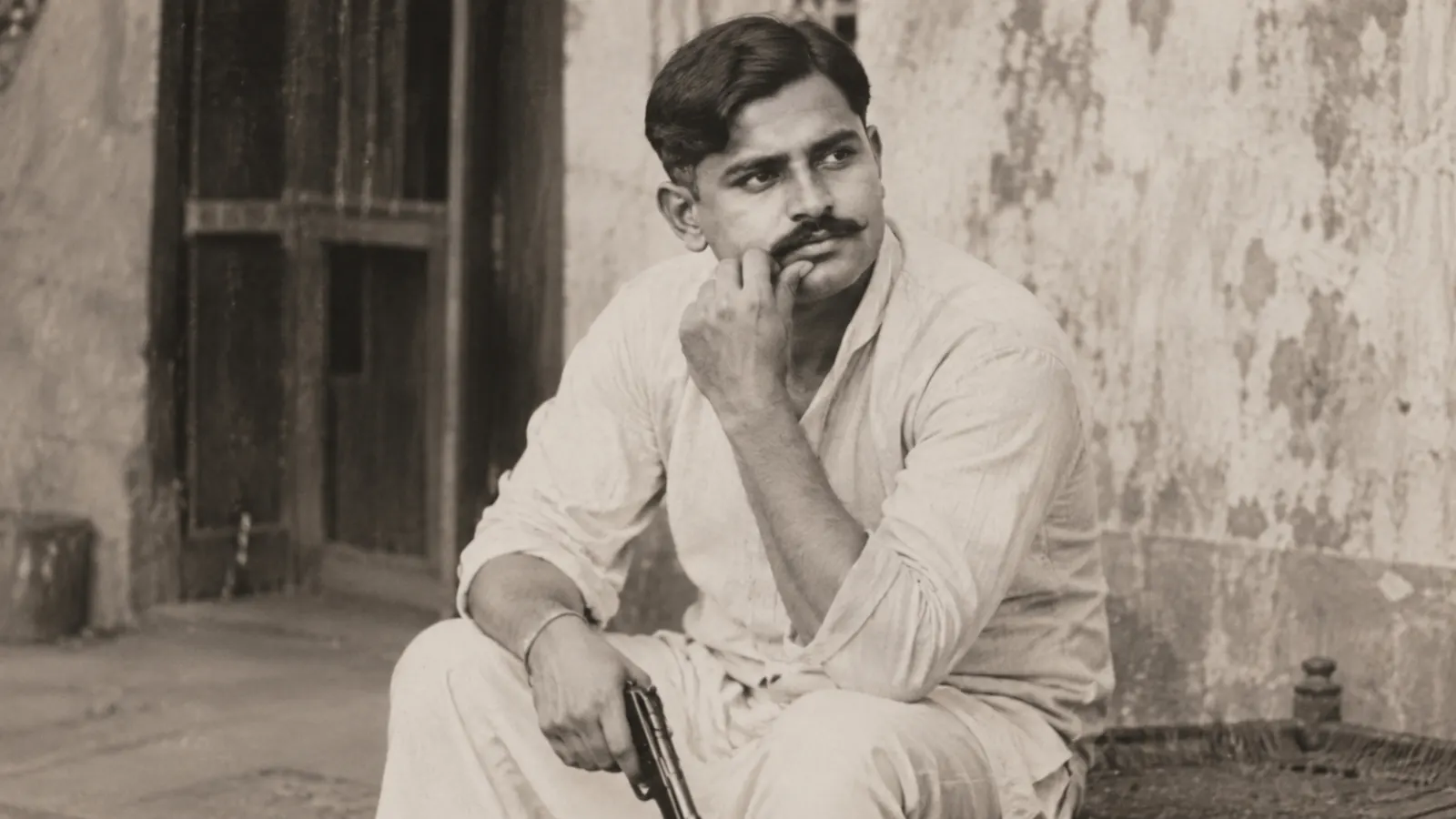
After independence, Chandrashekhar Azad became one of the most recognisable martyrs of the freedom struggle. Parks, schools, institutions, postage stamps, films and memorials preserved his name, while the familiar image of Azad with a curled moustache came to represent youthful defiance.
Commemoration, however, can simplify the person being commemorated. A life shaped by underground logistics, ideological disputes, socialist politics, financial shortages, strategic disagreements and constant surveillance is easier to remember as a sequence of daring escapes ending in a heroic gunfight.
Restoring those complexities produces a more historically significant Azad. His life connected Gandhian mass mobilisation with revolutionary republicanism and the later socialist politics of the HSRA. He belonged to an organisation that used political violence but was also debating the limits of such methods and searching for ways to connect revolution with broader social transformation. Academic studies of the HSRA increasingly place these revolutionaries within, rather than completely outside, the wider political history of Indian nationalism.
Azad’s sacrifice therefore cannot be reduced to the question of who fired the final bullet in Alfred Park. Long before that morning, he had repeatedly chosen to remain underground while comrades were imprisoned and executed, knowing what capture could mean. He continued maintaining a movement after Kakori had destroyed much of its leadership and remained active as colonial repression dismantled the HSRA around him.
Nor does his importance require unsupported betrayal stories, invented final words or the removal of uncomfortable facts about revolutionary violence. The documented record already presents a remarkable historical figure: a teenager shaped by anti-colonial mobilisation and colonial punishment, a survivor of the destruction of the HRA, an operational leader of the HSRA and one of the people who kept a revolutionary network functioning during one of the most difficult periods of the Indian freedom struggle.
Remembering Chandrashekhar Azad as an organiser does not make him less heroic. It reveals the harder form of revolutionary work behind the legend—the patient, dangerous and collective labour required to keep an underground political movement alive.