Keystone Species Explained: Meaning, Examples and Why They Matter in Ecosystems
Some species matter far more to an ecosystem than their abundance would suggest.
An organism may be relatively uncommon yet strongly influence predators, prey, competitors, vegetation or habitat structure. If that species disappears, the consequences can spread through the ecological community and sometimes reorganise the ecosystem itself.
Ecologists describe such organisms as keystone species.
A keystone species is a species whose ecological effect is disproportionately large relative to its abundance. The concept does not mean that the species is the largest, rarest or most charismatic organism in an ecosystem. It refers specifically to the strength of its ecological interactions.
The idea changed ecology because it showed that counting species or measuring biomass alone cannot reveal how an ecosystem works. Sometimes the decisive question is not how many individuals are present, but what those individuals are doing.
What Is a Keystone Species?
A keystone species is an organism whose presence, absence or abundance has an unusually strong influence on the structure and functioning of an ecological community.
The term comes from architecture.
In a stone arch, the keystone is only one part of the structure, but removing it can destabilise the whole arch. Ecologists adopted the metaphor because some species play a similarly disproportionate role within food webs and ecological communities.
Three characteristics are particularly important:
| Feature | What it means |
|---|---|
| Disproportionate effect | Ecological impact is large relative to abundance or biomass |
| Strong interactions | The species affects competitors, prey, habitat or other ecological processes |
| Community consequences | Its decline or removal can change the structure of the wider ecosystem |
This definition is more precise than simply calling an ecologically important animal a keystone species.
Many species are important.
Only some demonstrate the kind of disproportionate community-level effect that the keystone concept is intended to describe.
Where Did the Keystone Species Idea Come From?
The concept emerged from the experimental work of American ecologist Robert T. Paine on rocky intertidal communities along the Pacific coast of North America.
Paine studied the ochre sea star Pisaster ochraceus, a predator that fed on mussels and other intertidal organisms.
In a famous series of experiments, he removed the sea star from experimental areas.
The result was dramatic.
Without the predator, mussels expanded across the available rock surface. As mussels monopolised space, several other organisms declined or disappeared from the experimental community.
The predator had not been the most abundant organism.
Yet its presence prevented a powerful competitor from dominating the habitat.
The experiment demonstrated that interaction strength can matter more than abundance.
That insight became the foundation of the keystone-species concept.
Why Paine's Experiment Changed Ecology
Before the keystone idea, ecological importance could easily be associated with abundance.
That reasoning is understandable.
A forest-forming tree may dominate biomass. Grass may cover most of a grassland. Plankton may account for enormous portions of productivity.
But Paine showed that another form of ecological importance exists.
A relatively uncommon predator can have a large effect because it regulates a species that would otherwise dominate the community.
This created an important distinction between:
abundance — how much of a species exists,
and
interaction strength — how strongly that species affects others.
A species does not need to dominate the landscape physically to influence the organisation of the ecosystem.
That remains one of the most important lessons of keystone ecology.
Keystone Predators and Trophic Cascades
Predators are among the best-known examples of keystone species.
A predator can affect not only the species it eats but organisms several levels away in the food web.
Suppose a predator keeps an herbivore population under control.
If the predator disappears, herbivore numbers may rise.
Increased herbivory can then reduce vegetation.
The sequence can be represented simply:
Predator declines → herbivores increase → vegetation declines
This type of indirect chain is known as a trophic cascade.
Trophic cascades demonstrate why removing one species can generate effects far beyond the immediate predator-prey interaction.
However, not every predator is a keystone predator.
A predator qualifies only when evidence shows that its ecological effect is unusually strong relative to its abundance and that changes in its population substantially influence the wider community.
Sea Otters and Kelp Forests
Sea otters provide another widely discussed example of strong predator effects.
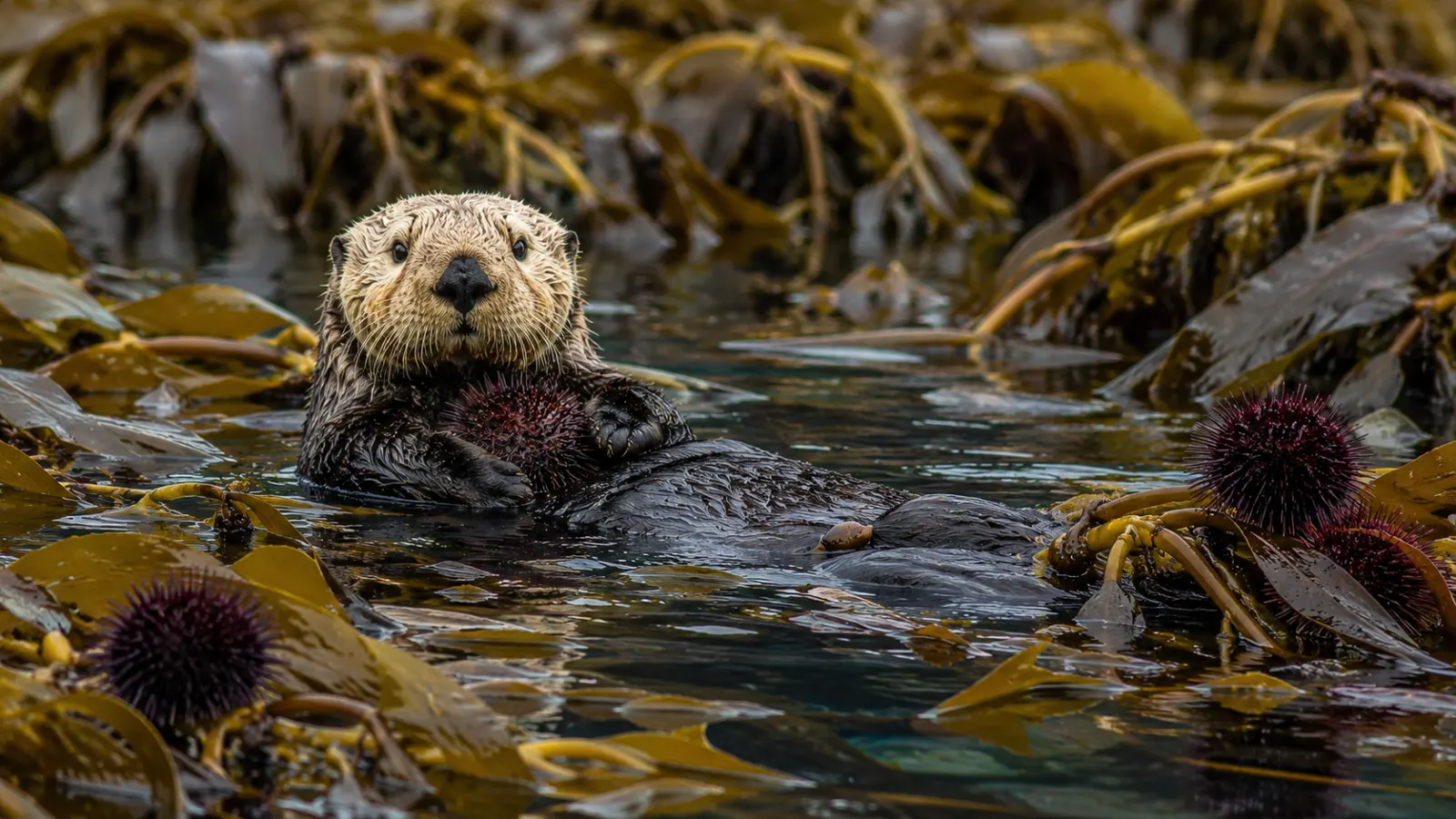
In parts of the North Pacific, sea otters prey on sea urchins.
Sea urchins eat kelp.
Where otters strongly suppress urchin populations, kelp forests can persist more successfully. Where otters decline substantially, urchin numbers can rise and intense grazing may contribute to the transformation of kelp forests into urchin barrens.
The basic relationship can be represented as:
Sea otters → fewer sea urchins → greater survival of kelp
When otters decline:
Fewer sea otters → more sea urchins → greater kelp grazing
The example illustrates how changing predator abundance can restructure an entire nearshore community.
But it also demonstrates an important principle: ecological effects depend on context.
The strength of the otter-urchin-kelp relationship varies geographically and through time, and other ecological forces can also influence kelp ecosystems.
Keystone status should therefore be supported by evidence rather than assigned automatically.
Keystone Species Are Not the Same as Dominant Species
A dominant species has a strong ecological influence largely because it is abundant, occupies substantial physical space or contributes a major proportion of ecosystem biomass or productivity.
A keystone species is conceptually different.
Its influence is considered unusually large relative to its abundance.
| Keystone species | Dominant species |
|---|---|
| Influence disproportionate to abundance | Influence often related to abundance or biomass |
| May be relatively uncommon | Usually numerically or physically prominent |
| Strong interaction effects are central | Large biomass or habitat occupancy is often central |
| Removal may produce cascading change | Reduction can matter because a large amount of ecosystem structure disappears |
A forest-forming tree, for example, may be enormously important because it creates habitat and represents much of the ecosystem's biomass.
That does not automatically make it a keystone species.
The mechanism of ecological importance matters.
Keystone Species vs Flagship Species
The distinction between keystone species and flagship species is even more important in conservation communication.
A flagship species is chosen primarily because it can attract public attention, funding or political support for conservation.
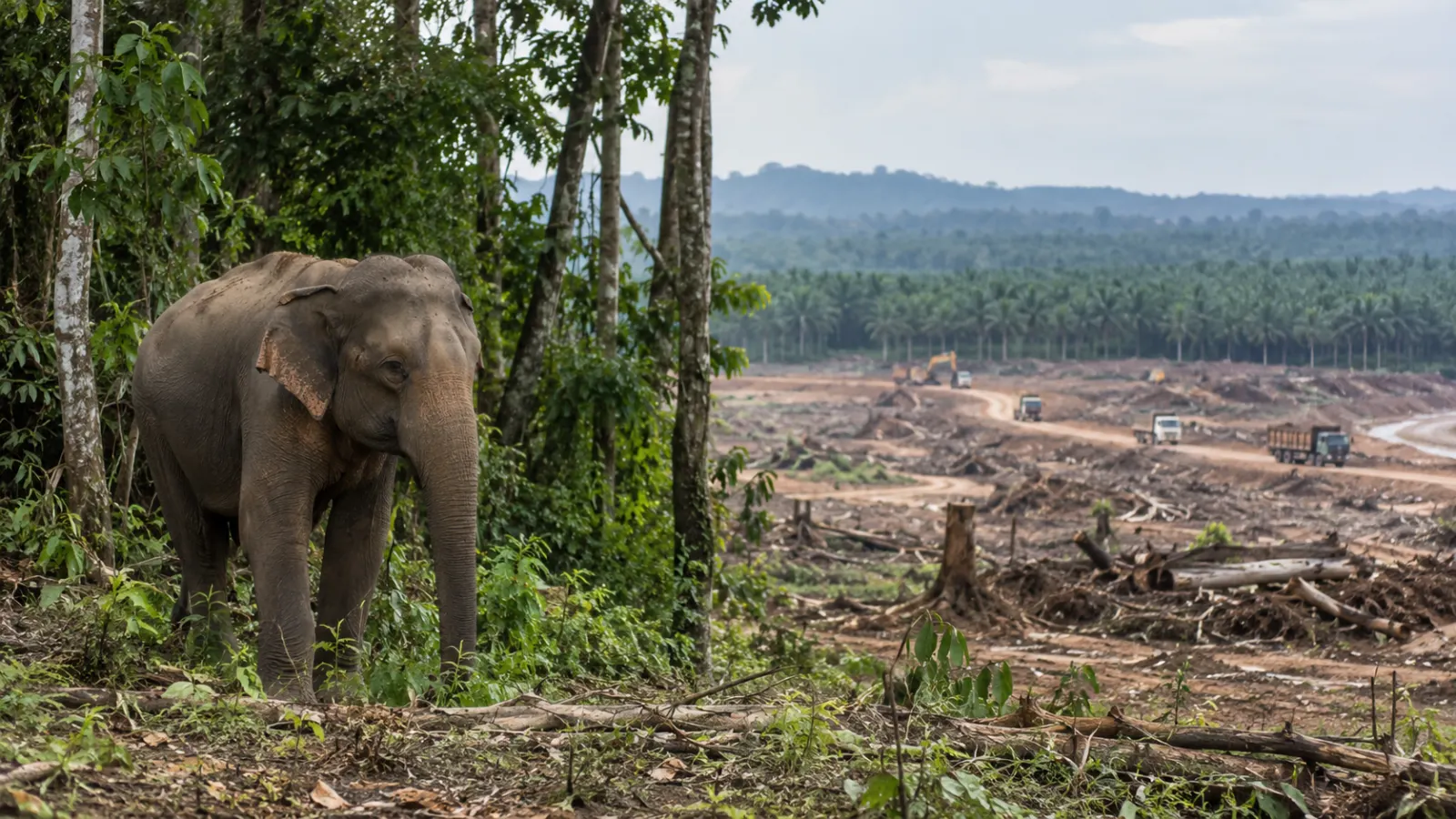
Tigers, elephants, pandas and other recognisable animals are frequently used as conservation flagships.
A keystone species, by contrast, is identified through ecology.
The questions are different:
Flagship species: Can this species represent a conservation cause?
Keystone species: Does this species exert a disproportionate influence on ecological structure?
A species can belong to both categories.
But one does not imply the other.
A charismatic animal should not automatically be labelled a keystone simply because it is endangered or popular.
Using the terminology precisely helps preserve its scientific value.
Keystone Species vs Ecosystem Engineers
Another concept that overlaps with keystone ecology is the ecosystem engineer.
Ecosystem engineers modify the physical environment in ways that affect other species.
Beavers are a classic example because their dams alter water flow and create wetlands.
Corals build reef structures used by enormous numbers of other organisms.
Burrowing animals can alter soil conditions, drainage and vegetation.
The distinction is mainly one of mechanism.
Ecosystem engineer describes how a species influences its environment—through physical habitat modification.
Keystone species describes the magnitude of ecological influence relative to abundance.
An ecosystem engineer can also function as a keystone species if its effects are sufficiently disproportionate.
But the concepts are not synonymous.
Are All Keystone Species Predators?
No.
The original keystone concept emerged from predator-removal experiments, but disproportionate ecological effects can arise through several mechanisms.
Potential keystone roles include:
Predators: regulate prey or competitors.
Pollinators: support reproduction of plants that depend strongly on them.
Seed dispersers: move seeds and influence vegetation regeneration.
Ecosystem engineers: physically alter habitat used by many other organisms.
Herbivores: influence vegetation structure.
Pathogens or parasites: sometimes restructure host populations and community relationships.
The important question is not what type of organism it is.
The important question is:
Does changing this species cause a disproportionately large change in the ecological community?
That requires evidence.
How Scientists Identify a Keystone Species
One of the difficulties with the keystone concept is proving that a species actually qualifies.
Simply observing that two populations change together does not establish causation.
The strongest evidence often comes from manipulative experiments.
Paine's sea-star studies were especially influential because he deliberately changed one ecological factor—the predator—and observed what happened to the rest of the community.
Large-scale ecosystems rarely permit such controlled experiments.
Researchers may therefore rely on several kinds of evidence:
- species-removal experiments,
- species-reintroduction studies,
- natural population collapses,
- population recoveries,
- historical comparisons,
- long-term ecological monitoring,
- food-web models,
- comparisons between sites with and without the species.
Strong evidence generally requires demonstrating both a mechanism and a community-level response.
A species should not be classified as keystone merely because it is assumed to be important.
Context Determines Whether a Species Acts as a Keystone
Keystone status is not necessarily a permanent label attached to a species everywhere it occurs.
Ecological relationships vary.
The same predator may strongly regulate prey in one ecosystem but have a weaker effect somewhere else because alternative predators are present.
A species may be a crucial pollinator in one region but only one of many interchangeable pollinators elsewhere.
Seasonal abundance can also alter interaction strength.
Habitat complexity, climate, prey availability and human pressures can all influence the ecological role of a species.
For this reason, lists claiming to identify the “world's keystone species” should be interpreted cautiously.
It is more accurate to think of keystone effects as properties of species interactions within particular ecological systems.
Why Species Abundance Can Be Misleading
Conservation frequently begins by asking how many individuals remain.
That is essential information.
But abundance alone cannot reveal ecological function.
A species may still be relatively common while disappearing from important parts of its historical range.
Another species may retain thousands of individuals but lose mature breeding adults.
A predator may remain present but fall below the density needed to regulate its prey effectively.
In such circumstances, a population can remain biologically present while becoming ecologically ineffective.
Keystone ecology therefore complements population monitoring.
Population data answer:
How much of the species remains?
Interaction studies ask:
What ecological work is that remaining population still performing?
Both questions matter.
Keystone Loss Can Produce Nonlinear Ecological Change
One reason keystone species matter for conservation is that ecosystem responses are not always proportional.
Suppose a predator population falls gradually.
The ecosystem may initially appear relatively stable.
But once predator numbers fall below a certain ecological threshold, prey populations may increase rapidly.
Vegetation or other organisms may then change abruptly.
The resulting shift may be much larger than the initial decline in predator numbers.
This type of nonlinear change is important because ecological systems can sometimes move into alternative states that are difficult to reverse.
Kelp forests and urchin barrens provide one example of how predator-prey changes can contribute to substantially different ecosystem conditions.
The broader conservation lesson is that waiting until a keystone interaction has nearly disappeared can make recovery much harder.
Keystone Species and Biodiversity Conservation
The keystone concept changed conservation thinking because it showed that biodiversity is more than a list of species.
Two ecosystems may contain similar numbers of species while functioning very differently.
If one retains its major predators, pollinators, seed dispersers and habitat modifiers while another has lost them, their ecological resilience and community structure may differ substantially.
Conservation therefore needs to protect ecological interactions, not merely species names.
This is especially important when a strongly interacting species remains technically present but has become too rare to perform its ecological role.
Protecting a keystone interaction may sometimes benefit many other organisms simultaneously.
Predator recovery can restructure food webs.
Restoring a critical pollinator can support several plant species.
Protecting a habitat engineer can preserve environments used by many other organisms.
This does not mean conservation should focus exclusively on keystone species.
But it demonstrates why some interactions deserve particular attention.
Keystone Species and Ecosystem Resilience
Ecologists are increasingly interested not simply in whether ecosystems contain particular species, but whether they retain enough functional diversity to respond to disturbance.
Strong ecological interactions can contribute to ecosystem structure.
Their loss can sometimes make ecological communities more vulnerable to reorganisation.
However, ecosystems are complex.
Multiple species can sometimes perform partly overlapping functions. Other ecosystems may depend heavily on a small number of interactions.
That is why conservation should avoid treating keystone species as magical ecological switches.
The concept is most useful when it identifies specific, evidence-supported interactions whose disruption has demonstrated consequences.
Used precisely, it helps scientists prioritise ecological processes that might otherwise be overlooked.
Examples of Keystone Roles
The following examples illustrate different ways a species can potentially exert disproportionate ecological influence.
| Keystone role | Possible ecological effect |
|---|---|
| Predator | Prevents prey or competitors from dominating |
| Pollinator | Enables reproduction of multiple dependent plants |
| Seed disperser | Influences plant distribution and forest regeneration |
| Habitat engineer | Creates or alters habitat used by many organisms |
| Herbivore | Shapes plant abundance and vegetation structure |
| Disease organism | Alters host populations and ecological competition |
These are categories of possible keystone effects, not proof that every organism performing these functions is a keystone.
Evidence of community-level consequences remains essential.
Why Keystone Thinking Matters for Wildlife Conservation
Traditional conservation measures often focus on whether an endangered species has survived.
Keystone ecology introduces another question:
Has the species retained its ecological function?
Imagine a predator that once shaped a landscape but now survives only in a few isolated individuals.
Technically, it is not extinct.
Ecologically, however, much of its former influence may already be gone.
That distinction matters because ecosystems can begin changing long before global extinction occurs.
Keystone thinking therefore encourages conservationists to protect:
- sufficient population density,
- ecological interactions,
- habitat connectivity,
- natural behaviours,
- and ecosystem processes.
The goal is not simply to keep organisms alive.
It is to keep ecological communities functioning.
Frequently Asked Questions About Keystone Species
What is a keystone species?
A keystone species is an organism whose ecological influence is disproportionately large relative to its abundance. Removing or greatly reducing it can cause substantial changes in community structure or ecosystem interactions.
Why is it called a keystone species?
The term comes from the keystone in an architectural arch. The keystone represents only a small portion of the structure but can be critical to maintaining its integrity.
Who introduced the keystone species concept?
Ecologist Robert T. Paine developed the concept through experimental research on rocky intertidal communities, particularly his studies involving removal of the predatory sea star Pisaster ochraceus.
What is a famous example of a keystone species?
The ochre sea star studied by Paine is the foundational example. Sea otters are another widely cited example because their predation on sea urchins can strongly influence kelp ecosystems.
Are all predators keystone species?
No. A predator is considered a keystone only when evidence demonstrates a disproportionately strong effect on the wider ecological community.
What is the difference between a keystone and dominant species?
A dominant species strongly influences an ecosystem partly because it is abundant or accounts for substantial biomass. A keystone species exerts a large ecological effect relative to its abundance.
Are keystone species and flagship species the same?
No. Keystone species are defined by ecological function. Flagship species are selected largely for their ability to attract public attention and support for conservation.
What is the difference between a keystone species and an ecosystem engineer?
An ecosystem engineer changes physical habitat. A keystone species is defined by disproportionate ecological influence. A species can satisfy both definitions, but the terms describe different characteristics.
Why are keystone species important for conservation?
Their decline can affect many other species and ecological processes. Protecting key interactions can therefore help maintain ecosystem structure and biodiversity.
A Keystone Species Is a Relationship, Not a Popularity Contest
The keystone-species concept remains powerful because it challenges a simple assumption: that the most abundant species must always be the most ecologically important.
Sometimes an organism present in relatively modest numbers helps prevent competitors from taking over, regulates herbivores, maintains habitat, supports plant reproduction or shapes food webs.
Removing it can cause ecological effects much larger than its abundance would predict.
But the term should be used carefully.
An endangered species is not automatically a keystone.
A flagship species is not automatically a keystone.
A large predator is not automatically a keystone.
And a species does not necessarily perform the same ecological role in every ecosystem.
The strongest use of the concept is evidence-based.
Scientists need to examine what happens when the species declines, disappears or returns and whether the wider community responds strongly.
When that evidence exists, keystone ecology provides a powerful reminder that ecosystems cannot be understood simply by counting organisms.
They must also be understood through relationships.
A species can be relatively scarce and still carry enormous ecological weight.
That is what makes the keystone concept one of ecology's most enduring insights.