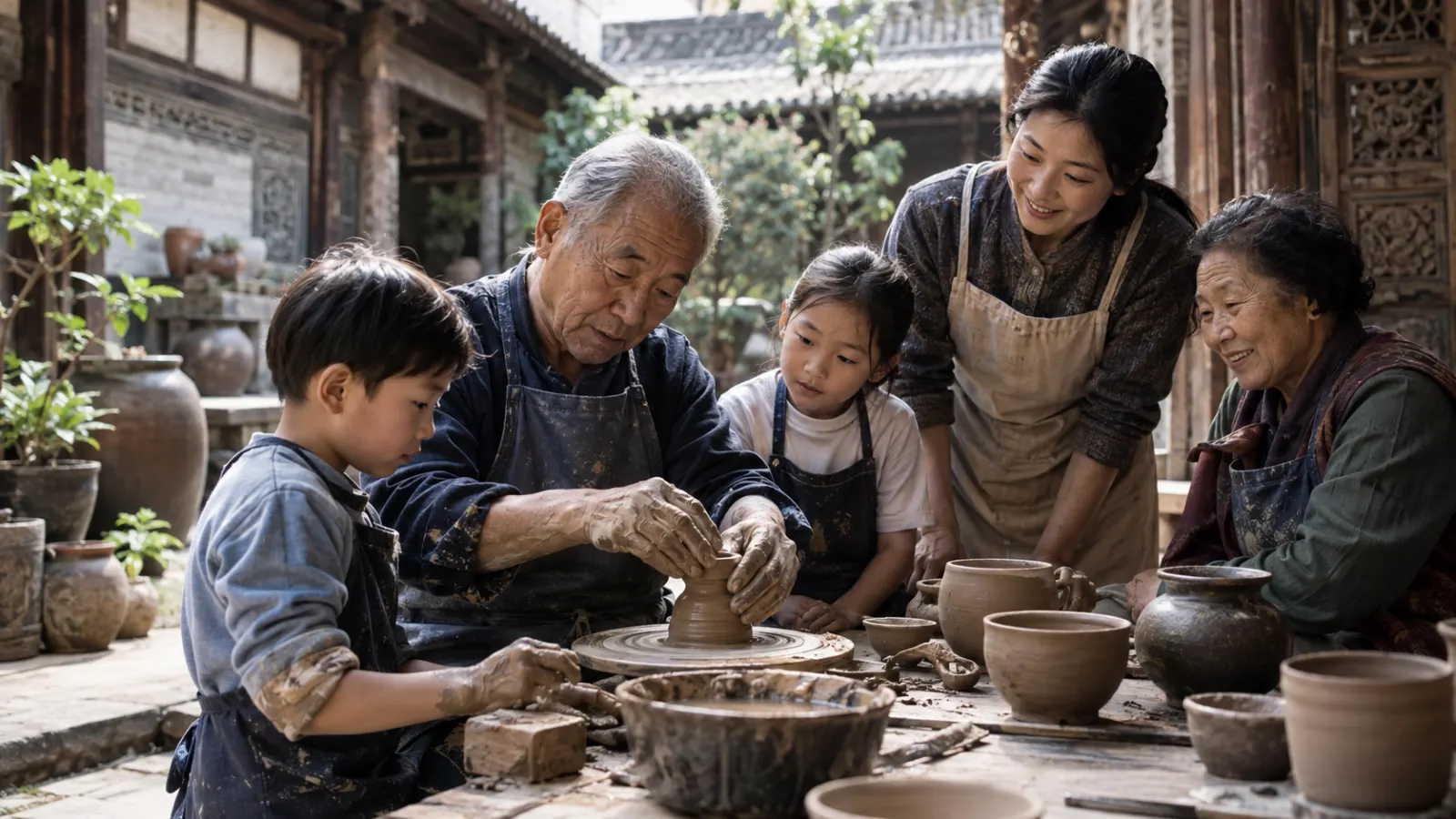
More Than Many People Under One Roof
The simplest description of a joint family is a household in which multiple generations or related married units live together. That description is useful but incomplete. The joint family is best understood as a system of pooled life: relatives may share property, income, domestic work, childcare, eldercare, rituals and authority.
The model is strongly associated with South Asia, especially India, but extended and multigenerational household systems have existed in many agrarian and kinship-based societies. Their forms vary. Some revolve around brothers and their spouses; others around parents, married children and grandchildren; some remain economically joint even when members work elsewhere.
What Makes a Family “Joint”?
Co-residence is the most visible feature, but researchers distinguish between household structure and wider family organisation. A family may occupy one dwelling yet keep incomes separate. Another may occupy nearby dwellings while sharing land, a business, meals or caregiving.
The classic joint-family idea therefore combines several elements: kinship across generations, shared or coordinated resources, mutual obligations, some common domestic life and collective authority over important decisions.
Why Joint Families Made Economic Sense
In agrarian economies, land and labour made larger kin groups practical. Farming required seasonal labour. Property could be difficult to divide without reducing economic viability. Children and older people could contribute according to ability. Domestic and productive work overlapped.
A joint household also spread risk. If one adult became ill or had a poor income year, others could compensate. Childcare did not fall entirely on one couple. Older people could remain embedded in daily family life rather than living separately.
This helps explain why extended families cannot be understood as sentiment alone. They were also economic institutions adapted to particular forms of property, work and social protection.
The Household as an Informal Welfare System
Where pensions, disability support, childcare and eldercare services are limited, family networks often absorb those responsibilities. Joint households can provide immediate assistance without formal eligibility rules.
The advantage is flexibility. A grandparent can supervise children while parents work. An employed sibling can support another during unemployment. Food and housing costs can be shared.
The limitation is that support depends on household resources and relationships. A poor joint family may pool scarcity. A member in conflict with household authority may have no independent safety net. Informal welfare is valuable, but it is not always sufficient or equal.
Joint Families Can Facilitate Migration
Migration might appear to weaken joint families, but sometimes the opposite occurs. An adult can migrate for work precisely because relatives remain behind to care for children, land or older parents. Remittances then become part of a distributed household economy.
Research from the International Institute for Population Sciences on Bihar and eastern Uttar Pradesh found a higher share of joint families among migrant households than among non-migrant and return-migrant households in the study sample. The authors note that joint or extended families can support those who stay behind and thereby facilitate migration.
This is an important reminder: migration does not always represent family breakdown. It can be a strategy organised through family cooperation.
Shared Childcare Is a Major Strength
In a nuclear household, childcare may depend heavily on two adults—or one. In a joint household, grandparents, aunts, uncles, older cousins and siblings may contribute.
This can reduce the practical cost of employment for parents and provide children with multiple attachment figures. It may also transmit language, stories and family history across generations.
But shared childcare can create disagreement. Different generations may hold conflicting ideas about discipline, education, diet, gender or privacy. More caregivers mean more support, but also more negotiation.
Older People May Gain Security and Status
Multigenerational living can reduce isolation and provide daily assistance to older relatives. Elders may retain valued roles in ritual, mediation, childcare or property management.
Yet living with family does not guarantee wellbeing. Authority can decline with age or illness. Older women and men may have different experiences depending on property, widowhood, gender norms and relationships with adult children.
Conversely, living separately does not necessarily mean abandonment. UN analyses of changing household structures emphasise that older people may live alone by choice or remain supported through non-residential family networks.
Authority Is the Difficult Side of Jointness
Joint households must coordinate decisions: spending, education, employment, marriage, property, domestic work and care. Coordination requires authority. Historically, that authority has often been unequal.
Age and gender may determine whose preferences carry the most weight. Younger adults may gain material security while losing privacy or autonomy. Daughters-in-law may enter households where domestic expectations are already established. Men may control property while women perform unpaid care.
Any celebration of the joint family that ignores these power relations becomes nostalgia rather than analysis.
Privacy Is a Modern Pressure Point
Urban housing and changing expectations have made privacy more valuable and more difficult. Couples may want independent decision-making. Young adults may prefer separate finances. Children may need quiet study space. Remote work can turn every room into contested territory.
These pressures do not prove that people value relatives less. They show that the material requirements of modern work and individual autonomy can conflict with older residential arrangements.
Urbanisation Changes the Economics
Joint households are easier to maintain where housing is expandable or family property is already available. In expensive cities, a large dwelling may be unaffordable. Employment may scatter siblings across different regions. Commuting can make one shared location impractical.
United Nations work on household composition notes long-term increases in nuclear households and declines in extended-family households in several countries, including India, although patterns vary by region and period.
Women’s Education and Employment Change Negotiation
As women gain education, income and mobility, the internal bargaining structure of families changes. Paid employment can increase autonomy, but it can also produce a “double burden” if domestic expectations remain unchanged.
A joint household can support women’s employment through shared childcare, yet it can also impose additional domestic obligations. The effect depends on how labour and authority are distributed, not merely on household size.
Inheritance Can Pull Families Together—or Apart
Shared property is often a foundation of jointness and a source of conflict. Land, houses and businesses can create incentives to remain economically connected. Succession can also expose disagreement over contribution, entitlement and control.
Legal reforms that expand inheritance rights may alter long-standing power arrangements. Economic diversification can do the same: when siblings earn independent salaries rather than working one family asset, the rationale for pooling may weaken.
The “Modified Extended Family”
A major change in contemporary family life is that relatives can remain interdependent without sharing one kitchen. Parents and adult children may live separately but nearby. Siblings may maintain a common business while keeping separate homes. Digital communication allows daily coordination across distance.
This is why analysts should be cautious about equating fewer joint households with the disappearance of extended-family culture. Residential separation can coexist with strong financial, emotional and caregiving ties.
Joint Versus Nuclear Is a False Moral Competition
Public debates often ask which family form is “better.” The question is too broad. A supportive joint household may offer resources no small household can match. A conflict-ridden joint household may impose severe constraints. A nuclear household may offer privacy and autonomy but face intense childcare and eldercare burdens.
Outcomes depend on income, gender equality, housing, relationship quality, public services and the needs of particular members.
Why the Joint Family Persists
The joint family survives because many of the problems it solves remain real: childcare is expensive, housing is costly, older relatives need support, migration separates workers from dependants and economic shocks are unpredictable.
What changes is the mechanism. Some families continue to share a home. Others become networks across homes and cities. The institution becomes less visible but not necessarily less important.
Understanding It Without Romanticising It
The joint family is neither a relic nor an ideal. It is one way of organising interdependence. Its strengths come from pooled resources, shared care and continuity. Its risks come from unequal authority, limited privacy and the possibility that family obligation substitutes for rights or public support.
The most useful question is therefore not whether joint families should disappear or return. It is which forms of intergenerational cooperation can preserve support while allowing members dignity, choice and fair sharing of work.
Jointness Can Continue Through a Family Business
One reason joint-family patterns persist is enterprise. A shop, farm, workshop or professional practice can bind siblings and generations economically even when they do not occupy one home. Family labour reduces some transaction costs because trust, reputation and long-term obligation substitute for formal contracts.
The same arrangement can create conflict when business roles and family roles become impossible to separate. A disagreement over salary may become a dispute about respect; a succession decision may reshape both ownership and household authority. Jointness therefore gains strength from overlapping relationships but also inherits their complexity. Clear accounting and agreed decision rules can reduce some of this tension without dissolving the wider family network, while preserving room for individual choice.